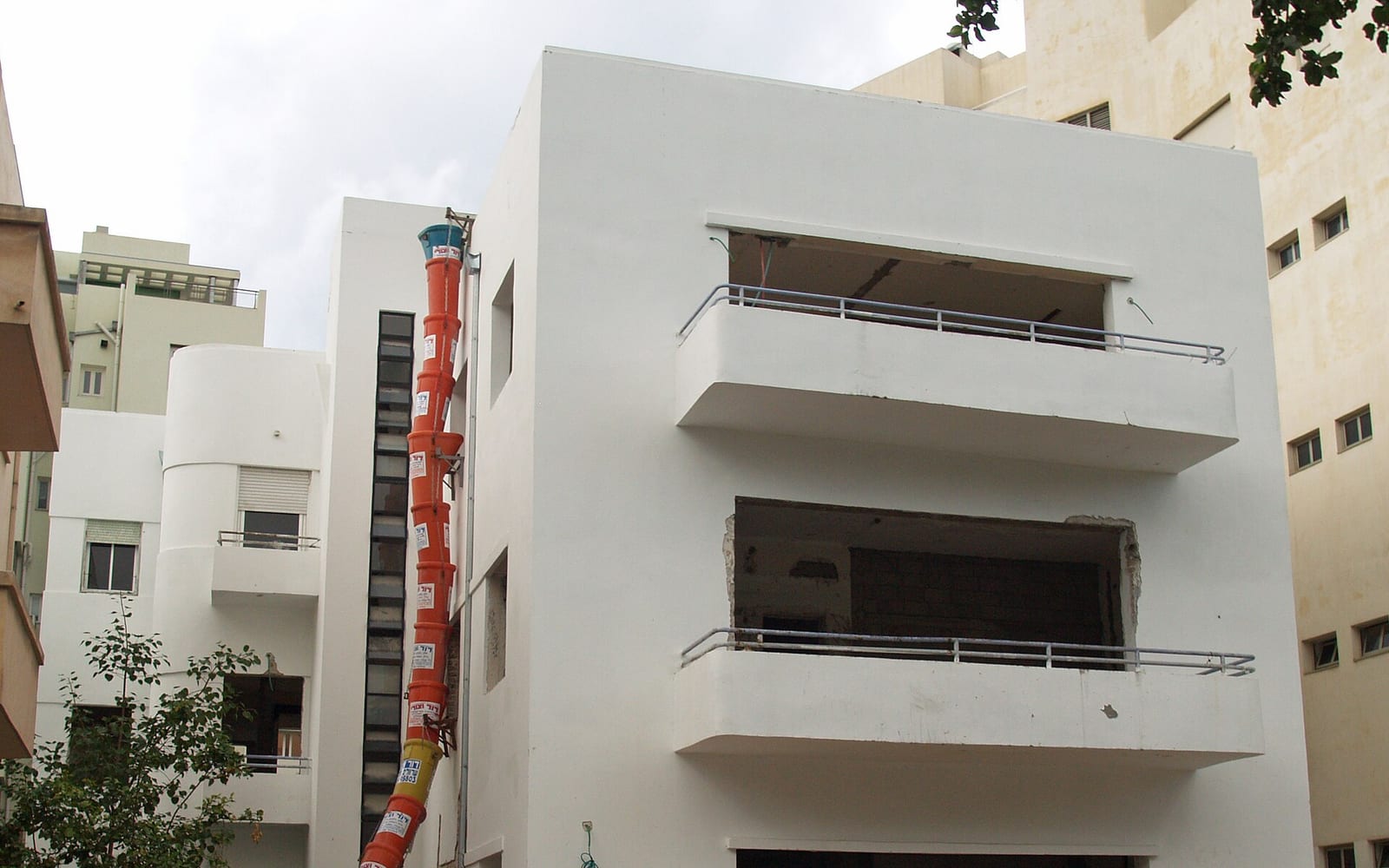
Rothschild Boulevard is the tree-lined pedestrian-friendly avenue that runs through the heart of central Tel Aviv. It is the historical and architectural anchor of the Bauhaus White City, a UNESCO World Heritage Site recognising more than four thousand 1930s Bauhaus and International-Style buildings built by Jewish architects who fled Nazi Germany. The boulevard itself is a daily local commute and café space; the buildings along it and the feeder streets are the architectural reason to walk it slowly. This guide covers the history, the walking route, the best Bauhaus facades, guided tour options, and how Rothschild fits into a Tel Aviv visit.
The boulevard runs from Habima Square at its north end down through HaShalom to Allenby in the south — roughly 1.5 kilometres of green centre median, juice stands, café terraces and cycle path. The architectural density along the boulevard and the streets that feed into it (Mazeh, Engel, Bialik, Dizengoff) is the reason UNESCO inscribed Tel Aviv in 2003.
Need to know
| Cost | Free — the boulevard is a public pedestrian space. Bauhaus Center self-guided audio tours cost a small fee; group walking tours typically ~₪100–150 per person. |
| Hours | The boulevard is always open. The Bauhaus Center on Dizengoff St runs Sun–Thu 10:00–19:00, Fri 10:00–14:00, closed Saturday. |
| Time needed | ~1 hour to walk end-to-end; allow ~2 hours with a guided/audio Bauhaus tour and a café stop. |
| Getting there | Central Tel Aviv. Habima (north end) is a 10-min walk from Carmel Market; Allenby (south end) is 5 min from Carmel Market. Light-rail Rothschild station sits roughly midway. |
| Best time | Early morning or late afternoon, when low light brings out the white plaster facades; mid-day flattens the depth. |
| Accessibility | Flat, paved boulevard with a central pedestrian median; fully walkable. Some shade, but side streets are exposed. |
What is Rothschild Boulevard?
Rothschild Boulevard was laid out in 1910 as the first major street of the new Ahuzat Bayit neighbourhood — the founding settlement of Tel Aviv. The boulevard is named after the Rothschild banking family, which provided early funding for Jewish settlement in Ottoman Palestine. The original buildings were modest single- and two-storey homes; the Bauhaus and International-Style additions came in the 1930s as Jewish architects trained at the German Bauhaus school and other modernist schools emigrated to Palestine.
The White City is the name given to the dense Bauhaus and International-Style cluster — UNESCO-recognised since 2003 as the largest concentration of 1930s modernist architecture in the world. The “white” refers to the pale plaster finish typical of the style, much of which has been restored in conservation work over the past two decades.
Visiting Rothschild and the White City
Hours: the boulevard is a public space, always open. The Bauhaus Center on Dizengoff Street (which runs interpretive exhibitions and audio-tour rentals) is open Sunday to Thursday 10:00–19:00, Friday 10:00–14:00, closed Saturday.
Getting there: the boulevard is in central Tel Aviv. Habima (the north end) is a ten-minute walk from Carmel Market. Allenby (the south end) is a five-minute walk from Carmel Market. The light-rail Rothschild station sits roughly midway.
Atmosphere: café-lined boulevard with juice stands and ice-cream kiosks at every other block. Mornings are quiet; lunch hours bring office workers to the café terraces; late evenings see bar trade at the south end near Allenby.
Top Things to See and Do
The Bauhaus Center
The Bauhaus Center on Dizengoff Street holds interpretive exhibits on the White City and rents self-guided audio tours that walk you through the key facades on Rothschild, Engel and Bialik. The shop sells the canonical books on Tel Aviv Bauhaus.
The Key Facades
The most photographed buildings include the Engel House at the corner of Rothschild and Mazeh (an iconic curved-corner Bauhaus apartment block), the Brown Hotel restoration at 25 Kalisher Street (a Bauhaus restoration done as a contemporary luxury hotel), and the Rothschild 16 (Beit Ben-Zion) facade. Walking the boulevard end-to-end with the Bauhaus Center self-guided audio tour points out a dozen others.
Bialik Street
Bialik Street branches west from Allenby and holds Bialik House (the restored home of the national poet Hayim Nahman Bialik), the Tel Aviv Museum of History (in the original City Hall building), and a tight cluster of Bauhaus facades. The street is short — fifteen minutes end-to-end — and pairs naturally with Rothschild.
Cafés and Juice Stands
Walking the boulevard slowly with multiple café stops is the local way to do Rothschild. Brown Bar at 25 Rothschild, Café Tola’at Sfarim near Habima, and Anita Gelato at the south end are standard stops.
Bauhaus Walking Tours
Guided tours run daily through the Bauhaus Center, plus several private operators. A typical tour runs two hours, covers 15 to 20 key buildings, and explains the typology (strip windows, recessed balconies, white render) and the conservation effort.
Practical Tips
Wear sun protection — the boulevard is partially shaded but the side streets are exposed. Bring a water bottle — public taps run along the centre median. Combine with Bialik Street for a complete White City experience. Eat lunch at a boulevard café for the local rhythm. Photography hint — early morning and late afternoon catch the white plaster facades at their most photogenic; mid-day light flattens the depth.
Nearby Attractions
The boulevard sits centrally — within walking distance of almost everything in central Tel Aviv. Carmel Market is five minutes south of Allenby; the Tel Aviv Museum of Art is fifteen minutes north of Habima; Habima Theatre itself anchors the north end of the boulevard. Neve Tzedek is a fifteen-minute walk south-west. Frishman Beach is twelve minutes west. A morning on Rothschild followed by an afternoon on the beach is a standard Tel Aviv day-one rhythm for first-time visitors.
Why Visit
Rothschild Boulevard is the architectural and historical core of modern Tel Aviv. Walking it slowly with attention to the Bauhaus facades on the feeder streets gives you the city’s defining visual identity — the 1930s European modernism that the architects brought from Berlin and Dessau and adapted to Mediterranean light. The UNESCO designation is well-earned; an hour with a guide doubles the value of the walk.