Timna Park is a 60 square kilometre desert reserve in the southern Arava Valley, 25 kilometres north of Eilat — sandstone landforms eroded over millennia into pillars, arches and the famous Mushroom Rock; 6,000-year-old Bronze Age copper mining shafts; a full-size replica of the biblical Mishkan (tabernacle); a chain of marked hiking trails from 20 minutes to a full day; and a small artificial lake with rental bicycles and paddle boats. The park is the headline desert excursion from Eilat and one of the most photographed landscapes in the southern Negev.
This guide covers the geological highlights (Solomon’s Pillars, Mushroom Rock, the Arches), the Bronze Age mining heritage, the tabernacle replica, practical logistics for self-drive and organised tour visits, and what makes Timna distinct from other Negev desert parks.
Need to know
| Cost | Park entry ~₪49 adult / |
| Hours | Daily ~08:00–16:00 in winter, ~08:00–17:00 in summer; last entry ~2 hours before closing. Open including Shabbat. |
| Time needed | Half a day (~4 hours) for the highlights; a full day for the longer hiking trails (Mount Timna, the Arches). |
| Getting there | ~25 km / ~25 min north of Eilat on Route 90; ample parking. No public bus to the park — drive or organised tour. |
| Best time | Early morning or late afternoon for cooler walking and the best landscape light; avoid the 12:00–15:00 window in summer (above 38 °C Jul–Sep). |
| Accessibility | The visitor centre, tabernacle replica and Lake Timna area are largely flat and drivable between; longer trails (Mount Timna) are strenuous. Limited natural shade — carry 2–3 L water per person. |
What is Timna Park?
Timna sits in the southern Arava Valley between the Eilat Mountains and the Edom Mountains across the Jordanian border. The valley was occupied from the Late Bronze Age (around 1400 BCE) onward as an Egyptian copper mining operation; the New Kingdom Egyptian state ran organised mining expeditions, leaving inscriptions, an Egyptian temple to Hathor, and an extensive network of mine shafts that you can still see today. The Israelites, the Edomites and later the Romans and Byzantines reworked the same copper deposits.
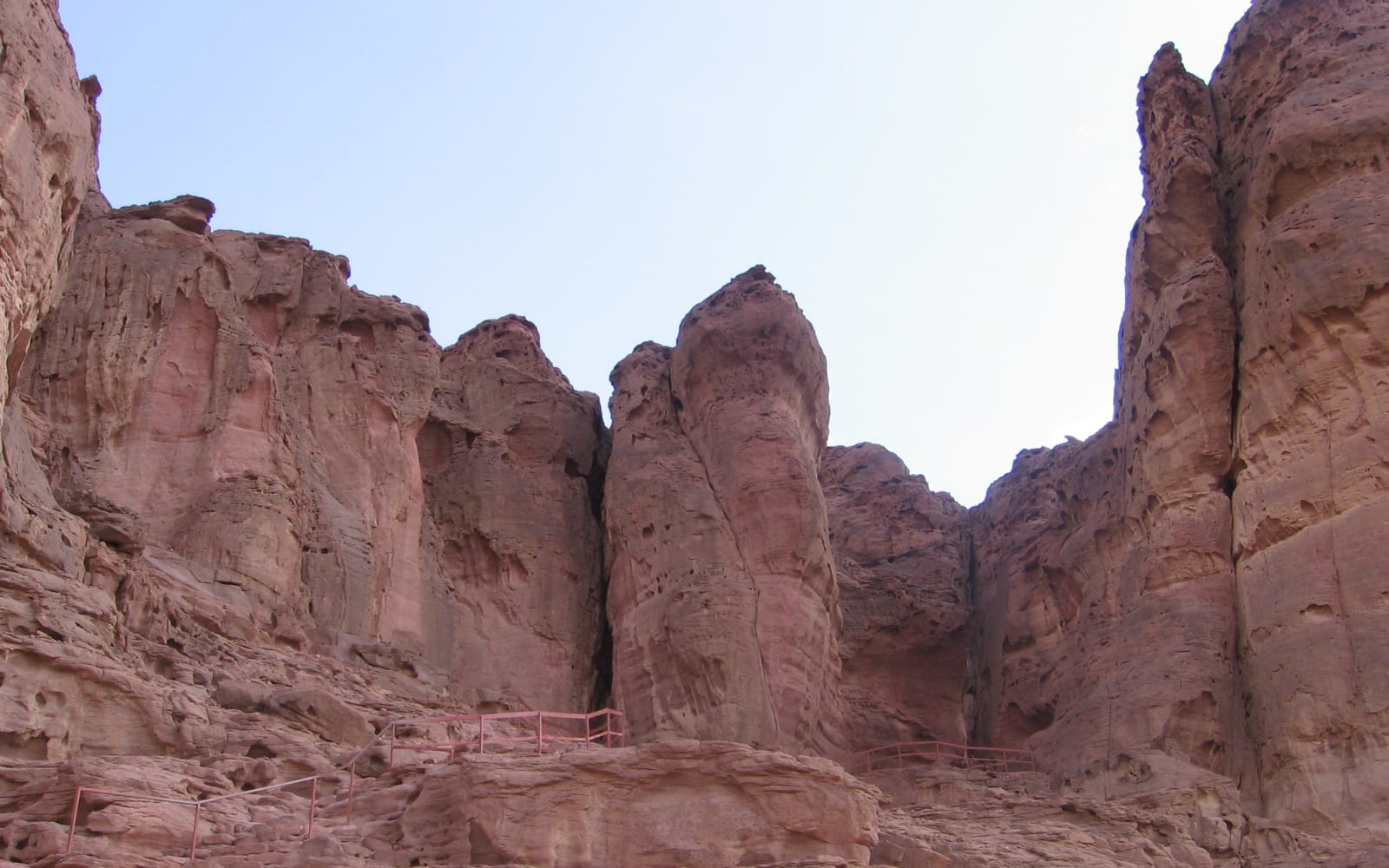
The natural geology — eroded Lower Cretaceous sandstone — produces the dramatic landforms that make the park photogenic: Solomon’s Pillars (a 50m tall sandstone formation), Mushroom Rock (a wind-eroded sandstone “mushroom”), The Arches (natural rock bridges), and a series of canyon walks. The Bronze Age copper-mining shafts honeycomb the western cliff faces.
Visiting Timna Park Today
Hours: typically 08:00 to 16:00 in winter and 08:00 to 17:00 in summer, with last entry 2 hours before closing. Open daily including Shabbat.
Entry fee: approximately 49 ILS adults, 39 ILS children. Israel National Parks pass covers entry.
Getting there: drive north from Eilat on Highway 90 for about 25 minutes. The park entrance is signed; ample parking at the visitor centre. No public bus service to the park directly. Organised tours from Eilat hotels are widely available for travellers without a rental car.
Atmosphere: mornings are cool and the light is good for landscape photography; afternoons get hot in summer (above 38 degrees July to September). Winter weekdays are the quietest; school holidays and weekends bring family crowds.
Top Things to See and Do
Solomon’s Pillars
The most photographed feature in the park — a cluster of 50-metre tall sandstone pillars produced by water erosion of the underlying rock. The Egyptian Temple of Hathor sits at the base, dated to the 13th century BCE; an Egyptian inscription naming Pharaoh Ramses III has been preserved on the cliff face. A short climb leads to a viewpoint over the surrounding valley.
The name “Solomon’s Pillars” is a modern label — the biblical King Solomon did not build them and the formation is purely geological. The real archaeological draw is the Egyptian mining heritage, which significantly pre-dates Solomon’s traditional dates.
Mushroom Rock and the Arches
Mushroom Rock is a wind-and-water-eroded sandstone formation about 5 km from Solomon’s Pillars — a roughly mushroom-shaped pillar on a narrow base. Short walk from the parking area; popular sunset photography spot. The Arches are several natural rock bridges accessible by a 30-minute walk from a separate parking area; the geology is less photogenic than Mushroom Rock but the walk through narrow canyons is rewarding.
The Tabernacle Replica
A full-scale, full-detail replica of the biblical Mishkan (the portable sanctuary the Israelites carried through the desert) sits in a flat area near Solomon’s Pillars. The structure follows the dimensions and construction described in Exodus, with the courtyard, the holy place and the holy of holies all built to scale. An on-site guide explains the symbolism for visitors interested in the biblical context; secular visitors can walk through independently.
The Bronze Age Mining Heritage
The Egyptian copper mines from the New Kingdom period (around 1300 to 1100 BCE) are scattered across the western valley wall. A self-guided trail with interpretive panels covers the Mining Shafts — vertical and angled shafts cut into the sandstone, some still showing the original chisel marks. The mining museum at the visitor centre holds artefacts from excavations including pottery, mining tools and copper ingots.
Lake Timna
A small artificial lake at the centre of the park offers rental bicycles, paddle boats and a shaded picnic area. Useful for families with younger children who need a break from desert walking. The lake is photogenic at sunset.
Hiking Trails
Timna’s marked hiking trails range from 20-minute strolls to full-day routes. The most popular options:
- Solomon’s Pillars Loop (45 minutes, easy) — covers the main formations and the Egyptian inscriptions.
- Mount Timna Trail (4 to 5 hours, moderate-difficult) — climbs Mount Timna for panoramic valley views; needs water (3 litres minimum) and good shoes.
- The Arches Trail (90 minutes, moderate) — through canyons to the natural rock bridges.
- The Mining Shafts (1 hour, easy) — interpretive walk past the Bronze Age workings.
The park map at the visitor centre marks all trails and grades them by difficulty.
Nearby Attractions
Red Canyon is 35 minutes south near Eilat — a complementary geological short hike. Mitzpe Ramon is 90 minutes north on Highway 40 for travellers continuing further into the Negev. The Arava agricultural settlements (Yotvata, Ketura) lie just north of Timna and run guided dairy and desert agriculture tours.
Practical Tips
Bring water — 2 to 3 litres per person minimum, particularly for longer hiking routes. The park sells water at the visitor centre but at desert-tourism prices.
Sun protection is non-negotiable — broad-brimmed hat, long sleeves for the longer hikes, high-factor sunscreen, sunglasses. The Negev sun is intense even in winter.
Drive carefully on Highway 90 — long straight stretches with isolated junctions. Watch for camels crossing in the early mornings and evenings.
Visit early or late — for photography and for cooler walking temperatures. Avoid the 12:00 to 15:00 window in summer.
Combine with a tabernacle visit — even secular visitors find the scale model worth 30 minutes; the contrast between modern desert geology and biblical reconstruction is unusual.
Why Visit
Timna Park is the headline desert excursion from Eilat and one of the most accessible windows on the southern Negev’s geology and ancient history. The combination of dramatic sandstone landforms, 3,000-year-old Egyptian mining heritage and the biblical tabernacle replica gives the park a depth that single-purpose attractions rarely match.
For travellers planning Eilat as a 3-day visit, Timna is the natural Day 2 — after the Red Sea on Day 1 and before Petra (or beach time) on Day 3. Combine with Red Canyon for a full desert-geology day, or treat as a half-day stand-alone with afternoon back at the Eilat beachfront.