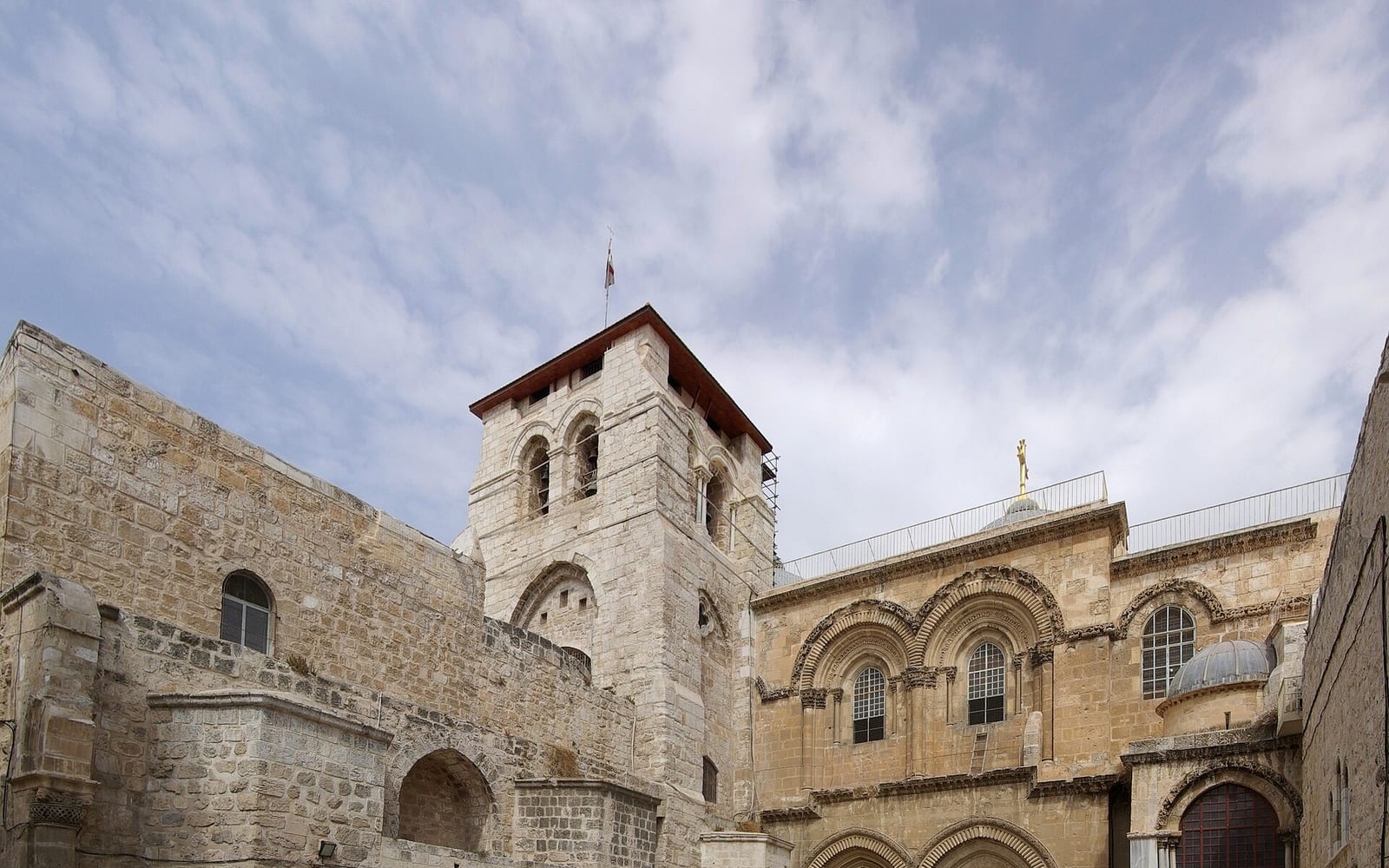
The Church of the Holy Sepulchre stands in the Christian Quarter of the Old City on the traditional site of the crucifixion, burial and resurrection of Jesus. Free, open daily, and one of the most layered religious buildings in Christendom — six denominations share the same roof under an 1852 agreement, and you can hear five liturgical languages in a single hour at the back of the rotunda. This guide covers the practical decisions of visiting today: when to arrive, what to expect in the queue for the Aedicule, dress code, and the half-day Christian-themed tour that adds context for a first visit.
Need to know
| Cost | Free — the church does not charge admission. |
| Hours | Main door opens ~04:00 most days, closing ~19:00 (winter) / ~21:00 (summer); schedules vary. The Aedicule (Tomb of Jesus) queue often runs 30–60+ min midday. |
| Time needed | ~1 hour for the main basilica and chapels; add time for the Aedicule queue. |
| Getting there | Christian Quarter of the Old City, a short walk from Jaffa Gate. Carry your passport — security at Old City gates may ask for ID. |
| Best time | Arrive at the 04:00 dawn opening (or after 17:00) for an empty interior; busiest 09:00–14:00. |
| Accessibility | Modest dress required (shoulders and knees covered, hats off inside). Historic stone floors, steep stairs to Calvary and Saint Helena’s chapel; not step-free. |
What is the Church of the Holy Sepulchre?
The current basilica dates to the 12th-century Crusader rebuild on Byzantine foundations laid by Constantine the Great in 326 CE. The site itself — a low rocky outcrop just outside the first-century city wall — is the traditional location of Calvary (Golgotha) and the tomb in which Jesus was buried. The Aedicule, a small shrine in the centre of the rotunda, encloses what tradition identifies as the tomb itself; a 2016 restoration removed and rebuilt the marble cladding for the first time since 1810.
The church is shared by six denominations under the Status Quo of 1852, an Ottoman decree later confirmed by British and Israeli authorities: Greek Orthodox (the largest custodian), Roman Catholic (Franciscan custodians of the Holy Land), Armenian Apostolic, Coptic Orthodox, Syriac Orthodox, and Ethiopian Tewahedo. The Status Quo fixes which chapel each denomination administers and even who can change a lightbulb where. The key to the church itself is held by two Muslim families (the Joudeh and Nuseibeh families) who unlock the door each morning — a tradition since the time of Saladin.
The site sits within east Jerusalem; we note this for transparency in our editorial guidance.
Visiting the Holy Sepulchre Today
Hours: the main door opens around 04:00 most days (winter and summer schedules differ slightly) and closes at 19:00 winter / 21:00 summer. The exact opening sequence — the Joudeh family door-opening — is itself a small ritual; arrive 15 minutes early to see it. Cost: free. Dress code: cover shoulders and knees; remove hats inside; modest dress strictly enforced by the doorkeepers. Photography: allowed in the main basilica and chapels, not during services, never with flash inside the Aedicule.
Aedicule queue: the line to enter the tomb chamber inside the Aedicule typically runs 30 minutes to over an hour during the day; arrive at 04:00 or after 17:00 to find it empty. The interior is a 90-second crawl; bring a head covering for women, and prepare for very low light. Greek Orthodox custodians regulate the queue.
Top Things to See Inside
Calvary (Golgotha)
A steep stone staircase to the right of the entrance leads up to two chapels at the level of the rock identified as Golgotha: the Greek Orthodox Chapel of the Crucifixion (with the silver disc over the rock) and the Roman Catholic Chapel of the Nailing of the Cross.
The Aedicule (Tomb of Jesus)
The marble-clad shrine in the centre of the rotunda. After the 2016 restoration the masonry is stable; the interior chamber holds two small spaces — the antechamber (Chapel of the Angel) and the tomb proper.
Chapel of Saint Helena
Down a stone staircase from the south transept — Armenian custodianship. Tradition identifies the chamber below as where Saint Helena, mother of Constantine, found relics of the True Cross. The descent itself is one of the most atmospheric corners of the church.
Ethiopian Monastery on the Roof
Reached through a side door — a small clay-walled chapel and monastic cells on the roof of the church, occupied by Ethiopian Tewahedo monks under one of the more poignant Status Quo arrangements.
Tours of the Holy Sepulchre
A guided Christian-themed walk along the Via Dolorosa ending inside the Holy Sepulchre is the natural pairing for a first visit; the guide carries you through the fourteen Stations of the Cross with the historical and denominational context that the signage assumes.
Practical Tips
Arrive at dawn for an empty rotunda — 04:00 to 06:00 is genuinely quiet. Friday processions at 15:00 (winter 16:00) follow the Via Dolorosa to the Holy Sepulchre; visitors can join the back of the Franciscan-led procession. Carry your passport; security at the Old City gates may ask for ID. No food or drink inside the church. Travel insurance is worth carrying for any Israel trip; we link our partner option from the Jerusalem canonical guide.
Nearby Attractions
The Holy Sepulchre sits in the Christian Quarter of the Old City, a short walk from Jaffa Gate, the Western Wall (down through the Muslim Quarter or via the Jewish Quarter), and the start of the Via Dolorosa at the Lion’s Gate. Cross-link to those sub-destination guides for site-specific hours. The Garden Tomb, a 19th-century Protestant alternative crucifixion site, sits just outside Damascus Gate and is a common second stop for Protestant pilgrims; it operates on a different traditional identification but is well worth half an hour after the Sepulchre. Christian Quarter Road between the Holy Sepulchre and Jaffa Gate offers the best Old City lunch — falafel, Armenian boureks, and fresh juice — within five minutes of the church doors.