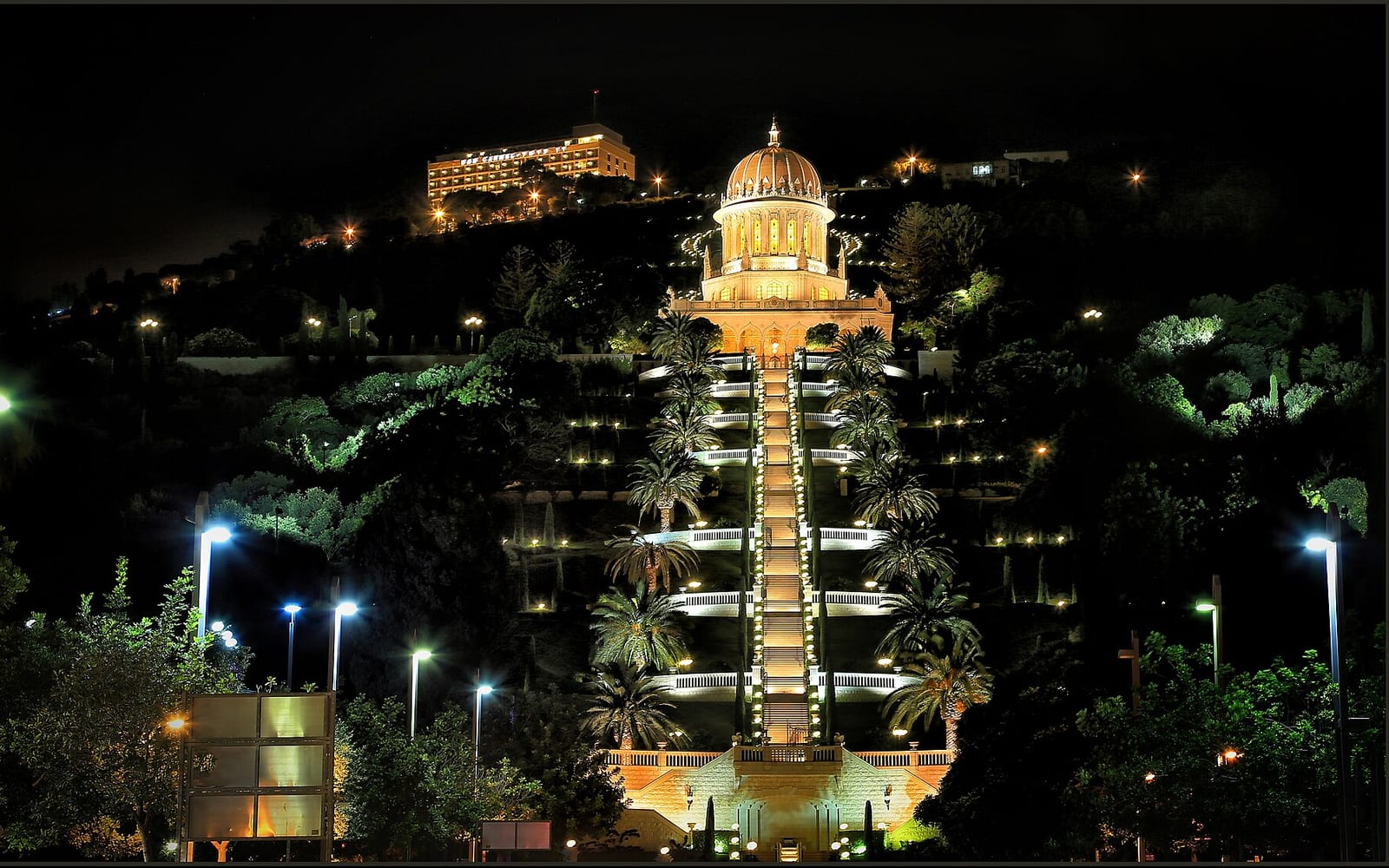
The Bahá’í Gardens in Haifa are the 19-terrace landscape gardens stepping down Mount Carmel from the Universal House of Justice at the top to Ben-Gurion Avenue in the German Colony at the bottom, with the Shrine of the Báb on terrace 11 at the visual centre. The terraces were inaugurated in 2001 and inscribed on the UNESCO World Heritage List in 2008 as part of the broader Bahá’í Holy Places property (which also covers the Mansion of Bahjí near Akko).
The Gardens are the world headquarters of the Bahá’í Faith — the only city outside of Iran where the central institutions of the Bahá’í Faith are based. Three governance buildings on the upper Carmel slope — the Universal House of Justice, the International Teaching Centre, and the Centre for the Study of the Texts — are not open to visitors; the visitor experience focuses on the terraced gardens and the two public-access zones (upper-terrace overlook and lower-terrace gardens), linked by the free 12:00 guided public tour.
Need to know
| Cost | Free for both public zones and the guided tour. |
| Hours | Upper-terrace overlook (Yefe Nof street) and lower-terrace gardens (Ben-Gurion Avenue) open daily, free. Free English-language public tour at 12:00 daily links the two — start times shift seasonally, so check the official Bahá’í World Centre schedule. The Shrine of the Báb (terrace 11) is closed to non-Bahá’ís. |
| Time needed | 15–30 min for the upper overlook; ~45–60 min for the full 12:00 tour. |
| Getting there | Upper overlook on Yefe Nof street (Carmelit funicular to Gan HaEm + walk, or car/bus). Lower entrance at the foot of Ben-Gurion Avenue in the German Colony (near the Carmelit Paris Square station). |
| Best time | Late afternoon — long shadow across the terraces; sunset gives the harbour-and-terraces composition. The tour descent is steep, so bring water. |
| Accessibility | The 12:00 tour descends all 19 terraces (steep, many steps). The upper overlook and lower-terrace gardens give the architectural views with far less climbing. |
What are the Bahá’í Gardens?
The Gardens were designed by the Iranian-Canadian architect Fariborz Sahba (also the architect of the Lotus Temple in Delhi) and constructed between 1990 and 2001. The 19 terraces step from 230 metres above sea level at the upper terrace down to 60 metres at Ben-Gurion Avenue. The central axis of the design is a stepped sequence of fountains, geometric flower beds, and cypress allées that frame the Shrine of the Báb on terrace 11.
The Shrine of the Báb itself is the burial place of Sayyid ‘Alí Muḥammad Shírází (the Báb, 1819-1850) — the prophet-herald whose announcement in 1844 preceded the founding of the Bahá’í Faith by Bahá’u’lláh. The Shrine was built between 1899 and 1953; the golden dome (added 1953 by the architect William Sutherland Maxwell) is the architectural anchor of the Haifa skyline.
The number 19 in the terrace count is meaningful in Bahá’í numerology — the Báb’s most important text, the Bayan, has a 19-month calendar and the 19 Letters of the Living were the Báb’s first disciples. The geometric symmetry of the design — the central axis, the matched stepped terraces, the formal cypress allées — is an architectural expression of Bahá’í principles of unity and order.
Visiting the Bahá’í Gardens Today
Access: Two zones are open to the public free of charge.
- Upper-terrace overlook on Yefe Nof street — open daily, free, gives the headline panorama down the 19 terraces toward the Mediterranean and the Bay of Haifa. Most-photographed view in Haifa.
- Lower-terrace gardens at the foot of Ben-Gurion Avenue in the German Colony — open daily, free, walkable, with the Shrine of the Báb visible from terrace 9 upward.
Free guided public tour at 12:00 daily — English-language guide (check the official Bahá’í World Centre schedule for seasonal shifts), starts at the upper-terrace overlook, walks down through the central terraces (visible from the path, not entered), ends at the lower-terrace gardens. About 45 to 60 minutes total. Modest dress requested.
The Shrine of the Báb on terrace 11 is closed to non-Bahá’ís per Bahá’í convention — the central terraces around the Shrine are kept contemplative for Bahá’í pilgrims who come to visit the burial place of the Báb. This is a religious convention, not a security closure. Visitors who follow the upper-terrace overlook plus the free 12:00 tour see the architectural and landscape views without entering the Shrine.
Photography policy (per Bahá’í International Community guidance): architectural and garden public-terrace subjects are permitted (and widely photographed — the upper-terrace overlook is among the most-photographed views in Israel). Photography of identifiable pilgrims and worshippers is not permitted; the contemplative environment on the upper inner terraces is maintained accordingly. Commercial commissioning (paid photography for monetized publication) requires written permission from press@bahai.org with a typical 4 to 6 week response cycle.
Top Things to See
The Upper-Terrace Overlook (Yefe Nof street)
The upper-terrace overlook on Yefe Nof street is the headline view. Standing at the railing, the 19 terraces step away down the Carmel slope toward the Mediterranean, with the golden dome of the Shrine of the Báb at terrace 11 framed dead-centre and the German Colony rooftops at the bottom. The view is best in the late afternoon when the long shadow falls across the terraces and the cypress allées glow against the lower-city skyline.
The overlook is small — a railing-and-bench observation deck with informational plaques. Allow 15 to 30 minutes plus time for photography. The cafés on Yefe Nof street are a natural pre- or post-overlook coffee stop.
The Shrine of the Báb (terrace 11 — visible from path)
The Shrine of the Báb sits at the geometric centre of the gardens on terrace 11. The Shrine itself (built 1899-1953; golden dome by William Sutherland Maxwell, 1953) is closed to non-Bahá’ís per Bahá’í convention — the interior is reserved for Bahá’í pilgrims in a contemplative environment.
From the free 12:00 guided tour path, the Shrine is visible from above (descending from terrace 9) and below (ascending from terrace 13), with the formal cypress allées flanking the approach. Take photographs of the architectural exterior; do not photograph pilgrims approaching or departing the Shrine.
The Lower-Terrace Gardens (Ben-Gurion Avenue)
The lower-terrace gardens at the foot of Ben-Gurion Avenue in the German Colony are the most accessible and most-visited zone. The terraces frame the central visual axis up to the Shrine — the photograph that everyone takes from the entrance gate looking up. The lower terraces are formal flower beds with seasonal plantings (roses, geraniums, marigolds), framed by clipped cypress.
The lower-terrace entrance is walking distance from the Carmelit’s Paris Square station and from the German Colony brasseries (Fattoush, Douzan). Combine the lower-terrace gardens with lunch in the German Colony for the natural afternoon itinerary.
Practical Tips
- Bring water and wear comfortable shoes for the free 12:00 tour — the descent through 19 terraces is steep.
- Modest dress is requested on the tour — shoulders and knees covered. The Shrine itself is closed to non-Bahá’ís, so the dress code applies primarily to the contemplative central-terrace zone.
- Photography ground rules — architectural and garden subjects are fine; identifiable pilgrims and worshippers are not. The upper-terrace overlook view is the headline shot.
- Best photo time is late afternoon when the long shadow falls across the terraces; sunset from the upper-terrace overlook gives the harbour-and-terraces composition.
- Combine with the German Colony at the foot of Ben-Gurion Avenue — Templer architecture, brasseries, and the lower-terrace garden entrance.
- The Shrine of the Báb closure is a Bahá’í convention preserving the contemplative environment around the burial place of the Báb; both the upper-terrace overlook and the lower-terrace gardens give the architectural views without entering the Shrine.
Why Visit the Bahá’í Gardens
The Bahá’í Gardens are among the most striking landscape-architecture projects in the Middle East — geometric symmetry on a steep Carmel slope, framed by formal cypress allées, with the golden dome of the Shrine of the Báb as the visual anchor of the entire Haifa skyline. The 19-terrace design carries Bahá’í numerological significance and the UNESCO 2008 inscription recognizes the gardens as cultural heritage in their own right, separate from the Shrine as a religious site. The free public tour at 12:00 daily makes the gardens accessible to all visitors, with the upper-terrace overlook and the lower-terrace gardens open year-round at no cost. The visit is a thoughtful complement to the more crowded religious sites of Jerusalem and Nazareth — a contemplative landscape-architecture experience in a less crowded city.