Stella Maris is the Carmelite Catholic monastery on the northwest tip of Mount Carmel in Haifa, above the Mediterranean and the Bat Galim port. The site is the world headquarters of the Discalced Carmelite Order — one of the Catholic Church’s contemplative monastic orders, founded in 1593 as a reform branch of the medieval Carmelite Order which itself originated on Mount Carmel in the 12th century. The present basilica is 19th-century with an Antonio Barluzzi domed restoration in the early 20th century; the foundation goes back to 1631 when Prosper of the Holy Spirit reestablished a Carmelite presence on the mountain after Ottoman destruction.
The Stella Maris complex has three distinct components — the upper basilica with its Italian dome and the icon of Our Lady of Mount Carmel, the lower Cave of Elijah (the biblical site traditionally identified as the prophet’s refuge), and the cliff-edge promenade with Mediterranean views down the coastline toward Akko and the Bay of Haifa. The site is venerated ecumenically — Catholic, Greek Orthodox, Muslim and Druze visitors all visit the Cave of Elijah, and the basilica receives Catholic pilgrim groups year-round.
Need to know
| Cost | Free to enter the basilica and Cave of Elijah. The Stella Maris cable car to Bat Galim beach is separately ticketed. |
| Hours | Basilica generally daily ~06:00–12:30 and ~15:00–18:00; Cave of Elijah open during basilica hours. Daily Latin Mass ~06:30 & 18:30; Sunday ~09:00 & 18:30. Cable car is seasonal (~Apr–Oct). |
| Time needed | ~1–1.5 hours for all three components; add ~30 min for the gardens and cliff-edge photography. |
| Getting there | NW tip of Mount Carmel, ~4 km from the city centre. Carmelit funicular to Gan HaEm + ~15-min walk; or drive west along the Carmel ridge road (paid parking). |
| Best time | Late afternoon for the cliff-edge Mediterranean view. Visit ~10:00–12:00 or ~15:30–17:30 to avoid the Divine Office (06:00, 12:30, 18:00). |
| Accessibility | Basilica forecourt and cliff-edge promenade are paved and railed; the Cave of Elijah is reached by stone steps down to the grotto. Modest dress required (shawls available). |
What is Stella Maris?
The medieval Carmelite Order traces its origin to Christian hermits on Mount Carmel in the 12th century, organized around the biblical figure of Elijah (whose contest with the prophets of Baal on Mount Carmel is described in 1 Kings 18). The hermits adopted the Rule of Saint Albert around 1209. After the fall of Crusader Acre in 1291, the Carmelites were expelled and the order moved to Europe; the Discalced Carmelite reform emerged from the 16th-century Spanish reform led by Teresa of Ávila and John of the Cross.
The modern Stella Maris foundation was established in 1631 by Prosper of the Holy Spirit, returning to reestablish the historic origin site. The original monastery was destroyed several times under Ottoman rule (in 1799 Napoleon’s troops used it as a hospital). The present basilica was completed in the 1830s with dome restoration by Antonio Barluzzi — the architect who also restored Nazareth’s Basilica of the Annunciation, the Mount of Beatitudes octagonal church, and the Basilica of the Agony at Gethsemane.
The icon of Our Lady of Mount Carmel in the basilica is the patronal Carmelite Madonna, venerated worldwide.
Visiting Stella Maris Today
Access: Stella Maris sits on the northwest tip of Mount Carmel, about 4 km from the city centre. The most efficient public-transport route is the Carmelit underground funicular to the Gan HaEm station, plus a 15-minute walk west along Tchernichovsky street. By car, drive west from the German Colony along the Carmel ridge road; paid parking is available at the basilica entrance. The Stella Maris cable car connects the basilica to the Bat Galim beach at the foot of the mountain (seasonal operation; check the schedule).
Hours: the basilica is generally open daily 06:00 to 12:30 and 15:00 to 18:00. The Cave of Elijah is accessed through a separate doorway on the lower terrace and is open during basilica hours. Daily Latin Mass at 06:30 and 18:30; Sunday Mass at 09:00 and 18:30. Modest dress required (shoulders and knees covered); shawls available at the entrance.
Atmosphere: Stella Maris is a working monastery rather than a tourist site — the Discalced Carmelite community of friars maintains contemplative liturgical hours throughout the day. Visitors are welcome but the prevailing atmosphere is quiet. The Cave of Elijah operates as a contemplative shrine with candles and prayer cushions; visitors of all faiths are welcome to enter respectfully.
Top Things to See
The Upper Basilica + Italian Dome Interior
The upper basilica is the architectural centrepiece — the Antonio Barluzzi dome restoration, the icon of Our Lady of Mount Carmel at the high altar, and a small museum of Carmelite history in the right-side ambulatory. The dome interior is decorated with a colourful early-20th-century fresco depicting the prophets Elijah and Elisha and the patriarchs of the Carmelite Order. The fresco is one of Barluzzi’s better-preserved interior works.
The high altar with the icon is the focus of liturgy. Sit briefly in the nave during the daily liturgical hours (the Carmelite community sings the Divine Office at 06:00, 12:30 and 18:00) for the contemplative-monastery atmosphere.
The Cave of Elijah (Lower Terrace)
The Cave of Elijah on the lower terrace is the actual biblical site, identified as the place where Elijah took refuge before his contest with the prophets of Baal (1 Kings 18). Accessed through a separate doorway from the basilica forecourt; stone steps descend to a small grotto.
The cave is venerated ecumenically — Catholic, Greek Orthodox, Muslim and Druze visitors all come. The Druze religious tradition reveres Elijah as a prophet; the Muslim tradition associates him with Khidr, the green prophet. The cave operates as a contemplative shrine with lit candles, prayer cushions, and inscriptions in Hebrew, Arabic, English and German. The mixed pilgrim demographic — Catholic Mass-goers, Greek Orthodox visitors from Wadi Nisnas, Druze families from the Carmel back-slope villages, Muslim visitors from Haifa’s Arab quarters — is one of the more authentic ecumenical experiences in Israel.
The Cliff-Edge Promenade + Bay of Haifa View
The cliff-edge promenade in front of the basilica gives the wide-angle Mediterranean view down the coastline toward Akko (visible 14 km north) and the Bay of Haifa harbour. The promenade is paved and railed; benches face the sea. Best light is late afternoon when the Mediterranean is in long-shadow gold and the Akko ramparts are silhouetted in the distance.
The Stella Maris cable car descends from the cliff-edge to the Bat Galim beach 200 metres below — a four-minute ride with panoramic Mediterranean views. Seasonal operation (typically April through October).
Practical Tips
- Modest dress required — shoulders and knees covered for both men and women throughout the basilica and the Cave. Shawls available at the entrance.
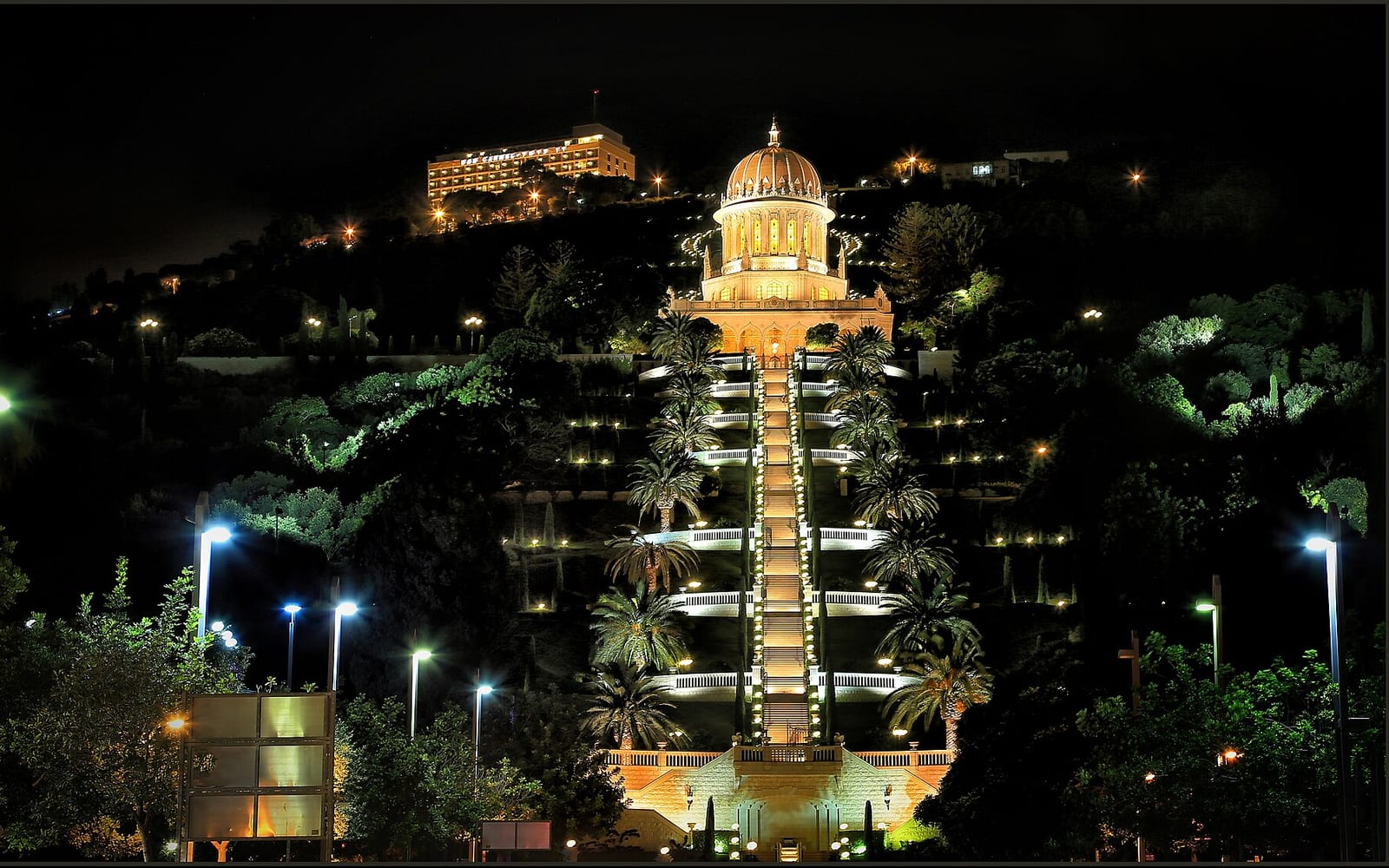
- Combine with the Bahá’í Gardens upper-terrace overlook for a Mount Carmel half-day — both are on the Carmel ridge, 15 minutes apart by car.
- The Cave of Elijah is the most ecumenical site in Haifa — Catholic, Greek Orthodox, Muslim and Druze visitors all venerate it; respect the contemplative environment regardless of your own background.
- Late afternoon for the cliff-edge view — Mediterranean long-shadow light gives the dramatic photography.
- Avoid liturgical hours if you want to walk through quietly — the Carmelite community sings the Divine Office at 06:00, 12:30 and 18:00; a visit between 10:00 and 12:00 or 15:30 and 17:30 typically finds the basilica between liturgical times.
Why Visit Stella Maris
Stella Maris is the most architecturally complete Catholic monastery on the Israeli pilgrim circuit — a working Discalced Carmelite community in the historic origin site of the Carmelite Order, with the biblical Cave of Elijah on the same terrace, a Barluzzi-domed basilica with a credible fresco interior, and a cliff-edge Mediterranean view that gives the geographic context. The ecumenical character of the Cave of Elijah — Catholic, Greek Orthodox, Muslim and Druze venerating the same biblical site — is one of the more authentic shared-religious-heritage experiences in the country. The visit is brief (one hour to 90 minutes) and pairs naturally with the Bahá’í Gardens upper-terrace overlook 15 minutes east along the Carmel ridge for a Mount Carmel religious-heritage half-day.