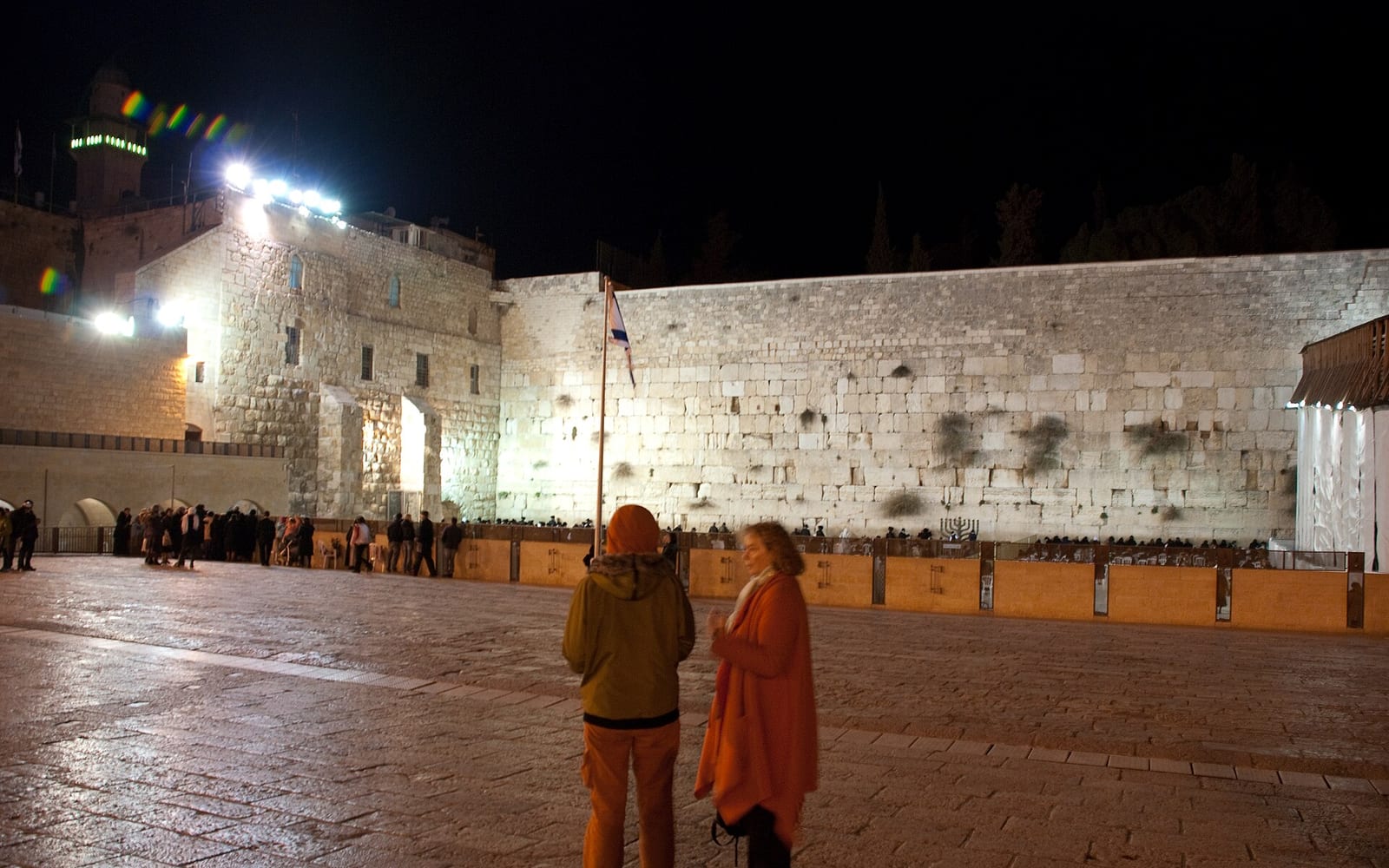
The Western Wall — known in Hebrew as HaKotel HaMa’aravi and widely called the Kotel — is the surviving western retaining wall of the Second Temple, and Judaism’s most significant active prayer site. Free, open 24 hours, and a destination for every faith and every traveller passing through the Old City. This guide covers the practical decisions of visiting today: dress code, the separate prayer sections, the windows when Friday-evening Shabbat services become the most powerful experience of an Old City trip, and the paid Western Wall Tunnels tour beneath the plaza.
The site has been Judaism’s primary place of prayer since the destruction of the Second Temple in 70 CE. The plaza you see today was opened up after 1967, when the buildings that had stood within a few metres of the wall were cleared to create the large open prayer area. The Wall is administered by the Western Wall Heritage Foundation, an Israeli public benefit company; commercial photography and ceremony bookings go through the Foundation.
Need to know
| Cost | Free. The separate Western Wall Tunnels tour is paid and requires advance booking. |
| Hours | The plaza is open 24/7, every day of the year; the prayer sections never close. Tunnels tours run ~06:00–23:00 most days. |
| Time needed | 30–60 min at the plaza; ~75 min for the Tunnels tour. |
| Getting there | Inside the Old City — closest entry is via Dung Gate, or walk down through the Jewish Quarter from Zion or Jaffa Gate. Bag check at every entrance; ID may be requested. |
| Best time | Friday evening for Shabbat services (no photography from sundown); weekdays for photography. Tunnels tours book out weeks ahead during Holy Week and the High Holidays. |
| Accessibility | The plaza is broad and largely step-free. Modest dress required (shoulders and knees covered); men need a head covering (free paper kippot at the entrance). |
What is the Western Wall?
The Western Wall is one segment of the much larger retaining wall Herod the Great built around 19 BCE to expand the Temple Mount / Haram al-Sharif platform. The full length of the western wall ran for 488 metres along the platform’s western face; what you see in the plaza is the southern portion of that wall, exposed after 1967. The Wall itself is not the Temple — the Temple stood on the platform above — but the Wall is the closest physical access for Jewish prayer to the site of the destroyed Second Temple, which is why it carries the religious weight it does.
The Wall is part of the broader Temple Mount / Haram al-Sharif compound, the most-contested square kilometre on earth: the Wall serves Jewish prayer at the base, the plateau above carries the Dome of the Rock and the Al-Aqsa Mosque under Jordanian Waqf administration, and access to the plateau (separate from the plaza) is controlled by the Israeli authorities. Visitors to the Wall enter from the Old City via the Western Wall Plaza security checkpoint.
Visiting the Western Wall Today
Access is from inside the Old City — walk down through the Jewish Quarter from Zion Gate or Jaffa Gate, or directly through Dung Gate (closest). Security screening: bag check at every entrance, ID may be requested. Hours: the plaza is open 24/7; the prayer sections never close. Cost: free. Two prayer sections: the men’s section to the north (larger), the women’s section to the south. The barrier between them is administered as an Orthodox prayer space. Mixed-gender prayer is permitted at the separate Ezrat Yisrael platform to the south, accessed via the Robinson’s Arch entrance.
Dress: cover shoulders and knees; men need a head covering (paper kippot at the entrance); women should bring a scarf. The atmosphere is reverent; photography is welcome during the week but not on Shabbat or Jewish holidays. Notes: it is customary to walk away from the Wall backwards as a sign of respect, but no one will mind if you turn and go; visitors are welcome regardless of faith.
Top Things to Do at the Western Wall
Friday-Evening Shabbat Services
Arrive at the plaza by sunset on a Friday and watch the Wall fill: songs, prayer circles, family groups dancing in the women’s section. No photographs (Shabbat begins at sunset), no recordings — just stand at the back of the plaza and watch. Many visitors call this the single most powerful experience of their Jerusalem trip.
The Western Wall Tunnels
Underneath the plaza, the Western Wall Tunnels expose the full 488-metre length of Herod’s retaining wall, including the largest single stone (over 500 tonnes). A guided tour runs roughly 75 minutes and books out weeks in advance during Christian Holy Week, Passover and the Jewish High Holidays. Book directly through the Western Wall Heritage Foundation or via a tour partner.
The Robinson’s Arch / Davidson Center
The Davidson Archaeological Park at the southern end of the Wall preserves the Herodian street that ran along the platform’s base. Separate ticket from the Wall plaza; the same paired Old City + Temple Mount tours often include it.
Tours of the Western Wall
The most useful guided option combines the Old City quarters walk + Western Wall + Tunnels in a half-day package; that pacing pairs the headline site with the context that signage does not provide.
Practical Tips
Carry your passport — checkpoint staff occasionally ask for ID. Do not bring food or drink into the prayer section. Modest dress is strictly enforced at the security check; cover-up shawls are available at the entrance. Photography off on Shabbat (Friday sundown to Saturday sundown) and on the Jewish High Holidays. Travel insurance is worth carrying for any Israel trip; we link our partner option from the Jerusalem canonical guide.
Nearby Attractions
The Wall sits at the foot of the Temple Mount / Haram al-Sharif (separate access from the plaza), opposite the Mount of Olives across the Kidron Valley, and a short walk from the Church of the Holy Sepulchre through the Muslim Quarter. All three have dedicated sub-destination guides covering site-specific hours and dress code.