Khan al-Umdan — the “Inn of the Columns” — is the most photogenic Ottoman-era building in Akko’s Old City. Built in 1785 by Ahmed Pasha al-Jazzar as a caravanserai for overland trade caravans arriving from Damascus, the square courtyard is surrounded by two storeys of vaulted rooms supported on forty granite columns scavenged from the Roman ruins at Caesarea. The clock tower added by Sultan Abdul Hamid II in 1906 remains one of the city’s most recognisable landmarks. The structure is the commercial anchor of Akko’s 18th-century Ottoman rebuilding programme.
This guide covers what a caravanserai was and what it did, the al-Jazzar-period reconstruction of Akko, the architectural details visible today, and how the Khan fits within the wider Ottoman period of the Old City.
Need to know
| Cost | The courtyard is free to enter during daylight hours. Upper galleries are ticketed only when an exhibition is running; the adjacent Hamam al-Pasha is a separate ticket (usually on the combined Old City ticket). |
| Hours | Courtyard open in daylight hours; check the visitor centre for current upper-gallery and Hamam hours. |
| Time needed | ~20–30 min for the courtyard and clock tower; add ~30 min for the adjacent Hamam al-Pasha. |
| Getting there | In Akko’s Old City near the harbour, a short walk from the souq and visitor centre. Akko is ~30 min from Haifa. |
| Best time | Late afternoon, when light hits the harbour-facing clock tower; the central courtyard is the textbook composition. |
| Accessibility | Ground-floor courtyard is flat and largely accessible; some upper galleries and restoration areas may be closed. |
What is a Caravanserai?
A caravanserai — Arabic and Ottoman Turkish khan — was an inn-and-trading-post serving overland trade caravans across the Ottoman, Persian, Mughal and Central Asian commercial networks. The basic architecture was a central courtyard for animal and cargo handling, surrounded by ground-floor stables and storage and upper-floor sleeping quarters for the merchants and their staff. The trader unloaded animals on arrival, transacted business in the courtyard, slept in the upper rooms, and left the next day for the next leg of the journey.
The caravanserai was a state-supported infrastructure — the Ottoman state and its provincial governors built them along major trade routes to encourage commercial flow. The Akko Khan al-Umdan was the western terminus of the overland route from Damascus — caravans arrived after the 3-to-5-day journey across the Galilee, traded their inland Syrian goods (textiles, dried fruit, leather) for coastal Mediterranean goods (fish, salt, citrus), and departed back overland.
Ahmed Pasha al-Jazzar and the 1785 Rebuilding
Ahmed Pasha al-Jazzar (Ahmed “the Butcher” — al-Jazzar in Arabic) was the Ottoman governor of the Sidon Eyalet province from 1775 onwards, who made Akko his capital and embarked on a major rebuilding programme. Akko had been largely uninhabited after the Mamluk destruction of 1291 — the Crusader Kingdom’s de facto capital had stayed in ruins for four centuries. Al-Jazzar’s reconstruction made Akko once again a significant Ottoman trading and administrative centre.
The al-Jazzar programme included:
- The Old City walls (reinforced, 6-12 metres thick at the base, designed to repel European assault — which they successfully did when Napoleon besieged Akko in 1799)
- The El-Jazzar Mosque (1781) — the largest mosque in Israel outside Jerusalem, built on the foundations of an earlier Crusader cathedral
- The Khan al-Umdan (1785) — the commercial trading anchor described on this page
- The Hamam al-Pasha (1795) — the public Turkish Bath supporting residents and merchants
- The al-Jazzar palace (administrative seat, now partially open to visitors)
- The street network and water-supply system of the modern Old City
The combined programme established Akko as the Ottoman administrative centre for northern Palestine for the next century — a position lost to Haifa only in the late Ottoman / British Mandate transition period.
The Khan al-Umdan Architecture
The Khan is a square courtyard roughly 50 by 50 metres, surrounded by two storeys of vaulted rooms supported on forty granite columns. The architectural details:
The Roman columns — many of the forty supporting columns are Roman granite scavenged from the ruins of nearby Caesarea Maritima (45 minutes south of Akko, see our Caesarea regional guide for the original Herodian Roman port). Reusing Roman columns in Ottoman building was standard practice across the eastern Mediterranean — al-Jazzar’s masons brought them by boat up the coast and reset them in the Khan’s foundations. Look for the slight variations in column thickness and material; these reflect the Roman origins.
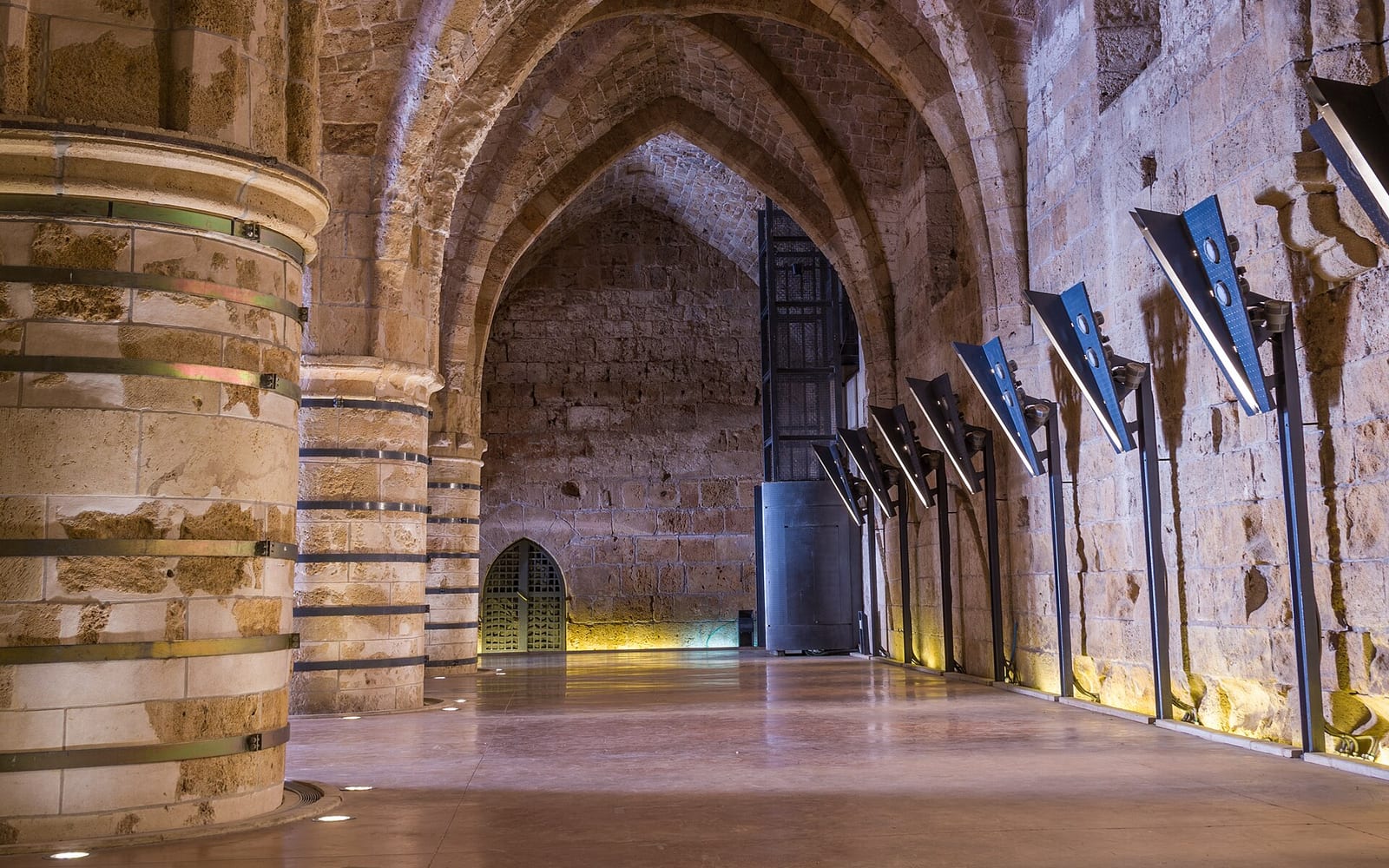
Ground floor — originally stables and storage rooms for the trade caravans. The vaulted bays remain intact; some now host artisan workshops and small museum displays.
Upper galleries — originally merchant sleeping quarters with views over the courtyard. Periodically host exhibitions (folk-art, archaeology, Ottoman heritage). Restoration ongoing; some sections may be closed.
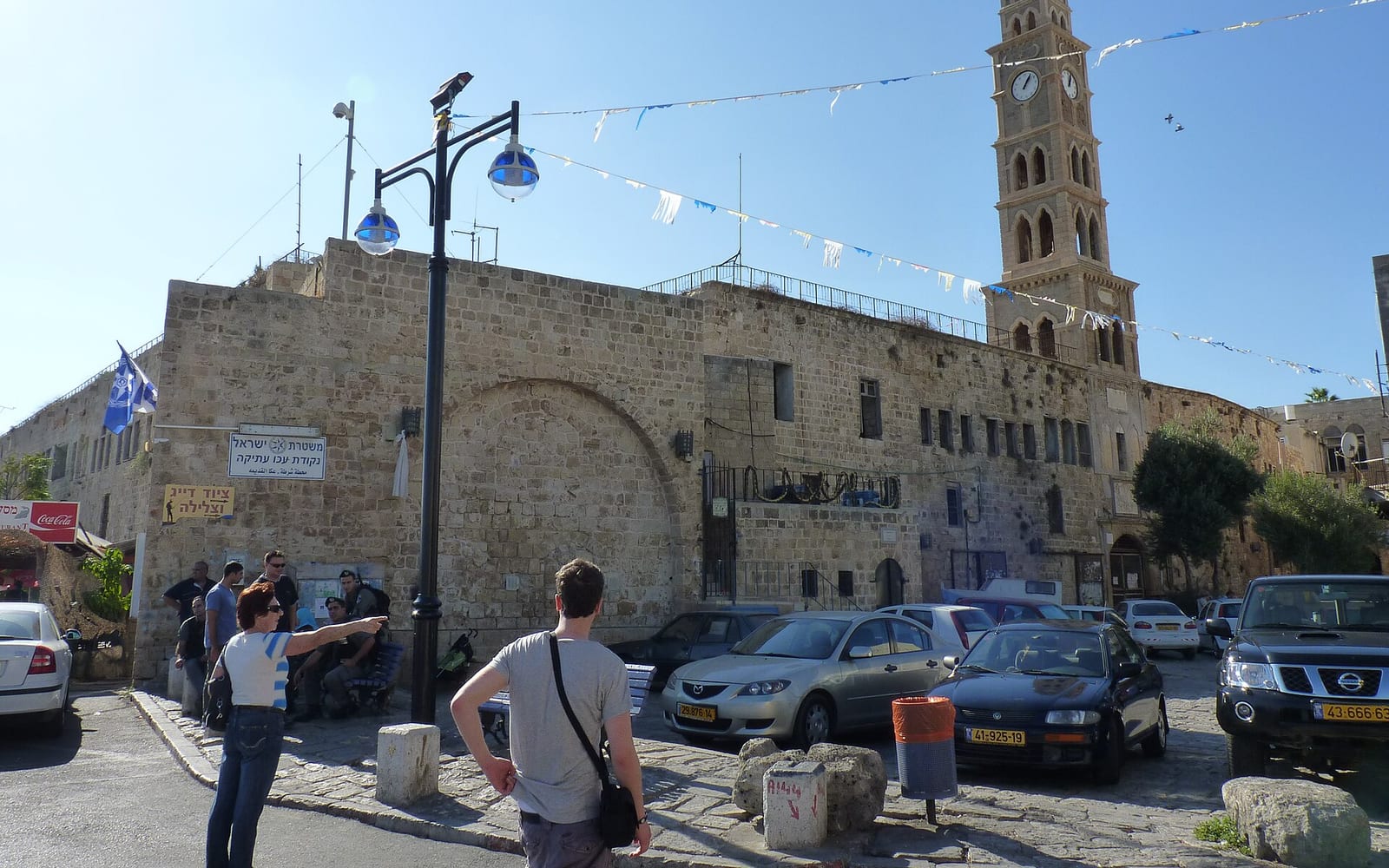
The 1906 clock tower — added by Sultan Abdul Hamid II as part of his programme of erecting modernising clock towers across Ottoman cities. The clock face is on the harbour-facing wall; the tower rises 30 metres above the courtyard and is the most photogenic single Old City landmark from the central position.
The seaward gate — opens directly onto the medieval harbour, which is why the Khan was the natural trading interface between overland and maritime commerce.
The Adjacent Hamam al-Pasha
Hamam al-Pasha — the Turkish Bath — is 50 metres from the Khan and was built by al-Jazzar in 1795 as part of the same urban programme. The bath operated as a public facility from 1795 through the late 1940s and was restored as a museum in the 2000s. The visit is a 30-minute multimedia narrative voiced by a fictional last-bath-attendant character explaining the Ottoman bathing culture (separate men’s and women’s hours, the three temperature rooms, the social-meeting function). The Hamam museum visit is included in the combined ticket alongside the Hospitaller Halls, Templar Tunnel and Underground Prisoners Museum.
Practical Visit Notes
Free entry to courtyard — the Khan al-Umdan courtyard is open to all at no charge during daylight hours. You can wander between the columns, photograph the clock tower from the central position, and absorb the scale.
Upper galleries — ticketed when an exhibition is running. Check the visitor centre on arrival.
Hamam al-Pasha — included in the combined Old City ticket (Hospitaller Halls + Templar Tunnel + Hamam + Underground Prisoners Museum). Allow 30 minutes for the bath visit.
Clock tower photography — the central courtyard position is the textbook composition. Late-afternoon light on the harbour-facing tower wall.
Pairing — combine the Khan al-Umdan + Hamam al-Pasha visit as a focused Ottoman half-day in the Old City, paired with the Hospitaller Halls or the Templar Tunnel as the Crusader half-day. The two periods (Crusader 12th-13th c. and Ottoman 18th-19th c.) are the two structural layers of the UNESCO inscription.
Frequently Asked Questions
The FAQ entries above answer the most common questions about Khan al-Umdan — the meaning of the name, who built it and when, the 1906 Sultan Abdul Hamid clock tower, the visitor access logistics, and the relationship to the adjacent Hamam al-Pasha. The schema-driven FAQPage at the bottom of this page surfaces these to search engines.