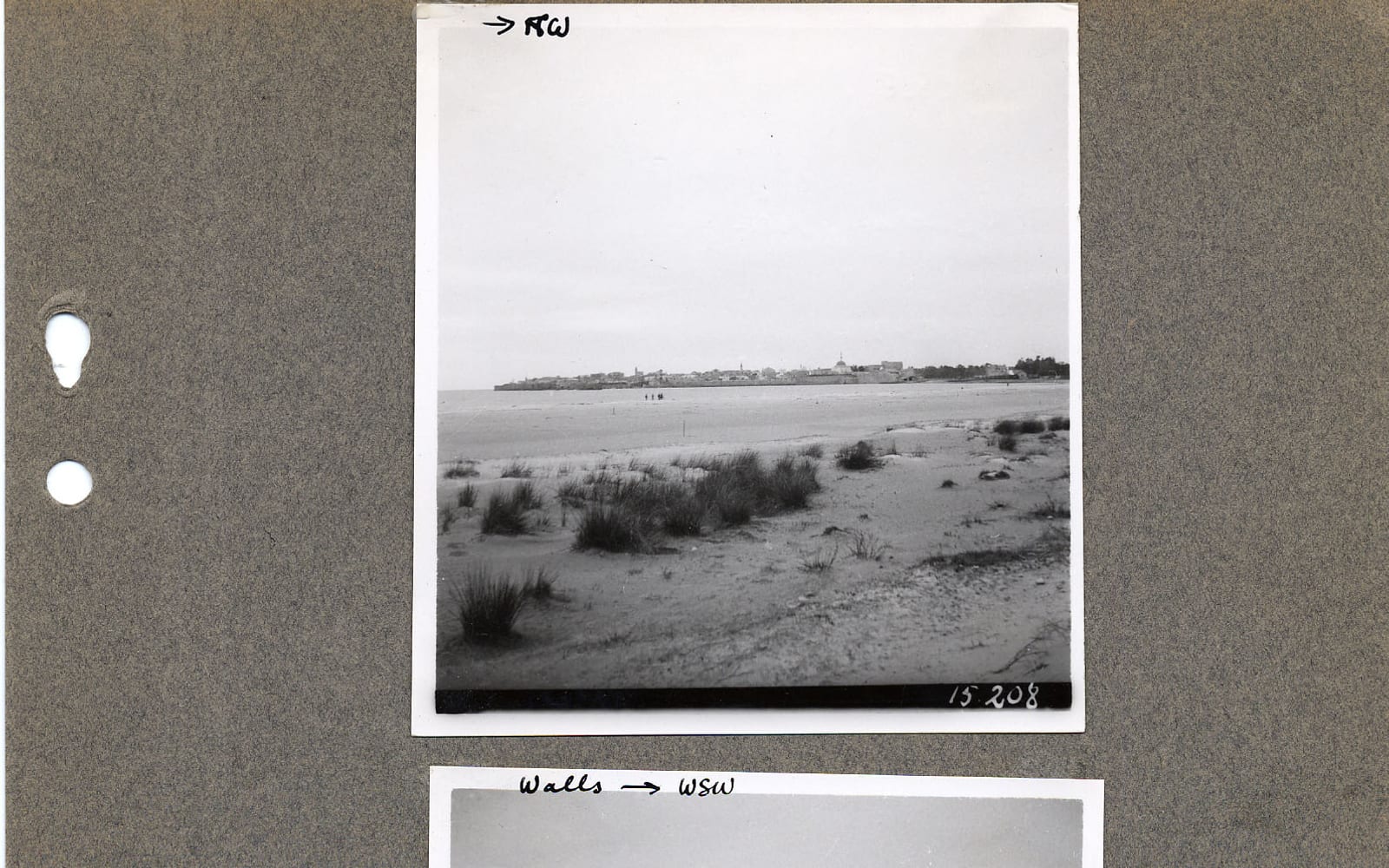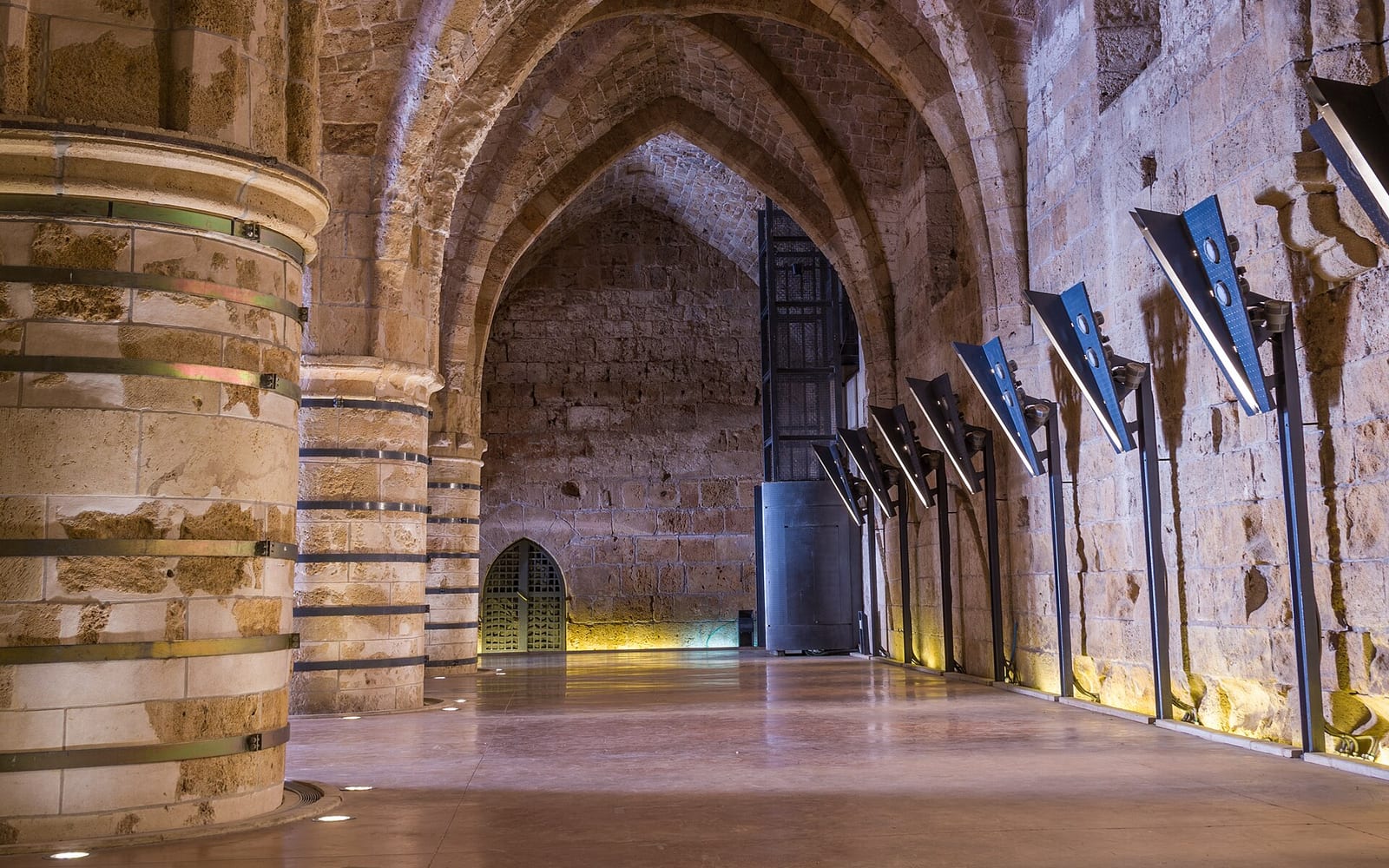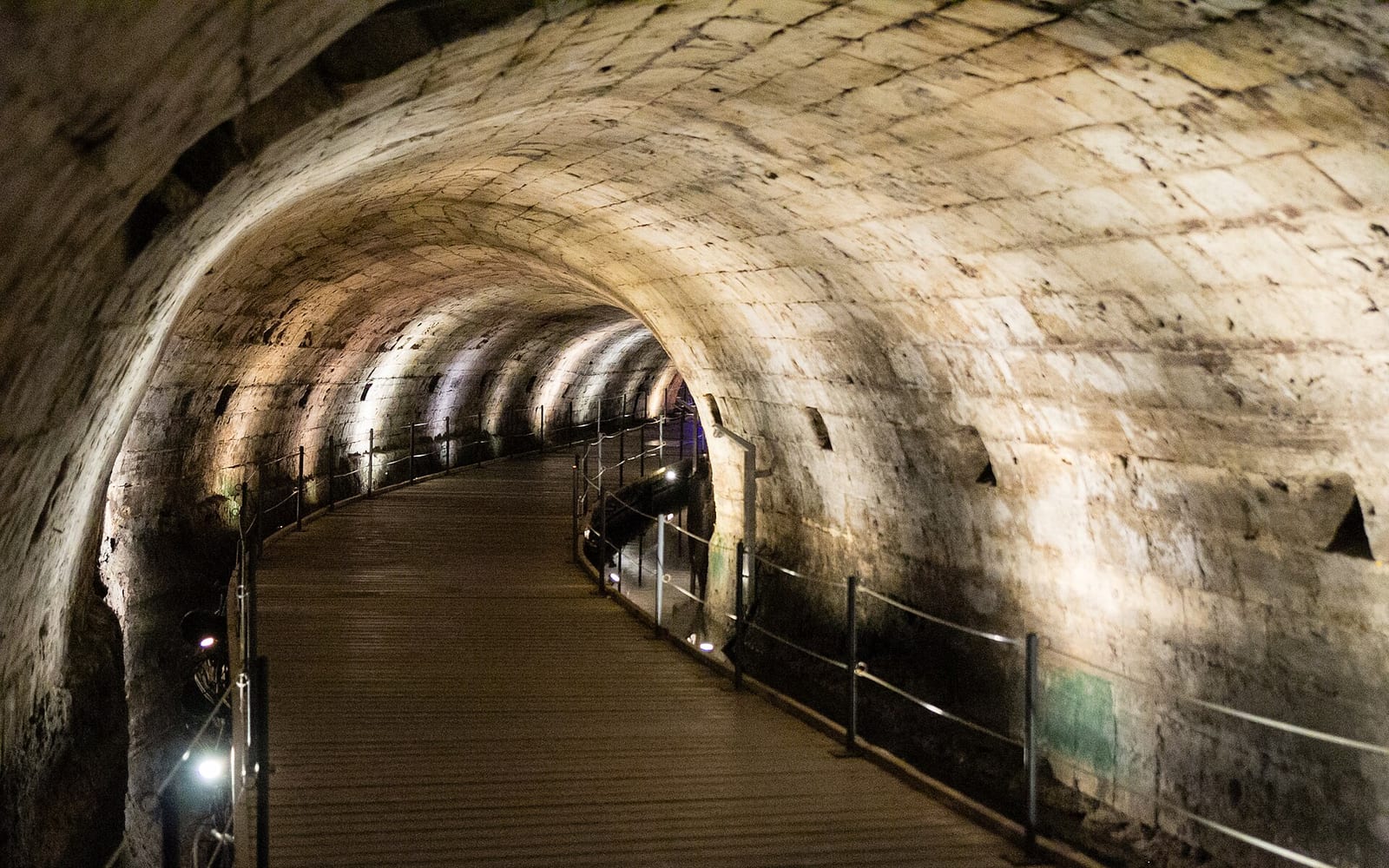
The Templar Tunnel is a 350-metre underground passage cut through the bedrock by the Knights Templar in the 12th century, connecting their fortified citadel on Akko’s western seaward extremity to the medieval harbour. It allowed people, military assets and trade goods to move discreetly between the Templar headquarters and the port out of sight of the wider Crusader-era town. Forgotten after the Mamluk destruction of 1291, the tunnel was rediscovered in 1994 by accident during a routine sewage-system survey; Israel Antiquities Authority excavation through 1995-1999 cleared it and added the wooden walkway visitors use today.
This guide covers the Templar Order’s distinctive identity, the tunnel’s military-engineering purpose, the rediscovery story, and the visit logistics within the wider Akko Old City circuit.
Need to know
| Cost | Ticketed; covered by the combined Old City ticket (Hospitaller Halls + Templar Tunnel + Hamam al-Pasha + Underground Prisoners Museum + ramparts). Check the official site for current prices. |
| Hours | Typically open ~09:00 to late afternoon; check the official site for current hours. |
| Time needed | ~15 min to walk the 350 m one-way; ~25 min if reading all the panels. |
| Getting there | In Akko’s Old City; entrance at the harbour-side (south) end, reached by a single flight of stairs from street level. Akko is ~30 min from Haifa. |
| Best time | The tunnel stays ~18°C year-round — a cool route in summer heat. |
| Accessibility | Reached by stairs from street level; the wooden walkway is otherwise level. Passage is ~2.5 m high and ~2 m wide. Not step-free; those with severe claustrophobia may prefer the open Hospitaller Halls. |
Who were the Knights Templar?
The Knights Templar — formally the Poor Fellow-Soldiers of Christ and of the Temple of Solomon — were founded around 1119 in Jerusalem on the Temple Mount / Haram al-Sharif, where their first headquarters gave them the “Temple” name. Like the Hospitallers (see the Akko Hospitaller Knights’ Halls sub-destination page), they were a medieval Christian military order, but where the Hospitallers were medical-first the Templars were military-first and banking-second. They were the elite shock troops of the Crusader armies and they invented the first international banking network in medieval Europe (pilgrims deposited funds at a Templar house in their home country and withdrew them at a Templar house in the Holy Land — the modern letter-of-credit pattern).
When Jerusalem fell to Saladin in 1187, the Templars relocated their primary headquarters to Akko, just as the Hospitallers did, but they took the western seaward end of the peninsula for their fortified compound — separate from the Hospitaller infirmary halls beneath the modern Old City centre. Their citadel was a defensible position with direct seaward escape to ships. The Templar Tunnel was the secret link between this seaward compound and the medieval harbour at the southern shore.
The Templar Order met a dramatic end in 1312, when Pope Clement V suppressed it under pressure from King Philip IV of France (who owed the Templars vast sums and wanted to repudiate the debts). The October 1307 mass-arrest of Templars in France — and the subsequent executions — is one of the formative trauma events of medieval European politics. By that point Akko was already 16 years gone (Mamluk destruction 1291), so the Templar presence in the Holy Land had effectively ended a generation earlier.
What the Tunnel Was For
The 350-metre passage runs east-southeast from the Templar citadel (now a partially excavated archaeological site at the western seaward extremity) to the medieval harbour at the southern shore of the Old City peninsula. The military-engineering logic:
- Discrete logistics — supplies, military assets and personnel could move between the citadel and the harbour ships out of sight of potential observers (whether external enemies or other internal Crusader factions).
- Emergency evacuation — if the citadel came under direct siege, the tunnel provided a fallback route to ships at the harbour.
- Trade secrecy — the Templars ran a substantial banking business; valuable cargo movements (gold reserves, sealed documents) could be conducted without public observation.
- Climate — the tunnel stays around 18 degrees year-round; this made it the natural route in the summer heat regardless of secrecy.
The tunnel was cut directly into the bedrock (kurkar sandstone, the local Mediterranean coast formation), which is why it survived intact through the Mamluk destruction, the Ottoman rebuilding and 700 years of urban habitation overhead. Most of the original 12th-century stonework remains visible — the wooden walkway protects the original floor.
The 1994 Rediscovery
The tunnel was sealed for 700 years after 1291. Ottoman-era Akko knew nothing of it; British Mandate surveys missed it; the original 1965-onwards Israel Antiquities Authority work in the Old City focused on the Hospitaller side. The rediscovery was accidental: in 1994, a routine sewage-system survey in the western Old City accidentally broke through a previously unmapped underground space. Excavation through 1995-1999 cleared the full 350-metre length, established the Templar attribution from architectural and inscriptional evidence, and constructed the wooden walkway for safe visitor access.
The 1994 date is why the Templar Tunnel is technically the most recent UNESCO 2001 inscription element — it wasn’t even known to exist when the original Akko Old City inscription nomination was being drafted in the late 1990s.
Walking the Tunnel Today
Entrance — the visitor entrance is at the harbour-side end (south), accessed via a single flight of stairs from the modern street. Some tickets enter at the citadel-side end (north); both entrances connect to the same walkway.
Walkway — a 350-metre wooden walkway runs the full length, with periodic informational panels covering Templar history, the rediscovery story, and the architectural details visible at each section. Single-direction flow at peak times.
Lighting — warm directional LED along the walkway; the original bedrock surfaces glow in the side-lighting. Bright enough to walk comfortably; dim enough to preserve the atmosphere.
Ventilation — natural draft from the harbour-side opening. Air quality is good throughout.
Photography — personal photography permitted; tripods awkward in the narrow walkway. Hand-held works at moderate ISO; flash unnecessary.
Time — 15 minutes one-way at moderate pace; 25 minutes if reading all panels. You exit the harbour-side end onto a different street and return to the visitor centre via the surface; the walk is one-way through the tunnel.
Pairing the Templar Visit
The natural Crusader-day sequence is Hospitaller Halls morning → souq lunch → Templar Tunnel afternoon → rampart sunset walk. This gives you the chronological story (medical-Hospitaller residence → secret-Templar passage to harbour → Ottoman walls).
Frequently Asked Questions
The FAQ entries above answer the most common questions about the Templar Tunnel — what it is, how long it takes to walk, the Templar Order’s identity, the 1994 rediscovery story and the claustrophobia question. The schema-driven FAQPage at the bottom of this page surfaces these to search engines.