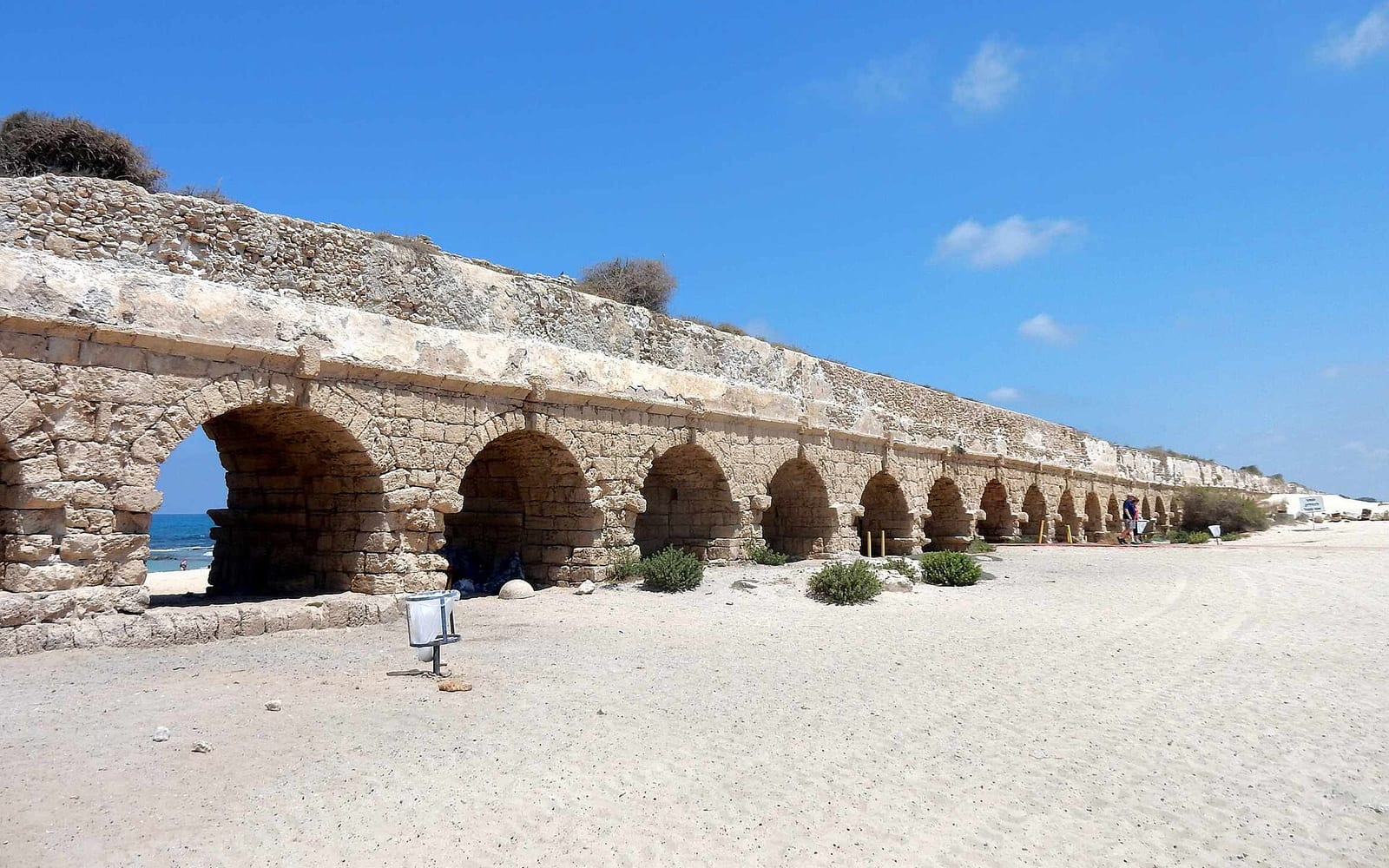
Aqueduct Beach is the 1 km stretch of open Mediterranean coastline directly beneath the surviving arches of the Roman aqueduct built around 130 CE under the emperor Hadrian. The aqueduct carried fresh water from springs at Mount Carmel 10 km north to supply Caesarea Maritima with drinking water — a typical Roman provincial-capital engineering project. The arches that survive (and are partially restored) march directly into the Mediterranean surf, creating one of the most photographed beach scenes on the Israeli coast.
This guide covers the aqueduct’s engineering history, the swimming logistics, the photography window, and how Aqueduct Beach pairs with the Caesarea National Park visit.
Need to know
| Cost | Free — no entrance fee, free parking, no gate. Seasonal sun-lounger and kiosk rentals only. |
| Hours | Open 24/7 (no gate). Kiosks and loungers operate seasonally (~May–Oct, daylight). Lifeguard service is seasonal, typically summer weekends (Fri–Sat). |
| Time needed | ~30 min for the aqueduct walk and photos; a half-day if swimming and picnicking. |
| Getting there | ~10 min north of the Caesarea National Park entrance off Hwy 2; signed turn-off to “Caesarea Aqueduct Beach”, parking behind the aqueduct. ~55 min from Tel Aviv. |
| Best time | Sunset — the west-facing arches frame the Mediterranean at golden hour. Swimming best May–Oct. |
| Accessibility | Open sandy beach with no shade; soft sand and gentle slope. No formal step-free beach access. |
What is Aqueduct Beach?
The beach is a regular public Mediterranean coast — soft sand, gentle slope, no entrance fee — distinguished by the Roman aqueduct that runs the length of the beach behind the sand line. The aqueduct itself is a double-arched structure (two parallel water channels stacked vertically) built in two phases — the lower channel by Herod the Great in the 1st century BCE bringing water from the Shuni springs 6 km north, and the upper channel added by the emperor Hadrian around 130 CE expanding the supply with additional springs from Mount Carmel.
The aqueduct carried about 22,000 cubic metres of water per day at peak — enough for a Roman provincial-capital city of around 100,000 inhabitants. It operated for roughly 600 years before falling out of use in the early Islamic period as Caesarea’s population collapsed.
The aqueduct survives in a 400-metre arched stretch directly inland of the beach. The arches were partially restored in the 19th century (Ottoman authorities) and again under the British Mandate. Today the structure is a free-access archaeological monument with no fence or admission gate.
Visiting Aqueduct Beach Today
Hours: the beach is open 24/7 (no gate, no closure). Sun-loungers and snack kiosks operate seasonally — typically May to October during daylight hours.
Entry fee: free. Free parking. No lifeguard in winter; municipal lifeguard service typically operates summer weekends (Friday and Saturday).
Getting there: drive 10 minutes north of the Caesarea National Park entrance on Highway 2; signed turn-off to “Caesarea Aqueduct Beach” leads to the parking area directly behind the aqueduct. From central Tel Aviv it is about 55 minutes total (45 minutes to Caesarea junction + 10 minutes to the beach).
Atmosphere: sunset is the photographer’s window — the arches face west and frame the Mediterranean horizon at golden hour. Summer afternoons can be crowded with Israeli families; winter is quiet with dramatic light and few visitors. The beach is suitable for casual swimming in spring through autumn; winter brings cold water (15 to 17 degrees) and occasional rough surf.
Top Things to See and Do
Swim Under the Aqueduct
The signature experience — swimming in the open Mediterranean with the 2,000-year-old aqueduct as the immediate backdrop. The water is regular Mediterranean coastal (no reef, no snorkel), best in May through October when temperatures are comfortable. Soft sand, gentle slope, no significant marine hazards.
Photograph the Arches
The double-arched structure runs 400 metres along the beach. Best photography window is late afternoon to sunset when the arches face the sun directly. Telephoto lens captures arches-with-surf framing; wide-angle works for the full beach + aqueduct panorama. The most photographed scene is the arched structure receding into the distance with the surf-line at the foreground.
Walk the Aqueduct Trail
A walking path runs the length of the aqueduct at beach level — accessible from either end of the parking area. The 400-metre walk takes 10 minutes and gives a sense of the engineering scale; informational signage explains the two construction phases and the water-supply system.
Sunset Picnic
The beach works as a free picnic spot — bring food and drinks (no commercial restaurant on the beach itself, kiosks for cold drinks and ice cream in summer). The combination of free entry, free parking, and Mediterranean sunset with 2,000-year-old engineering as the backdrop makes this one of the highest-value travel moments in the country.
Tours of Aqueduct Beach
There are no guided tours of the beach itself — it is a free public beach. Most Caesarea day-tour packages from Tel Aviv include a short photo-stop at Aqueduct Beach as part of the broader Caesarea visit. For self-driving visitors, the natural rhythm is National Park in the morning, lunch in modern Caesarea or Zichron Yaakov, and Aqueduct Beach in the afternoon for swimming and sunset photography.
Nearby Attractions
The Caesarea National Park (Roman + Crusader archaeology) is 10 minutes south — the natural pair. The Ralli Museum (contemporary art, free admission) is 5 minutes south in modern Caesarea. Zichron Yaakov winery village is 15 minutes north — wine-tasting + farm-to-table restaurants. Haifa + Bahá’í Gardens is 25 minutes north — full urban day-trip option.
Practical Tips
No entrance fee, free parking — Aqueduct Beach is one of the few completely free coastal heritage experiences in Israel.
Sun protection — open Mediterranean beach with no shade. Sun shirt, hat, sunscreen, water bottle. The aqueduct provides minimal shade only directly under specific arches.
Lifeguard awareness — service is seasonal and weekend-biased. Standard Mediterranean caution applies — swim parallel to shore, watch for rip currents in winter.
Jellyfish season — late July to early August can have jellyfish in the eastern Mediterranean (regional issue, not Aqueduct Beach specific). Check local notices before swimming during that window.
Photography timing — sunset frames the arches against the sea. Bring a tripod for long exposures of the surf-line. The path along the aqueduct at beach level is the best vantage point.
Bring food/drink — no on-beach restaurant. Picnic supplies from the supermarket in Or Akiva (5 minutes north) or restaurants in modern Caesarea or Zichron Yaakov.
Pair with National Park — most efficient day = archaeology morning, lunch, beach afternoon. Bring a swimsuit.
Why Visit
Aqueduct Beach is the rare combination of a free public swimming beach with one of the most photogenic Roman engineering monuments still standing — and the 10-minute drive from the Caesarea National Park makes it a natural extension of the archaeology visit. No ticket, no fence, no schedule — just a Roman aqueduct, Mediterranean sand, and a sunset over the Roman provincial capital that fed Rome.
For travellers planning the north-coast loop, Aqueduct Beach is the late-afternoon swim and sunset photo after the morning archaeology.