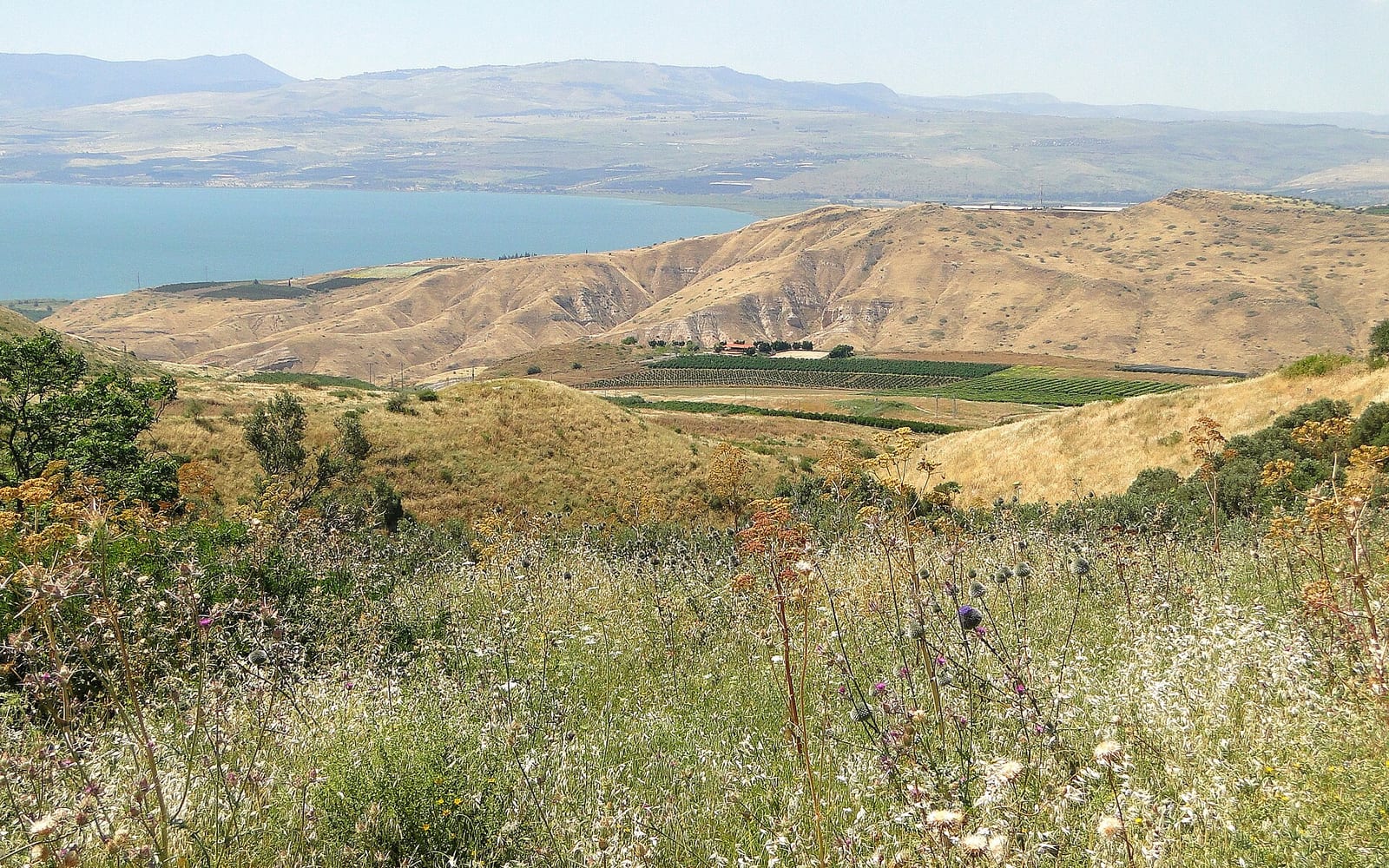
The western shore of the Sea of Galilee holds the densest concentration of New Testament sites in the world outside Jerusalem — a 25-km arc of lakeside road connecting the places where the Gospels locate the core of Jesus’s Galilean ministry. Capernaum, Tabgha, the Mount of Beatitudes and Magdala can all be visited in a single day by car, in a natural anti-clockwise loop from Tiberias that traces the geography the Gospel writers describe.
This guide covers all six circuit sites with enough detail for a self-guided visit: what to see, how long to allow, practical logistics, and how to sequence the loop for the best experience.
The circuit at a glance
The route runs anti-clockwise from Tiberias, heading north along the western shore on Route 90:
- Capernaum National Park — 18 km north of Tiberias
- Church of the Multiplication of the Loaves and Fishes, Tabgha — 13 km south of Capernaum
- Church of the Beatitudes — 1.5 km uphill from Tabgha
- Church of the Primacy of Peter, Tabgha — the lakeside chapel, 500 m south of the Multiplication church
- Magdala — 8 km south of Tabgha, just north of Tiberias
- Kursi National Park (optional extension) — northeast shore, ~20 km east of Tiberias across the lake
Total driving: approximately 45 km. Allow 7–8 hours for all five main sites; a half-day (4–5 hours) for the three highest-priority stops.
1. Capernaum National Park
The single most important Galilean site for most pilgrims, Capernaum is where Jesus based his ministry after leaving Nazareth, performed some of his best-documented healings, and called Peter, Andrew, James and John from their fishing boats. All four Gospels name it as “his own town.”
The excavations reveal two principal features. The fifth-century synagogue — white limestone columns rising from black basalt foundations — is one of the most photographed buildings in Israel. The 5th-century structure may stand on the earlier 1st-century synagogue mentioned in Luke 7:5 as built by a Roman centurion; the original basalt foundation stones are visible beneath. Two black basalt corner pillar capitals, Corinthian in style, are original; the white limestone columns above are partially reconstructed.
A 30-metre walk south brings you to the “house of Peter” — a modest first-century stone dwelling over which a modern suspended octagonal chapel hovers on metal stilts. The chapel (a mid-20th-century Franciscan building) is designed to allow visitors to look down through the glass floor to the excavated remains below. The identification of the house as Peter’s is based on Byzantine and Crusader tradition rather than first-century archaeology — be clear about this framing, but the early church built a place of worship over this precise structure, and the layers of that history are genuinely visible beneath your feet.
The park grounds along the lakeshore are exceptionally atmospheric — ancient olive trees, the smell of water and stone, and a lakeside position that feels unchanged from the landscape the Gospels describe.
Practical: Entry approximately ₪35 (INPA National Parks Pass valid). Open daily; check INPA website for current hours. Allow 60–90 minutes.
2. Church of the Multiplication of the Loaves and Fishes, Tabgha
Thirteen kilometres south of Capernaum, Tabgha (from the Greek “Heptapegon,” meaning seven springs) is home to two distinct churches worth separate visits.
The Church of the Multiplication is a Benedictine monastery church built in 1982 over 4th- and 5th-century Byzantine foundations. The reason to come is the floor: the 5th-century Byzantine mosaic of loaves and fishes is one of the finest early Christian mosaics in existence, and unlike many ancient mosaics displayed in climate-controlled museums, this one is in situ on its original floor. The famous central panel — two fish flanking a basket of loaves — is the original mosaic, not a reproduction. The surrounding panels of water birds and plants are equally extraordinary.
This is a genuinely remarkable archaeological survival. The modesty of the modern building (functional, unostentatious) throws the ancient floor into sharp relief.
Practical: Free entry. Open approximately 08:00–17:00, closed midday Friday. Modest dress required. No entrance fee but donations support the monastery. Allow 20–30 minutes. For a deeper look at both Tabgha churches, see the dedicated Tabgha churches guide.
3. Church of the Beatitudes
Five hundred metres uphill from the Tabgha junction, a narrow road climbs to the Church of the Beatitudes — a 1938 octagonal Franciscan church built on the hillside above the Sea of Galilee at the site traditionally identified with the Sermon on the Mount (Matthew 5–7; Luke 6:17–49). The church’s architect, Antonio Barluzzi, designed it with eight sides to represent the eight Beatitudes.
The church itself is restrained and beautiful — pale stone, a colonnaded veranda, and interior windows framing the Galilee panorama. The garden terrace is where most visitors spend the most time: the view across the Sea of Galilee from this hillside, with the Golan Heights on the opposite shore, is one of the most satisfying panoramas in the entire region.
The Franciscan community asks visitors to maintain a prayerful atmosphere inside the chapel. Photography is permitted in the gardens and exterior; check signage inside.
Practical: Free entry. Open approximately 08:00–17:00. Modest dress required. Allow 30 minutes for a thoughtful visit; longer if you want time in the gardens.
4. Church of the Primacy of Peter, Tabgha
Back at the lakeshore, 500 metres south of the Multiplication church, the Church of the Primacy of Peter is a small, dark Franciscan chapel built of black basalt directly over the lakeside. It marks the tradition of John 21 — the post-Resurrection breakfast appearance of Jesus on the shore, when he reinstated Peter with the threefold question “Do you love me?”
Inside the chapel, the “Mensa Christi” (Table of Christ) is a flat rock projecting from the floor, identified in tradition as the stone on which Jesus prepared the breakfast of fish and bread for the disciples. The chapel is intimate and contemplative — far quieter than Capernaum, and the lakeside position a few metres from the water is extraordinarily atmospheric.
Practical: Free entry. Open approximately 08:00–17:00. Modest dress. Allow 20–30 minutes.
5. Magdala
Eight kilometres south of Tabgha and just north of Tiberias, the Magdala archaeological site is the circuit’s most recent discovery and, for many visitors, its most intellectually extraordinary stop.
Excavations begun in 2009 uncovered a first-century synagogue — one of only seven confirmed pre-70 CE synagogues known in Israel. The synagogue dates to a period when Jesus is recorded as preaching throughout the Galilee, and its discovery generated significant scholarly interest for the light it sheds on 1st-century Jewish religious practice.
Inside the excavated synagogue, archaeologists found the Magdala Stone — a large carved block bearing a seven-branched menorah, the oldest stone carving of this symbol found outside Jerusalem. Nearby they recovered what is now called the “Ark of Magdala,” a carved stone chest whose precise function and iconographic programme have no parallel in Second Temple archaeology. Replicas are displayed in the Duc in Altum centre; the originals are at the Israel Antiquities Authority.
The Duc in Altum pilgrim centre (Latin: “Put out into the deep”) built around and over the excavation is the work of the Legionaries of Christ. Its chapel walls carry mosaics of women from the Gospels; the centre is open to visitors of all faiths and offers a peaceful space to sit with the site’s history.
The identification of this site as the town of Mary Magdalene rests on location rather than inscribed evidence. Magdala / Migdal in Aramaic means “tower” — a common enough name — and the site’s location on the western shore of the Galilee matches the Gospel geography of Mary Magdalene’s home. This is the consensus scholarly identification; it is reasonable to present it as Magdala without overclaiming certainty about specific buildings.
Practical: Free entry to the archaeological zone and Duc in Altum centre. Open approximately 08:00–18:00 (check their website for current hours). Allow 45–60 minutes.
6. Kursi National Park (optional extension)
If you have time and energy, Kursi on the northeast shore of the Sea of Galilee — reached via the eastern shore road after crossing the Jordan at the southern outlet — is the largest Byzantine monastery complex excavated in Israel, associated in the Gospels with the “Gadarenes” or “Gergesenes” and the tradition of the swine (Mark 5:1–20, Luke 8:26–39). The INPA park preserves the 5th-century monastery mosaic floors and the fortified complex walls.
Practical: INPA entry (INPA pass valid). Add approximately 1.5–2 hours if including Kursi.
Driving logistics
Starting point: Tiberias is the natural base — all sites are within 30 km of the city centre. Rent a car in Tiberias (or pick up in Haifa and drive north via Route 90) for maximum flexibility.
Route: Drive north on Route 90 along the western shore. Stop at Capernaum first (northernmost point), then retrace south through Tabgha and Magdala back into Tiberias. The route is clearly signed throughout; all sites have car parks.
Timing: Arrive at Capernaum before 09:00 on any day from May to October to beat the first coach arrivals. The Multiplication church at Tabgha closes for several hours around midday on Fridays — check current hours before building your schedule around it.
Parking: All six sites have free car parks. The Tabgha sites (Multiplication and Primacy of Peter) share a small car park that can fill during high season — arrive early or park on the road verge.
Combining with Nazareth
Nazareth is 25 km west of Tiberias — the drive takes approximately 35–40 minutes. A combined Nazareth + Galilee circuit day is feasible with an early start: visit the Basilica of the Annunciation and Mary’s Well in Nazareth in the morning (2 hours), then drive east to begin the lake loop by midday. You will complete the circuit by late afternoon.
Alternatively, base yourself in Nazareth and drive to the lake circuit as a dedicated day trip. Our Nazareth travel guide covers the city’s main sites.
Practical tips
- Dress code: Covered shoulders and knees at all sites; carry a light layer or scarf even in summer.
- Heat: In July and August, temperatures on the lake shore reach 38–42°C. Carry 2 litres of water per person; start before 08:00; take a long midday break in air conditioning.
- Cash: Capernaum accepts credit cards at the ticket office; all other sites are free. Some of the small restaurants in Tiberias or near Tabgha prefer cash for lunch.
- Photography: Exterior and ground-level photography is generally welcome at all sites; some chapels restrict interior photography — follow signage.
- Combined itineraries: This circuit pairs naturally with a Galilee tours compared overview if you want to add a boat trip on the lake or a deeper dive into a specific site. Our Christian pilgrimage planning guide covers the Jerusalem end of the trip.