Mitzpe Ramon sits on the northern rim of the Makhtesh Ramon — the largest erosion crater on Earth — at roughly 900 metres above sea level in Israel’s central Negev. A small desert town of around 5,000 residents, founded in 1951 as a workers’ settlement for the Route 40 road-building project, it has over the last two decades become the southern Negev’s main tourism hub: the base for crater hiking and jeep tours, the best stargazing destination in Israel, and the location of the Beresheet Hotel, one of the country’s most recognisable luxury properties.
The crater itself is the draw. Makhtesh Ramon stretches 40 kilometres long, 2–10 kilometres wide, and roughly 500 metres deep — dimensions that make photographs inadequate and the first direct view from the rim consistently stop visitors in their tracks.
Quick reference
| |
|---|
| Location | Central Negev; 240 km south of Tel Aviv |
| Drive from TLV | ~2 h 20 min via Route 40 |
| Bus from Beer-Sheva | ~1 h 15 min (Egged) |
| Best for | Crater hiking, stargazing, jeep tours, desert photography |
| Altitude | ~900 m above sea level |
| INPA Park Pass | Valid at crater floor access and Space Center |
Makhtesh Ramon — understanding the crater
The single most important thing to know before visiting is what kind of geological feature you are looking at. Makhtesh Ramon is a makhtesh — a Hebrew geological term with no direct English equivalent. It is sometimes translated as ‘erosion crater’, ‘box canyon’, or ‘cirque’, but none of these fully captures it. A makhtesh forms when tectonic forces dome up a layer of hard limestone crust; erosion then cuts drainage outlets at the edges, the rivers carve down through the dome, and the softer sedimentary rock inside is gradually washed away until you are left with a deep enclosed depression with steep walls and a flat floor through which a seasonal river exits. This process plays out over tens to hundreds of millions of years.
There are five makhteshim in the world and all five are in Israel’s Negev and Sinai. Ramon is by far the largest. It is emphatically not a meteor impact crater (impact craters have a round form and visible breccia ejecta; Ramon’s form is elongated and structurally controlled) and not a volcanic crater. Using the word ‘impact’ or ‘meteor’ in connection with it is a factual error.
The other two accessible craters — Makhtesh HaGadol (the Big Crater, near Yeruham) and Makhtesh HaKatan (the Small Crater, near Dimona) — are an hour north of Mitzpe Ramon. Both are far less visited than Ramon and can be combined into a one-day extension; see the Makhtesh HaGadol & HaKatan guide for details.
The crater floor is anything but empty. The exposed cross-section of geological strata visible from the rim — and accessible on hikes and jeep tours — displays Triassic and Jurassic sedimentary sequences laid down 200–250 million years ago when this desert was a shallow Tethys Sea. You will find ammonite fossils on the crater floor, multicoloured sand dunes (reds, yellows, and purples from different mineral-rich layers), and prism-shaped basalt formations from later volcanic intrusions that followed the tectonic uplift. It is the most visually layered geological landscape in Israel.
The crater rim promenade is free to walk at any hour. The main viewpoint lookout is 5 minutes from the Ilan Ramon Space Center; secondary viewpoints extend along the rim in both directions. Sunrise from the rim — with the crater floor shadowed and the far wall illuminated in orange light — is one of the genuinely bucket-list natural experiences available in Israel.
Ilan Ramon Space Center
On the crater rim, the Ilan Ramon Space Center (formerly the Makhtesh Ramon Visitor Center) combines a geological museum with a memorial to Ilan Ramon — Israel’s first astronaut, who died in the Space Shuttle Columbia disaster in February 2003. The renaming was a decision by the town to acknowledge that Ramon’s most famous son (he grew up in Mitzpe Ramon) had given the town a connection to space exploration that fitted the dark-sky tourism identity the community was developing.
The center’s geology exhibitions are the practical companion to the crater itself: scale models, sediment core samples, and hands-on displays explaining makhtesh formation, the fossil record, and the region’s prehistoric geology. The observation terrace on the roof gives the best wide-angle crater view available from the town — wider than the main lookout below, and elevated enough to see both the near rim walls and the far wall clearly.
INPA entry fees apply to the indoor exhibitions; the rim promenade and lookout are free. Hours and current pricing are at parks.org.il; the Israel National Parks Pass covers the Space Center. Allow 60–90 minutes for the full exhibition and observation terrace.
Hiking — the crater from the rim and the floor
Mitzpe Ramon has over 35 marked trails ranging from a 30-minute rim stroll to multi-day overnight routes that traverse the full crater length. Three practical options for day visitors:
Rim walk (1–2 hours, easy): The marked trail along the northern crater rim from the main lookout eastward gives continuously evolving crater views and reaches secondary geological formations above the rim. No significant elevation change; suitable for all fitness levels.
Carpentry Shop trail / Mifsatz HaNagarim (2–3 hours, moderate): The most accessible descent into the crater, named after the unusual hexagonal basalt columns on the crater wall that resemble a carpenter’s bench. The trail descends from the crater rim, crosses the crater floor through geological formations, and returns via a different route. The coloured sand layers and basalt formations are the main visual reward. Parking at the designated trailhead just west of the Space Center. Carry water; start early — the crater floor has no shade.
Nahal Ramon stream bed (4–6 hours, moderate-strenuous): The seasonal stream that carved the drainage outlet at the crater’s western end. The trail follows the stream bed across the crater floor to the outlet canyon — a long flat walk through the most geologically varied part of the crater floor, ending at a viewpoint above the outlet. Return either on foot or arrange transport at the far end. This route in particular requires 3 litres of water per person and must start by 7:00am in summer.
For multi-day crater traverses and technical routes, the Negev desert multi-day hiking guide covers a 3–5 day circuit based in Mitzpe Ramon with water logistics, camping, and day-by-day planning. The Hiking in Israel guide covers broader logistics, and the INPA rangers’ office at the Space Center can advise on current trail conditions.
Jeep tours, rappelling, and mountain biking
4×4 jeep tours are the most practical way to reach the remote parts of the crater floor — the coloured-sand canyon above Nahal Ardon, the fossil ammonite beds, and the volcanic ‘prism’ formations are too far from the trailheads for a comfortable day hike in most seasons. Licensed operators in Mitzpe Ramon run half-day tours (3–4 hours) and full-day tours (6–7 hours) with English-speaking guides. Advance booking is essential during Passover and Sukkot school holidays; some operators can be reached via GetYourGuide and Viator (use the CTA above), others directly through the Mitzpe Ramon tourism information office. For a full breakdown of jeep circuits, tour formats, self-drive tracks and practical booking advice, see the Negev jeep tours guide.
Rappelling and abseiling are available on the crater’s northern wall — cliff faces of 100–300 metres that require a licensed guiding company and equipment. Several operators in Mitzpe Ramon offer this year-round; half-day sessions are the standard format. Not suitable for beginners without prior experience; most operators provide a brief ground briefing. Book ahead — groups are capped for safety reasons.
Mountain biking: the crater rim trail circuit makes an excellent mountain bike route for experienced riders — the technical terrain, elevation changes, and exposure are significant; the trail is unsuitable for standard road bikes. Bikes can be hired in Mitzpe Ramon. A gentler graded track on the crater rim west of the Space Center is accessible to casual cyclists.
Paragliding: the Ramon Crater’s altitude (~900 m) and open terrain generate strong thermals, particularly in spring and autumn. Licensed commercial operators offer tandem paragliding flights from crater-edge launch sites. No experience required for tandem flights; the aerial view of the crater floor and surrounding Negev desert is genuinely exceptional. See the Israel paragliding guide for operator details and seasonal windows.
Stargazing — Israel’s IDA-certified dark-sky park
The Ramon Crater Dark Sky Park holds certification from the International Dark-Sky Association (IDA) — the only designated dark-sky park in Israel and one of a small number in the Middle East. The combination of high altitude (~900 m), minimal light pollution (the nearest large city, Beer-Sheva, is 85 km north), low humidity, and the Negev’s 300+ clear nights per year makes the site exceptional for naked-eye and telescopic astronomy.
Several operators run guided stargazing sessions from approximately sunset through midnight, offering 8–12 inch telescopes and commentary ranging from classical constellation mythology to astrophotography. The Ilan Ramon Space Center operates sessions on selected evenings; independent operators advertise in the town centre. Advance booking is advisable in autumn and spring.
Practical notes: even summer nights on the crater rim drop to 15–18°C after midnight — bring a warm layer regardless of the daytime temperature. Winter nights can reach 0–5°C; a down jacket and thermos are necessary. The crater rim is exposed — wind chill compounds the cold. Arrive before full dark to allow your eyes to adjust before the session begins.
The best period for Milky Way visibility is May to October (when the Galactic Centre is above the horizon and observable from this latitude). Winter offers fewer hours of darkness but clearer, drier air.
The town: Spice Route Quarter and Alpaca Farm
Mitzpe Ramon’s Spice Route Quarter (Rova HaBsamim) occupies the old residential area near the western edge of town — a cluster of independent studios, craft galleries, ceramic workshops, and organic cafes that have established themselves since the early 2000s. The quarter’s name references the ancient Nabataean trade routes that crossed this region; several gallery owners are practicing artists who will show and discuss their work during opening hours. The area is walkable from the main town square in 10–15 minutes.
The Alpaca Farm (HaChava HaAlpaka), 5 km west of town on Route 40, is home to a mixed herd of llamas and South American alpacas. The attraction is straightforward: you can feed, brush, and lead the animals, and the farm has an introductory walk. It is one of the more child-friendly stops in the central Negev; allow 60–90 minutes. Entry charges apply; check current hours at the farm directly, as they vary seasonally.
Where to stay
Beresheet Hotel is the property most strongly associated with Mitzpe Ramon — a luxury desert lodge perched directly on the crater rim, with the crater view from room terraces and the infinity pool as its defining image. It is consistently ranked among the top hotels in Israel and books up months in advance for weekend stays in spring and autumn. Room rates are in the upper-premium range; check Booking.com for live pricing (the rates fluctuate significantly with season and availability). Non-guests can access the spa by advance booking.
Selina Ramon occupies a converted building in the town centre with a range of room types including private rooms, dormitories, and some glamping-style options. It operates as part of the Selina global hostel-hotel network and attracts a younger, budget-conscious crowd; the social areas, co-working space, and rooftop terrace make it a practical base for solo travellers.
Mid-range and guesthouses: the town has a range of smaller family-run guesthouses (tzimmerim in Hebrew — Israeli bed-and-breakfast-style accommodation) concentrated around the main town square. Many are purpose-built desert lodges with private courtyards and outdoor breakfasts; use the Booking.com CTA above to filter by guest rating and price.
For a full breakdown of each property — rates, who each suits, and booking-timing advice — see the best hotels in Mitzpe Ramon & Negev guide.
Practical planning
Getting there by car: from Tel Aviv, take Route 1 east to Route 6 (toll motorway; pay by Rav-Kav or credit card) then Route 40 south through Beer-Sheva and continuing south on the same road to Mitzpe Ramon. Total distance approximately 240 km; typical driving time 2 hours 20–30 minutes in off-peak conditions. Fill the petrol tank in Beer-Sheva; the next station is Mitzpe Ramon itself, and there is nothing reliable between the two. A rental car from Tel Aviv, Jerusalem, or Ben Gurion Airport is the most practical approach — public transport reaches the town but cannot serve the crater floor, Ein Avdat, or Avdat independently.
Getting there by bus: Egged buses run from Beer-Sheva Central Bus Station to Mitzpe Ramon roughly every 1–2 hours on weekdays; the journey is approximately 1 hour 15 minutes. Reach Beer-Sheva from Tel Aviv by direct train (1 hour from Savidor Center; roughly every 30 minutes on weekdays). From Jerusalem, change at Beer-Sheva. Check current timetables at egged.co.il before travel.
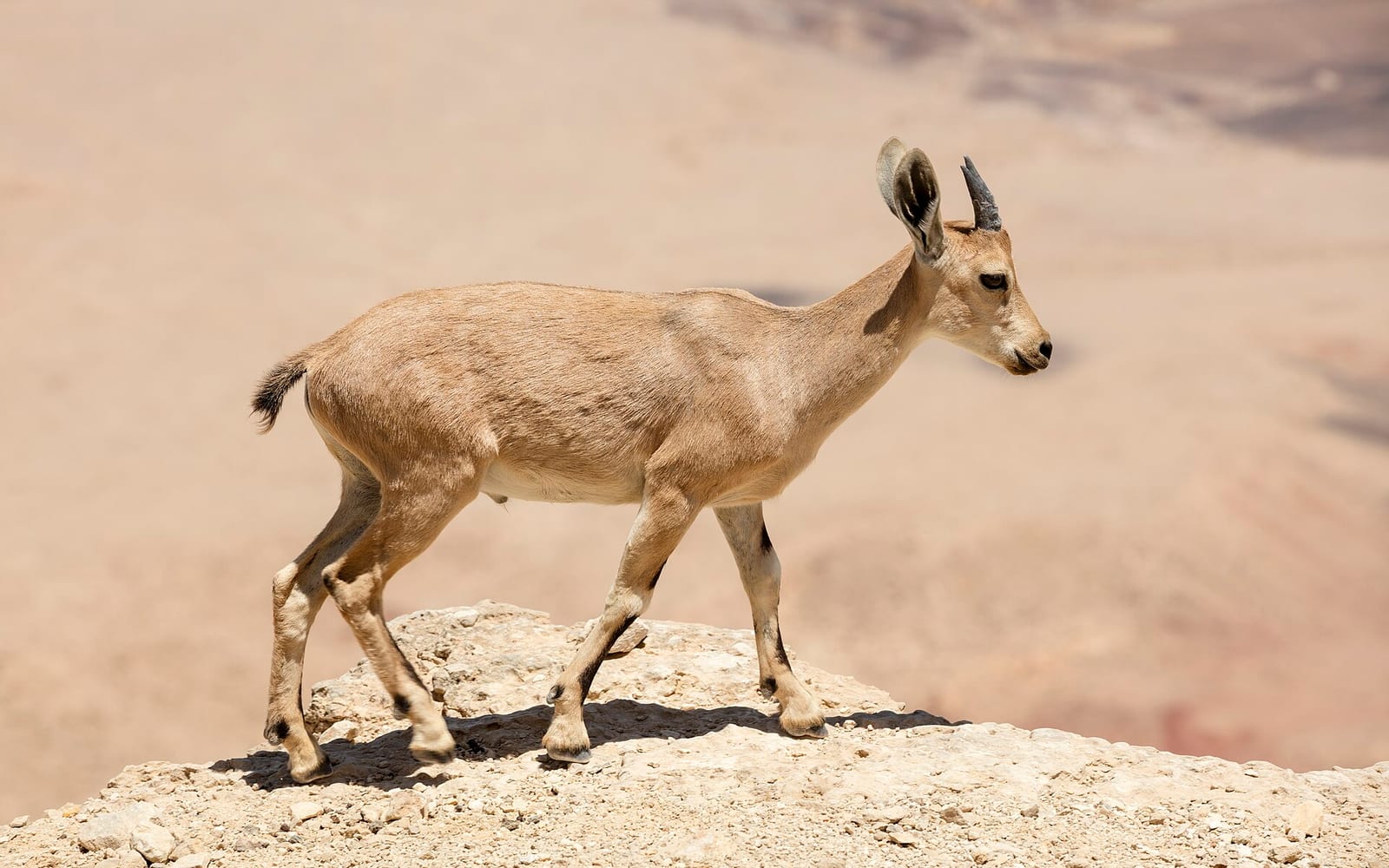
Continuing south: from Mitzpe Ramon, Route 40 continues south through the Arava desert to Eilat — approximately 2 hours. The route passes through sparse Arava settlements and the Hai-Bar Yotvata nature reserve (Arabian oryx and Persian fallow deer reintroduction programme; worth a brief stop). Roughly 1 hour 20 minutes south of Mitzpe Ramon, the Shaharut highlands hold Six Senses Shaharut — Israel’s MICHELIN-listed luxury desert retreat and the premier international-standard luxury property in the southern Negev; see the luxury Arava desert guide if an overnight at the property fits your circuit. Eilat itself has snorkelling, coral reefs, and a very different desert-meets-sea atmosphere; a night there completes the south circuit well.
Combining with Avdat and Ein Avdat: from Mitzpe Ramon, Avdat UNESCO Nabataean ruins are 30 km north on Route 40 (30–35 minutes); Ein Avdat canyon trail is 5 km further north. Both are excellent additions to a two-day Negev base at Mitzpe Ramon. The Negev region guide covers Avdat and Ein Avdat in detail; the Israel National Parks Pass covers all three INPA sites. See also the Beer-Sheva guide for the northern Negev gateway.
Season-specific advice:
- Spring/autumn (Mar–May, Sep–Nov): ideal weather, busy at weekends and holidays — book accommodation early
- Summer (Jun–Aug): hikes must start before 7:00am; crater floor temperatures reach 38–42°C by 10:00am; afternoons for indoor/shaded activities; best season for long evening stargazing without extreme cold
- Winter (Dec–Feb): best stargazing; occasional rain can make some crater floor trails slippery; cold nights (near freezing at altitude); trails largely empty
Water: carry at least 3 litres per person for any crater hike; more in summer. There are refill stations at the Space Center and at major trailheads. The crater floor has no shade and no water sources once you leave the marked trailheads.
Cell signal: reliable in Mitzpe Ramon town and along Route 40; patchy on crater floor access roads and remote trails. Download offline maps (Maps.me or the Amud Anan hiking app) before descending into the crater.
Bedouin experience: several Bedouin-hosted camps near Sde Boker (roughly 35 km north) offer camel rides, traditional meals, and overnight tent stays that combine naturally with a Mitzpe Ramon itinerary. See the Bedouin experience guide.
Three days in the Negev: if you have three days, see the 3-day Negev itinerary — a day-by-day plan covering Makhtesh Ramon, Wadi Ardon, Ein Avdat canyon and Sde Boker, with transport, hotel and heat-safety guidance.
Four to five days — south circuit: for a longer Negev loop continuing all the way to Eilat, the South Israel road trip itinerary covers Beer-Sheva, Sde Boker, Makhtesh Ramon, Timna Park and the Red Sea, with day-by-day driving directions, heat safety notes and INPA tips.
Comparing organised tour formats: if you are deciding between a Negev day trip from Tel Aviv, an overnight Bedouin camp package, and a self-drive option, see the Negev tours compared guide for an honest side-by-side breakdown of what each format covers, costs and is best suited for.