Kerem HaTeimanim — Tel Aviv’s Yemenite Quarter — is one of the city’s oldest and most distinctive neighbourhoods: narrow whitewashed lanes, decorative iron balconies, the smell of jachnun baking since before dawn, and a bar scene that has grown up around the neighbourhood’s affordable rents and creative community. It sits a short walk south of the Carmel Market, but feels like a different city — slower, more residential, and shaped by a food culture that has no equivalent anywhere else in Israel.
The neighbourhood is a living community, not a preserved attraction. Visit it the same way you visit a neighbourhood — on foot, with time to wander, and with the willingness to follow your nose rather than a map.
History and character
The neighbourhood was founded in 1904 by Yemenite Jewish immigrants, making it one of the oldest residential quarters in what would become Tel Aviv. The name translates as “Vineyard of the Yemenites.” The low-rise two-storey buildings with their whitewashed walls and wrought-iron balconies date from the early settlement period and give the neighbourhood a scale and intimacy unlike the White City’s Bauhaus apartment blocks or the beach-strip hotels to the north.
For much of the 20th century, Kerem HaTeimanim remained a working-class quarter, less visited than the Carmel Market immediately to its north. From the 2000s onward, affordable rents drew artists, musicians and a young creative crowd into the lanes, and a bar and café scene grew up alongside the original Yemenite food culture — without replacing it.
The result is a neighbourhood with genuine layers: original Yemenite families still living here, Israeli artists and chefs who moved in over the past two decades, and a bar scene centred on HaKovshim Street that operates quietly by Tel Aviv’s standards, more local wine bar than tourist venue.
The food: what to eat and when
Yemenite-Israeli cuisine is the main reason visitors come to the neighbourhood, and Saturday morning is the best moment to experience it.
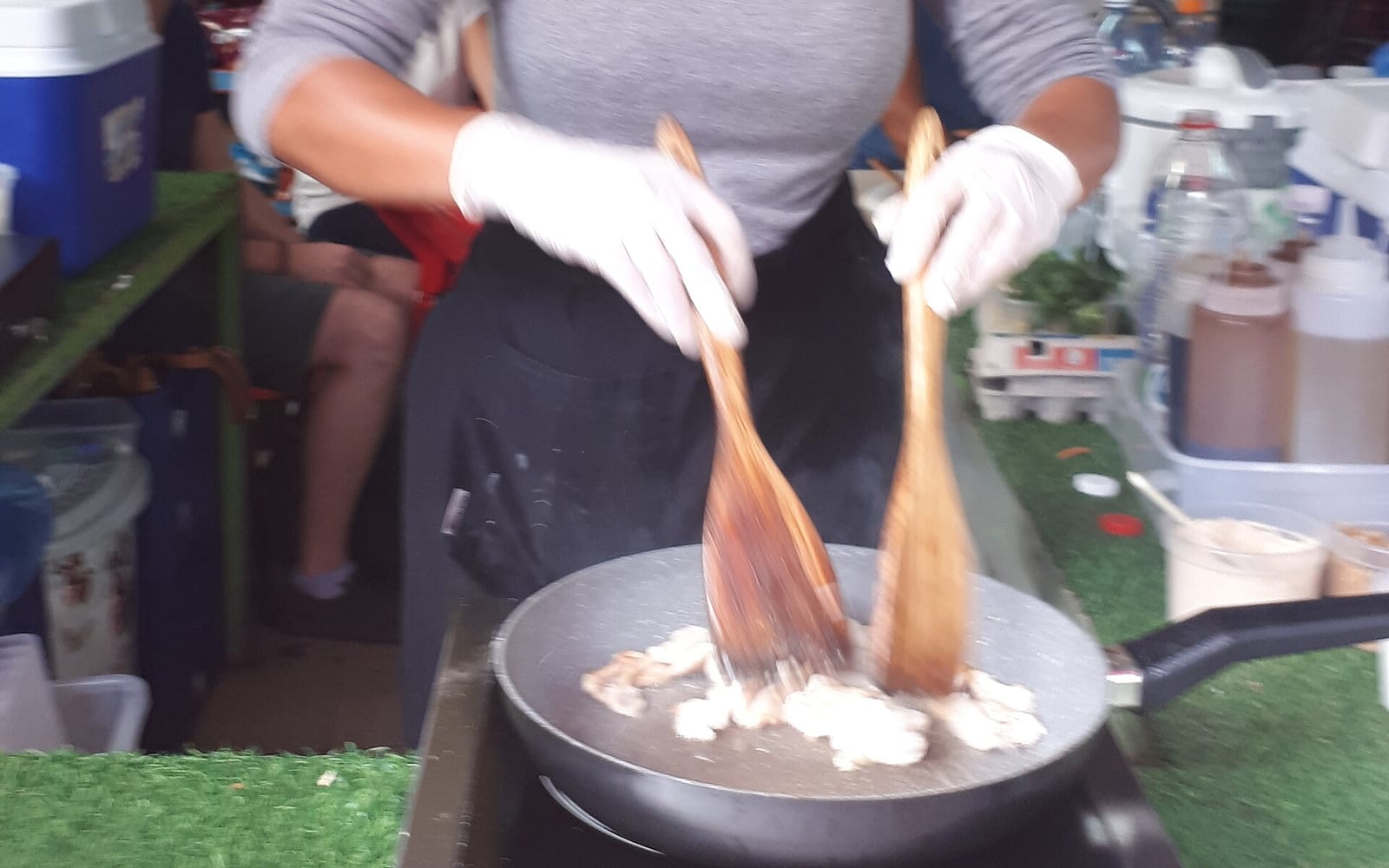
Jachnun is the centrepiece: a dense, caramelised rolled pastry made from laminated dough slow-baked in a sealed tin from Friday night through Saturday morning. It emerges dark, slightly sweet and intensely rich, and is served with grated fresh tomato, a hard-boiled egg and z’hug — the fiery green or red coriander-chilli sauce that cuts through the richness. Eating jachnun on a Saturday morning in Kerem HaTeimanim is one of the most specifically Tel Aviv things you can do.
Malawach is the everyday version: a thinner flaky flatbread pan-fried until crisp on the outside and layered within. It is eaten with honey for breakfast or with z’hug and grated tomato as a savoury dish. Faster to make than jachnun and available throughout the week in most Yemenite cafés.
Lachuch is a spongy, slightly fermented flatbread resembling a crumpet — honeycombed on top, cooked on one side only. It is eaten with honey or z’hug, or used to scoop up hilbe (fenugreek sauce). Less well known outside the neighbourhood but equally worth trying.
Kubbaneh is a dense, slightly sweet overnight bread baked in a sealed pot on a low flame — a Shabbat morning institution. It arrives at the table warm and is eaten torn by hand.
Hilbe (fenugreek paste thinned to a sauce with water and lemon) and merak (Yemenite lamb soup with turmeric and hawaiij spice blend) are the hot-dish staples. Merak is a proper meal; hilbe is a condiment and sauce eaten with everything.
Practical note: Yemenite restaurant hours in the neighbourhood are often irregular and primarily weekend-oriented, particularly for Saturday jachnun service. Several family-run venues have no online presence. Ask at your accommodation for the current recommended spot — names and hours shift over years, and a fresh local recommendation beats a guidebook listing.
The bar and café scene
HaKovshim Street and the lanes immediately south of the Carmel Market have a bar and café scene that grew up organically over the past decade. It is not a nightlife strip — more a collection of neighbourhood bars where you can sit on the street with a local craft beer or a glass of Israeli wine, with little fanfare and no tourist pricing.
The neighbourhood draws a mixed, creative crowd that includes a significant LGBTQ-friendly contingent, making it one of the more relaxed and welcoming bar areas in central Tel Aviv. The atmosphere is low-key by design; the venues are small. Thursday and Friday evenings are when the neighbourhood comes most alive.
This is distinct from the club scene further north around Florentin and the beach promenade — Kerem HaTeimanim’s nightlife is neighbourhood-scale, suited to a couple of hours with a drink rather than an all-night outing.
Combining with the Carmel Market
Kerem HaTeimanim and the Carmel Market are natural complements on the same morning. The Carmel Market entrance on Allenby Street is a three-minute walk from the heart of Kerem HaTeimanim. A logical sequence: arrive at the Carmel Market from the north for spices, pomegranate juice and burekas around 9–10am, then walk south into the Yemenite Quarter for malawach or lachuch at one of the neighbourhood cafés.
On Tuesdays and Fridays, the Nahalat Binyamin artisan market runs alongside Carmel Market on Nahalat Binyamin Street — Israeli designers selling ceramics, jewellery and handmade goods, directly connected to the Carmel Market’s southern section. The combination of all three in a half-day makes for one of the best mornings available in Tel Aviv.
Photography and community respect
The neighbourhood’s narrow lanes and whitewashed buildings are highly photogenic. A few notes: Kerem HaTeimanim is a residential community where people live and work, not a set piece. Photographing individuals, particularly in their doorways or at personal moments, requires sensitivity and preferably permission. Street scenes and architecture are straightforwardly public; private moments and family gatherings are not. The neighbourhood’s character has survived precisely because it has not been entirely touristed — treat it accordingly.
Location: Bounded by Allenby Street (north), HaArzot Street (east), Har Tsiyon Boulevard (south), and Yigal Alon Street (west). The heart of the neighbourhood is the grid of lanes around HaKovshim Street.
Getting there: 15–20 minutes walk south of Dizengoff Square; immediately southwest of the Carmel Market south entrance. Tel Aviv Red Line light rail stops at the Carmel Market area. Rideshare (Gett, Yango) from anywhere in central Tel Aviv in under ten minutes.
When to visit: Saturday morning for Yemenite breakfast (jachnun, malawach — arrive 9–11am). Thursday/Friday evenings for the bar scene. Any morning combined with the adjacent Carmel Market.
Payment: Cash strongly preferred at Yemenite food venues. Cards accepted at most bars and cafés.
Accessibility: The neighbourhood lanes are mostly flat, though some are narrow and the paving is uneven in older sections.
Plan your visit
For the broader Tel Aviv eating picture, see the Tel Aviv food guide. The Israeli street food guide covers falafel, sabich and shawarma across all cities. The Carmel Market guide is the natural pairing for the same morning. The Tel Aviv neighbourhoods guide covers the character of Florentin, Neve Tzedek, the Port area and other districts.
For evening plans after the neighbourhood: the Tel Aviv nightlife guide covers bars, clubs and the beach scene. The LGBTQ travel guide covers Tel Aviv as an LGBTQ destination in full.