Israel is one of the most rewarding and genuinely surprising countries to travel — but several practical realities catch first-timers off guard. This guide covers the 20 most useful things to know before you arrive: the small logistics that make a real difference, the cultural norms that matter, and the common mistakes that waste time or money.
For the step-by-step trip-planning framework (when to go, how long to stay, sample routes), see First Time in Israel. This guide is the companion piece: practical tips you want to have absorbed before day one.
Entry and documents
1. Get your ETA-IL before you fly
Since January 2025, most visa-exempt travellers (US, UK, EU, Canada, Australia and many others) must obtain an ETA-IL (Electronic Travel Authorisation) before boarding a flight to Israel. It is applied for online via the Israeli PIBA portal, costs approximately ₪25, and requires at least 72 hours for processing — do not leave it to the day before departure.
The ETA-IL is not the same as a visa — citizens who previously flew to Israel without any advance authorisation now need this step. Airlines may deny boarding without a valid ETA-IL. Check your nationality’s exact requirements at visa-information.gov.il before booking, then use our visa and ETA-IL guide for a step-by-step application walkthrough.
2. Arrive through Ben Gurion if stamp history matters to you
Israel has not passport-stamped since 2013 — you receive a biometric entry card instead, not a stamp in your passport. This resolves the historic “Israel stamp” problem for onward travel to certain countries. Entering via the King Hussein Bridge (Jordan) or Taba (Egypt) crossings leaves different border records, though Israel’s side still issues the entry card rather than a stamp. If this matters for your onward travel plans, entering via Ben Gurion Airport is the cleanest option.
3. Health insurance and travel insurance are recommended
Israel’s private healthcare is excellent and expensive. Your home country’s national health scheme almost certainly does not cover international emergency treatment. Comprehensive travel insurance covering medical evacuation is strongly recommended. See our Israel travel insurance guide for what to look for in a policy. EHIC cards are not recognised in Israel.
Money and connectivity
4. ATM withdrawals beat airport currency exchange — always
The airport currency exchange desks at Ben Gurion offer poor rates. Bank ATMs (Bank Leumi, Bank Hapoalim, Bank Discount) give the interbank exchange rate minus a small fee — typically the best available. One practical note: Israeli ATMs require a 4-digit PIN. If your card has a longer PIN, request a temporary 4-digit PIN from your bank before travelling.
When an Israeli ATM or card terminal offers to charge you in your home currency (“dynamic currency conversion”), always decline and choose to pay in NIS. The conversion rate offered is typically 5–8% worse than your card’s own rate.
5. Cards are accepted nearly everywhere
Israel is a very cashless society by regional standards. Debit and credit cards work at almost all shops, restaurants, hotels, taxis, and even many market stalls. Keep some cash (₪200–400) for the Arab market sections of Jerusalem’s Old City, some Machane Yehuda vendors and tips. Markets like Nahalat Binyamin and Carmel Market in Tel Aviv are increasingly card-friendly, but cash still helps at the smaller stalls.
Israeli mobile data is cheap by European or North American standards. Buying a local SIM at the airport (all three main operators — Cellcom, Hot Mobile, Partner — have desks in the arrivals hall) gives you fast data and a local number for the equivalent of $5–15 for a 30-day plan. An eSIM downloaded before departure is even easier — see our Israel eSIM guide for provider comparisons and activation steps. Do not rely on your home roaming plan for a whole trip; the cost difference is significant.
The Shabbat reality
7. Shabbat shuts down public transport — plan around it
From approximately sunset Friday to 40 minutes after sunset Saturday, intercity trains stop and most urban bus lines in Jewish cities cease. This means:
- Friday afternoon: Avoid scheduling any journey requiring trains or buses after about 3:00pm — the exact shutoff time varies by season and is earlier in winter.
- Shabbat Saturday: Sherut (shared taxis) and Arab bus lines continue running. Taxis (white Nesher-style or app-based Gett) are available but prices surge on Shabbat.
- Saturday night: By 8:00pm most Saturday nights, public transport resumes.
A common mistake is booking a Friday evening train from Tel Aviv to Jerusalem. It simply will not run if Shabbat has started. Check the Israel Railways timetable and the Rav-Kav app for that week’s exact shutoff time.
8. Jerusalem’s Old City operates differently from Tel Aviv on Shabbat
Tel Aviv is largely secular and remarkably lively on Friday night and Saturday. The beaches fill with locals, restaurants in Florentin and the port area are packed, and the nightlife is in full swing.
Jerusalem’s Jewish Quarter and most of the Jewish city centre closes almost entirely. However: the Muslim Quarter and Christian Quarter of the Old City are open on Shabbat, as are Arab restaurants in East Jerusalem, and the Church of the Holy Sepulchre. Saturday is actually a busy day for Christian and Muslim visitors to the Old City. Plan your Jerusalem Shabbat around the Arab and Christian sections, or accept a very quiet day in the Jewish areas — which can be its own atmospheric experience.
Religious sites and dress code
9. Pack a scarf or shawl that you can wear over your shoulders
The single most useful item for Israeli religious tourism is a light fabric scarf or shawl that takes up almost no bag space but solves the dress code requirement at every religious site across all faiths. Both men and women should have shoulders covered and knees covered at: the Western Wall, the Church of the Holy Sepulchre, the Dome of the Rock plaza, mosques in Akko and Nazareth, and church interiors throughout Nazareth, Bethlehem and Jerusalem.
At the Western Wall, disposable cardboard kippot (skullcaps) are provided free at the men’s section entrance. Women’s arms need to be covered; wraps are available at the entrance if needed.
For the full breakdown by site and faith, see our holy sites dress code guide.
10. Temple Mount / Haram al-Sharif has restricted access hours for non-Muslims
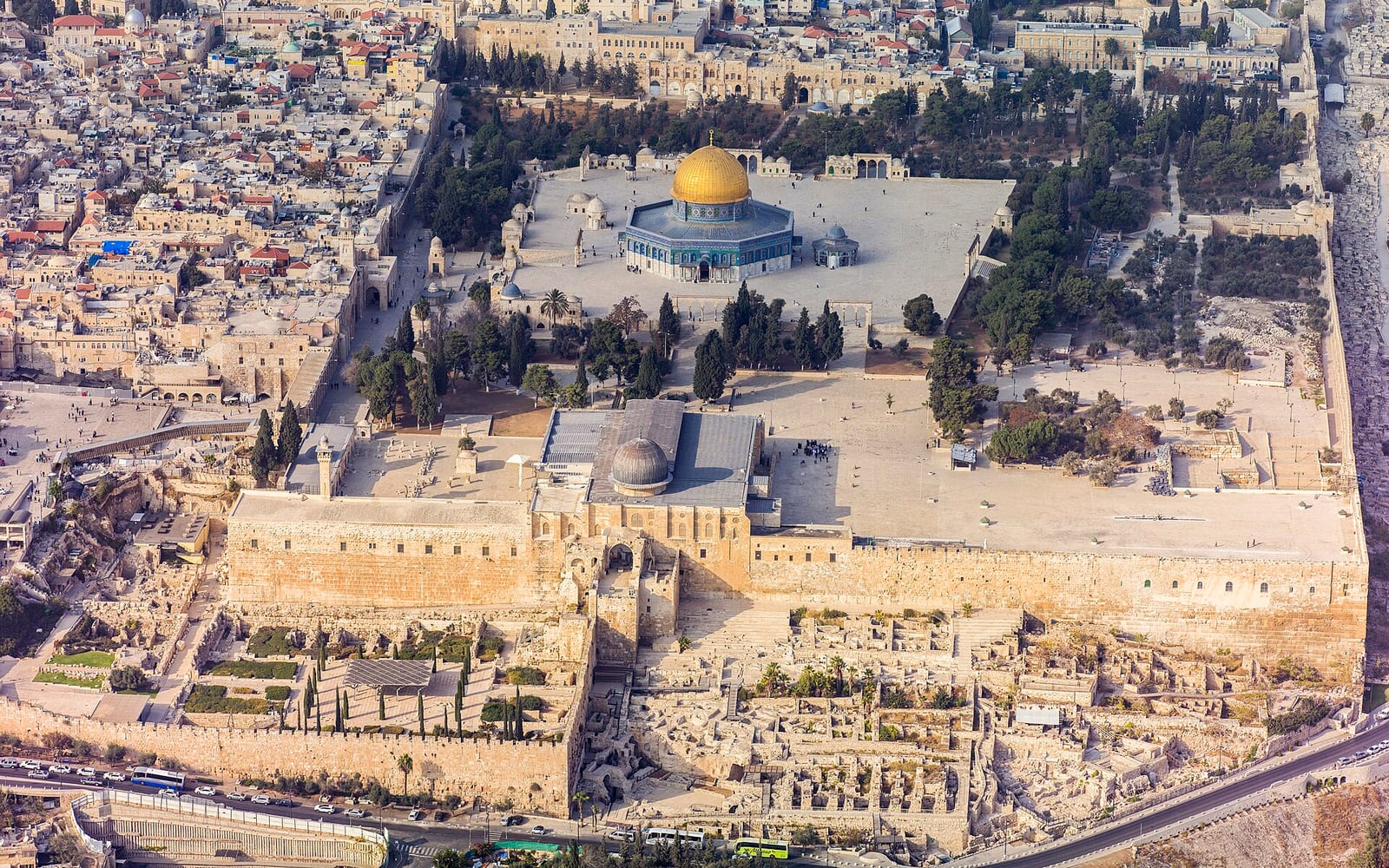
The Temple Mount (Haram al-Sharif) — the hilltop platform above the Western Wall containing the Dome of the Rock and Al-Aqsa Mosque — is controlled by the Jordanian Islamic Waqf. Non-Muslim visitors may access the plaza (not the mosque interiors) only through the Mughrabi Gate during limited weekday hours (typically 7:30–11:00am and 1:30–2:30pm, Sunday–Thursday, closed Friday and Saturday). These hours change frequently, close on Muslim holidays, and are sometimes suspended for security reasons.
Do not plan your entire Jerusalem morning around Temple Mount access — closures happen with no notice. Go early, treat it as a possible bonus, and have the Western Wall as your anchor. The Jerusalem Old City walking tour guide covers how to sequence your morning accordingly.
11. Haggling is expected in the Old City bazaar — but not in shops
In the souks of Jerusalem’s Muslim Quarter (the covered market between Damascus Gate and the Church of the Holy Sepulchre), bargaining is the cultural norm. Starting at 40–50% of the first quoted price and working toward 60–70% is a reasonable approach. A calm, friendly negotiation is welcomed. Vendors will not be offended by a reasonable counter-offer or by walking away.
However, in modern Israeli shops — supermarkets, pharmacies, clothing stores, even most souvenir shops outside the bazaar lanes — prices are fixed and haggling is not appropriate. The distinction is physically obvious: once you leave the arched bazaar lanes and enter a proper shopfront, the price is the price.
Transport practicalities
12. The Rav-Kav card is the most convenient way to pay for public transport
The Rav-Kav is Israel’s nationwide reloadable transit card, equivalent to London’s Oyster or New York’s MetroCard. It works on city buses, intercity buses, the Tel Aviv light rail and metro lines (where operational), and Israel Railways trains. Load credit at the airport or at any post office or train station service point. A loaded Rav-Kav costs less per journey than cash payment on most networks. If you are planning more than 2–3 days of public transit use, the Rav-Kav saves meaningful money and avoids fumbling with exact change. Full details in our transportation guide.
13. Never take your rental car into the West Bank — read the rental agreement
Rental car agreements in Israel explicitly exclude insurance coverage in Areas A and B of the Palestinian Authority. Even a brief shortcut through a West Bank checkpoint voids your cover. The practical implication: if visiting Bethlehem, travel by tour, taxi or Jerusalem Light Rail + bus combination. The Al-Walaja scenic road and Route 60 south of Jerusalem are the areas most tempting to drive on a map but risky for rental cars in terms of insurance. See our car rental guide for the specific exclusion language and how to visit Bethlehem without your rental car.
14. Intercity driving is fast but airport traffic is not
Israel is a tiny country — Tel Aviv to Jerusalem is 60 km, Tel Aviv to Haifa is 90 km — and highway driving is fast and well-signed. However, the road toward Ben Gurion Airport during morning and evening peaks (7:30–9:30am, 4:30–7:00pm) can be significantly congested on the Ayalon Highway. Allow extra time if catching a morning or late-afternoon departure. Use Waze rather than Google Maps for live Israeli traffic — it is the dominant navigation app in Israel and has the best real-time data. For transport planning between specific cities, see our Israel travel time guide.
Health, food and culture
15. Tap water is safe everywhere in Israel
Drink the tap water. Israel’s water supply is desalinated seawater that meets European Union drinking standards throughout the country. Buying bottled water for safety reasons is unnecessary and adds significant cost over a week’s travel. Carry a refillable bottle — it saves money and reduces plastic. Exception: in the West Bank (Bethlehem, Jericho, if you visit independently), stick to bottled water as the water infrastructure varies.
16. Kosher law affects restaurants significantly
In observant Jewish areas (particularly central Jerusalem, Bnei Brak, and many neighbourhoods outside Tel Aviv), kosher law shapes the restaurant landscape:
- Milk and meat are never mixed. You will not find a cheeseburger or butter sauce on a steak at a kosher restaurant.
- Restaurants close on Shabbat and Jewish holidays. This is particularly significant in Jerusalem — on Friday evening, most Jewish-owned restaurants close early. The Arab Quarter, Christian Quarter and some hotel restaurants remain open.
- Shabbat kitchen rules mean no hot meals are cooked during Shabbat at many establishments — hotels have Shabbat-compliant hot trolleys, but the cooking is done before sunset.
- In Tel Aviv and tourist areas, many restaurants are non-kosher and operate freely. Arab and non-Jewish-owned restaurants are unaffected by kashrut and operate normally throughout Shabbat and holidays.
For dining guidance by city and context, see our Israeli food and cuisine guide.
17. Israeli addresses are not always precise — plan meeting points carefully
Directions in older Israeli cities (and virtually all of Jerusalem’s Old City) rely more on landmark navigation than precise street numbers. “The gate next to the blue door” or “50 metres past the spice market” is more reliable than a street number in the Muslim Quarter. Download offline maps in advance, and for meeting guides or drivers, identify a named landmark rather than an address.
18. The Israeli greeting culture is assertive — do not mistake it for rudeness
Israelis are famously direct: queue-pushing, honest-to-bluntness feedback, and loud, overlapping conversation are normal. This cultural directness — sometimes called “chutzpah” — is not hostility. A shopkeeper who ignores you for 30 seconds is not being rude; someone who answers your question with a dismissive one-liner genuinely means it helpfully. First-timers sometimes mistake Israeli directness for aggression. The same person who seems abrupt about a wrong-turn question will often spend 20 minutes giving you an unsolicited detailed restaurant recommendation immediately after.
Common mistakes to avoid
19. Do not underestimate August in Jerusalem
August in Jerusalem is hot — typically 28–32°C in the Old City’s stone corridors — and Jewish holiday crowds have not started yet, so it is not the most chaotic time, but the combination of heat and summer tourist peak (European and American family holidays) makes it the most crowded and expensive month. The same applies to the Dead Sea in summer: the water temperature makes floating pleasant, but midday temperatures in the 40°C range make the beach unpleasant without shade. Spring and autumn are dramatically more comfortable. See our best time to visit Israel guide for the seasonal breakdown.
20. Do not skip Jaffa on a Tel Aviv trip
Tel Aviv and Jaffa are a single continuous city, but Jaffa — the ancient port — is a 20-minute walk or short Gett ride south along the waterfront. Travellers who keep their Tel Aviv day in the Bauhaus White City and beaches miss one of the most atmospheric spots in the country: Ottoman-era alleyways, a port where Jonah allegedly embarked, gallery-filled galleries on the hilltop flea market, Arab-Israeli fusion restaurants, and a sunset view back over the Tel Aviv skyline. It adds two hours to a Tel Aviv day and is free to explore. Our Jaffa travel guide has the walking-route detail.
Quick reference
| Practical fact | Answer |
|---|
| Tap water | Safe to drink throughout Israel |
| ETA-IL | Required for most visa-exempt travellers since Jan 2025 |
| Currency | Israeli new shekel (NIS / ₪) |
| Electricity | 220V / Type H plug (3-prong triangular). Adaptors needed for US/UK devices. |
| Tipping | Expected in restaurants: 10–15%. Taxis: round up. Hotels: bell staff ₪10–20 per bag. Full tipping guide at currency & tipping tool |
| Emergency number | 100 (police), 101 (ambulance), 102 (fire) |
| Language | Hebrew (official), Arabic (official), English (widely spoken at tourist destinations) |
| Shabbat (2026) | Begins Friday at sunset; ends Saturday after dark. Public transport mostly suspended. |
| Public holidays | Passover, Rosh Hashanah, Yom Kippur, Sukkot, Hanukkah, Purim — most affect shop/restaurant hours. |
Where to go next