The Golan Heights is a basalt plateau in the far north of Israel, rising from the Jordan Valley and Sea of Galilee to a volcanic high country of craters, springs, waterfalls, and ancient fortresses. It is one of the least-visited and most rewarding corners of the country — particularly in spring, when the entire plateau is carpeted in wildflowers and the trails are at their best.
Wineries, hiking, Druze culture, and a panoramic viewpoint over Syria, Lebanon, and the Sea of Galilee in a single afternoon: the Golan Heights repays a full day and justifies a two-night stay.
Top attractions in the Golan Heights
Mount Bental
Mount Bental (1,165 m) is the most visited site in the Golan Heights, and rightfully so. A dormant volcanic crater at the summit has been converted into an observation platform with one of the most striking views in Israel: on a clear day you can see the Syrian city of Quneitra directly below (in the UN buffer zone), Lebanon’s Mount Hermon to the north, the Sea of Galilee to the south, and the Jordan Valley and Jordanian mountains beyond.
The summit holds preserved Syrian bunkers and military fortifications from the 1967 and 1973 wars, with signposted explanations in English. The adjacent Coffee Anan café (a pun on Kofi Annan and the Arabic word for clouds) is a well-known stop for coffee above the clouds.
Mount Bental is an easy walk — a short paved path from the car park to the observation platform takes 10–15 minutes. From the summit, the Avital Trail connects to the neighbouring extinct volcano Mount Avital for a 2–3 hour circuit with excellent 360-degree views.
The valley immediately east of Mount Bental is Emek HaBacha — the Valley of Tears — where one of the most decisive tank battles of the 1973 Yom Kippur War was fought. An outdoor museum of Syrian and Israeli tanks preserved in situ sits 7km from the summit. See the full Valley of Tears guide for the battle history, site details, and visit planning.
Banias Nature Reserve
The Banias (Caesarea Philippi) is one of the most atmospheric sites in northern Israel — a place where nature, ancient history, and religious significance converge at the headwaters of the Jordan River. A large spring emerges from a cliff face near a cave sanctuary dedicated to the Greek god Pan (hence the name Banias, from Panias), and the ancient remains of Philip’s city — Herod’s son who rebuilt it as Caesarea Philippi — spread across the adjacent terrace.
The nature reserve (managed by the Israel Nature and Parks Authority) has two main walking circuits:
- Upper trail (2.5 km, 1.5 hours): passes the Pan grotto, the Herodian palace ruins, and the spring — the most historically significant route.
- Waterfall trail (3.5 km, 2 hours): follows the Hermon Stream (Banias River) downstream to the Banias Waterfall — one of the largest and most photogenic waterfalls in Israel. This is the better walking circuit for scenery.
Both trails are suitable for families with children. The reserve is busiest on weekends and Israeli holidays; an early start on a weekday is much calmer. The INPA National Parks Pass is valid here — see our Israel National Parks Pass guide.
Our full Banias visitor guide covers the site in depth, including entrance fees, opening hours, and the best route for limited time.
Nimrod Fortress
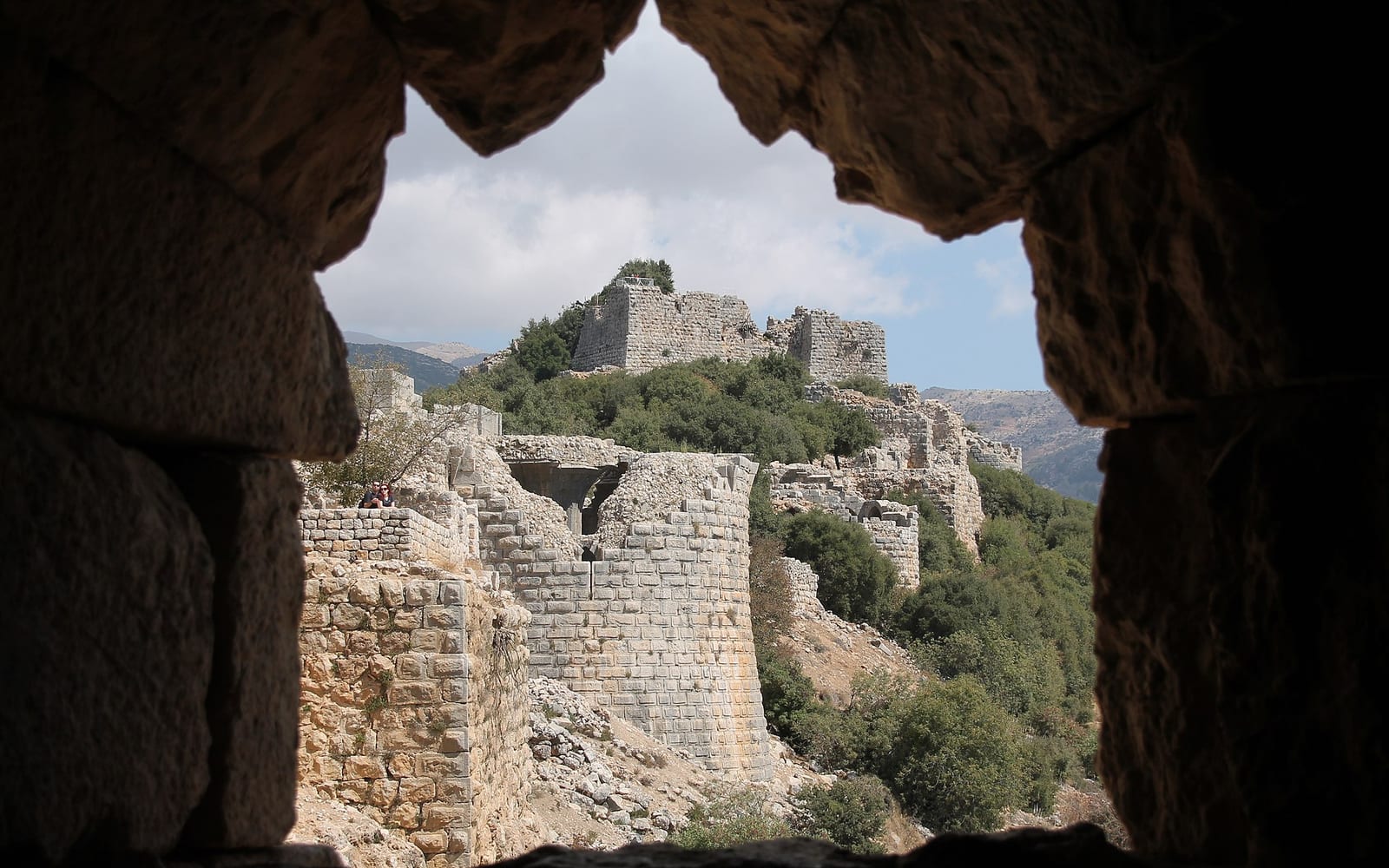
Nimrod Fortress (Qal’at Nimrod) is a 13th-century Ayyubid and Mamluk castle perched on a basalt ridge at the foot of Mount Hermon, commanding a strategic position above the Banias valley and the route to Damascus. It is the largest medieval fortress in Israel — 420 metres of outer walls, 21 towers, and a keep with panoramic views across the Hula Valley and into Lebanon.
Built in 1229 CE by the Ayyubid ruler Al-Aziz Uthman (not the Crusaders — a common misconception), and substantially reinforced by the Mamluk sultan Baibars after 1260, the castle is an Ayyubid-Mamluk structure with a rare in-situ Arabic inscription from 1275 CE still visible near the western gate. A concealed 27-metre staircase passage descending inside the castle walls is one of the highlights of the circuit.
Allow 1.5–2.5 hours for a thorough visit. The fortress is covered by the INPA National Parks Pass and pairs naturally with Banias Nature Reserve 5 km southwest. See the full Nimrod Fortress visitor guide for the complete circuit, history, and how to combine it with Tel Dan and the Druze villages.
Druze villages
The Golan Heights has four Druze villages — Majdal Shams, Mas’ade, Buq’ata, and Ein Qiniyye — whose population holds Syrian citizenship and has largely maintained its Syrian identity since 1967. The villages are open to tourists and offer a genuine cultural experience that is distinct from any other part of Israel.
Majdal Shams is the largest and most accessible of the four, with a market street, Druze restaurants serving traditional food (mansaf, kibbeh, freshly baked pita with labneh), and the distinctive Druze hospitality culture. The town sits below the ski slopes of Mount Hermon and is the main base for winter visits.
The Shouting Hill (Har HaTze’akot) at Majdal Shams is a poignant site: during the Cold War-era separation of the Golan from Syria, families divided by the ceasefire line used amplified loudspeakers and later mobile phones to communicate across the buffer zone. Today it is a park with views into the buffer zone and a memorial to this period.
Golan Heights wineries
The Golan Heights has been producing wine since the 1970s and now accounts for a significant share of Israel’s premium wine production. The cool volcanic plateau, high elevation, and reliable spring rainfall create conditions for varieties that struggle in the hotter lowlands.
Golan Heights Winery in Katzrin is the largest and most visited producer. Its three labels — Yarden (premium), Gamla (mid-range), and Golan (entry) — are widely exported and the best introduction to Israeli wine. The visitor centre has guided tastings and a video tour of the winery.
Boutique producers worth seeking out:
- Pelter Winery near Ein Zivan — small production, strong red varietals, appointment recommended
- Bazelet HaGolan near Gamla — family-run, beautiful terrace views, known for Cabernet Sauvignon
- Odem Mountain Winery at the highest-elevation vineyards in Israel — terroir-driven, limited production
Winery visits are best combined with a spring or autumn trip; autumn coincides with the grape harvest (September–October). For a producer-by-producer breakdown, self-drive circuit routes, and booking tips, see the dedicated Golan Heights wineries guide.
Gamla Nature Reserve
Gamla (the Masada of the North) is a dramatic horseshoe-shaped ravine that was the site of a Jewish revolt against Rome in 67 CE, ending with the city’s destruction and the mass suicide of its inhabitants — a fate that preceded Masada by three years. The archaeological remains of the city are well-preserved and significant, and the site carries a powerful historical atmosphere.
Beyond the archaeology, Gamla is one of the best places in Israel to see Griffon vultures — a colony of over 200 birds nests on the cliffs of the ravine, and a dedicated observation platform gives close views of the nesting ledges. The Gamla waterfall at the bottom of the canyon is one of the tallest in Israel.
Allow 2.5–3 hours for the full circuit to the archaeological site and back. Covered by the INPA National Parks Pass. See the Gamla Nature Reserve guide for a full breakdown of the circuit, the vulture colony, and the waterfall.
Hamat Gader
Hamat Gader is a privately operated site at the far south of the Golan Heights, tucked into a basalt river gorge where the Yarmouk River marks the border with Jordan and Syria. Its combination of 42°C thermal mineral pools, the Middle East’s only crocodile farm (200+ Nile crocodiles; feeding shows on Fridays and Saturdays), and well-preserved Roman bath ruins makes it one of the most distinctive attractions in northern Israel.
Unlike Gamla, Banias and Nimrod Fortress, Hamat Gader is not covered by the INPA National Parks Pass — it operates independently with its own admission structure. The Roman thermae ruins here were among the largest bath complexes in the eastern Mediterranean, and a 5th-century synagogue with a mosaic floor is included on site. Around half a million visitors come annually, the majority Israeli — which says something about the site’s draw and explains why early arrival on weekends is advisable.
Hamat Gader is approximately 25 minutes south of Tiberias via Route 98; a car is essential as no public bus serves the gorge. It pairs naturally with a Golan day that starts at Gamla or the Sea of Galilee shore and exits south through the Jordan Valley. See the full Hamat Gader guide for practical information, show times and combined itinerary ideas.
Mount Hermon
Mount Hermon dominates the northern skyline of the Golan Heights. At 2,814 m at its peak (the accessible summit is at 2,224 m on the Israeli-administered section), it is the highest point reachable from Israel. In winter, the Hermon ski resort operates chairlifts, ski rental, and marked runs from the upper station.
Outside ski season, the cable car runs to the upper station for panoramic views over three countries. In summer, the mountain plateau has good hiking trails through unusual high-elevation terrain — cushion plants, snow patches in shaded hollows, and wildflowers not found at lower elevations.
The road to Hermon passes through Majdal Shams (see Druze villages above); combining a half-day at Hermon with lunch in the village is a natural pairing.
Hiking in the Golan Heights
The Golan Heights has excellent hiking through terrain that differs markedly from the rest of Israel — volcanic basalt, wide open views, and perennial streams even in summer.
| Trail | Difficulty | Duration | Highlights |
|---|
| Zavitan Canyon loop | Moderate | 3–4 hrs | Basalt columns, stream pools, hidden waterfall |
| Banias Waterfall trail | Easy | 2 hrs | Hermon Stream, waterfalls, ancient mill |
| Avital–Bental circuit | Easy–moderate | 2–3 hrs | Two volcanic craters, 360° views |
| Yehudiyye Forest loop | Moderate | 4–5 hrs | Mixed terrain, Yehudiyye waterfall, basalt landscape |
| Gamla circuit | Moderate | 2.5–3 hrs | Ruins, vulture colony, Gamla waterfall |
| Hamat Gader gorge trail | Easy | 1–2 hrs | Gorge, springs, Roman ruins (private site) |
The Israel National Trail passes through the Golan Heights, and multi-day sections from Katzrin north to Mount Hermon are among the most scenic on the entire trail. Spring (March–May) is the best time for trail hiking; streams are full and the wildflower display is at its peak.
A car rental is essential for reaching most trailheads. For detailed trail information — distances, difficulty grades, seasonal swimming, and the Hexagon Pool logistics — see the Golan Heights hiking trails guide. The Israel adventure sports guide covers jeep tours, rappelling, and more active Golan experiences.
Where to eat in the Golan Heights
Druze food is the standout culinary experience of the Golan Heights. In Majdal Shams and Buq’ata, restaurants serve traditional dishes — pita baked to order on an open fire, labneh drizzled with olive oil, kibbeh, mansaf (slow-cooked lamb with yoghurt sauce), and strong Arabic coffee. Prices are modest by Israeli standards. Lunch in a Druze village is a highlight of any Golan visit.
Katzrin has a range of cafes and restaurants; it is the main urban centre of the Golan and a practical lunch stop if you are dividing the day between southern and northern sites.
Winery restaurants — several wineries, including Golan Heights Winery, have attached restaurants or light-meal spaces. A winery lunch anchored around local produce and the plateau’s wine is a Golan institution.
Getting there by car — from Tel Aviv: Highway 2 north to Hadera, then Highway 65 east to Afula, then Highway 90 north along the Jordan Valley. Turn east at the Golan access roads toward Katzrin or the specific site you’re visiting. Allow 2.5–3 hours from Tel Aviv. From Jerusalem: Highway 1 west then north via Highway 6, connecting to Highway 65 or Highway 90 north — also about 2.5–3 hours.
Getting there by public transport — Trains and buses from Tel Aviv and Jerusalem serve Tiberias and Haifa. From Tiberias, bus routes (Kavim / Superbus) run to Katzrin on weekdays; the schedule is limited on Fridays and absent on Saturdays (Shabbat). Check moovit.com or the Rav-Kav app for current timetables. Without a car, a guided day trip is the most practical option for visitors based in Tel Aviv.
When to visit — Spring (March–May) for wildflowers and hiking; autumn (October–November) for harvest season and mild temperatures; winter (December–March) for ski season at Mount Hermon. Summer is warm but the elevation keeps it more bearable than lower-lying parts of Israel.
Where to stay — The Golan Heights has a strong zimmer culture — rural farm-stay B&Bs that typically include breakfast. Concentrations around Katzrin, the northern villages, and near Banias. Booking well ahead is essential for spring weekends and the ski season. Tiberias (30–45 minutes from most Golan sites) is an alternative base with more hotel options.
Shabbat — Almost all restaurants, shops, and attraction visitor centres in the Golan are closed on Shabbat (Friday afternoon through Saturday night), with the exception of Druze village restaurants, which typically remain open. The INPA nature reserves open normally on Shabbat and are often quieter than on weekdays. Plan food and petrol stops accordingly.
Combining the Golan Heights with nearby destinations
With the Galilee and Sea of Galilee — The Golan Heights overlooks the Sea of Galilee; combining a morning at the Golan with an afternoon in Tiberias, or vice versa, is a natural pairing. Our Nazareth and Sea of Galilee day trip guide covers the broader northern circuit.
With Galilee tours — If you want a guided overview of the north, see our Galilee tours comparison for vetted operators covering Galilee and Golan in a single itinerary.
Compare Golan tours — Day trip, jeep safari, wine trail or self-drive? Our Golan Heights tours compared guide breaks down every format with honest pricing guidance and tips on how to choose.
With hiking in Israel — The Golan is one of the top hiking regions in the country. Our hiking in Israel guide covers the best trails by difficulty and season.
With day trips from Tel Aviv — The Golan Heights is a long but manageable day trip from Tel Aviv by car (5+ hours driving total); most visitors combine it with an overnight in Tiberias or a Golan zimmer. See day trips from Tel Aviv.