Israel and Jordan together make one of the great travel combinations in the world. The two countries share a long land border, two open crossing points, and a density of historic, spiritual and natural attractions that few regions on earth match. This 10-day itinerary threads the highlights into a logical route: beginning in Jerusalem, passing the Dead Sea and Masada on the way south, crossing into Jordan at Eilat, then working northward through Petra, Wadi Rum and Amman before returning to Israel via the Allenby Bridge.
If you are only looking for a single-day Petra excursion from Israel, see our Petra from Israel guide and the Petra from Eilat vs Amman comparison instead. For a focused 2- or 3-day Petra and Wadi Rum trip from Eilat without the full 10-day itinerary, see our Petra & Wadi Rum from Eilat guide. This itinerary is for travellers who want to give both countries proper time.
At a glance
| Details |
|---|
| Total duration | 10 days / 9 nights |
| Best season | March–May or September–November (mild, manageable heat) |
| Entry crossings | Fly into Tel Aviv (Ben Gurion); southbound land crossing Eilat → Aqaba; northbound Allenby Bridge (Amman → Jericho) |
| Driving | Israeli rental car south to Eilat; Jordan-side car hire or organised transfers |
| Jordan visa | Jordan Pass (buy online before crossing) or visa on arrival |
| Rough budget | Budget: ~$150–220/day/person; Mid-range: ~$280–420/day/person |
| Key considerations | Shabbat timing; border fees ($30–65 per side); Jordan Pass saves money if visiting 3+ sites |
Day 1–3: Jerusalem
Fly into Ben Gurion Airport and head straight to Jerusalem — about 50 minutes by train or shuttle. Three days here is the minimum that does the city justice.
Day 1 — Old City foundations. Walk the Jerusalem Old City: the Jewish Quarter and the Western Wall (lower plaza by day, more atmospheric at night), the Via Dolorosa through the Muslim Quarter to the Church of the Holy Sepulchre, and the Armenian Quarter on the return loop. Lunch in the Muslim Quarter markets. Evening at Mahane Yehuda — the market transforms from a food bazaar into a bar and restaurant strip after dark.
Day 2 — Mount of Olives and Yad Vashem. Start early at the Mount of Olives viewpoint for the iconic Jerusalem skyline. Walk down through the Garden of Gethsemane and the Church of All Nations to the Kidron Valley. Afternoon at Yad Vashem — allow three hours minimum. The Israel Museum or the Tower of David Night Spectacular make strong evening options.
Day 3 — Day trip to Bethlehem. A morning trip to Bethlehem (30 minutes from Jerusalem’s Damascus Gate area by shared taxi) covers the Church of the Nativity — the oldest continuously active Christian church in the world — Manger Square and the Milk Grotto. Return by early afternoon for final Jerusalem wandering: the Jewish Quarter’s Burnt House and Cardo, or the Ramparts Walk above the Old City walls.
For Jerusalem food recommendations, neighbourhood orientation and more on the sites, see the linked guides.
Day 4: Dead Sea
A Dead Sea day fits naturally between Jerusalem and the south. From Jerusalem it is about 90 minutes on Route 1 east then Route 90 south to Kalia Beach (northernmost public beach) or Ein Bokek (resort strip, 45 minutes further south). If you are staying overnight at Ein Bokek — the recommended approach — you have a sunset float and access to hotel spa facilities in the evening.
Essentials for the Dead Sea: bring an old swimsuit (salt bleaches), water shoes (the shoreline is sharp salt crystals), fresh water to rinse immediately if sea water reaches your eyes, and SPF 50+. Do not shave the same day. The recommended maximum float is 15–20 minutes. Mineral mud is naturally present in shallow areas and at vendor stalls on the beach; slather, wait 15 minutes, rinse.
The Dead Sea is shrinking roughly one metre per year — the visible salt crystal formations on the exposed shore are an ongoing environmental story. Frame your visit accordingly.
For hotel recommendations at the Dead Sea, see our Dead Sea hotels guide.
Day 5: Masada + Travel to Eilat
Masada sunrise is the classic way to end the Dead Sea section. The cable car runs from around 8am; hikers on the Snake Path should leave the base before 5:30am. The site — Herod the Great’s desert palace turned Zealot fortress — rewards an hour on the summit before the crowds and heat build. From Masada, it is a roughly 2.5-hour drive south to Eilat.
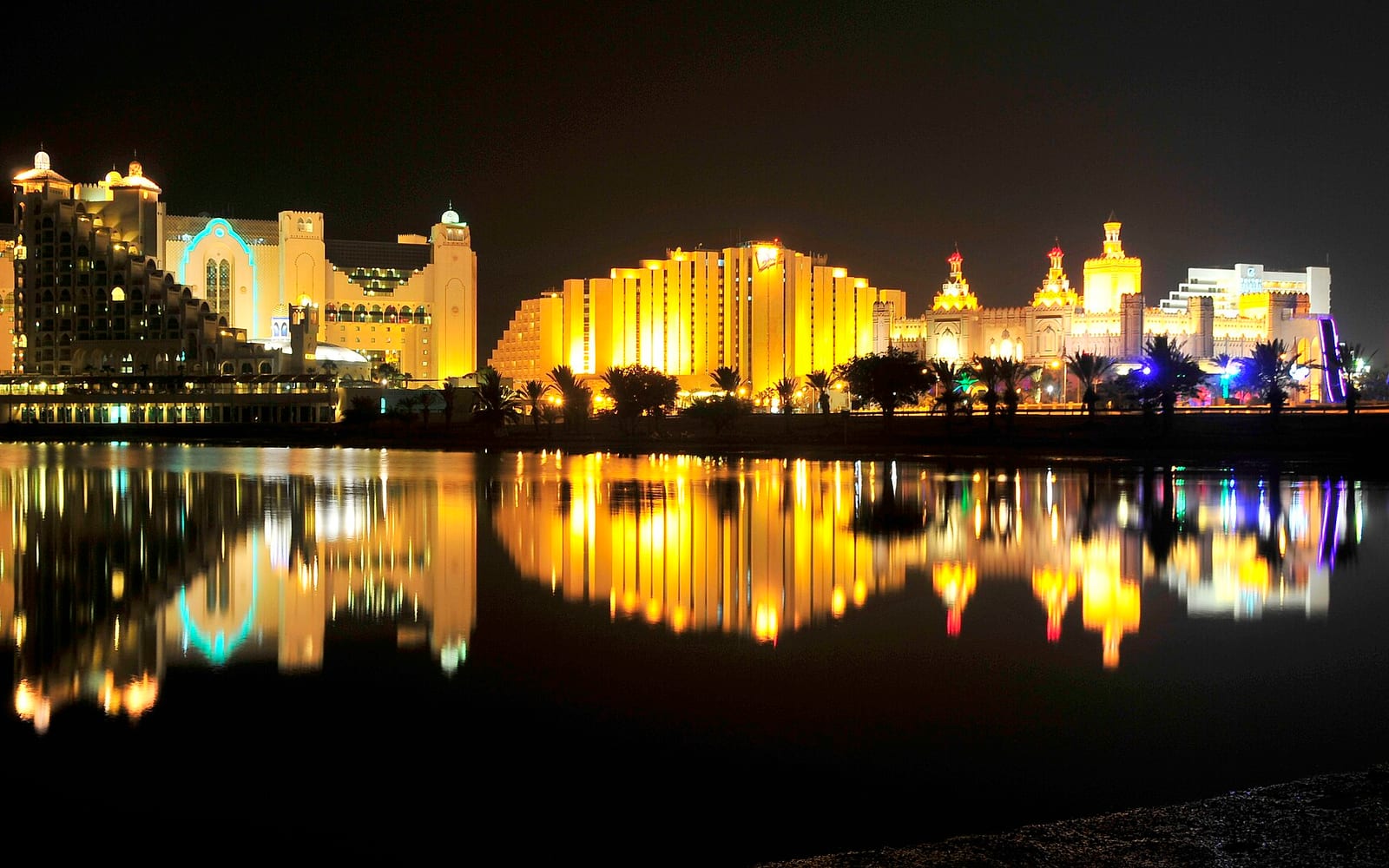
Eilat is Israel’s Red Sea resort city: tax-free shopping (no VAT = 17% savings on electronics, cosmetics, alcohol), year-round warm water, and 15 minutes from the Jordanian border. Spend the afternoon at the Coral Beach Nature Reserve (protected reef, snorkel-friendly, entrance ~₪40 adult) or decompress before tomorrow’s crossing.
Day 6: Cross into Jordan — Eilat → Aqaba → Petra
The border: the Yitzhak Rabin/Wadi Araba crossing between Eilat and the Jordanian city of Aqaba is the most straightforward crossing between the two countries. It is open daily and typically processes tourist crossings in 45–90 minutes (longer on busy weekends). Walk or take a taxi from Eilat city centre to the terminal; cross on foot; collect your Jordan entry stamp and arrange onward transport in Aqaba. Budget for Israeli exit and Jordanian entry fees at the border (roughly $30–65 total per person for both sides).
Jordan Pass: if you purchased the Jordan Pass online (strongly recommended — it bundles the Jordanian visa fee with free entry to Petra and 40+ other sites), present it at the Jordanian immigration desk and you will not pay the visa fee separately. The pass must be activated before you cross.
Aqaba to Petra: approximately 130 km north on the Desert Highway, two to two-and-a-half hours by taxi or private transfer. Pre-book a driver from Aqaba if possible; alternatives include shared taxis or connecting via Wadi Rum. Check into your Petra hotel or guesthouse by early evening to be rested for tomorrow.
Day 7: Petra — A Full Day
Allow the entire day at Petra — this is the world’s most spectacular archaeological city and it rewards unhurried attention.
Must-see with a day: the Siq (1.2 km gorge entrance), the Treasury (Al-Khazneh), the Street of Facades, the Theatre, the Colonnaded Street, the Great Temple and the Qasr al-Bint (main temple to the gods). These fill half a day.
If time allows: the High Place of Sacrifice (45-minute hike up, sweeping views), the Royal Tombs on the eastern cliff face, and the Byzantine Church with its mosaic floors. For the Monastery (Al-Deir) — Petra’s largest monument — you need either a very early start or a second day; it is an 800-step climb from the Basin and takes the better part of a morning.
Practical notes: the site is large (26 km² of walking territory) — wear comfortable shoes and carry water. Entrance is included in the Jordan Pass. Horses are offered for the first 600 metres to the Siq entrance; they are optional and not necessary. Refuse to pay for unsolicited guiding services; instead, hire accredited guides at the gate if you want in-depth context.
Day 8: Wadi Rum
From Petra, Wadi Rum is about 1.5–2 hours south — the dramatic red sand desert of enormous sandstone monoliths and ancient rock inscriptions, a UNESCO World Heritage Site and the filming location for numerous desert sequences in major films.
A standard four-hour jeep tour covers the main sites: Lawrence’s Spring, the Khazali Canyon inscriptions, the sand dune, the Um Fruth rock bridge. Sunset jeep rides are popular.
Overnight in a Bedouin camp is one of the most memorable experiences in the region — sleeping under an astonishing sky with minimal light pollution. Camps range from basic to “glamping” tented lodges. Book ahead in peak season (March–May, October–November). Morning hot air balloon rides are available if arranged in advance.
Day 9: Wadi Rum → Amman
From Wadi Rum, head north to Amman — around 3.5–4 hours by road. The route passes Petra town (bypass or detour for anything missed yesterday) and runs through central Jordan.
Amman is a modern Arab capital built across seven hills, with a mix of ancient and contemporary worth at least one evening. The Roman Amphitheatre in downtown (built 2nd century CE; still used for events) is a five-minute walk from the Citadel Hill, which holds the Temple of Hercules columns and a small archaeological museum. The Rainbow Street area is the most visitor-friendly stretch for coffee, restaurants and bars.
Stay centrally (downtown, Jabal Amman or Abdali area) for easy access to both the Allenby Bridge tomorrow and the Jerash day-trip option in the morning.
Day 10: Jerash → Allenby Bridge → Return to Israel
Jerash in the morning: the Roman Decapolis city of Jerash, 48 km north of Amman, is one of the best-preserved Roman provincial cities in the world — Hadrian’s Arch, the Oval Plaza, two theatres, the Temple of Artemis and the Cardo Maximus colonnade all intact. Allow 2–3 hours. Gerasa/Jerash is straightforward to reach from Amman by taxi or minibus.
The Allenby Bridge (King Hussein Bridge): the crossing between Amman and the Palestinian Authority/Israeli territory near Jericho. Allow more time here than for Wadi Araba — queues can extend to 2–3 hours, especially on Sunday mornings. The crossing is managed jointly; your baggage will be screened. Arrive by noon at the latest if you plan to reach Jerusalem or Tel Aviv the same evening.
On the Israeli side, shared taxis (sheruts) run from the crossing to Jerusalem (30–45 minutes). From Jerusalem, Ben Gurion Airport is 45–60 minutes by train or shuttle.
Border-crossing checklist
| Wadi Araba (Day 6, southbound) | Allenby Bridge (Day 10, northbound) |
|---|
| Open | Daily, typically 6:30am–8pm | Daily (limited on Jewish/Muslim holidays) |
| Processing time | 45–90 min | 1.5–3 hrs (allow more) |
| Jordan Pass accepted | Yes — show at Jordanian immigration | Jordan exit stamp only |
| Israeli passport stamp | No (removable slip) | Minimal stamp visibility |
| Exit fees | Both sides charge; budget $30–65 total | Both sides charge; budget similar |
| Shabbat operation | Open (most reliable Shabbat crossing) | Limited — verify before Saturday crossing |
Dual-stamp considerations
Jordan does not stamp your Israeli entry slip in your passport; it stamps the passport itself with a Jordanian entry stamp. If your onward travel plans include countries that restrict entry to passport holders with Israeli stamps, research your specific situation before travelling. The Jordan stamp itself is not the issue for most travellers — it is the Israeli stamps that some countries restrict. Both the Wadi Araba and Allenby crossings now minimise Israeli stamps in your passport for tourists crossing for Jordan visits.
Practical tips
Transport in Jordan: Israeli rental cars cannot cross the border. Arrange Jordan-side transport as: (a) a pre-booked private driver from Aqaba for the Jordan section; (b) rental car from a Jordanian company in Aqaba; or (c) an organised Israel–Jordan tour that handles all logistics. Buses exist between Aqaba, Petra and Amman but are slow and infrequent for tourists.
Budget planning: allocate separately for border fees ($30–65 per crossing per side), Jordan Pass (JD 70–100 depending on type), Petra entry (included in Jordan Pass), and Wadi Rum jeep/camp (~JD 25–100 depending on duration and camp tier). Eating and accommodation in Jordan is generally less expensive than in Israel.
Shabbat timing: if you arrive on a Friday, be aware that Israeli transport shuts down from Friday afternoon to Saturday night. Plan the Eilat-to-border drive for Friday morning (not Friday afternoon). The Wadi Araba crossing itself is open on Shabbat; the Allenby Bridge has limited Saturday operation.
When to go: March to May and September to November offer the most comfortable temperatures for both countries. July–August is very hot in Petra (35°C+) and extremely hot in Wadi Rum and Eilat (40°C+); the Dead Sea is manageable in summer only very early morning. December–February can be cold in Jerusalem and occasionally rainy in Jordan.
For a single-day Petra visit from Eilat rather than this full itinerary, see our Petra from Israel guide. For the question of whether to approach from Eilat or from Amman, see Petra from Eilat vs Amman. For Eilat itself, see the Eilat travel guide. Still deciding between Israel and Jordan as your main destination? See the Israel vs Jordan comparison guide. Want to add Egypt — the Pyramids, Sinai coast and Cairo — to your Israel and Jordan trip? See our Egypt, Jordan & Israel 3-country itinerary guide.