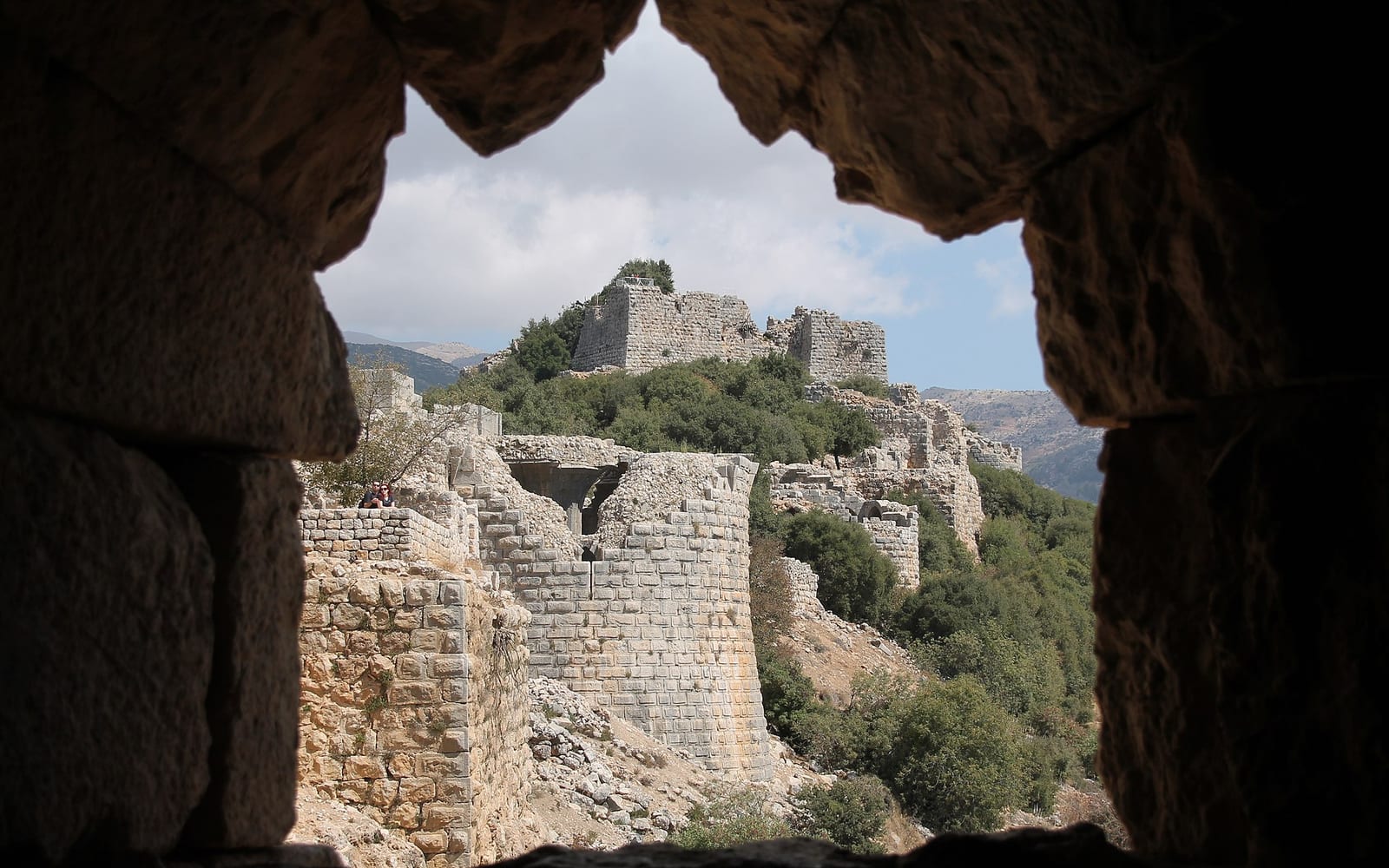
Gamla is not widely known outside Israel, which makes it one of the most rewarding sites in the country for visitors who make the effort. The reserve combines three distinct draws that are unusual even by Israeli standards: a first-century Jewish city destroyed by Rome, one of Israel’s largest Griffon vulture colonies nesting on the reserve’s clifftops, and a waterfall at the base of a basalt canyon that ranks among the tallest in the country. All of it is covered by a single 5 km loop that most visitors complete in under four hours.
The site is part of the Golan Heights — a basalt plateau in Israel’s far north. It lies about 30 km from Tiberias, and its remoteness (no public transport; no kiosk; modest signage) means you’ll rarely find it crowded, even in the main travel season.
The ancient city of Gamla
The name Gamla means “camel” in Aramaic — the ridge the city occupied is shaped like a camel’s hump, with steep drops on three sides and a narrow saddle connecting it to the wider plateau. The Romans called it gamala, and Josephus Flavius, the Jewish general-turned-historian who fought here before defecting, described it as “a natural fortress.”
The city dates to at least the Hellenistic period (2nd century BCE) and was substantially built up in the early Roman period. By 67 CE it was a prosperous Jewish city — the excavations have revealed densely packed houses built into the slope, industrial installations, ritual baths (mikvaot), and what may be the oldest known synagogue in the world, dating to around the 1st century BCE. The synagogue’s basalt columns are still standing.
The First Jewish–Roman War reached Gamla in the autumn of 67 CE. Vespasian, commanding the Roman campaign in Galilee, sent three legions to take the city. The first assault failed — the Romans broke through the wall but were driven back down the slope by defenders who showered them with stones and roof tiles from the houses above; 20 Romans fell into the ravine. The second assault, reinforced and better planned, succeeded. Josephus describes a massacre: around 4,000 defenders killed in the fighting, and a further 5,000 — including women and children — who jumped from the cliff rather than surrender. The city was never rebuilt.
The parallel with Masada (73 CE) is real and the ancients drew it: Gamla preceded Masada by three years and shares the same mass suicide narrative. But Gamla is far less visited and the archaeology is arguably as significant. Walking through the ruined houses — walls still standing to shoulder height, stone thresholds, grinding stones in the kitchens — has an intimacy that the crowd at Masada sometimes obscures.
The Griffon vulture colony
Gamla is the most accessible place in Israel to observe Griffon vultures (Gyps fulvus) at close range. A colony of these large birds — wingspan up to 2.8 metres — nests in the clifftops of the reserve’s canyon walls. A dedicated vulture observation platform, reached partway along the main circuit, faces the primary nesting cliff and puts you within 100–200 metres of the nesting ledges.
The best time to visit is morning, particularly from February to July (the breeding season), when the birds are most active on the ledges and regularly launch into the thermals above the canyon. Watching a bird with a 2.8-metre wingspan take off from a ledge 150 metres away, catch a thermal, and spiral overhead is one of the more dramatic wildlife moments available in Israel.
Griffon vultures were once critically endangered in Israel due to poisoning and persecution; a dedicated conservation programme — including supplementary feeding stations and legal protection — has reversed the decline. Gamla is one of the strongholds of the recovery.
Binoculars make the platform experience significantly better. The platform is exposed, so bring sun protection; there is no shade.
The Gamla waterfall
The circuit descends from the archaeological ruins down a rocky ravine path to the Gamla waterfall, which drops roughly 51 metres into a rock pool at the base of a basalt cliff. It is among the tallest waterfalls in Israel. The water source is a seasonal stream; the falls are at their most dramatic in winter and spring (December through April) after rainfall, and may reduce significantly or cease in the dry summer months. The INPA site indicates current water levels — check before visiting if a dramatic waterfall is the main draw.
The pool at the base is cool and clear. Swimming is not formally permitted at all INPA sites; respect any signage on site.
The hiking circuit
The standard Gamla circuit is approximately 5 km and takes 2.5–3.5 hours at a comfortable pace.
| Segment | What you see | Notes |
|---|
| Car park → ruins descent | Basalt landscape, views of canyon | Steep in sections; rocky underfoot |
| Ruins area | Ancient synagogue columns, house walls, thresholds, mikvaot | Allow 45–60 min for thorough exploration |
| Ruins → vulture platform | Cliff-edge path with views into the ravine | Exposed; keep children close |
| Vulture platform | Griffon vultures on nesting ledges opposite | 20–45 min; bring binoculars |
| Platform → waterfall | Rocky descent into the canyon | Slippery after rain |
| Waterfall | Rock pool, 51 m drop | Most dramatic Dec–April |
| Return to car park | Ascent via rocky path | Steeper return; poles help |
The trail is marked in the standard INPA colour system. Solid hiking shoes or trail shoes are recommended — road shoes or sandals are not suitable for the descent and waterfall section. Bring at least 1.5 litres of water per person; there is no water source on the circuit and no kiosk at the trailhead.
Getting there and practical details
| |
|---|
| Access | Road 869, east of Katzrin — follow INPA signs to Gamla |
| Public transport | None — rental car or guided tour required |
| From Tiberias | ~30 km via Road 87 + Road 869 (30–40 min) |
| From Tel Aviv | ~150 km (2.5–3 hrs) |
| INPA Pass | Yes — standard pass covers entry |
| Hours | Typically 08:00–17:00 (check inpa.org.il for current hours) |
| Facilities | Car park, toilets at trailhead; no café or water point on trail |
| Best season | Spring (Mar–May) for wildflowers + full streams; any season for vultures |
A rental car is the practical way to visit independently. The Golan road network is straightforward and well-signed; drivers comfortable with Israeli roads will find the Gamla trailhead easy to reach. If you prefer not to drive, a guided day tour from Tel Aviv, Tiberias, or Haifa is the alternative — most Golan tours include Gamla as one stop on a broader circuit.
The Israel National Parks Pass covers Gamla entry and is worthwhile if you plan to visit more than two INPA sites. The Golan Heights guide covers the full range of the plateau — Mount Bental, Banias, Nimrod Fortress, wineries, and hiking options beyond Gamla.
Combining Gamla with other Golan sites
Gamla works well as one stop on a full Golan day rather than as a standalone destination. The drives between sites are short once you’re on the plateau:
- Gamla + Mount Bental: 30 km apart; combine for an archaeology-and-panoramic-views day. Mount Bental adds 2 hours including the summit walk and Syrian bunkers.
- Gamla + Banias Nature Reserve: 35 km apart. Banias adds the Hermon Stream waterfall, ancient temples of Pan, and the Crusader-era Nimrod Fortress above. A full Gamla + Banias day is long (6+ hours walking) but very rewarding.
- Gamla + Katzrin: The Golan’s main town is 8 km from the Gamla trailhead. The Golan Heights Winery visitor centre in Katzrin is a natural post-hike stop — the winery produces the Yarden and Gamla labels and offers guided tastings (hours vary; call ahead). The Katzrin Archaeological Park in town reconstructs an ancient Talmudic-era village.
- Gamla + overnight in the Golan: zimmer rural B&Bs near Katzrin and in the Druze villages allow a two-day Golan itinerary; see the Israel zimmer guide for options.
The hiking in Israel guide has more on multi-day Golan trails, including the Israel National Trail sections through the plateau.