Tiberias (Hebrew: טְבֶרְיָה) sits on the western shore of the Sea of Galilee — the Kinneret — at 200 metres below sea level, making it one of the lowest cities on earth and one of Judaism’s four holy cities alongside Jerusalem, Hebron, and Safed. Founded by Herod Antipas in 20 CE and named for the Roman Emperor Tiberius, the city was a centre of Jewish learning after the destruction of the Second Temple: the Jerusalem Talmud was largely compiled here, the Sanhedrin met here for a time, and the medieval Jewish philosopher Maimonides is buried here.
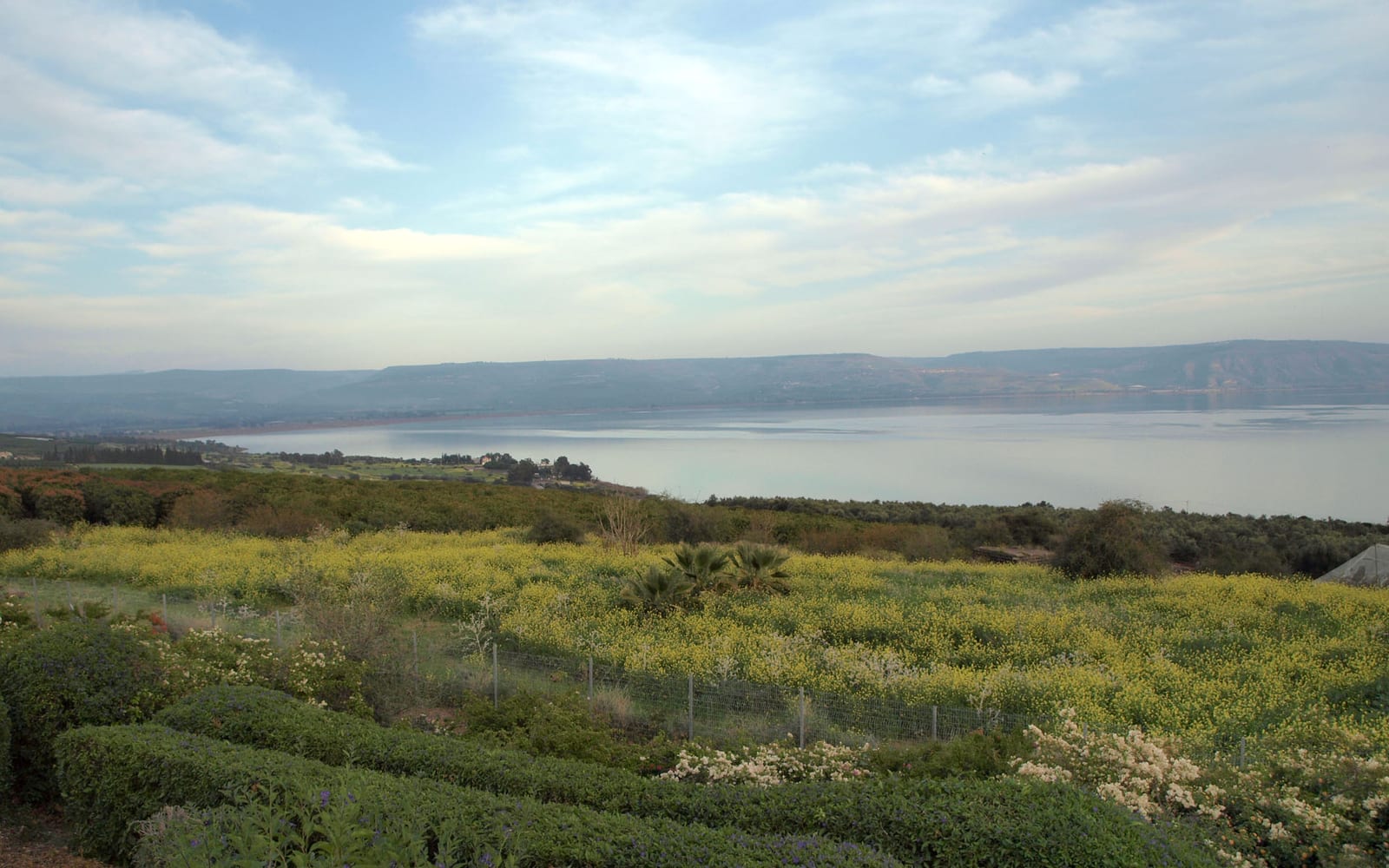
For modern travellers, Tiberias serves two roles: it is a destination in its own right — with exceptional ancient synagogue mosaics, a lakefront promenade, and a significant archaeological museum — and the natural base for exploring the wider Galilee. The Sea of Galilee is simultaneously Israel’s most important freshwater reservoir, a Christian pilgrimage heartland, and one of the country’s most peaceful landscapes: a blue lake ringed by green hills, the Golan Heights rising to the east, and at dawn an extraordinary still-water light that explains centuries of devotion.
Hamat Tiberias National Park
The single most remarkable archaeological site in Tiberias is Hamat Tiberias National Park, a short walk south of the city centre — and among the most under-visited significant ancient monuments in Israel.
The park preserves the remains of ancient Hamat (a settlement predating Tiberias itself) including, most strikingly, a 4th-century CE synagogue with one of the finest mosaic floors in the ancient world. The centrepiece mosaic shows a zodiac wheel — twelve signs arranged around a central figure of Helios, the Greek sun god, riding a chariot — flanked by panels depicting the Ark of the Covenant, a menorah, and Hebrew dedicatory inscriptions. The quality of craftsmanship is extraordinary: the tessellation is fine, the colours still vivid after sixteen centuries, and the imagery a remarkable record of how late-antique Jewish communities engaged with Hellenistic artistic traditions while maintaining their own theological identity.
The hot mineral springs at Hamat have been in use since antiquity. Ancient Roman Tiberias was built partly for these thermal waters; Byzantine travellers described them; they continue to flow today. A modern thermal pool complex at the site allows visitors to bathe in the same mineral-rich waters that have drawn visitors for two millennia — an unusual opportunity to combine archaeology with experience. For a broader overview of Israel’s wellness and thermal bathing options including the Dead Sea and hammam traditions, see the Israel wellness and spa guide.
Practical notes:
- The park is managed by the Israel Nature and Parks Authority; the Israel National Parks Pass is valid here
- Current opening hours and thermal pool arrangements vary seasonally — check parks.org.il or hamat-tiberias.co.il before visiting
- The mosaic floor is covered and climate-controlled; photography is permitted
- The park is approximately 2 km south of Tiberias city centre, walkable along the lake road or reachable by local taxi
The Jesus Boat Museum (Yigal Allon Museum, Ginosar)
Ten kilometres north of Tiberias, at Kibbutz Ginosar, the Yigal Allon Museum houses an extraordinary piece of ancient archaeology: a 2,000-year-old wooden fishing vessel recovered from the mud of the Sea of Galilee in 1986, during a severe drought that exposed sections of the lake bed.
Carbon dating places the boat between 100 BCE and 70 CE — making it contemporaneous with the era described in the Gospels, when Jesus and his disciples fished this same lake. The boat carries no historical identification and is not presented as a vessel Jesus used; the significance is rather that it is an actual 1st-century fishing boat from the very lake where the New Testament fishing narratives are set. The type of vessel, its construction methods, and its scale match the descriptions in the Gospels closely. For Christian pilgrims, the experience of standing beside the boat in the museum — built around the vessel after its painstaking multi-year conservation — is genuinely powerful.
Kibbutz Ginosar has accommodation for those wanting to stay on a private lake beach, with direct access to the water and views across the Kinneret to the Golan. It is also a convenient base for visiting the northern-shore Christian sites — Capernaum and the Mount of Beatitudes are 20–25 minutes further north by car.
Tiberias promenade (Tayelet)
The Tayelet — the lakefront promenade — is the heart of daily life in Tiberias: a linear park running along the water’s edge with cafés, benches, jetties, and views across the lake to the Golan Heights. At sunrise or sunset, the light across the Kinneret justifies the walk in itself: the flat surface of the lake reflects colour in a way that has drawn painters and pilgrims here for centuries.
The promenade is also where Tiberias’s working fishing culture is still visible: small boats tied at the waterfront, the smell of the lake in the morning, and the opportunity to take a boat excursion across the water. Several operators run tourist cruises from the main jetty area, including the Kinneret Sailing Company’s crossing to Ein Gev and the Jesus Boat replica sailing at Kibbutz Ginosar. For full details on booking, logistics and what to expect on the water, see the Sea of Galilee boat tours guide.
The promenade connects the city centre to the older southern districts, passing restaurants, hotels, and the access points for the main public beaches. A full walk of the accessible lakefront takes about 45 minutes at a relaxed pace.
St. Peter’s Church
On the promenade, the Franciscan Church of St. Peter marks a site traditionally associated with the post-resurrection appearance of Jesus to his disciples on the lake shore — specifically, the account in John 21 of the miraculous catch of fish and the commissioning of Peter. The current church was built by the Franciscans in the 19th century on the foundations of a Crusader-era structure; the nave is boat-shaped, a deliberate architectural allusion to the fishing tradition of the site.
The church interior is simply decorated and contemplative in atmosphere. Modest dress is required. It is generally open during daylight hours but can close for services or private events — check at the gate before planning your visit around it.
Rabbi Meir Baal Haness Shrine
The Shrine of Rabbi Meir Baal Haness (literally “Master of the Miracle”), perched on the hillside above the southern Tayelet with its distinctive twin blue domes, is one of the most active pilgrimage sites in Tiberias. Rabbi Meir was a 2nd-century Talmudic sage of extraordinary legal authority — one of the foundational voices of the Mishnah — and his tomb here has drawn petitioners and pilgrims for centuries. The tradition of giving charity in his name as a merit for miracles (particularly finding lost objects) has made him one of the most popularly invoked sages in Jewish tradition.
The site operates continuously as a functioning pilgrimage destination: candles are lit, prayers recited, and visitors from across the observant Jewish world come to pray at the tomb. Non-Jewish visitors are welcome to observe respectfully. Dress code applies — covered shoulders and knees; women should cover their hair at the tomb itself.
The blue domes are visible from the lake and from much of the southern waterfront — they are a navigational landmark as much as a religious one.
Sea of Galilee swimming
The Sea of Galilee (Kinneret) is fresh water and entirely swimmable. The main options for visitors:
Ginosar Beach (adjacent to the Jesus Boat Museum) is one of the most pleasant: a kibbutz-managed beach with calm water, shade, and lifeguards during the summer season (June–September). The beach gives direct access to the lake with views south across the full breadth of the Kinneret.
Tiberias City Beach is accessible from the promenade. Facilities are basic but the water is the same lake.
Ein Gev Beach is on the eastern shore (the Golan side), accessible by boat from Tiberias’s main jetty or by road via Route 92 around the southern end of the lake. Ein Gev Kibbutz has a well-organised beach with lifeguards in season and a fish restaurant famous for St. Peter’s Fish (amnun), the tilapia species native to the Kinneret.
Hamat Tiberias thermal pool — within the national park — provides a different experience: mineral hot springs in a pool rather than open-lake swimming. Check current pool hours at parks.org.il as they vary seasonally and may differ from the archaeological park hours.
Summer water temperatures reach 25–27°C; the lake is warmest July–September. Winter swimming (15–17°C) is viable for enthusiastic swimmers. There are no significant currents or tides; the main practical note is to follow lifeguard instructions on designated swimming areas.
For a full comparison of all Kinneret beach options — paid vs free, southern shore spots, Luna Gal Water Park, and the 55 km Shvil Sovev Kinneret circuit trail — see the Sea of Galilee beaches guide.
Tiberias as a base for the Galilee
Tiberias is the most practical overnight base for exploring northern Israel. Key day trips from the city:
Northern lakeshore Christian sites (20–25 min by car):
- Capernaum — the lakeside village where Jesus based his ministry; remains of a 4th-century synagogue built on the site of an earlier 1st-century synagogue; atmospheric ruins with a modern church suspended above Peter’s house site
- Church of the Multiplication of the Loaves and Fishes (Tabgha) — a 5th-century Byzantine church with a stunning intact mosaic floor depicting loaves and fish; one of the most beautiful mosaic interiors in Israel
- Mount of Beatitudes — the traditional site of the Sermon on the Mount; a Franciscan church in a garden setting with panoramic lake views; one of the most peaceful sites in the Galilee
Yardenit Baptism Site (15 min south): The landscaped commercial baptism site near Kibbutz Kinneret, with steps into the Jordan River, robes available for rental, and facilities for individual and group baptisms. A second major baptism site, Qasr el-Yahud near Jericho, is the site with stronger historical identification as the traditional baptism location — compare the two if pilgrim logistics permit.
Safed / Tzfat (45 min north): The kabbalistic hilltop city — Ha’Ari Synagogue, the Artists’ Quarter, the Old Cemetery. See the Safed travel guide.
Nazareth (40 min west): The Basilica of the Annunciation, Mary’s Well, the Old City souq. See the Nazareth travel guide.
Golan Heights (30 min east via Route 87): Gamla (ruined Jewish town of the first-century revolt, dramatic canyon views, griffon vulture colony), Nimrod Fortress (Crusader/Mamluk castle), Banias/Caesarea Philippi waterfalls. Car essential for the Golan.
Practical planning
Getting there from Tel Aviv: By car, approximately 2 hours via Route 6 north. By bus (Egged direct or with connections): approximately 2.5 hours from Tel Aviv Central Bus Station. No direct train. Organised day tours from Tel Aviv depart around 07:00–08:00. Verify current schedules at egged.co.il or via Rome2rio.
Getting there from Haifa: Bus 430 from Haifa Lev HaMifratz to Tiberias: approximately 75–90 minutes. By car via Highway 77 east: about 60–75 minutes.
Getting there from Jerusalem: By car via Highway 1 east then Route 90 north through the Jordan Valley: approximately 2.5–3 hours (the route passes the northern Dead Sea, making a stop at Qasr el-Yahud practical). By bus: approximately 3 hours with connections.
A rental car strongly recommended: The sites around the lake (Capernaum, Ginosar, Mount of Beatitudes) are spread along 20–30 km of lakeshore, and bus services between them are limited. The Golan Heights and Safed require a car entirely. Tiberias is one of the Israel destinations where car rental pays for itself in a single day’s touring. See the transportation guide for intercity options.
Shabbat: Tiberias has a significant religious population; many shops and restaurants close early Friday and remain closed Saturday. The lake and outdoor sites are accessible regardless. Hotels are generally open and functional. Plan for reduced services, particularly for intercity bus connections which run on a limited Shabbat schedule.
Weather: Tiberias is one of Israel’s warmest cities in summer — temperatures regularly exceed 38°C in July and August. Hamat Tiberias outdoor site and lake swimming are viable in heat; plan outdoor hiking for before 09:00. Spring (March–May) and autumn (September–November) are the most comfortable seasons for outdoor exploration.
Cross-links
For what to eat in Tiberias and across the Galilee — Saint Peter’s fish on the waterfront, Druze flatbread villages, Golan Heights wine and Nazareth Arab-Israeli mezze — see the Galilee food guide. For hotel picks at every tier — from the Scots Hotel 5-star to Nof Ginosar Kibbutz Hotel’s private lake beach — see the best hotels in Tiberias guide. For the full picture of the northern region, the Galilee region guide covers geography, seasonal highlights, and orientation. The Sea of Galilee complete circuit guide covers all four shores of the Kinneret — Magdala, Capernaum, Ein Gev, Yardenit, and Hamat Gader — for visitors who want to extend beyond Tiberias city itself. The Nazareth & Sea of Galilee day trip covers the one-day Christian circuit from Tel Aviv or Jerusalem. For day trips into the Galilee’s holy sites, the Christian pilgrimage guide gives the full theological and practical context. The Israel National Parks Pass covers admission at Hamat Tiberias and a dozen other northern sites. For driving logistics around the Galilee, the driving in Israel guide covers Route 90 (the Jordan Valley road) and Route 87 into the Golan. If planning a Jewish heritage focus, the Jewish heritage guide gives context on Tiberias as one of Judaism’s four holy cities and on the Talmudic sages buried here.