Mount Hermon in the northern Golan Heights is Israel’s only ski resort and, at 2,814 metres above sea level, the highest point in the country. The ski area itself runs from 1,640 m to 2,073 m — a compact but genuinely snow-reliable mountain that draws around 300,000 visitors in a typical winter season, including Israeli families, school groups, and international travellers who find skiing in the Middle East worth experiencing simply for the novelty of it.
The resort is not Chamonix or Verbier. There are 13 runs covering beginner through intermediate terrain, and the conditions are highly snow-dependent from one year to the next. What it offers instead is a completely unexpected experience: snowcapped peaks rising above the Sea of Galilee, a terrain that mixes Golan volcanic rock with alpine snowfields, and the knowledge that you are skiing at the intersection of Israel, Syria, and Lebanon.
In summer, Hermon transforms into a cable car viewpoint and outdoor activity centre — the views from the upper station on a clear day extend over Lebanon, Syria, Jordan, and the full length of the Golan plateau. The wildflower season in April and May makes the access roads to the resort among the most scenic drives in the country.
Quick reference
| |
|---|
| Location | Northern Golan Heights, near Neve Ativ |
| Summit elevation | 2,814 m (ski area 1,640–2,073 m) |
| Runs | 13 (beginner to intermediate) |
| Lifts | 10 (cable cars, chair lifts, tow ropes) |
| Ski season | Approximately late December–late March (snow-dependent) |
| Tickets | Pre-order required at skihermon.co.il |
| Drive from TLV | ~3.5 h via Route 6 + Route 98 |
| Drive from Haifa | ~2.5 h |
The ski resort — terrain and facilities
The Hermon ski area is divided into two main sections connected by lift, covering 13 marked runs of varying difficulty:
Beginner zones are concentrated at the mid-station and base areas. The wide, gently graded slopes here are where the ski school operates and where most first-timers spend the day. A synthetic-surface beginner track at the base station is available year-round for absolute beginners to practice regardless of snow cover.
Intermediate and advanced runs fan out from the upper cable car terminus, offering longer descents with more elevation and more interesting terrain. The upper slopes also carry the best natural snow in most winters — powder conditions after a significant snowfall are genuinely good on the upper mountain.
Facilities at the base and mid-station: ski and snowboard rental shop (all equipment available including helmets and children’s sizes), ski school office and meeting area, kosher cafeteria and coffee kiosks, changing rooms and equipment storage lockers, first aid station. Equipment quality is adequate; bring your own gloves and neck gaiter if you have preferences.
Snow conditions and the season
The honest position on Mount Hermon snow: the snowpack varies significantly from year to year and cannot be predicted in advance. Winters with deep, reliable snow from January through March are common — but there are also years where the upper lifts close in February due to insufficient base depth, or where an unseasonably warm spell in January leaves the lower slopes bare while the upper mountain holds.
The practical advice is: do not plan a ski trip to Hermon more than one week in advance. Check the snow report at skihermon.co.il on Monday or Tuesday, decide by Wednesday, and book your accommodation and tickets for the coming weekend. The resort publishes daily webcam footage and snow depth readings — this is a reliable planning tool.
Typical season windows:
- January–February: the most consistently snowy months; best chance of good conditions on the main runs
- Late December: hit or miss depending on the year’s first snowfall timing
- March: often the best late-season window — stable conditions, longer daylight, and reduced crowds as Israeli school holidays end
- April: rarely snow-viable; the resort switches to summer cable car mode
The base station synthetic track and small beginner area operate year-round regardless of snow conditions.
Tickets — pre-ordering is mandatory
The resort no longer accepts walk-in ticket purchases at the gate during busy periods, and arriving without a pre-purchased ticket on weekends or school holidays (particularly the Hanukkah holiday week in December) risks being turned away at the entrance checkpoint.
Purchase tickets in advance at skihermon.co.il. The site lists current prices for:
- Full-day ski/snowboard pass (all lifts)
- Half-day pass (morning or afternoon session)
- Cable car only (non-skiers visiting for the view)
- Equipment rental bundles (skis or snowboard + boots + poles)
- Ski school lesson packages
Guided tours from Tel Aviv and Haifa frequently include lift tickets in the price — confirm what is covered before booking a tour, as the packages vary.
Ski school and equipment rental
The on-site ski school teaches lessons in Hebrew, English, and Russian. Group lessons for beginners run in hourly or multi-hour sessions from the mid-station learning area; private instruction is available for all levels. Children from approximately age 4 participate in a dedicated children’s ski school with separate slopes and qualified instructors.
First-timer recommendation: a 2-hour group lesson followed by free time on the beginner slope is the standard approach and gives most people enough to feel confident on skis or a board by the afternoon.
Equipment rental is available at the base station for skis, snowboards, boots, poles, and helmets. The selection covers children’s and adult sizes across all ability levels. Arrive with your own warm base layer, waterproof outer layer, and gloves — the resort’s rental shop covers equipment but not clothing.
What to wear and bring
The mountain is cold — more so than the Golan plateau town of Neve Ativ, and much colder than Jerusalem or Tel Aviv, even in the same season. Pack accordingly:
- Ski jacket and waterproof trousers (rental available for equipment, not clothing)
- Thermal base layer — essential; the chairlifts are exposed
- Gloves — bring your own; rental shop typically does not supply them
- Neck gaiter or balaclava — wind chill on the upper lifts is significant
- Sunscreen SPF 50+ — altitude + snow reflection = strong UV even on overcast days
- Sunglasses or ski goggles — required; goggles are the better choice in precipitation
- Cash and/or Visa/Mastercard — the cafeteria and some rental counters prefer card; small cash useful for kiosks
Summer at Mount Hermon
From April through October, Hermon operates as a cable car viewpoint and mountain activity centre. The summer experience is entirely different from skiing — quieter, cooler than the rest of Israel (18–24°C at peak summer, vs 32–40°C in the Jordan Valley below), and exceptionally clear for views on good days.
What to do in summer:
- Cable car ride to the upper station (2,073 m) for panoramic views over the Golan plateau, Lebanon range, and on clear days into Syria and Jordan — buy tickets in advance as summer demand from heat-fleeing Israelis can be high on weekends
- Zip-line from the upper slopes — a high-altitude run across open mountain terrain with valley views
- Mountain bike trails — descents from the cable car terminal; bikes rentable at the resort
- Short walking and hiking paths from the cable car station across alpine meadows; the wildflower season (late March–May) is particularly impressive
- Picnic and family areas near the base station with barbecue facilities
Summer hours and ticket prices differ from ski season rates; check skihermon.co.il for current schedules.
Combining Hermon with the Golan Heights
The Hermon access road runs through some of the most dramatic Golan scenery, and a day trip to the resort combines naturally with several nearby stops that add cultural and historical depth to the mountain visit:
Banias / Caesarea Philippi (15 min from the Hermon access road): One of Israel’s most dramatic natural sites — a spring that bursts from the base of a cliff, forming the source of the Jordan River, surrounded by Greco-Roman temple ruins and a Byzantine-era niches carved into the rock. A shaded 3-km trail follows the river through a basalt canyon to Banias Waterfall (15 m drop, the tallest waterfall in Israel). Covered by the Israel National Parks Pass. Allow 2 hours. See the Golan Heights region guide for more.
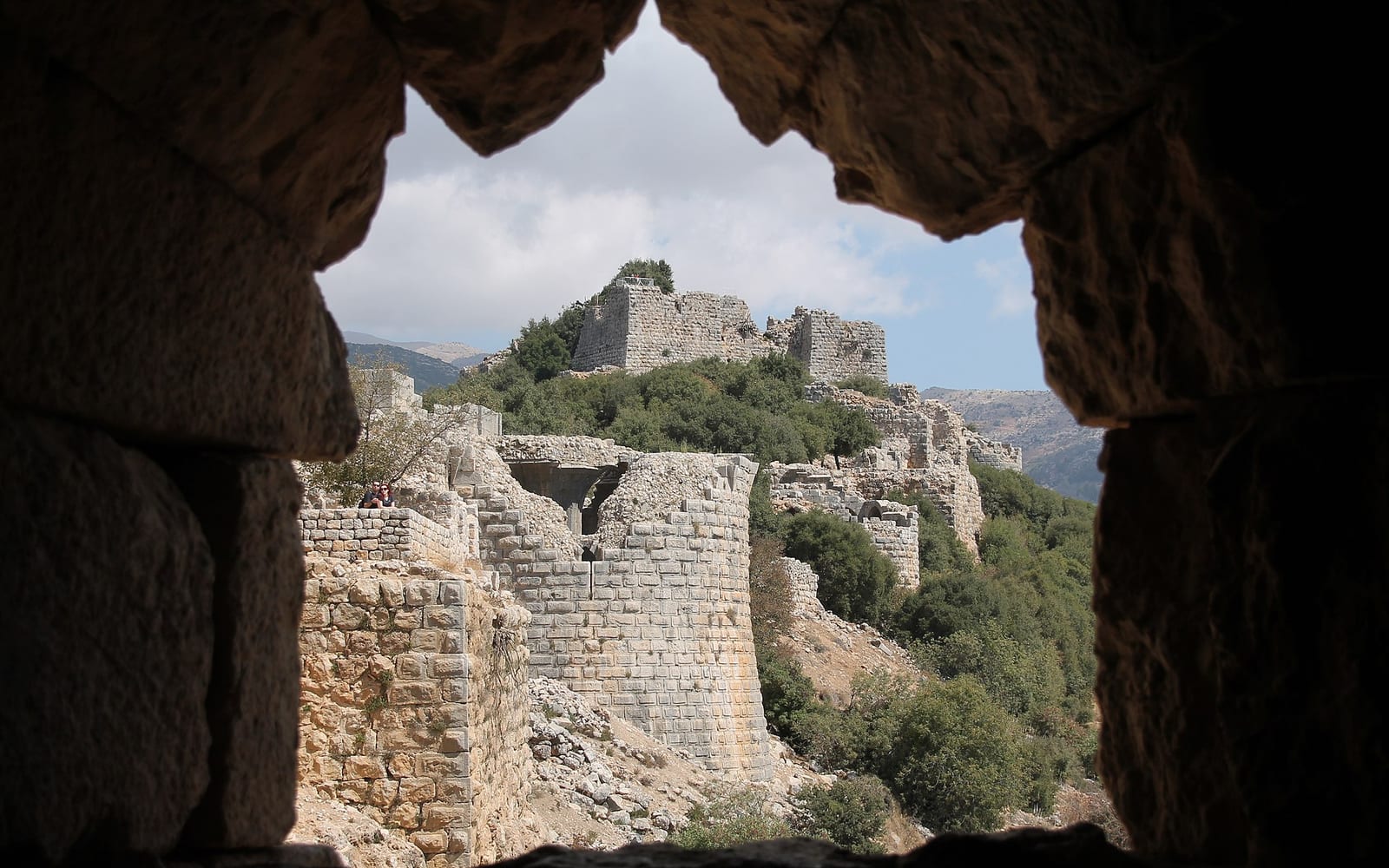
Nimrod Fortress (10 min from Banias): A Crusader-era castle on a narrow ridge above the Hermon foothills, built in the 13th century and later enlarged by the Mamluks. The fortress walls and towers have survived remarkably well; the ridge views into Lebanon and across the Golan are among the best accessible viewpoints in the north. Covered by the INPA pass.
Druze village lunch (Majdal Shams, 20 min): The Druze village of Majdal Shams on the Hermon slopes is the best stop for lunch — the Druze cuisine is a distinct Israeli culinary tradition (lamb, fattoush, muhammar bread, kibbeh, sweet cheese knafeh) and the village restaurants are unpretentious, cheap, and excellent. The village is also a living example of the Golan’s complex human geography — Druze residents here hold Syrian identity while living in Israeli-administered territory.
Mount Bental viewpoint (40 min south): An inactive volcano in the central Golan with a decommissioned Israeli army bunker converted into an observation point and coffee shop. On clear days, Damascus is visible to the northeast. A sobering Cold War-era military landscape now serving as a tourist lookout.
A typical day structure combining all of these: Banias 9am (2h) → Nimrod Fortress 11am (1h) → Majdal Shams lunch 12:30pm → Hermon cable car or ski afternoon → Mount Bental sunset.
Getting there
By car (recommended): the Golan Heights and Mount Hermon are not practical by public transport. From Tel Aviv, Route 6 north (toll motorway) to Route 65 or Route 70 east connects to Route 98 along the eastern Golan edge — follow signage to Neve Ativ and Har Hermon ski resort. Typical driving time from Tel Aviv: 3.5 hours. From Haifa: approximately 2.5 hours via Route 70 east and Route 98.
In ski season, arrive early: the road to the resort is a single-lane mountain access road that backs up significantly on weekends and Israeli school holidays. Aim to leave from Tel Aviv no later than 5:30am for a weekend ski day to avoid multi-hour queues at the mountain access point. A rental car from Tel Aviv, Haifa, or Tiberias is the standard approach — see the car rental in Israel guide for booking tips and operators. For the Golan, you do not need a 4×4 — the resort access road is sealed and graded.
By guided tour: several operators run full-day Golan and Hermon day trips from Tel Aviv and Haifa, with bus pickup at central locations, lift ticket or cable car ticket included, and a guide for the non-ski stops. This is a good option if you do not want to navigate the mountain access road queues independently. Use the GetYourGuide CTA above to compare current offerings.
Fuel: fill up in Kiryat Shmona or along Route 90 before turning east into the Golan — petrol stations on the upper Golan and near the resort are limited. The drive from Kiryat Shmona to the resort is approximately 20 km.
Practical planning
Crowds and timing: the resort is busiest during Israeli school holidays — Hanukkah week (December), mid-winter break, and Israeli Independence Day long weekend. These periods see the access road queue times of 1–3 hours. If possible, visit on weekday school-term days in January or February for the shortest queues and best slope conditions.
Golan Heights security context: the Hermon area and broader Golan Heights are Israeli-administered territory and have been under stable Israeli civil and military administration since 1967. The resort and its surroundings are regularly visited by Israeli and international tourists. For current security context, check the is Israel safe guide and your home government’s current travel advisory. Do not enter any closed military zone or UN buffer area signs — these are clearly marked.
Combining with the Galilee and north: the Hermon is 45 minutes from Tiberias, 30 minutes from Kiryat Shmona, and 2 hours from Haifa. A 2-night Golan circuit — Haifa → Akko → Rosh Hanikra (first day) → Golan + Hermon (second day) — is a popular northern Israel format. See the northern Israel road trip guide for the full circuit itinerary.
Children: the resort is child-friendly and popular with Israeli families. The children’s ski school, beginner areas, and the summer cable car ride are all suitable for ages 4 and above. The mountain access road has guardrails and is maintained, but the drive is winding — children prone to motion sickness should take precautions.