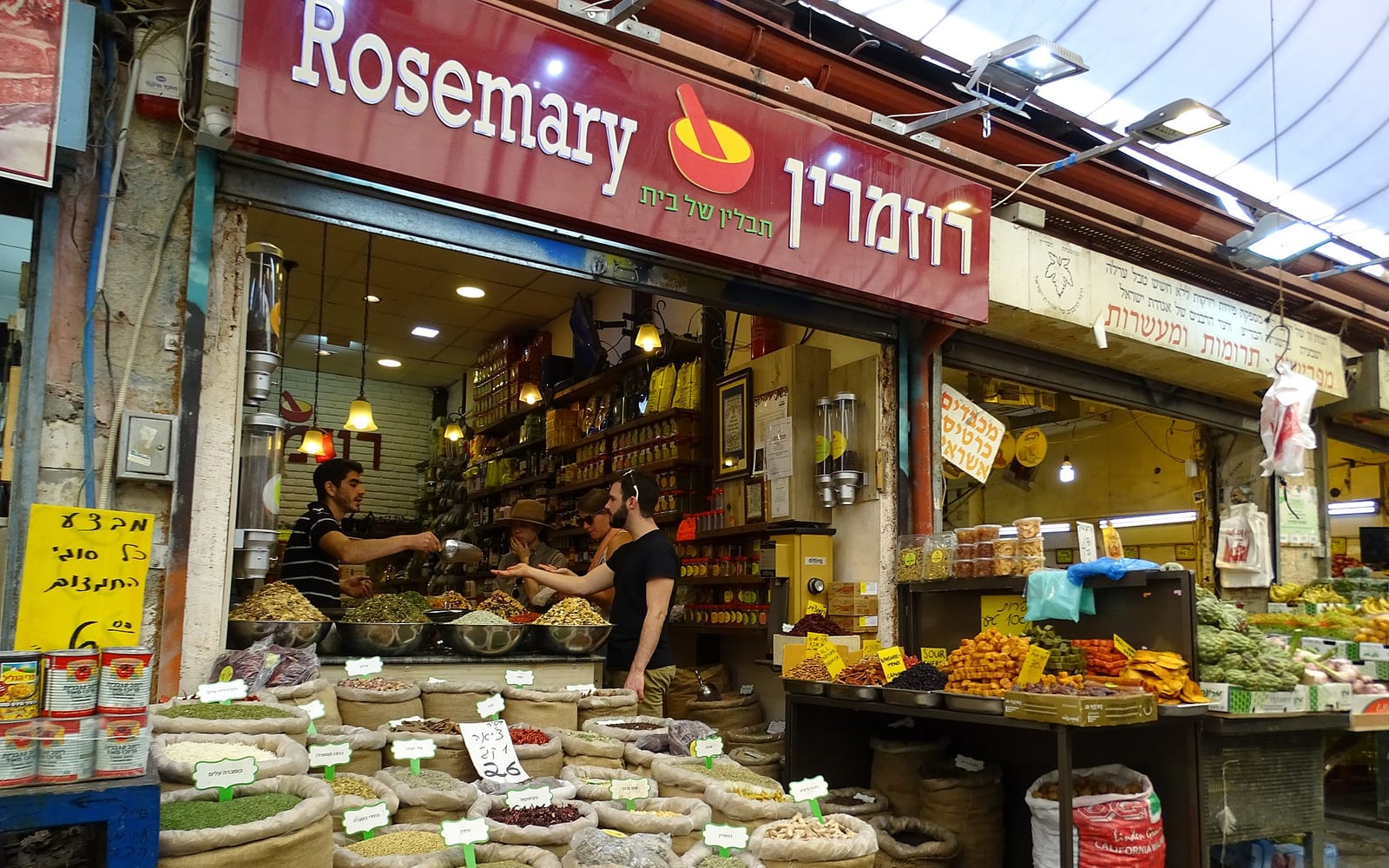
Mahane Yehuda market — the Shuk — is the centrepiece of Jerusalem’s food culture and one of the great open-air markets of the Middle East. Two hundred and fifty stalls crowd the covered and open-air lanes between Jaffa Road and Agrippa Street, selling everything from fresh-ground spices and Medjool dates to Israeli cheeses and halva sliced from enormous wheels. On Friday mornings the whole city’s pre-Shabbat energy is concentrated here. On Thursday and Saturday evenings the produce stalls close their shutters and the same lanes open as a bar district.
A guided food tour is the fastest route into the market’s rhythms — the booking options above combine Machane Yehuda with the Old City for a full half-day. But the market navigates well independently; this guide covers the layout, the food, the evening transformation and the seasonal variations.
Market layout
The market occupies a dense grid of covered and open-air lanes in West Jerusalem, with the main entrance on Mahane Yehuda Street off Jaffa Road to the north and secondary entrances on Agrippa Street to the south.
The covered iron-roofed hall running down the centre of the market is the heart of the produce section — vegetables, fruits, fresh herbs, olives in brine, Israeli dairy and a constant stream of shoppers. The overhead skylights make it light on clear mornings; in summer the covered section is welcome shade. Burekas and bread bakeries are concentrated through this section.
The open-air lanes running parallel on either side carry the spice and specialty food vendors — za’atar blends, sumac, dried rosebuds, tahini, artisan honeys, dried fruit, nuts, and roasted seeds. The halva vendors here cut blocks from enormous slabs; the quality of freshly cut halva is distinct from pre-packaged varieties.
The outer ring (approaching Jaffa Road and Agrippa Street) carries clothing, household goods and some secondhand items alongside the newer bars and restaurants that have established themselves around the market’s energy in recent years.
The restaurant strip on Beit Yaakov Street, one short block north of the market, is not technically inside the Shuk but grew up as its culinary extension — the restaurants here are some of Jerusalem’s most celebrated, feeding off the same market ingredients but in sit-down format.
What to eat
The market is built for eating while walking. The essential stops:
Marzipan Bakery rugelach — the chocolate-filled pastry from this bakery, on Agrippa Street near the south entrance, is cited across multiple sources as the finest in Israel. The claim is defended with enthusiasm. The bakery sells them by weight in bags; there is nearly always a queue. Buy more than you think you need.
Burekas — warm, flaky pastry filled with white cheese, potato or spinach, baked on-site and sold by piece or weight. The best stalls have a visible oven and a short queue. Avoid pre-packaged or glass-display cases — the quality difference with fresh-baked is significant.
Knafeh — the shredded-wheat-and-cheese pastry soaked in orange-blossom syrup, served hot from a round tray. The Shuk has several knafeh vendors; buy it hot and eat it immediately. This is a Palestinian-Arab street-food tradition as much as an Israeli market staple.
Fresh-pressed juices — juice bars at the market entrances press pomegranate, carrot and citrus to order. In season (autumn through spring for pomegranate), a glass of fresh-pressed juice is the right way to start a market morning.
Spices to take home — the Shuk’s spice stalls are among the best in Israel for quality and range: za’atar (the herb-and-sesame blend), sumac (the tart purple powder), amba (pickled mango condiment), baharat (warming meat-spice blend), dried rosebuds, and ground cardamom. Most pack in vacuum-sealed bags suitable for travel.
Halva — the sweet sesame-paste confection is sold in blocks sliced from large wheels; flavours include plain, chocolate marble, pistachio and coffee. Buy a small piece to try before committing to a larger block.
The Shuk’s most striking feature: on Thursday and Friday evenings from around 18:00, the produce stalls close their shutters, the lanes briefly empty — and then reopen as a bar district.
Pop-up bars operate from within the same stalls that sold spices and vegetables hours earlier. The Shuk’s permanent bars (several line the inner lanes) serve craft beers and cocktails. Live music appears informally on Thursday and Friday evenings — usually a guitarist or a small acoustic setup at a corner stall. The crowd shifts from families with shopping bags to young Jerusalemites, students and tourists staying in the neighbourhood.
The experience is disorienting in the best way: the physical market is unchanged, the lanes are the same, but the function has entirely flipped. Thursday evening is generally the peak (the city’s nightlife equivalent of Friday in most cities, since Friday is Shabbat eve and the market closes early). Friday evening the bars open but the night is shorter, closing before Shabbat.
Saturday night after Havdalah (roughly 20:00–21:00 in summer, 18:30–19:00 in winter) the market reopens in full evening mode — this is often the most accessible evening if you have been observing Shabbat and want to see the bar scene.
The evening Shuk is distinct from Tel Aviv’s nightlife — it is outdoor, street-party in character, and happens in a market setting rather than a bar strip. It is also distinct from the Carmel Market’s Friday transformation in Tel Aviv: the Jerusalem version runs multiple evenings per week and has a stronger live-music tradition.
Seasonal events at the Shuk
The market has a different character at each of the major Jewish holidays:
Passover (Pesach) — the week before Passover is the market’s most intense shopping period. Families stock up on Passover foods; chametz (leavened bread) sells out as vendors clear their inventory; matzah, almond flour, and kosher-for-Passover products dominate. The queues at the bakeries are long. The market atmosphere is urgent and communal in a way that is unique to this period.
Sukkot — in the week after Yom Kippur, Sukkot (the harvest festival) brings sukkahs (temporary wooden huts decorated with hanging fruits and vegetables) into the market’s open spaces and some covered areas. Vendors sell lulav-and-etrog sets (the palm frond and citrus used in Sukkot ritual). The decorated market in autumn light is one of the most visually distinctive Jerusalem experiences.
Hanukkah — for the eight-day Festival of Lights (typically December), every bakery stall fills with sufganiyot — deep-fried jelly donuts in a dozen flavours: classic rose jelly, strawberry, chocolate, pistachio, halva cream. The market smells of frying oil and the display counters overflow. Sufganiyot are sold across Israel at Hanukkah but the Shuk does them at their best.
The Beit Yaakov restaurant strip
One block north of the market on Beit Yaakov Street sits the cluster of restaurants that has made the neighbourhood one of the most celebrated dining destinations in Israel.
Machneyuda is the centrepiece — an open-kitchen restaurant that changes its menu daily based on what arrived from the market that morning. The food is creative, confident modern Israeli cuisine; the atmosphere is loud, high-energy, and involves the chefs cooking in full view. Book well in advance, especially for Friday dinner and Saturday night; walk-ins are near-impossible at peak times. This is not a market lunch stop — it is a destination dinner requiring reservation.
Azura is the older, quieter counterpoint: an Iraqi-Jewish restaurant near the market that has been serving stovetop-cooked hummus, slow-braised meats and traditional Mizrahi dishes since 1952. The hummus here — cooked to order in small pots on the stove — is consistently cited alongside Abu Shukri in the Muslim Quarter as Jerusalem’s finest.
Other well-regarded market-area restaurants have come and gone around these two anchors; the neighbourhood’s reputation ensures new openings are frequent. Ask at your accommodation for what is currently most recommended — this area evolves faster than most of Jerusalem’s food scene.
Hours: Sunday–Friday, approximately 08:00 to dusk. Closed Saturdays. Friday stalls begin closing from around 14:00 for Shabbat. Bar district opens from 18:00 Thursday and Friday; Saturday after Havdalah.
Best time to visit: Friday morning (09:00–10:00) for full market atmosphere. Thursday evening (18:00–22:00) for the bar scene. Midweek mornings for lower crowds and excellent selection.
Payment: Cash preferred at produce and street-food stalls; many do not accept cards. The bars and sit-down restaurants generally accept credit cards. ATMs are available on Jaffa Road near the market entrance.
Kashrut: The majority of vendors are kosher. The evening bars vary — ask if kosher certification is important to you.
Getting there: Mahane Yehuda light rail station (Jerusalem Red Line on Jaffa Road) is directly at the north entrance — the most convenient arrival. From Ben Yehuda pedestrian street: 10 minutes walk west. From the Old City (Jaffa Gate): 15 minutes walk through Mamilla. Gett and Yango rideshare are fast within the city. No dedicated parking — don’t drive during market hours.
Accessibility: The market’s covered central lanes are paved but narrow and can be very crowded at peak hours. The main north entrance from Jaffa Road is the widest access point. Midweek mornings offer the most manageable accessibility conditions. Some of the inner lanes are uneven.
Plan your visit
The Jerusalem food guide covers the full eating landscape — Old City hummus at Abu Shukri, Machneyuda restaurant bookings, the best kosher fine dining near Jaffa Gate, and how Shabbat closures affect your options.
For a comparison: the Tel Aviv Carmel Market guide covers Shuk HaCarmel and its own Friday evening transformation — the two markets are the respective food hearts of their cities, distinct in character. Machane Yehuda is denser, more traditional and tied to the rhythms of Jerusalem’s Jewish calendar; Carmel Market has a lighter, more secular Tel Aviv energy.
If you are traveling around Jewish holidays and want to understand what to expect, the traveling Israel on Jewish holidays guide covers Passover logistics, Sukkot, Hanukkah and Shabbat planning in depth.
For the organised version: Israel food tours and cooking classes covers guided market experiences across Jerusalem and Tel Aviv, including options that combine Machane Yehuda with the Old City.
The market is also a natural anchor for plant-based eating in Jerusalem — the produce stalls, fresh hummus counters and falafel kiosks are entirely vegan-friendly. The vegan and vegetarian Israel guide covers the broader plant-based picture, including the Abu Shukri hummus institution inside the Old City and how to navigate Shabbat closures for vegan dining in Jerusalem.
For a complete overview of Israel’s market landscape — Carmel Market, the Jaffa Flea Market, Old City bazaars and what to buy across the country — see the shopping in Israel guide.