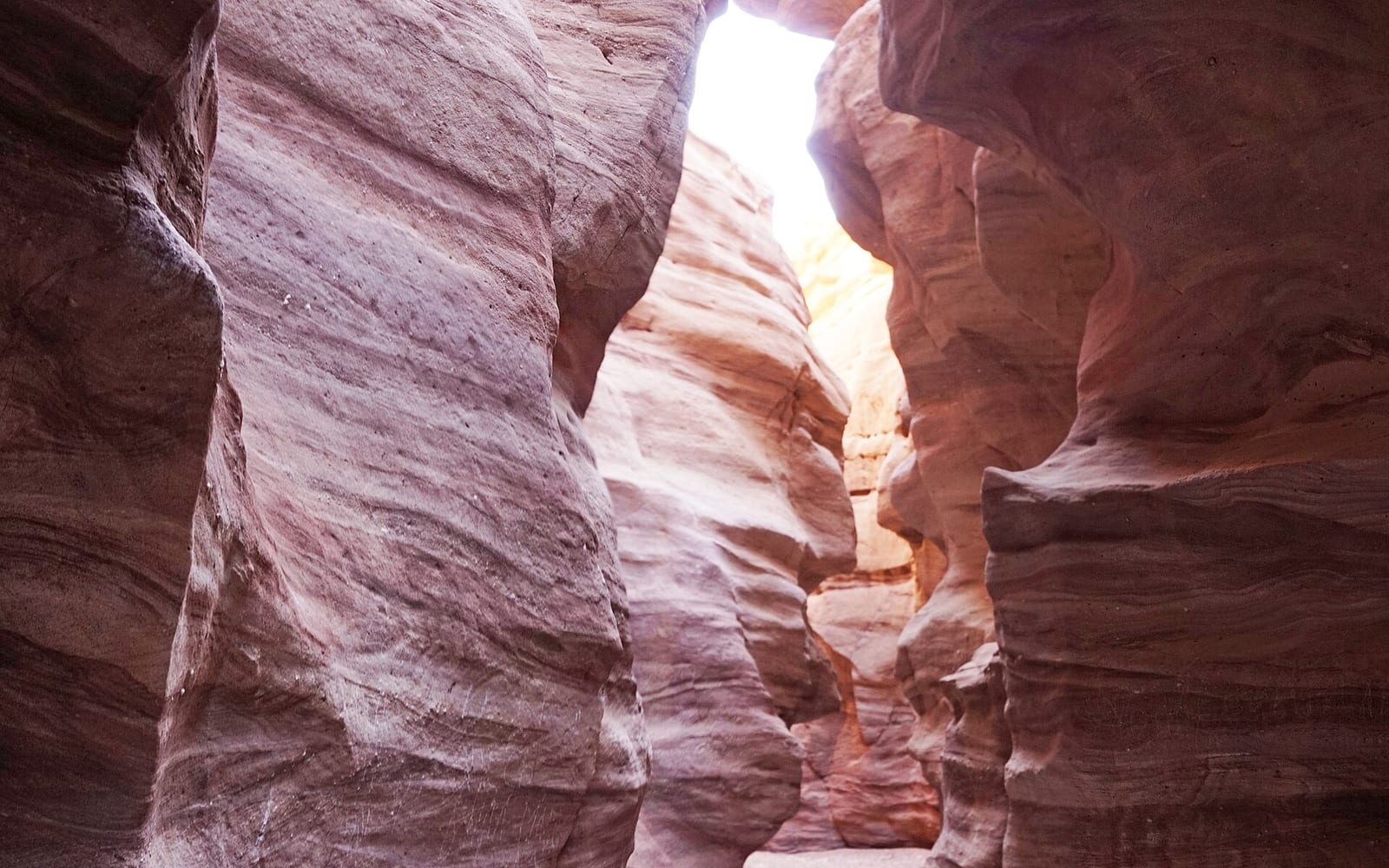
The Red Canyon — HaMakhtesh HaAdom in Hebrew — is a free slot canyon hike 20 km northwest of Eilat in the Eilat Mountains, carved over millennia by flash floods through layers of Nubian sandstone. The canyon walls narrow to 1–2 metres in the tightest passages and rise 10–15 metres on either side, glowing red-orange, ochre and purple from the iron-oxide rich sandstone of the Eilat Mountains formation. It is Israel’s closest equivalent to the famous Antelope Canyon in Arizona.
The circuit is 2 km, takes roughly 1.5–2 hours at a comfortable pace, and costs nothing. There are 3–4 sections where metal rungs and short ladders (1–2 metres) assist descent into the canyon narrows. The canyon sits within a protected nature area managed by the Israel Nature and Parks Authority — no fees, no ticket booth, and no ranger on site. That also means you are responsible for checking conditions before you go.
The canyon and its geology
The Eilat Mountains are part of the ancient Precambrian basement complex of the Arabo-Nubian Shield — one of the oldest exposed rock formations in the region, dating back roughly 600 million years. The canyon itself is carved through Nubian sandstone, a younger sedimentary layer deposited during the Cretaceous period (roughly 100 million years ago) when the area lay under a shallow sea. The deep red and orange colouration comes from iron oxide (haematite) in the sandstone — the same mineral that gives the Grand Canyon and Petra their characteristic colours.
The slot canyon shape is the result of episodic flash flooding. The Eilat Mountains receive very little annual rainfall, but when it does rain — even for short periods — the water drains rapidly off the rocky ridgelines and channels with great force through the weakest lines in the rock. Over thousands of years, these flood events carved the smooth curved walls and tight narrows that visitors walk through today.
Trail description
The trail begins at the parking area and trailhead on Highway 12, roughly 20 km northwest of central Eilat. The approach is well marked with red trail blazes from the car park.
Approach (0–300 m)
A short path leads from the trailhead toward the canyon rim over open desert ground. This section is exposed and sunny — the heat here is significant in warmer months. You will see the canyon cutting into the plateau ahead.
Canyon entry and the first narrows (300 m–1 km)
The trail descends into the canyon via a marked path with metal rungs and a short ladder at the steepest point. Once inside, the walls close in dramatically. The first narrows are the most visually striking section: canyon walls less than 2 metres apart, rising 10+ metres, with the sky visible as a thin strip overhead. The rock faces shift colour from section to section — deep red, orange, purple and cream layers often visible in sequence.
Midday light, when the sun is directly overhead, illuminates the canyon floor from above and creates the most vivid colour saturation — different from most outdoor photography sites in Israel where midday light is typically unflattering. Midday is the correct time to photograph this canyon.
Second narrows and exit climb (1 km–2 km)
The trail continues through a second set of narrows before climbing back to the plateau via another set of metal rungs. The exit climb is slightly more exposed than the entry descent. Once back on the rim, the return path follows the canyon edge back to the trailhead, giving elevated views into the slot below.
| Detail | Info |
|---|
| Entry fee | Free — no ticket required |
| Trail length | 2 km circuit |
| Duration | 1.5–2 hours at comfortable pace |
| Difficulty | Moderate — 3–4 sections with metal rungs / short ladders |
| Minimum age | ~8 years with good agility; adult accompaniment required |
| Getting there by car | Highway 12 northwest from Eilat; 20–25 min drive; trailhead car park on the right |
| Getting there by bus | Egged Bus 392 (Eilat–Beer Sheva); stops at trailhead; ~25 min from Eilat Central Bus Station |
| Facilities | Shade cover at trailhead; no toilets, no water, no shop |
| Best months | October–April |
| Avoid | June–September (extreme heat); any day with rain forecast in the watershed |
| Flash flood risk | HIGH — check ims.gov.il before every visit |
What to bring
Non-negotiables:
- Water — at least 1.5 litres per person for a short hike; 2.5+ litres if hiking in March–April warmth
- Closed shoes with grip — sandals are unsuitable for the ladder sections; trail runners or hiking shoes are ideal
- Sun protection — hat, sunscreen, lightweight long sleeves for the exposed approach and rim
- Charged phone with offline maps downloaded (mobile signal is weak in the narrows)
Optional but useful:
- Headtorch or phone torch — useful in the deepest narrows on cloudy days
- Trekking poles — for stability on the approach and rim sections
- Camera — the canyon rewards photography; a wide-angle lens captures the full height of the walls
Combining with nearby sites
Red Canyon works naturally as part of a longer day in the Eilat Mountains and Arava:
Red Canyon + Timna Park (half-day + half-day): Timna Park is 45 km north of Eilat on Highway 90. Do Red Canyon first (earlier = cooler for the approach) and Timna in the late morning. Both sites together make a full desert day from Eilat — Timna entry is roughly ₪60–80 per adult. Drive time between sites is under 30 minutes.
Red Canyon + Hai Bar Yotvata: The Hai Bar Yotvata Nature Reserve — a biblical wildlife breeding centre with white oryx, onager and ostrich — is 35 km north of Eilat on Highway 90, between Kibbutz Yotvata and Kibbutz Samar. It works as a morning stop before Red Canyon, or the reverse for an afternoon wildlife visit. Both sites require a car.
Desert hiking + Eilat diving: Red Canyon takes a morning. The drive back to Eilat and an afternoon snorkelling at Coral Beach or a glass-bottom boat tour is a natural pairing — desert in the morning, sea in the afternoon.
Red Canyon + Arava mountain biking: For fit mountain bikers, the Red Canyon hike (2 hours) can precede a drive north to Kibbutz Yahel (55 km on Highway 90) to ride the southern section of the new Yahel–Timna singletrack. The singletrack covers different terrain — volcanic basalt and limestone wadi rather than sandstone slot canyon — making the two a complementary day for riders who want both hiking and technical MTB in the Eilat region.
Flash flood safety: the full protocol
This section is longer than it needs to be for most visits, but Red Canyon has seen fatal flood events. Read it once.
Why the risk is non-obvious: The canyon is in an arid desert that receives less than 30mm of rainfall per year. But the catchment area — the Eilat Mountains watershed — is large, and any rain falling on the ridgelines drains directly into the canyon network. A 15-minute rainfall event 10 km away, with no clouds visible above the canyon itself, can send a flash flood through within minutes.
The warning signs: A rushing sound from upstream is the key audio signal — evacuate immediately to the highest ground you can reach inside or outside the canyon. There is typically no visual warning. Do not stop to photograph or film.
The no-go rule: If the Israel Meteorological Service forecast for the Eilat Mountains or southern Negev shows any rain probability for your day of visit, do not enter the canyon narrows. The canyon rim walk gives excellent views without entering. This is not an overcautious rule — it is the correct interpretation of the risk.
INPA rules inside the canyon:
- No open fires under any circumstances
- No littering (carry everything in, carry it out)
- Do not climb or damage the canyon walls
- Stay on the marked trail
Getting there
By car: From central Eilat, take Highway 12 (the road to Timna Park and Beer Sheva) northwest. The Red Canyon trailhead car park is on the right after approximately 20 km — look for the INPA brown sign reading “HaMakhtesh HaAdom / Red Canyon.” The drive takes 20–25 minutes. No fee for parking. Car hire comparison from Eilat if you’re visiting independently.
By bus: Egged Bus 392 runs between Eilat Central Bus Station and Beer Sheva via Highway 12. The bus stops directly at the Red Canyon trailhead — tell the driver when boarding if you’re unsure of the stop. Journey time from Eilat is approximately 25 minutes. Check current timetables at moovit.co.il or the Egged app; early morning departures are the most practical. The last afternoon bus back to Eilat is typically 15:00–16:00 — verify before setting out.
For the full range of Eilat activities — guided desert jeep tours, Red Sea snorkelling, Timna Park, Dolphin Reef and the Underwater Observatory — see our Eilat tours compared guide.