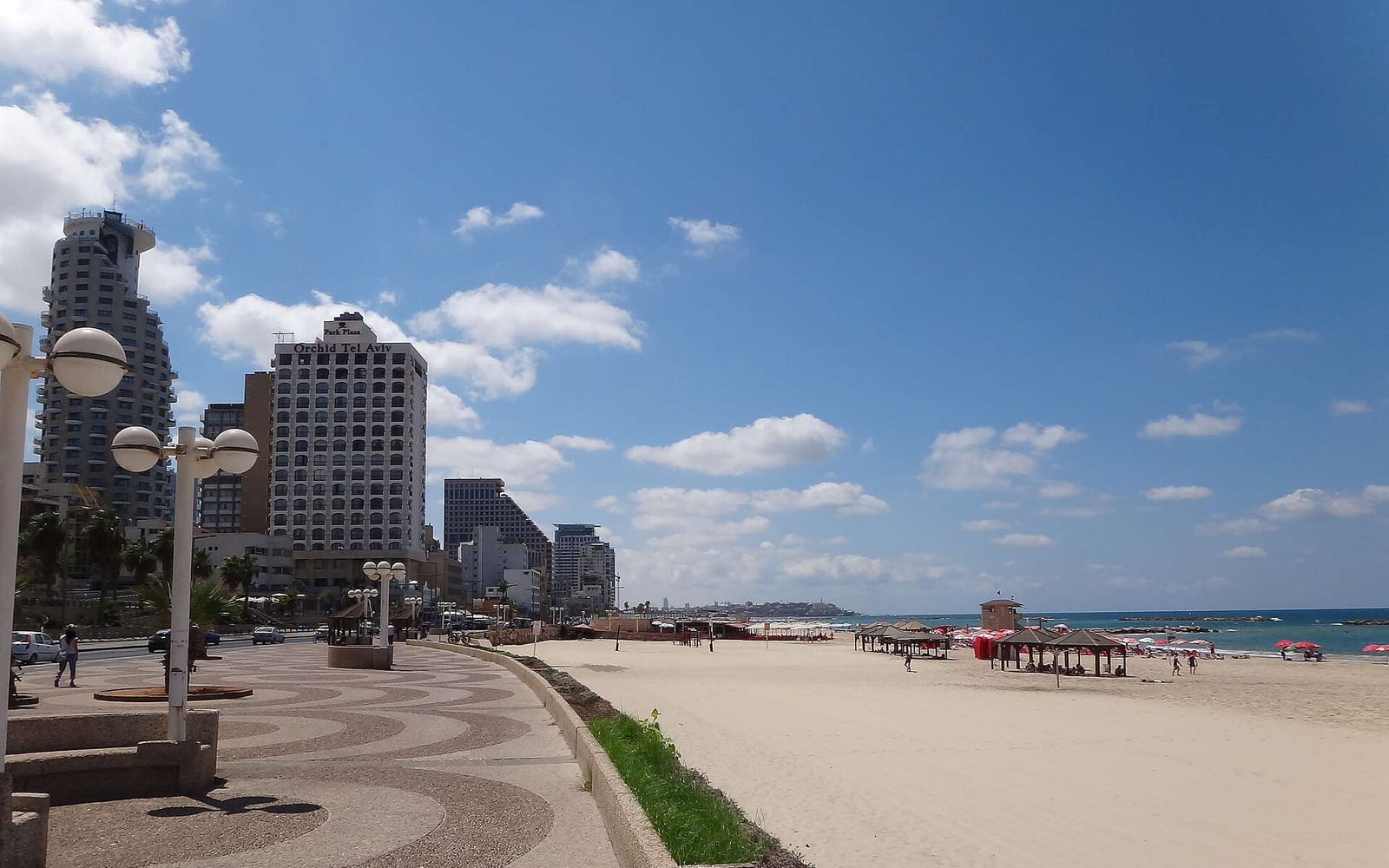
Tel Aviv is Israel’s cycling city. Over a million journeys are made by bike every month, the beachfront promenade runs uninterrupted for 12 kilometres, and the flat Mediterranean terrain means you are rarely fighting a hill. This guide covers the key routes, the Tel-O-Fun bike-share scheme, practical tips and what cycling looks like in the rest of the country.
Why Tel Aviv works for cyclists
Three things make Tel Aviv genuinely good for cycling, not just passable:
Flat terrain. The coastal strip from the Yarkon River south to Jaffa is completely flat. There is nothing to climb. This makes cycling accessible even for people who have not been on a bike in years.
Separated infrastructure. The Tayelet (beachfront promenade) and the Yarkon River park both have wide, dedicated cycling paths physically separated from car traffic. On these routes you are not competing with vehicles. The city also has painted bike lanes on Rothschild Boulevard, Ibn Gvirol, Ben-Gurion Avenue and sections of Allenby — not always separated, but marked.
Density and distance. Most of what visitors want to see is within a 5–8km radius of the seafront. Carmel Market, the White City Bauhaus streets, Neve Tzedek, Florentin and Old Jaffa are all reachable by bike without any serious detour.
Tel-O-Fun: the city bike-share
Tel-O-Fun stations are distributed across the city, with dense coverage near the beach, Rothschild Boulevard and the main residential and commercial streets. The scheme is straightforward:
- Download the Tel-O-Fun app and create an account.
- Buy a day pass (check the app for current rates — prices change seasonally and the app always shows the live tariff).
- Unlock a bike at any station using the app.
- Return it to any station before the clock on your current leg runs too long (the first 30 minutes of each leg are typically included; longer legs add a fee).
The bikes are heavy three-speed city bikes. They are not suited to long-distance touring or anything approaching sport cycling, but for the Tayelet-to-Jaffa run or a White City neighbourhood loop they are entirely adequate. The main limitation is station availability in peak hours — near popular beaches on summer weekends, all bikes are sometimes out. Check the app’s live availability map before walking to a station.
Key routes
1. The Tayelet: beach promenade
The Tayelet runs from the mouth of the Yarkon River in the north to the Jaffa hill in the south — a continuous 12km path beside the Mediterranean. This is the flagship cycling route and the busiest: weekday mornings see commuters and joggers; evenings fill with leisure cyclists, families and the general city crowd. Weekends are lively to the point of slow-going in peak hours.
From north to south you pass: Nordau Beach, Gordon Beach (volleyball courts, a surf school), Frishman Beach, Ben Gurion Beach, Hilton Beach, Charles Clore Park (the first beach that is truly park-facing), and eventually the slope up into the Jaffa hill and the Jaffa flea market (Shuk HaPishpishim) area.
Allow 45–60 minutes one-way at a relaxed pace. The return leg north is equally easy.
2. Yarkon River park
The Yarkon River flows west through the north of the city, and the park along its banks has a dedicated cycle path running roughly 10km inland from the seafront. This is quieter than the Tayelet, shaded in long stretches, and passes Sportek (a sports complex with kayak rental), the Yarkon park’s stone bridge, the park gardens and, further east, the Reading power station area. It connects naturally to the Hayarkon Park cycling loop, which adds another several kilometres of car-free path around the park’s interior.
This route suits anyone wanting to escape the beach-crowd atmosphere and cycle in green space rather than beside the sea. For a deeper look at what the park offers beyond cycling — boat rental, bird sanctuary, botanical gardens and concerts — see the Hayarkon Park visitor guide.
3. White City Bauhaus loop
Rothschild Boulevard, Dizengoff Street and Bialik Street form a loose triangle through the heart of the Bauhaus White City — one of the world’s largest concentrations of International Style architecture. Rothschild has a separated bike lane running along its tree-lined centre. This loop (roughly 6–8km depending on diversions) passes the Engel House (the first pilotis building in Israel), the Bauhaus Center at 77 Dizengoff, the Rubin Museum, City Hall and dozens of rounded-balcony 1930s apartment buildings.
Best time: early morning before the boulevard fills with café tables. See the Tel Aviv White City guide for building-by-building detail.
4. Tayelet to Jaffa
Extending the Tayelet south past Charles Clore Park brings you up the slope into Old Jaffa — the ancient port, the flea market, the clock tower and the galleries of Neve Tzedek visible to the north. The Jaffa hill section is the only genuine gradient on this route (a brief 15m climb). Lock the bike at the Jaffa port area and explore on foot. This is the most popular full-day leisure combination: morning Tayelet ride, Old Jaffa afternoon, Florentin evening.
Practical tips
Lock properly. Bike theft is a genuine issue in Tel Aviv. If you are hiring a private bike rather than using Tel-O-Fun (which locks at its own stations), use a D-lock through the frame and back wheel, not just a cable lock. Chain the bike to a fixed object.
Heat. Summer cycling (June–September) is manageable on the coast where sea breezes help, but starts earlier and finishes later than you might expect from home. Aim to be on the bike before 8am or after 5pm for the Tayelet in July–August. Carry water — 1.5 litres minimum for any ride over 90 minutes. See the Israel in summer guide for heat management strategy.
Traffic lane courtesy. On roads with painted bike lanes (as opposed to separate paths), cyclists have right-of-way within the lane. Israeli drivers know this and generally respect it on lanes like Rothschild, but be assertive and visible. On roads without lanes, the situation is more mixed — main arterials are not beginner-friendly.
E-bikes. Several private hire shops near the beach and around Florentin now stock e-bikes for daily hire. This is worth knowing for anyone who wants to range further afield (Herzliya coast to the north, Bat Yam to the south) without the effort.
Cycling elsewhere in Israel
Sea of Galilee loop
The 60km circuit around the Kinneret (Sea of Galilee) is Israel’s most popular leisure cycling day. The road around the lake is flat and mostly shaded in sections, with views of the Golan Heights on the east bank and the Galilee hills on the west. Tiberias is the usual start and finish, with bike hire available in the city. See the Galilee region guide for base logistics. Best season: October–May.
Golan Heights
The Golan’s plateau roads are quiet and scenic. The section between the Katzrin junction and the Gamla nature reserve or the Banias falls works as a half-day loop with a hired mountain bike from a Katzrin-area shop. The climbs are real here — the Golan sits at 300–1,200m — so route-read before setting out.
Negev mountain biking
The Ramon Crater (Makhtesh Ramon) and surrounding trails offer technical mountain biking terrain, with volcanic rock formations, dry riverbeds and open desert. A small number of hire shops in Mitzpe Ramon stock hardtail MTBs. Strictly autumn–spring: summer heat in the Negev (38–44°C) makes trail cycling dangerous, and several trails close. See the Negev region guide for base logistics, trail access and overnight stay options in the crater area.
The southern Arava Valley, between Eilat and Kibbutz Yahel, has a newer and more extensive trail network: the Yahel–Timna singletrack, opened in 2026. This 100+ km continuous desert route threads through volcanic basalt ridges and limestone wadis before descending to Timna Park — the most technically demanding and scenically remote mountain biking in Israel. See the Arava mountain biking guide for trail details, logistics and bike hire in Eilat.
Israel National Bike Trail
The 1,200km Israel Bike Trail is a multi-week undertaking for experienced touring or mountain cyclists. Day sections of the IBT near Mitzpe Ramon and in the Upper Galilee are popular for one-day rides with a hired bike. The official site (israelbiketrail.com) publishes GPX files, stage-by-stage elevation profiles and recommended accommodation points.
Getting your bike to Israel
El Al and most carriers allow bikes as checked baggage with advance notice and standard oversized fees. Rules and fees change — confirm with your carrier before booking. For shorter visits, private hire or Tel-O-Fun is almost always the more practical option unless you are cycling the full IBT.
See Getting Around Israel for how cycling fits alongside trains, buses and car rental. For driving logistics (for accessing Galilee or Negev cycling areas), see the car rental Israel guide.