Haifa offers a different Israel from Jerusalem’s intensity or Tel Aviv’s buzz: a layered port city climbing from sea level through a coexistent Arab-Jewish neighbourhood and a 19th-century colonial quarter all the way up to a mountain ridge crowned with a UNESCO World Heritage garden that may be the most geometrically precise piece of landscape design in the country. It is also, practically, one of Israel’s most comfortable cities to visit — the only one where public buses run on Shabbat, and one of the best rail-connected nodes for exploring the north.
This guide covers the Bahá’í World Centre terraces, the Carmelit funicular, the German Colony and Wadi Nisnas, Stella Maris and the Louis Promenade, Haifa’s beaches, how to get here, and what to combine nearby.
Bahá’í World Centre
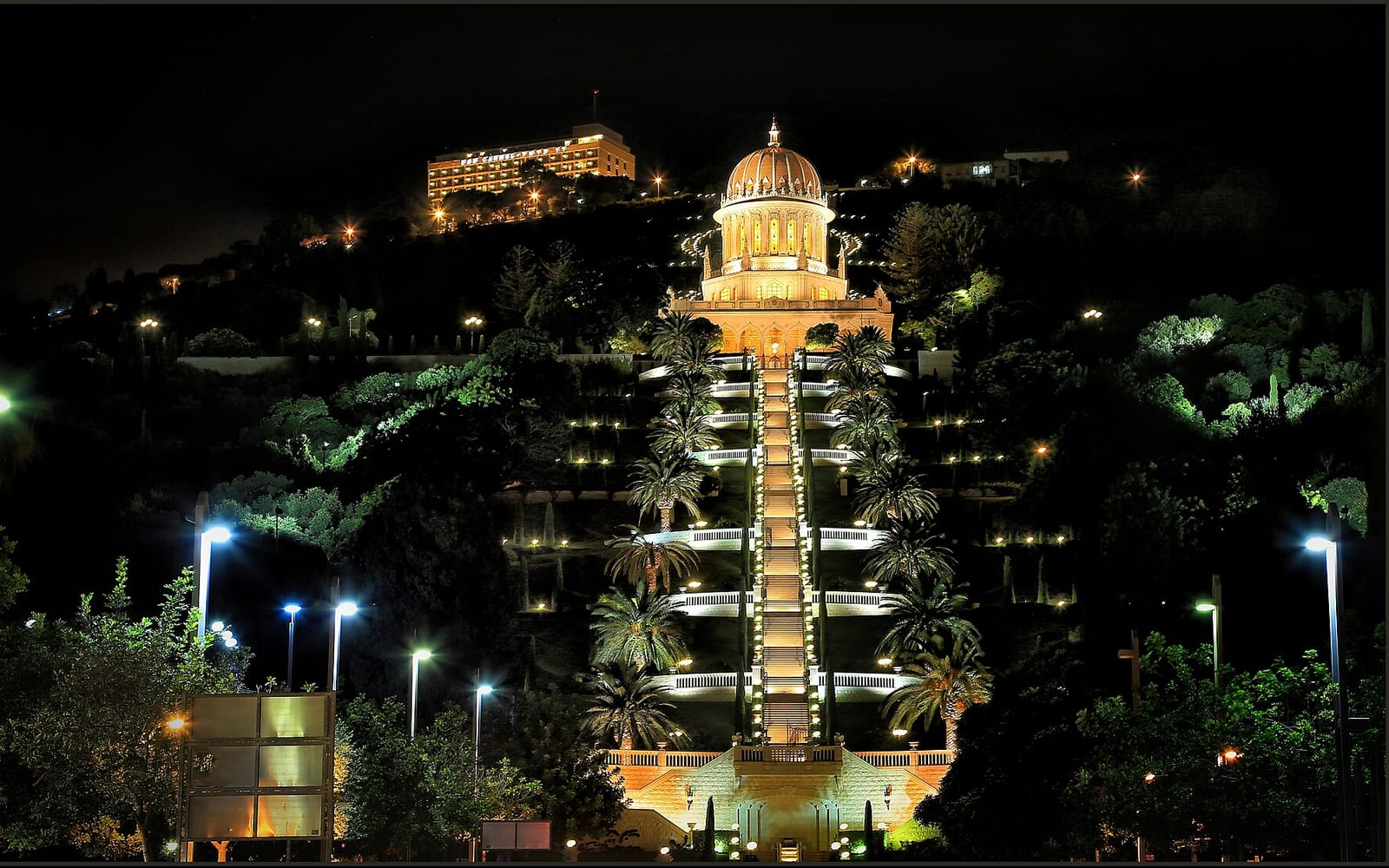
Haifa’s defining sight is the Bahá’í World Centre — a UNESCO World Heritage Site (inscribed 2008) centred on the Shrine of the Báb, the white-marble and gold-domed mausoleum of the Báb, one of the two central figures of the Bahá’í faith. Nineteen immaculate terraced gardens descend from the summit of Mount Carmel to the German Colony below, aligned on a perfect north–south axis that also points toward the Shrine of Bahá’u’lláh in Akko, four kilometres north. The geometry — fountains centred on the axis, symmetrical flights of steps, sculpted hedges — is exceptional. The view from the upper terraces over Haifa Bay and the Mediterranean rivals any viewpoint in northern Israel.
Visiting the terraces:
The terraces have two visitor modes. Free guided tours of the full 19-terrace descent run Sunday to Friday, typically departing at 09:00 — reserve via bahai-haifa.org as places fill during peak season. These tours last about 75 minutes and are led by knowledgeable volunteers; the guides’ Bahá’í faith backgrounds give the visit a depth that self-guided walking cannot replicate. Self-guided walking is permitted on the upper nine terraces during separate public hours (generally Sunday to Thursday 09:00–17:00; Friday 09:00–13:00 — verify current hours before you go). Photography in the terraces is welcome; photography inside the Shrine of the Báb is not permitted.
Practical tips:
- The terraces are open-air; bring sun protection in summer and a layer in winter — the elevation makes it cooler than the port below
- The steep staircase descent is around 270 metres of vertical; wear comfortable shoes; the garden paths can be slippery after rain
- The shrine is at mid-mountain, not the summit; the upper end is at the Carmel ridge (accessible by Carmelit)
- Combine with the German Colony (lower end of the garden axis, a 5-minute walk below the terrace exit)
For the complete picture — including dress code, Bahá’í holy day closures, the Akko Bahjí and Ridván Garden sites, and a two-day circuit — see the Bahá’í World Centre complete visitor guide.
German Colony & the lower city
At the foot of the Bahá’í Gardens axis, the German Colony — Moshava Germanit — is the best street in Haifa for food, coffee and atmosphere. The stone buildings lining Ben Gurion Avenue were constructed in the 1860s–1880s by members of the German Templer Society, a Protestant sect who believed they were preparing Palestine for the Second Coming. The arcaded houses, carved lintels and courtyard gardens have been beautifully restored as restaurants, wine bars and boutique shops. The Colony is most lively on Friday afternoons and weekend evenings; during Shabbat it is one of the few places in Haifa where secular life continues visibly.
Recommended stops on Ben Gurion Avenue: the Colony Hotel for its courtyard garden; Fattoush restaurant for Arab-Israeli mezze (one of Haifa’s most famous addresses and often crowded); Décks for seafood on the Bahá’í Gardens side. The weekly German Colony Night Market (typically summer Thursdays) fills the boulevard with street food and artisan stalls. For a full restaurant guide to the Colony, Wadi Nisnas and the port district, see the Haifa food guide.
Wadi Nisnas
A ten-minute walk northeast of the German Colony, Wadi Nisnas is one of the most photographed neighbourhoods in Israel and one of the most genuinely lived-in. It is an Arab-Israeli neighbourhood — predominantly Christian Arab — where artists and café owners have set up alongside long-established family homes. The neighbourhood’s Gallery Garden project covered its narrow alleys with murals and sculptures, making it into an open-air museum that can be walked in 30–45 minutes.
Key address: Al-Pasha restaurant on Jaffa Street, known for the Haifa-style version of Palestinian-Arab home cooking; and the small market alley off HaSmadar Street where street-food vendors sell sabich (fried aubergine sandwich), freshly squeezed pomegranate juice and pastries. Wadi Nisnas is busiest on weekday mornings; quieter on Shabbat (Saturday), when some stalls are closed.
The Carmelit funicular
Israel’s only underground transit system, the Carmelit, is a single-track cable-car line with two counter-balanced cars that serve 6 stations climbing from Paris Square in the lower city to Gan Ha’Em Park on the Carmel ridge — a 270-metre climb through Mount Carmel over 1.8 kilometres. The ride takes about 8 minutes and the intermediate stations (Solel Boneh, HaNassi, Massada, Golomb) are worth poking your head into for the vintage Bauhaus-era station architecture.
Practical information: A single journey costs approximately ₪7; unlimited day passes are available. Operating hours are Sunday–Thursday 06:00–22:00, Friday 06:00–15:00, and Shabbat (Saturday) from nightfall to approximately 22:00 — one of the very few pieces of Israeli public transit that runs on Saturday. The Carmelit is both a useful way to reach the Carmel summit viewpoints and a minor attraction in itself.
Stella Maris & the Carmel ridge
At the top of the Carmelit, the Carmel ridge offers panoramic views over Haifa Bay, the port, and on clear days as far north as Lebanon. The most accessible viewpoint is the Louis Promenade (Tayelet Louis), a park walkway along the Carmel escarpment above the Rambam Medical Center — particularly good for photography at golden hour. Five minutes’ walk east brings you to Stella Maris Carmelite Monastery, the Order’s international mother church, built over a cave associated with the prophet Elijah. The church interior is worth the brief visit for its painted ceiling and the small adjacent Elijah’s Cave below; the terrace has a sweeping northward view toward Akko and the coast.
Gan Ha’Em Park at the upper Carmelit stop has a small zoo (good with children), a sculpture garden and cafés — a pleasant area to sit and recover from Bahá’í terrace-walking before descending.
Museums
MadaTech — National Museum of Science, Technology and Space (near the Carmelit’s Golomb station) is Israel’s largest interactive science museum and the city’s most-visited attraction for families with children. Hands-on exhibits span engineering, aviation, sustainable energy and space; a dedicated children’s section works for ages 3+. Allow 2–3 hours.
The Tikotin Museum of Japanese Art on HaNassi Boulevard (Carmel district) is the only dedicated Japanese art museum in the Middle East — a collection of prints, ceramics and swords accumulated by Felix Tikotin, a Dutch collector who donated his holdings to Haifa in 1959. Small, quiet and genuinely excellent.
The National Maritime Museum in the lower city near the port covers 5,000 years of seafaring in the Eastern Mediterranean, from ancient Phoenician anchors through Ottoman galleys to the founding of the Israeli Navy.
Beaches
Haifa has three main beach areas. Bat Galim Beach, just north of the port in the lower city, is the closest to the German Colony — a neighbourhood beach with a promenade popular with local families. Dado Beach (formally Zamir Beach), 5 kilometres south, is the largest Haifa beach with the best facilities, lifeguards and restaurants. Hof HaCarmel National Park further south is a paid-entry beach reserve with a quieter, less crowded atmosphere; the INPA pass covers entry.
Water quality on Haifa beaches varies seasonally — check the current status at ilcoast.co.il before swimming.
What to combine nearby
Akko (25 min by train north): The obvious combination — UNESCO Crusader underground in the afternoon after a Haifa morning. Trains run frequently and the Akko Old City is a 10-minute walk from the station.
Rosh Hanikra (45 min by car north): Sea grottos carved into the white chalk cliffs on the Lebanon border, with a cable-car descent to the water. Best combined with Akko as a full northern day.
Caesarea (45 min south by car or train): Roman theatre, Herodian harbour and Crusader walls south of Haifa — see the Caesarea guide.
Carmel Druze Villages (40 min by car): Daliyat el-Carmel and Isfiya on the Carmel mountain ridge — Druze market street, pita-and-cheese street food fresh off the saj, and the El-Muhraka Carmelite Monastery with a panoramic Jezreel Valley view. Saturday is the busiest market day. No direct public bus; car or organised tour required.
Beit She’arim Necropolis (30 min east by car): A UNESCO World Heritage Site (2015) comprising 33 rock-cut Jewish catacombs from the 2nd–4th century CE, including ornate sarcophagi, menorah carvings and multilingual inscriptions. The site served as the seat of the Sanhedrin under Rabbi Judah ha-Nasi and as the premier Jewish burial ground of the Roman Empire. Rarely crowded; covered by the Israel National Parks Pass.
Zichron Yaakov (30 min south by car): A Rothschild-era winery village with vine-covered stone streets — the birthplace of Israeli wine tourism. Carmel Winery is the main address.
Atlit Detainee Camp (25 min south by car): A real British Mandatory detention facility where 16,000+ Holocaust survivors were imprisoned while attempting to reach Mandatory Palestine (1938–1948). Original barracks, an electrified perimeter fence, a full-scale immigrant ship replica, and the site of the 1945 Night of the Raiders rescue by Palmach — one of the most emotionally powerful Jewish heritage sites in Israel. English tours by advance booking.
Getting there & getting around
From Tel Aviv: Israel Railways coastal train from Tel Aviv Savidor Center or Tel Aviv HaShalom to Haifa Hof HaCarmel (south; near German Colony) or Haifa Merkaz HaShmona (city centre). Journey: 55–65 minutes, frequent departures. By car: Highway 2 north, 55–75 minutes. See also the Tel Aviv to Haifa transport guide.
From Jerusalem: Train via Tel Aviv (~2 hours total) or direct express bus (~1h 45min). By car: Highway 1 to Highway 2 via Tel Aviv, 1.5–2 hours.
By air via Haifa Airport (HFA): If you are arriving from Eilat, Cyprus or the Greek islands, Air Haifa flies directly to Haifa International Airport (HFA) — 4 km from the city centre. This is particularly useful for travellers ending a southern Israel trip and flying north, or those arriving from a Greek island summer break without routing via Ben Gurion.
Within Haifa: The Carmelit connects the lower city (Paris Square) to the Carmel ridge in 8 minutes. City buses cover the rest, including Bat Galim beach and the Carmel ridge hotels, and uniquely in Israel they operate on Shabbat. Taxis and Gett are readily available. The German Colony, Wadi Nisnas, the port promenade and the Bahá’í Gardens lower terrace are all walkable from each other (15–20 minutes flat).
Planning your visit
For a full breakdown of which neighborhood suits your trip — German Colony, Wadi Nisnas, Hadar, Merkaz HaCarmel, Bat Galim or the Port area — see the Haifa neighborhoods & where to stay guide. For specific hotel picks at every tier — Colony Hotel Haifa (German Colony boutique), Dan Carmel (ridge panorama), and Port Inn (budget) — see the best hotels in Haifa guide.
One full day: Morning — Bahá’í Gardens guided tour (book ahead; 09:00 start), followed by the German Colony for lunch. Afternoon — Wadi Nisnas neighbourhood walk, Carmelit up to the Carmel ridge, Stella Maris, Louis Promenade sunset. Return by train to Tel Aviv or Jerusalem by 21:00.
Two days: Day 1 as above. Day 2 — Akko in the morning (train, 25 min), afternoon free in Haifa or Rosh Hanikra by car. Alternatively use Day 2 for MadaTech (families) or the Carmel Druze villages.
Three days: Use the 3 days in Haifa itinerary — the complete day-by-day plan covering the Bahá’í Terraces, Wadi Nisnas, the Carmel market, Druze villages and Stella Maris, with transport and hotel guidance.
From a cruise ship in Haifa port: Haifa opened a new cruise terminal in May 2026 — the largest in Israel — with doubled capacity, 28 immigration booths, currency exchange, duty-free and a direct bus to the city centre. The German Colony is a 10–15 minute walk or short taxi from the terminal. The Bahá’í Gardens terrace base is another 10 minutes beyond that. See the Haifa cruise terminal guide for arrival logistics and the best shore excursion options, or the cruise shore excursions guide for the full comparison with Ashdod port.
For an honest side-by-side comparison of every Haifa tour format — Bahá’í Gardens city tour, Haifa + Akko day trip, Haifa + Akko + Rosh Hanikra and the cruise shore excursion — with a decision guide and where to book, see the Haifa tours compared guide.
Paragliding from the Carmel ridge: The west-facing slopes of Mount Carmel south of Haifa (near Atlit) are Israel’s main commercial paragliding area, generating reliable sea-breeze lift on most afternoons October–June. Tandem flights with CAAI-licensed instructors are available from operators based in the area — no experience required. See the Israel paragliding guide for operator details and seasonal advice.
Haifa International Film Festival (October 1–10, 2026): Israel’s oldest and largest film festival — 280+ screenings, 300,000+ attendees, free outdoor evenings in Hadar HaCarmel and Carmel Center squares — runs each October at Cinematheque Haifa and across the city. The 41st edition opens October 1, which aligns with Sukkot Hol HaMoed in 2026. See the full Haifa International Film Festival guide for tickets, venues, and how to combine the festival with Haifa sightseeing.