Jaffa (in Hebrew, Yafo) is one of the world’s oldest inhabited port cities — its harbour mentioned in Egyptian records from the 15th century BCE, its Phoenician-era name found in the Bible. Today it forms the southern anchor of the Tel Aviv municipality, and for visitors it offers everything its northern neighbour does not: Ottoman stonework, Byzantine lanes, a medieval port, and a food scene rooted in the hummus institutions, 24-hour bakeries and seafood restaurants that have been here for generations.
A 15-minute walk south along the beach promenade from central Tel Aviv, Jaffa is the obvious extension to any city stay — and, for visitors based in Jerusalem, an easy high-speed train ride away.
The Old Port (Nof Yam)
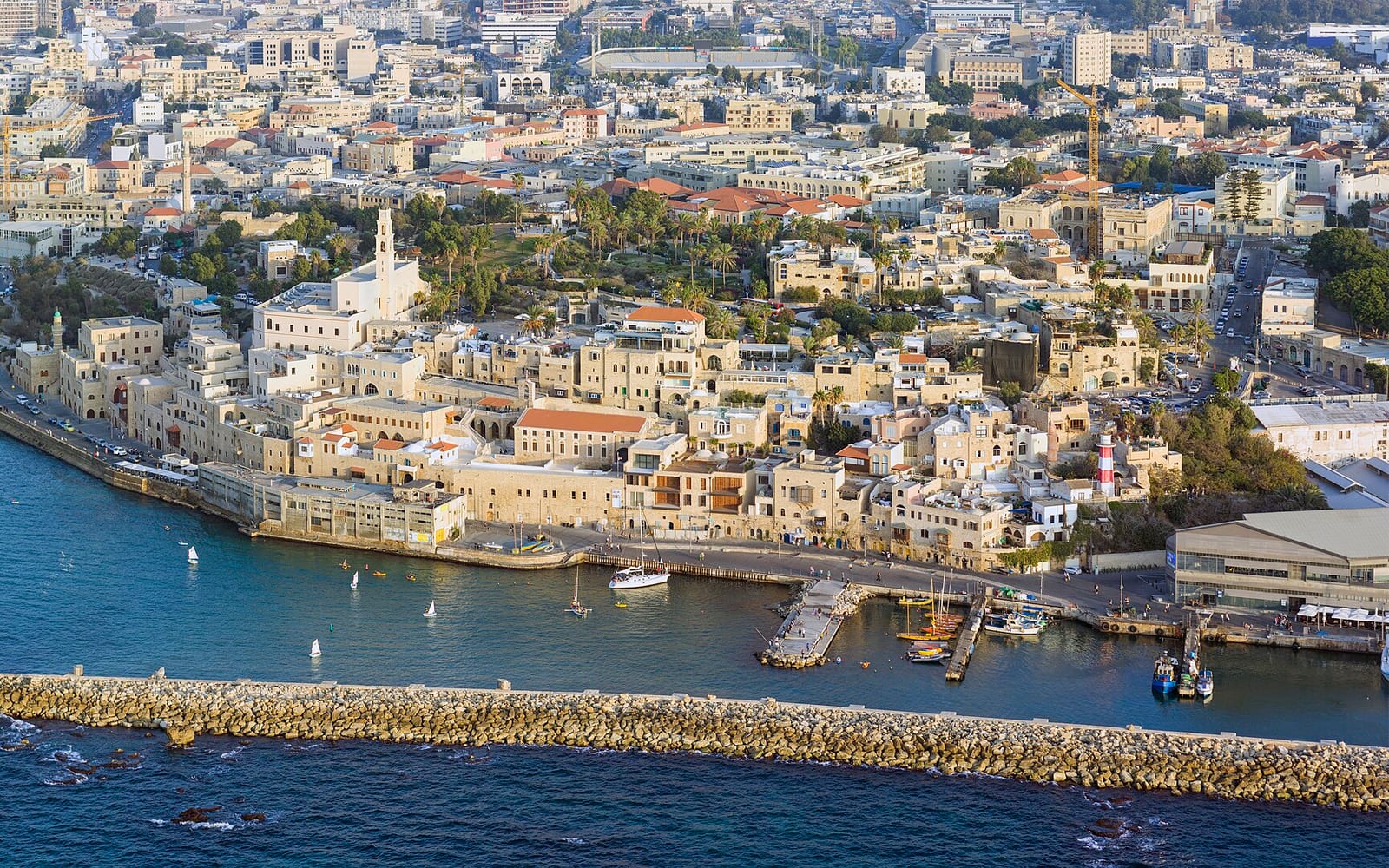
Jaffa’s ancient harbour is 3,500 years old and still working — fishing boats sit alongside converted warehouse galleries, event spaces and restaurants, their hulls almost close enough to touch from the wooden boardwalk that runs along the harbour’s edge.
The port’s history layers on every surface: Crusader-era walls visible at the base of modern buildings; Ottoman arches repurposed as café entrances; British Mandate-era bollards still mooring pleasure craft. The seafront promenade offers some of the finest sunset views in Israel — the light catches the water, the old stone and, on clear evenings, the tower blocks of central Tel Aviv receding north.
The restaurant strip inside the converted port warehouses runs from upscale fish restaurants to casual outdoor tables. Kalamata, the fine-dining flagship of celebrity chef Haim Cohen inside the port complex, is one of the best Mediterranean-Israeli restaurants in the country — advance reservation essential. For a more casual meal, several seafood grills operate on the waterfront with outdoor seating and views of the harbour.
The Clock Tower and starting a walking tour
The Ottoman Clock Tower at the southern end of Jerusalem Boulevard — built in 1906 to mark the 25th anniversary of Sultan Abdulhamid II’s reign — is the natural starting point for exploring Old Jaffa on foot. The limestone tower is a landmark navigational anchor in a warren of curved lanes that can disorient even experienced visitors.
From the Clock Tower, the lanes curve south and west toward the port, passing through a neighbourhood that has been continuously inhabited across Canaanite, Israelite, Assyrian, Greek, Roman, Byzantine, Arab, Crusader, Mamluk, Ottoman and British periods. Every major empire in the ancient world left something here.
The Napoleon Statue at the entrance to St Peter’s Church — a 19th-century Franciscan pilgrimage church built on a Crusader foundation — recalls the brief French occupation of 1799. The church courtyard contains the original Crusader column and an unusual collection of carved olive wood. It is an active place of worship; modest dress is appreciated and the interior is open to visitors outside services.
The Ilana Goor Museum
Halfway between the Clock Tower and the port, the Ilana Goor Museum occupies an 18th-century Ottoman caravanserai that the sculptor Ilana Goor converted into her home, studio and gallery over several decades. The building itself — stone vaulted ceilings, roof terraces with harbour views, irregular rooms stacked across four floors — is as interesting as the 500-piece eclectic collection inside.
Opening hours: Wednesday–Monday 10:00–16:00 (check the museum’s official site for current hours before visiting as schedules change seasonally). Admission is a modest entrance fee. The rooftop view of the port is worth the climb alone.
The Jaffa Flea Market (Shuk HaPishpeshim)
South of the Clock Tower, the Jaffa Flea Market (Shuk HaPishpeshim — literally “the flea market”) spreads through a cluster of lanes between Olei Zion Street and HaPishpeshim Street. It is one of the best markets in the Middle East for antiques, vintage furniture, Judaica, collectibles, ceramic art, vinyl records and secondhand clothing.
When to go: Sunday morning is the peak — the most stalls, the best selection, and the highest energy. Some stalls also open on Saturday nights (after Shabbat ends). On weekdays the market thins significantly — good for browsing without crowds, less reliable for choice.
What to expect: Fixed-price stalls (books, records, small objects) sit alongside dealers who expect negotiation (furniture, paintings, ceramics). Starting an offer at around half the asking price on un-tagged items is normal practice. Cash is strongly preferred — bring shekels.
The surrounding lanes now also host a cluster of independent cafés, concept stores and design studios that have moved in around the antiques trade, making the Flea Market area one of the more architecturally interesting parts of Jaffa for an afternoon browse even outside of market hours.
The food: hummus, bakery and the port
Abu Hassan (Ali Karavan)
Abu Hassan — the institution, opposite the market entrance on Dolphin Street — is the hummus pilgrimage site in Jaffa. The hummus arrives fresh each morning and typically sells out by noon, sometimes earlier on weekends. The format is simple: creamy hummus in a range of preparations (with foul, with a hard-boiled egg, with chickpeas, plain), served with fresh warm pita and raw onion. The experience is worth the queue.
Opening: typically weekdays from early morning until sold out, usually by midday — call ahead or arrive early; do not plan your day around a specific Abu Hassan lunch unless you arrive before 10am. Cash only. There are no reservations and no advanced booking.
Abouelafia Bakery
Near the Clock Tower, Abouelafia is one of the oldest and most reliable bakeries in Jaffa — open 24 hours, seven days a week, including on Shabbat, which makes it an essential stop for observant and non-observant visitors alike on Friday nights and Saturdays. The za’atar pita (flatbread brushed with oil and dried herbs), cheese-filled burekas and sesame rings are the classics. Prices are very low — this is genuinely cheap eat in an increasingly expensive city.
Port seafood and fine dining
The port warehouses house several seafood restaurants with outdoor terraces and harbour views. For a special occasion, Kalamata by Haim Cohen is one of the finest tables in Israel — Mediterranean-Israeli tasting menu, exceptional ingredients, advance booking essential via the restaurant’s website.
Jaffa history: the brief, honest version
Jaffa was a predominantly Arab city before 1948. In the final months of the 1948 Arab-Israeli War, most of Jaffa’s Arab population — estimated at 50,000–70,000 people — fled or were expelled as Israeli military operations advanced. After Israel’s independence, Jewish immigrants moved into the largely emptied city; Jaffa was formally merged with Tel Aviv in 1950.
Today, Jaffa has a mixed Jewish and Arab population of roughly 50,000. It is genuinely a working mixed neighbourhood — Arab-Israeli families living alongside Jewish residents, Arabic-language shops alongside Hebrew ones, mosques and churches within walking distance of synagogues. This coexistence is real and visible in daily life; it is also set against the deep complexity of what happened here in 1948, which is worth understanding before framing Jaffa as simply a “charming mixed city.”
Getting there from Tel Aviv: Walk south along the seafront promenade (15–20 minutes from the beach hotels), take the Tel Aviv Red Line light rail south, or use Gett/Yango rideshare apps (around 10 minutes from city centre in light traffic).
Getting there from Jerusalem: The high-speed train reaches Tel Aviv in ~45 minutes; from Tel Aviv HaShalom, a short rideshare heads south to Old Jaffa. Excellent as a day trip from Jerusalem.
Parking: Limited and expensive around the Old City. If driving from outside the city, park in central Tel Aviv and walk south.
What to bring: Cash in shekels for the Flea Market and Abu Hassan; comfortable shoes for cobblestone lanes; a light layer for evenings at the port.
Flea Market hours: Sunday morning for the best selection; some stalls open Saturday nights. Most stalls closed on weekdays. The cafés and galleries in the surrounding lanes are open throughout the week.
Port restaurants: Vary by season — busiest April to October; reduced winter hours. The waterfront fills quickly on warm evenings; arrive early or book ahead.
Combining Jaffa with Tel Aviv
The natural itinerary from any Tel Aviv base is: Old Jaffa in the morning (Clock Tower → port → hummus at Abu Hassan) → Carmel Market for afternoon browsing (full guide to Carmel Market) → beach promenade walk north → dinner in Florentin or along Rothschild Boulevard.
For architecture enthusiasts, the White City Bauhaus walking route begins a 10-minute walk north of the Carmel Market — Jaffa and the White City make a complete full-day itinerary.
For visitors interested in Jaffa’s food specifically, a guided food tour is the most efficient way to taste across the hummus institutions, market stalls and bakeries in 3–4 hours with local context.
For hotels in Jaffa — from the converted 19th-century French hospital at The Jaffa Hotel to mid-range boutique options in the Clock Tower district — see the Jaffa hotels guide.
For the broader shopping picture — what to buy across Israel’s markets, Old City bazaars, Dead Sea cosmetics, Israeli wine and Judaica — see the shopping in Israel guide.
Visiting during Ramadan? Jaffa’s Arab food scene is at its most festive in the evenings during Ramadan — the Clock Tower area and Yefet Street come alive after iftar with lanterns, street food and community gatherings. See the Ramadan in Israel guide for what to expect.