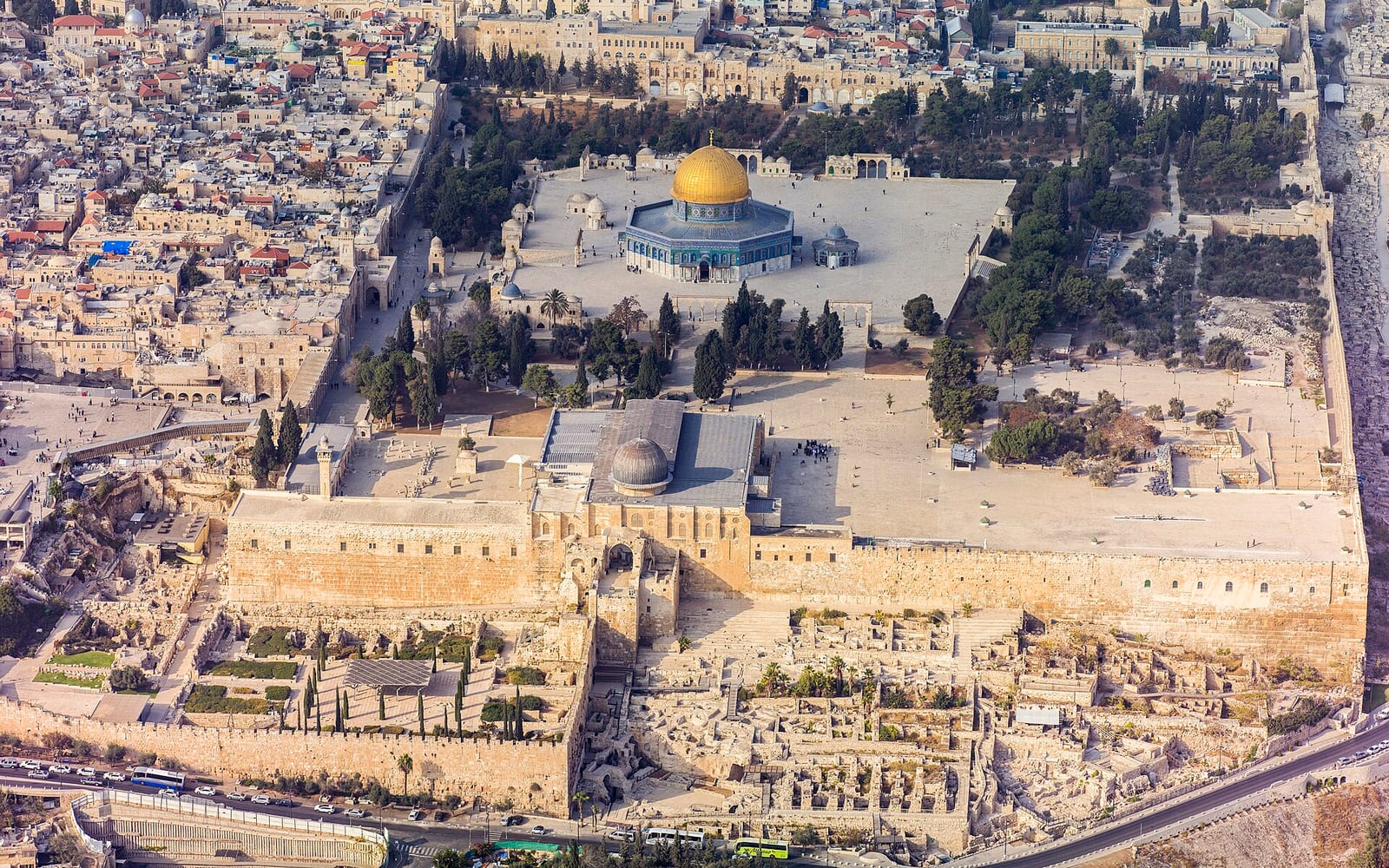
Jerusalem’s Old City is one kilometre square and contains Christianity’s most sacred shrine, Judaism’s holiest accessible site, one of Islam’s most important mosques, and an Armenian cathedral that predates the Crusades. This self-guided walk covers all four quarters in sequence — a 3 to 4 kilometre loop — that takes between 4 and 5 hours at a comfortable pace. No reservation is required for the route itself; specific sites that benefit from advance booking are noted below.
Before you start
Entrance gate: This route begins at Jaffa Gate, the main tourist entrance on the western face of the Old City walls. Jaffa Gate is served by light rail Line 1 (Jaffa Gate stop), bus connections from the city centre, and a 10-minute walk from Jerusalem’s Central Bus Station. By taxi from Jerusalem Yitzhak Navon railway station, the fare is approximately ₪25–35. Parking is not available at or near Jaffa Gate — arrive by public transport or taxi.
Security check: Bag X-rays at Old City gates are standard. At Jaffa Gate, the check typically takes 5 to 15 minutes at peak hours (9am–2pm). Allow this time in your schedule.
What to carry: water (no fountains inside the Old City), covered shoulders and knees or a layer to add, offline maps downloaded, and small cash (₪20–50) for a market lunch or the Cardo entry fee.
When to go: Sundays through Thursdays work best. Fridays the Muslim Quarter becomes very crowded before and during midday prayers (1pm). On Shabbat (Friday sunset to Saturday night) the Jewish Quarter is quieter but accessible.
The route
Step 1 — Jaffa Gate (entry)
Enter through the Jaffa Gate archway. Immediately inside, you will see the Citadel (Tower of David) on your right — the medieval fortification built on Hasmonean and Herodian foundations. If archaeology and Jerusalem’s urban history interest you, the Tower of David Museum (₪50–60 entry; book online to skip the queue) is worth a 45-minute stop. Otherwise, continue straight ahead.
You are now on David Street, the main tourist artery of the Old City. It descends gently toward the market and the quarters below.
Step 2 — Armenian Quarter
Turn left immediately inside Jaffa Gate into the Armenian Quarter, the smallest and quietest of the four. The quarter has been continuously inhabited since the 5th century CE. Walk south along Armenian Orthodox Patriarchate Road.
Cathedral of Saint James: The Cathedral of Saint James (Surp Hagop) is one of the most atmospheric churches in Jerusalem. Built on 12th-century Crusader foundations over an older Armenian church, it houses the tomb of James the Apostle and the head of John the Baptist in Armenian tradition. The interior is lit almost entirely by oil lamps — no electric light — and the walls are covered with hand-painted Armenian tiles. Entry is restricted to services (Monday–Friday 6am–7:30am, Saturday–Sunday 8am–9:30am; daily 3pm–3:30pm). If the timing works, step in. Even the exterior courtyard and cloister are worth 10 minutes.
Armenian ceramic shops: The Armenian Quarter is known for its hand-painted ceramic tiles — the distinctive blue-and-white style was brought from Kütahya (Turkey) in the early 20th century. Several family studios on Patriarchate Road sell directly. Prices are higher than market stalls elsewhere, but the work is genuine.
For a deeper look at the quarter — including the Mardigian Museum, the Cows’ Garden and practical timing advice for the cathedral — see the Armenian Quarter Jerusalem guide.
Step 3 — Jewish Quarter
Continue east from the Armenian Quarter into the Jewish Quarter, reconstructed almost entirely after 1967. The architecture is clean limestone; the streets are wide and navigable.
The Cardo: Walk to the Cardo Maximus — the Roman-era main street of the city, partially excavated and displayed in situ. Byzantine mosaics on the wall show the original layout. The southern end of the Cardo is a shopping arcade; the northern archaeological section (small entry fee or included with some museum tickets) exposes column bases and the original 6th-century Byzantine paving at a lower level. This is one of the clearest examples of Jerusalem’s layered archaeology visible above ground.
Hurva Synagogue: The Hurva Synagogue (also written Hurvat Rabbi Yehuda he-Hasid) has been destroyed and rebuilt three times — the current dome, completed in 2010, is the third reconstruction. You can see its exterior from the plaza below; interior entry is available when services are not taking place. The reconstruction of the dome restored a Jerusalem landmark that had been a ruin for 60 years.
Broad Wall: A short walk east brings you to the Broad Wall — a section of Iron Age city wall from the reign of King Hezekiah (8th century BCE), preserved in an open-air section of the Jewish Quarter archaeological park. At 7 metres wide and several metres high, it is the most substantial visible remains of pre-Babylonian Jerusalem in the city.
For a deeper visit to the Jewish Quarter’s archaeological sites — the Wohl Museum mansions, the Burnt House, the Davidson Center southern-wall circuit and the Four Sephardic Synagogues — see the dedicated Jewish Quarter Jerusalem guide.
Step 4 — Western Wall Plaza
Descend to the Western Wall Plaza via the Dung Gate route (exit the Jewish Quarter eastward) or via the internal Jewish Quarter steps. A short security check (bag scan) is standard at the plaza entrance.
The Western Wall (HaKotel) is the remaining western retaining wall of Herod the Great’s expansion of the Temple Mount, built around 19 BCE. It is the holiest site in Judaism accessible to all people — the Temple Mount above is accessed by Jews and non-Jews under different rules. Men and women pray in separate sections; non-Jewish visitors are welcome in both areas. Covering head is requested (kippot available free at the men’s entrance).
Timings: The plaza is open 24 hours. Morning is the most serene time. Jewish holidays and Friday night (Kabbalat Shabbat services) bring the largest crowds and the most extraordinary atmosphere.
Western Wall Tunnels: The underground tunnel running along the full length of the Wall’s western face — exposing the complete Herodian-era wall down to its original foundation courses — requires advance booking at the Western Wall Heritage Foundation (english.thekotel.org). Slots sell out weeks ahead in peak season. See our Western Wall Tunnels guide for booking details, what you’ll see, and the exit route onto the Via Dolorosa. This is a significant add-on if you can pre-book before travelling; it is not part of the self-guided day route.
Step 5 — Muslim Quarter and Via Dolorosa
Exit the Western Wall Plaza northward through the Muslim Quarter gate. You are now in the largest and most commercially active quarter of the Old City.
Navigation: Streets here are signed in English, Arabic and Hebrew. The main commercial street is Al-Wad Road (HaGai Street in Hebrew), running north–south. Market stalls sell spices, textiles, sweets and tourist goods; vendors compete for attention. A firm “no thank you” is universally understood.
Via Dolorosa: The Via Dolorosa is the traditional route of Christ’s procession to Calvary — 14 Stations of the Cross along a 600-metre path. For the correct start, walk to Lion’s Gate (the eastern gate of the Old City, 10 minutes’ walk north from the Western Wall plaza) and begin at Station I near the Church of the Flagellation. The stations then proceed westward, ending at Stations X–XIV inside the Church of the Holy Sepulchre.
If you are following the full Via Dolorosa, allow 45 to 60 minutes for the walk itself. Franciscan friars lead a group walk every Friday at 3pm — open to anyone. See the complete Via Dolorosa station guide for station-by-station descriptions, procession timing, and the best morning windows.
St Anne’s Church: On the way to or from Lion’s Gate, the Church of St Anne (near the Bethesda Pool excavations, just inside Lion’s Gate) is worth a brief stop. This 12th-century Crusader church has extraordinary natural acoustics — a group singing inside creates a resonance that is remarkable. Entry fee is around ₪10. The Pool of Bethesda excavations in the adjacent garden (the site of a healing miracle in John 5) are included.
Abu Shukri and lunch: Abu Shukri on Al-Wad Street is the most consistently cited hummus shop in the Old City — a bowl with pita costs under ₪30 and the restaurant typically closes around 3pm. If you are walking the route midday, stop here rather than after the Church.
Step 6 — Church of the Holy Sepulchre
Follow the Via Dolorosa or signs through the Christian Quarter to the Church of the Holy Sepulchre — the site venerated by Christians as the place of the Crucifixion and Resurrection of Jesus Christ.
Entry: Free; open daily 5am–8pm (summer) / 5am–7pm (winter).
Orientation: The church is physically complex — shared since the 11th century by six Christian denominations (Greek Orthodox, Roman Catholic/Franciscan, Armenian Apostolic, Coptic Orthodox, Ethiopian Orthodox and Syriac Orthodox), each controlling specific chapels and altars.
Key spaces inside:
- Stone of Unction at the entrance: a flat marble slab where pilgrims press items and offer prayer; crowds surround it continuously
- Calvary Chapels (Golgotha): climb the steep staircase to the right of the entrance to reach the Latin altar (left) and the Greek Orthodox altar (right), where the Rock of Calvary is visible through a glass floor opening
- The Edicule (Tomb of Christ): the marble shrine over the Tomb chamber at the centre of the rotunda; queue 45 to 90 minutes is typical; arrive before 7am to enter without a significant wait; photographs allowed inside
- Ethiopian Monastery on the rooftop: accessible via exterior steps from a Christian Quarter alley — monastic cells of the Ethiopian Orthodox community built on the Crusader-era roof; quiet, atmospheric, almost always uncrowded
- Syrian Chapel / Chapel of Adam: at the rear of the ground floor, a skull-shaped rock is visible through glass, associated with Adam’s burial in Christian tradition
Photography is allowed throughout the church, including the Edicule interior.
For a fuller treatment of the Edicule queue, the six-denomination Status Quo and timing tips, see the Church of the Holy Sepulchre complete visitor guide.
Step 7 — Exit and options
From the Church of the Holy Sepulchre, you have two natural exit routes:
Jaffa Gate (10-minute walk west through the Christian Quarter): the most direct route back to public transport and taxis. Pass the Muristan shopping area (reconstructed Crusader-era market) on the way.
New Gate (10-minute walk northwest): the gate nearest to the Christian Quarter and Christian information offices; exits directly to West Jerusalem and the Notre Dame Hospice area.
Optional: Ramparts Walk. Jaffa Gate sells tickets (₪18) for the Ramparts Walk — a path along the top of the Old City walls offering elevated views over all four quarters and into the Arab and Jewish neighbourhoods beyond. The northern section (Jaffa Gate → Damascus Gate → Lion’s Gate) and the southern section (Jaffa Gate → Zion Gate → Dung Gate) can be walked separately. The northern route passes above the Muslim Quarter souq. Allow 1 hour for the southern section, 45 minutes for the northern. Note that this adds significant walking to an already full day.
Duration and distance: 3 to 4 kilometres of walking; 4 to 5 hours at a relaxed pace covering all four quarters and the major sites. Faster walkers can complete the core route in 3 hours; slower, more thorough visitors may prefer to split the route across two visits.
Accessibility: The Old City is almost entirely cobblestone and the terrain includes significant inclines and descents, particularly in the Armenian and Muslim Quarters. There is no paved wheelchair-accessible route through the core walking tour. The Western Wall plaza itself is accessible; the Hurva Synagogue, Cardo museum and some churches have partial accessibility — check individual sites. The Ramparts Walk is not wheelchair accessible.
Best time of day: Begin at 8am to arrive at the Western Wall and the Church of the Holy Sepulchre before the tour-group wave (typically 10am–1pm). An afternoon start (2pm) works well for the lighter-crowd second half of the day at the souq and Christian Quarter.
Navigation: Download an offline map before entering (Google Maps, OsmAnd or Maps.me all cover the Old City streets in detail). Paper maps are available free from the Christian Information Centre near Jaffa Gate and from the Jewish Quarter visitors’ centre.
Combining with other Jerusalem experiences
The walking tour works best as a morning activity combined with afternoon Jerusalem experiences:
- Yad Vashem Holocaust Museum: book in advance, located west of the city, best visited on a separate day or combined with a morning walking tour by taxi (not walkable from the Old City)
- Tower of David Museum: directly at Jaffa Gate entry — a 45-minute stop at the start adds historical context for everything that follows
- Mount of Olives viewpoint: 15 minutes by taxi from the Old City; the panorama above the Dome of the Rock at sunset is Jerusalem’s best single view — see the Mount of Olives complete guide for descent-walk logistics and the Gethsemane churches
- Mahane Yehuda Market: 20 minutes by light rail or taxi from Jaffa Gate; evening transformation from market to bar district starts around 8pm
See the Jerusalem tours compared guide for a review of guided-tour options across all Old City formats. For what to expect at the holy sites — dress code, security and etiquette — see the holy sites dress code guide.
Cross-links: Jerusalem · Western Wall · Church of the Holy Sepulchre · Mount of Olives guide · 1-Day Jerusalem Itinerary · Jerusalem Tours Compared · Jerusalem Food Guide · Where to Stay in Jerusalem · Day Trips from Tel Aviv