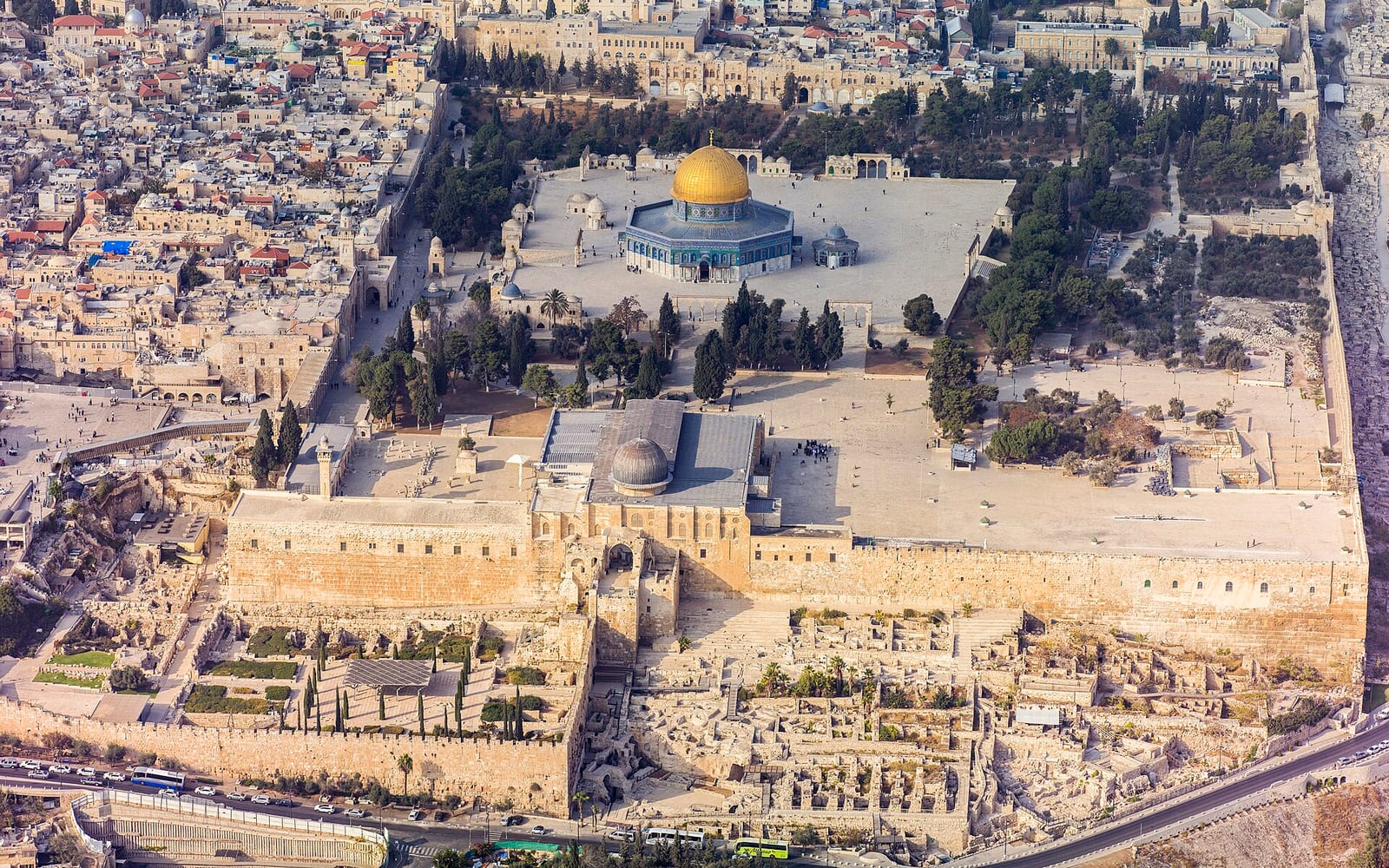
Jerusalem’s neighborhoods are more sharply divided than in any other Israeli city. The Old City’s four ancient quarters — Jewish, Christian, Muslim and Armenian — stand inside a wall from the 16th century and feel entirely separate from the modern West Jerusalem that grew up outside from the 19th century onward. Where you stay shapes not just what you can walk to but how you experience the city: inside the walls is ancient, quiet after dark and alive with pilgrims; Mamilla just outside the Jaffa Gate is polished and convenient; the German Colony’s leafy restaurant street is the city’s most relaxed base; Mahane Yehuda delivers market energy and Jerusalem’s best food scene. This guide explains each area so you can choose the right base for your visit.
Neighborhoods at a glance
| Neighborhood | Best for | Vibe | Walk to Old City gates |
|---|
| Old City — Jewish Quarter | Pilgrims, Western Wall proximity | Ancient, devotional, quiet evenings | At the Western Wall |
| Old City — Christian Quarter | Christian pilgrims, pilgrim guesthouses | Biblical streets, atmospheric alleys | Via Dolorosa access |
| Old City — Muslim Quarter | Souq immersion, lowest prices | Bustling market, lived-in | Damascus Gate |
| Old City — Armenian Quarter | Quiet atmosphere, contemplative | Walled courtyards, smallest quarter | Jaffa or Zion Gate |
| Mamilla & Jaffa Gate | Luxury and mid-range, Old City edge | Modern design meets historic walls | 5 min on foot |
| City Center / Ben Yehuda | Budget and mid-range, central | Tram-served, broad hotel range | 15 min on foot or tram |
| German Colony (Emek Refaim) | Dining, atmosphere, relaxed stays | Leafy restaurant street, stone houses | 20 min walk or tram |
| Mahane Yehuda / Nachlaot | Food-lovers, boutique, young travellers | Market energy, bar lanes | 20 min walk or tram |
Hotel prices in Jerusalem fluctuate significantly around Jewish, Christian and Muslim holidays — always check live rates before booking.
Old City — Jewish Quarter
The most spiritually charged base, two minutes from the Western Wall.
The Jewish Quarter occupies the southern section of the Old City and was largely rebuilt after 1967. It feels newer and more orderly than the other quarters — paved plazas, restored stone buildings and archaeological sites beneath street level. The Cardo (an excavated 1st-century Roman street) runs north–south underfoot; the Burnt House museum documents the destruction of the Second Temple period; the rebuilt Hurva Synagogue dominates the central square. The Western Wall Plaza begins immediately below and to the east.
Why stay here: unmatched proximity to the Western Wall and Jewish Quarter archaeological sites; the quietest and cleanest Old City streets after dark; a genuine sense of immersion that no West Jerusalem hotel can replicate. Accommodation is limited — yeshiva guesthouses and a small number of boutique properties — and demand is extremely high for Passover, Rosh Hashana and Yom Kippur. Book 3–6 months ahead for holidays.
Eat: strictly kosher options within the quarter. Restaurants cluster around Hurva Square. For a wider evening dining range, the Armenian Quarter is a few minutes’ walk.
Stay here if: proximity to the Western Wall and full Old City immersion are your primary goals. Not suited to visitors wanting nightlife or a diverse restaurant scene — the quarter observes Shabbat strictly and closes early.
Key sites: Western Wall Plaza; Hurva Synagogue; Cardo; Burnt House Museum; Ramparts Walk access from Zion Gate (south route end-point).
More: Western Wall visitor guide · Jerusalem Ramparts Walk guide · 3 Days in Jerusalem itinerary · Jerusalem Old City walking tour.
Old City — Christian Quarter
Biblical streets, pilgrim guesthouses and the Church of the Holy Sepulchre.
The Christian Quarter occupies the northwestern section of the Old City, anchored by the Church of the Holy Sepulchre — where Christian tradition identifies the crucifixion, burial and resurrection of Jesus. The Via Dolorosa — the path walked to the crucifixion — winds from the Muslim Quarter to the Church; pilgrims walk it in organised groups from early morning. The quarter has the widest range of pilgrim accommodation in the Old City: guesthouses attached to Catholic, Greek Orthodox, Armenian and Anglican institutions have operated here for centuries.
Why stay here: to walk to the Church of the Holy Sepulchre or Via Dolorosa in minutes; for historically rich pilgrim guesthouses at moderate prices (standards vary widely — request rooms in advance); for access to the adjacent Muslim Quarter souqs and to the Jaffa Gate five minutes west. Just outside the New Gate, the Notre Dame of Jerusalem Center is a higher-quality Catholic guesthouse with a rooftop restaurant and excellent Old City views.
Eat: cafés and basic restaurants near the New Gate and along Christian Quarter Road; the adjacent Muslim Quarter souq for street food and fresh juice. Limited fine dining inside the walls.
Stay here if: you are a Christian pilgrim or want Old City immersion on a moderate budget. Notre Dame (just outside the New Gate) is the best-value option in this zone with more amenities than most Old City guesthouses.
Key sites: Church of the Holy Sepulchre; Via Dolorosa stations; Lutheran Church of the Redeemer (rooftop panorama); Muristan bazaar area.
More: Church of the Holy Sepulchre guide · Jerusalem Old City walking tour.
Old City — Muslim Quarter
The largest and most market-dense quarter — the Old City’s commercial heart.
The Muslim Quarter covers the northeastern section of the Old City from Damascus Gate south to the Temple Mount/Haram al-Sharif boundary. It is the most energetic quarter, with the densest network of covered souq alleys — textiles, spices, ceramics, street food and religious goods. Damascus Gate is the main entry from East Jerusalem and one of the most photogenic gate facades in the Old City. The Via Dolorosa passes through the northern section here.
Why stay here: lowest accommodation prices in the Old City; direct immersion in the market quarter; close proximity to the Rockefeller Archaeological Museum (just outside the northeast walls). Budget-conscious visitors find the best Old City value here.
Stay here if: you want direct market-life experience and cost is a factor. Families with young children may find the dense crowd and narrow alleys tiring in peak hours. Respectful dress and awareness of local customs are standard practice.
Key sites: Damascus Gate; covered souq lanes; the upper section of the Via Dolorosa; Rockefeller Archaeological Museum (outside northeast walls).
Old City — Armenian Quarter
The quietest quarter — walled courtyards and centuries of living history.
The Armenian Quarter occupies the southwestern section of the Old City, sharing the Jaffa Gate approach with the Jewish Quarter but feeling entirely separate from it. The Armenian Patriarchate and the Cathedral of St. James (built over the tomb of St. James the Apostle, 12th century) anchor the quarter, which is also home to a resident Armenian community whose families descend in part from survivors of the 1915 Armenian Genocide. The Armenian Museum inside the Patriarchate compound holds a significant collection documenting that history.
Why stay here: the most contemplative Old City base; the quietest streets after dark; a small number of atmospheric guesthouses and apartments have opened in recent years. The Jaffa Gate approach and Mount Zion (5-minute walk through Zion Gate) are immediate.
Key sites: Cathedral of St. James; Armenian Museum; Mount Zion — Room of the Last Supper, David’s Tomb complex (Zion Gate exit, 5-minute walk). See the Armenian Quarter guide for cathedral hours, the Mardigian Museum and ceramic workshops.
Mamilla & the Jaffa Gate Corridor
The most convenient non-Old City base — luxury and design on the walls’ edge.
Mamilla is a modern open-air hotel and shopping district built directly against the western face of the Old City walls, with the Jaffa Gate — the main tourist entry — a five-minute walk from its northern end. It is the clearest option for visitors who want Old City proximity with contemporary hotel amenities. The Mamilla Hotel (boutique design; rooftop pool and terrace with unobstructed Old City views) and the King David Hotel a few minutes south on King David Street (one of the Middle East’s most storied hotels, overlooking the Old City walls from the west) are the two landmark properties; mid-range and business hotels fill in across the corridor.
Why stay here: the most direct connection between modern hotel amenities and Old City gates; pedestrian mall with restaurants open through Shabbat; 5-minute walk to Jaffa Gate and 20 minutes to the German Colony.
Eat: Mamilla’s restaurant strip runs the length of the arcade from noon until late. The Mishkenot Sha’ananim area (adjacent, with views of Jaffa Gate and Hinnom Valley) has additional upscale dining. The YMCA Jerusalem on King David Street — a 1930s landmark building with a rooftop bell tower — has a well-regarded restaurant.
Stay here if: you want the fastest Old City access without sleeping inside the walls, or you are looking for a luxury or upscale mid-range hotel within walking distance of the main sites.
Key streets: Mamilla Avenue (arcade + hotels); King David Street (hotel strip); Keren Hayesod for mid-range options toward the center.
City Center / Ben Yehuda / Jaffa Road
The practical hub — good connectivity and the widest hotel price range.
Central Jerusalem — the pedestrian Ben Yehuda Street and the Jaffa Road light-rail corridor — is the city’s functional center for practical visitors. The Light Rail (Red Line) runs along Jaffa Road from the Central Bus Station through here and on toward the Old City, making every other Jerusalem neighborhood accessible in under 20 minutes. The Abraham Hostel (Jerusalem’s best-known backpacker hostel, with a strong community of tour-joining travellers) is in this zone; mid-range business hotels fill Jaffa Road and the adjacent streets.
Why stay here: the broadest hotel price range in Jerusalem; tram access in both directions; a central base if you plan to move between neighborhoods daily without needing to be in any particular one.
Eat: Ben Yehuda Street has cafés and mid-range restaurants; the Mahane Yehuda market is a 10-minute walk west; the central zone covers the widest everyday price range, from street falafel to sit-down restaurants.
Stay here if: you want flexibility, value for money and good public-transit access rather than proximity to a specific neighborhood’s character.
German Colony (Emek Refaim Street)
Jerusalem’s most relaxed neighborhood — the best base for longer stays.
The German Colony — named for the 19th-century German Templer Society members who built its stone houses from the 1870s onward — runs along Emek Refaim Street from the junction with Derekh Beit Lehem south to Liberty Bell Park. It is the Jerusalem neighborhood that locals consistently recommend to visitors who want to walk around, eat well and breathe without feeling that every surface carries a religious or historical claim. The architecture is quieter — restored stone houses, café terraces, wine bars — and the scale is residential.
Why stay here: Jerusalem’s best concentration of quality restaurants on a single walkable street; adjacent to Liberty Bell Park (green space with a replica of the Philadelphia Liberty Bell, popular with families and joggers); 20 minutes by light rail north to the Old City perimeter or south to Teddy Stadium. Several boutique guesthouses in restored Templer buildings and good mid-range apartments line the street and the quieter lanes off it.
Eat: Emek Refaim delivers genuine restaurant variety: morning cafés, lunch spots (Israeli-Mediterranean, Asian fusion, sushi), evening wine bars and late-night dining. Some restaurants remain open on Shabbat in this less-observant neighborhood. The nearby Baka and Katamon residential streets south add more independent options.
Stay here if: you plan two or more Jerusalem nights and want a base rather than just a bed; if food culture, architecture and a pace that lets you think are important; if you want the feeling of living in a Jerusalem neighborhood rather than staying in a hotel zone.
Key streets: Emek Refaim Street (the main axis); Lloyd George Street for side-street cafés; Rachel Imenu Street linking toward Liberty Bell Park.
Mahane Yehuda / Nachlaot
Market energy, craft bars and the best street food in Jerusalem.
The Mahane Yehuda market — the Shuk — is Jerusalem’s most vivid daily-life experience: 250+ stalls selling spices, produce, pastries, cheeses, halva and street food six days a week, closed Shabbat. Thursday and Friday afternoons see the city converge on the market for pre-Shabbat shopping; in the evenings from around 20:00, the stalls transform into a bar and live-music scene that continues until late. Nachlaot — the honeycomb of small residential lanes immediately east and south of the Shuk — is the most bohemian corner of West Jerusalem: narrow alleyways, community gardens and a concentration of musicians, artists and young professionals.
Why stay here: immediate access to the Shuk and to the city’s most distinctive food and bar scene; boutique guesthouses and apartment rentals in Nachlaot’s lanes that feel unlike any standard hotel; the most local-feeling Jerusalem base outside the Old City. The light rail (Mahane Yehuda stop) runs directly toward the Old City and the center.
Eat: the Shuk itself — one of the best food markets in the Middle East — is the main draw. Jerusalem food guide covers market dining in detail. Agripas Street and the lanes off it have the city’s best selection of evening restaurants and craft bars.
Stay here if: food culture and local atmosphere matter as much as ancient history; you want to experience how Jerusalemites actually live and eat; you are a repeat visitor who has seen the Old City and wants the city’s other dimension.
Key streets: Agripas Street and Mahane Yehuda Street (market lanes); Nachlaot’s labyrinth of small residential alleys (Betzalel, Rav Kook, Nahman Barauch, etc.).
More: Jerusalem food guide.
Getting around Jerusalem
The Light Rail (Red Line) connects the Central Bus Station in the west through the city center — Ben Yehuda area, Mahane Yehuda stop, Jaffa Road — to the Jaffa Gate perimeter at the eastern end. A single ride costs approximately ₪6 and covers most West Jerusalem neighborhoods in under 20 minutes. Taxis (Jerusalem yellow taxis; Gett app is available) operate throughout the city and through Shabbat when the rail stops. Note that buses and the light rail pause from roughly 15:00 Friday until Saturday night.
Within the Old City, everything is on foot. The lanes are pedestrian-only and distances are short: Jaffa Gate to the Western Wall Plaza is a 10-minute walk; from the Western Wall to the Church of the Holy Sepulchre is another 10 minutes through the Jewish and Christian Quarters.
Parking: driving into the Old City is not possible. For West Jerusalem neighborhoods, the central Mamilla parking garage (largest in the center, underground) is the practical option for visitors arriving by car. The German Colony and Mahane Yehuda have limited street parking — arrive early or use the light rail from a park-and-ride.
More: Getting around Israel · Day trips from Jerusalem · Where to stay in Jerusalem · Best hotels in Jerusalem.