Israel and Jordan share the most intriguing border in the Middle East, and together they account for some of the most extraordinary sights on earth: Jerusalem, the Dead Sea, Petra and Wadi Rum within a few hours’ drive of one another. For travellers planning a Middle East trip, the question of Israel or Jordan — or both — is one of the most common comparison searches, and one of the most genuinely interesting to untangle.
Side by side
| Criterion | Israel | Jordan |
|---|
| Best known for | Jerusalem, the Dead Sea float, Tel Aviv, the Galilee | Petra, Wadi Rum desert, Aqaba Red Sea, Jerash |
| Historical focus | Jewish, Christian and Islamic — 3,000 years in a compact footprint | Nabataean (Petra), Roman (Jerash), Crusader, Biblical |
| Unique drawcard | Walking the Western Wall/Church/Dome of the Rock in 20 min | Petra’s Treasury at sunrise, Wadi Rum under stars |
| Coastline | 273 km Mediterranean + Red Sea (Eilat) | 27 km Red Sea coast (Aqaba) |
| Typical mid-range daily cost | ₪600–900 / person (approx €150–230) | Lower — especially on accommodation and food |
| Visa | ETA-IL (~USD 7, online) | Jordan Pass (includes visa + 40+ sites) or visa on arrival |
| Flight time from London | ~4.5 hrs (Ben Gurion, TLV) | ~5 hrs (Queen Alia, AMM) |
| Flight time from New York | ~10–11 hrs (TLV) | ~12 hrs (AMM) |
| English coverage | Very high — widely spoken in tourist areas and beyond | Good in tourist zones (Petra, Amman, Aqaba); variable elsewhere |
| Best season | Spring (Mar–May) and autumn (Sep–Nov) | Mar–May and Sep–Nov (avoid summer heat in Wadi Rum and Petra) |
| Best for | Historical density, urban energy, beaches, compact geography | Petra, desert adventure, Roman archaeology, Bedouin culture |
History and monuments
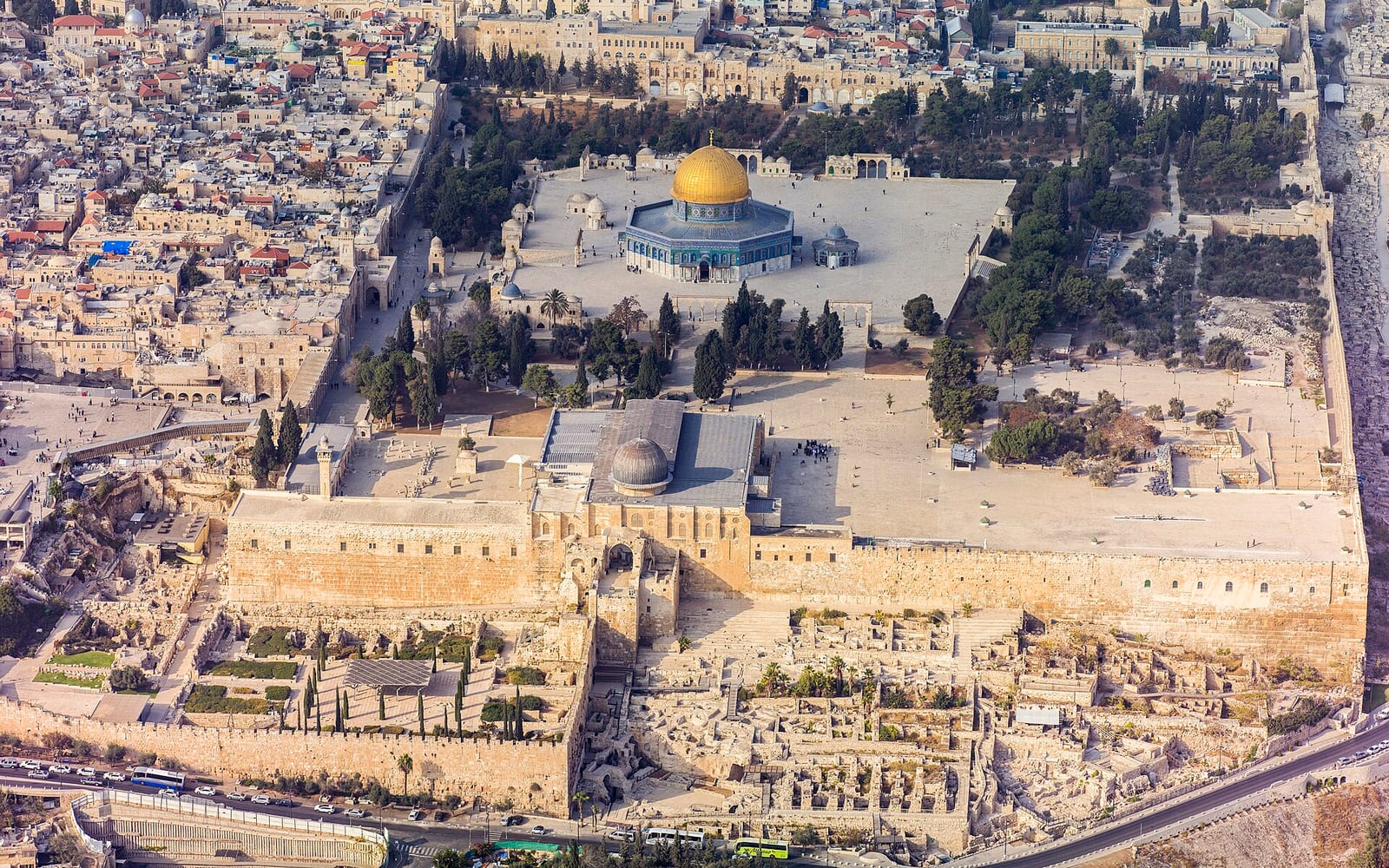
Israel offers historical density unmatched almost anywhere on earth. In Jerusalem, you can walk in 20 minutes from the Western Wall — the holiest site in Judaism — to the Church of the Holy Sepulchre — the site of the Crucifixion and Resurrection in Christian tradition — to the Al-Aqsa Mosque and Dome of the Rock on the Temple Mount. Three of the world’s major religions share the same hilltop, and the archaeology beneath it spans 3,000 years. The Masada fortress, Caesarea Roman port city, Akko Crusader city and Qumran Dead Sea Scrolls site add further depth.
Jordan’s singular achievement is Petra — the Nabataean rose-red city carved into sandstone cliffs, occupied from around the 4th century BCE and at its peak one of the ancient world’s great trading hubs. The approach through the Siq canyon, the first glimpse of the Treasury (Al-Khazneh), and the scale of the Monastery (Al-Deir) reached after 800 steps are experiences that do not disappoint even the most seasoned travellers. Jordan also hosts Jerash — one of the best-preserved Roman provincial cities in the world, with colonnaded streets, two theatres and a triumphal arch — Madaba’s famous Byzantine mosaic map of the Holy Land, and the Crusader-era Karak Castle.
For layered multi-faith history across the broadest civilisational sweep, Israel wins on density. For the singular spectacle of Petra — a site that appears on virtually every “bucket list” list for good reason — Jordan is irreplaceable.
Adventure and landscapes
Wadi Rum gives Jordan one of the most extraordinary desert landscapes in the world: a vast sandstone and granite wilderness, home to Bedouin communities, used as a filming location for Lawrence of Arabia, The Martian and Star Wars: Rogue One. Jeep tours, camel treks and overnight desert camps under an extraordinarily dark sky make Wadi Rum a destination in its own right. The terrain is genuinely spectacular.
Israel’s adventure offer spans the Negev Desert crater landscape (Makhtesh Ramon — the world’s largest erosion crater), Eilat’s Red Sea diving and coral reef snorkelling, water hiking in the Galilee, the Israel National Trail (a 1,000+ km long-distance route from Eilat to the Lebanese border), and Via Ferrata climbing routes in the north. Israel’s adventure offer is more varied across the country; Jordan’s is more concentrated and more dramatically scaled in Wadi Rum.
For desert adventure at the most dramatic scale, Jordan’s Wadi Rum is hard to match. For variety across desert, sea, mountains and water hiking without driving long distances, Israel delivers more per kilometre.
The Dead Sea
The Dead Sea is shared — its northern shore belongs to Israel (Ein Gedi, Kalia Beach) and its eastern shore belongs to Jordan (Dead Sea Spa Hotels at Sweimeh). From either side, the experience of floating in water 10 times saltier than the Mediterranean is the same. The Israel Dead Sea guide covers the practical detail for the Israeli shore; Sweimeh covers the Jordanian comparison in detail.
The Israeli shore is more accessible by public transport from Jerusalem and Tel Aviv; the Jordanian shore is typically booked as part of an Amman circuit or a Dead Sea resort stay.
Costs
Israel is priced at a Western European level. A mid-range hotel room in Tel Aviv or Jerusalem runs ₪700–1,200 per night; a sit-down restaurant meal ₪80–150 per person. Budget travel is achievable with hostel accommodation and street food, but Israel is not a budget destination by any standard. See the Israel cost and budget guide for full tier breakdowns.
Jordan is less expensive for daily accommodation and food in Amman; Petra and Aqaba run higher due to tourist concentration. The Jordan Pass (which bundles the visa fee plus entrance to Petra over 1, 2 or 3 days plus 40+ other sites) removes the sting from Petra’s per-day entry fees — at roughly USD 75–120 depending on the tier, it almost always represents better value than paying separately. Wadi Rum desert camp stays add meaningfully to the daily cost.
For pure day-to-day budget value, Jordan’s general costs are lower. Factor in the Jordan Pass to compare like-for-like.
Food
Israeli and Jordanian cuisines share Levantine roots: hummus, flatbreads, grilled meats, pickled vegetables, mezze spreads and spiced legumes are central to both. The difference is what’s layered on top. Israel’s food culture has absorbed wave after wave of Jewish diaspora immigration — Yemenite malawach, Persian-style rice, North African shakshuka, Eastern European brisket and a thriving modern restaurant scene particularly in Tel Aviv. Israel has one of the highest per-capita vegan populations globally, and vegan and vegetarian options are everywhere. See the Israeli food and cuisine guide.
Jordanian food at its best is mansaf — lamb slow-cooked in fermented dried yoghurt (jameed) over fragrant rice, traditionally eaten communally by hand. It is the national dish, and experiencing it at a Petra lodge or an Amman restaurant with a Jordanian family context is a genuine cultural encounter. Mezze culture in Amman has depth; the market food in the downtown areas is excellent value.
For urban food variety, dietary-restriction flexibility and world-class restaurant scenes, Israel is significantly stronger. For cultural immersion through a distinctive national dish and Levantine hospitality traditions, Jordan’s mansaf and mezze hold their own.
Safety
Both countries are visited by millions of tourists annually on well-established safe routes.
Israel operates a visible, pervasive security infrastructure: bag checks at public buildings and major sites, armed security personnel, and rapid national emergency response. Mainstream tourist areas in Jerusalem, Tel Aviv, the Galilee, the Dead Sea and Eilat have a well-managed security environment. The is Israel safe guide covers the regional context and which areas require additional care. Always check your government’s current travel advisory before booking.
Jordan is one of the most politically stable countries in the Middle East and has invested heavily in tourism infrastructure and visitor safety. Amman, Petra, Wadi Rum and Aqaba are safe, well-patrolled tourist environments; the Jordanian government has a strong interest in maintaining Jordan’s reputation as an accessible destination. The country neighbours complex geopolitical situations in Syria and Iraq but its main tourist corridor is well-removed from those borders. As always, verify your government’s current advisory for Jordan specifically.
Visas and entry
Israel (ETA-IL): Citizens of the EU, USA, UK, Canada, Australia and many other countries apply for an Electronic Travel Authorisation online before travel. The fee is approximately USD 7 and authorisation is typically granted within minutes. See the Israel visa information guide for full details.
Jordan: Most Western nationalities can obtain a visa on arrival at Queen Alia International Airport in Amman and at Aqaba’s special economic zone (ASEZA), or purchase the Jordan Pass before travel. The Jordan Pass bundles the visa fee with entry to Petra (1/2/3 days) and 40+ other sites — for any traveller visiting Petra, it is almost always better value than a separate visa plus entry fees. Verify the current Jordan Pass tiers and pricing at visitjordan.com.
Getting there
Israel is well served from major European hubs. From London, El Al and British Airways fly to Ben Gurion Airport (TLV) in approximately 4.5 hours; EasyJet has served the Gatwick route seasonally (verify current status on easyjet.com before booking). Low-cost routes have expanded significantly since 2023. From New York (JFK), El Al flies direct to TLV in approximately 10–11 hours.
Jordan is served from London to Queen Alia International Airport (AMM) in approximately 5 hours, via Royal Jordanian, British Airways and other European carriers. Royal Jordanian and connections via European hubs serve North American routes; direct transatlantic service to Amman is limited.
Who should visit Israel
- Travellers whose primary goal is experiencing multi-faith Jerusalem — three major world religions in a single walled city
- First-time Middle East visitors who want Western-standard infrastructure, reliable English and compact geography
- LGBTQ+ travellers (Tel Aviv is one of the most queer-friendly cities in the world)
- Beach-plus-history travellers (Mediterranean beaches and the Dead Sea float in one trip)
- Visitors combining with a Petra day trip or Jordan extension — the Eilat–Wadi Araba crossing makes it practical
- Winter sun seekers: the Dead Sea and Eilat are warm through December–February
See first time in Israel for a practical planning overview.
Who should visit Jordan
- Travellers whose primary motivation is Petra — it is genuinely one of the world’s great ancient monuments
- Desert adventurers drawn to Wadi Rum’s landscape for jeep tours and desert camps under dark skies
- Roman archaeology enthusiasts (Jerash is one of the best-preserved sites outside Italy)
- Budget-conscious travellers who want to maximise Middle East history value per dollar
- Travellers with a Bedouin culture and traditional Jordan hospitality interest
- Those visiting the Israeli Dead Sea shore who want to compare the Jordanian side
Combining both
A combined Israel–Jordan itinerary is highly achievable and is the natural approach for travellers with two weeks or more. The most popular route uses the Eilat–Wadi Araba crossing (Yitzhak Rabin Border Terminal on the Israeli side, Wadi Araba Terminal on the Jordanian side) — it links Eilat to Aqaba in Jordan in under an hour, and from Aqaba to Petra is approximately 1.5–2 hours by road. A second option is the Allenby/King Hussein Bridge near Jericho — the busiest crossing, which links Jerusalem directly to Amman.
The Israel–Jordan 10-day itinerary guide covers the full dual-country circuit in detail: Jerusalem, Dead Sea, Masada, Eilat, Wadi Araba crossing, Petra, Wadi Rum, Amman and Jerash, with Shabbat and border-timing logistics included.
Most travellers with 7–10 days are better served by focusing on one country and seeing it well. Those with 12–14 days can do both justice without rushing.
More: First time in Israel · Best time to visit Israel · Israel costs and budget guide · Is Israel safe? · Israel visa information · Israel–Jordan itinerary · Petra from Israel · Dead Sea visitor guide · Eilat snorkeling guide · Israel vs Egypt · Israel vs Turkey · Israel vs Dubai · Israel vs Albania