Mount Tabor (Hebrew: הַר תָּבוֹר, Har Tavor; Arabic: جبل الطور, Jabal al-Tur) rises from the floor of the Jezreel Valley as one of the most distinctive landmarks in Israel — an isolated dome reaching 575 metres, visible across the valley from Nazareth to the Carmel ridge. It has been a sacred site for millennia, identified since at least the 3rd century CE as the location of the Transfiguration of Jesus, and today crowned by a Franciscan basilica whose twin towers are one of the iconic silhouettes of Christian pilgrimage in the Holy Land.
This guide covers everything you need to plan a visit: the Transfiguration tradition and what to expect at the basilica, the Crusader ruins and Byzantine layers, the famous summit road that no private car can climb, and how to combine Mount Tabor with Nazareth and the wider Lower Galilee in a single day.
Getting to the top: the summit road and the taxi rule
The single most important practical fact about Mount Tabor is that you cannot drive your own car to the summit. The narrow, hairpin spiral road ascending the final 4 km from the base village of Daburiyya is licensed exclusively to registered servees (shared minibuses) and taxis. Rental cars, coaches and privately hired vehicles must park at the signed car park in Daburiyya village and wait for a licensed vehicle.
Your options from Daburiyya:
- Shared servee: a minibus that fills with passengers and departs when full (or on a loose schedule). Pay per person, typically ₪20–30 one way. The most economical option but less predictable in timing.
- Taxi: negotiate directly with drivers who wait at the Daburiyya car park. A return fare for the car (up to 4 passengers) typically runs ₪40–60; confirm the return before you set off. Drivers wait at the summit while you visit.
The drive itself is spectacular — a steep, tight spiral through oak and pine forest, with the valley falling away below at each switchback.
By public transport: buses from Nazareth (8 km) and Afula (10 km) serve Daburiyya village. From the village, take a taxi or servee to the summit. There is no direct public transport to the top.
On a guided tour: many Galilee day tours include a stop at Mount Tabor with the summit taxi factored into the itinerary — the simplest option for visitors who prefer not to navigate the logistics independently.
The Basilica of the Transfiguration
The Basilica of the Transfiguration was built in 1924 by the Franciscan architect Antonio Barluzzi — the same architect responsible for the Church of All Nations at Gethsemane, the Church of the Multiplication at Tabgha, and the Dominus Flevit on the Mount of Olives. Barluzzi designed the Tabor basilica to evoke the shape of the mountain itself: two flanking towers rise to either side of the main facade, while the interior’s long nave leads toward a mosaic of the Transfiguration scene above the altar.
What to see inside:
The centrepiece is the mosaic in the apse depicting the Transfiguration: Christ radiant in white at the centre, flanked by the prophets Moses and Elijah, with the three apostles prostrate below. The mosaic’s gold tesserae create the effect of radiant light that the narrative describes.
Two chapels flank the nave — one dedicated to Moses, one to Elijah, echoing the figures present at the Transfiguration. The chapels’ mosaics were added after the basilica’s initial construction and vary in style.
The Franciscan Custody of the Holy Land maintains the basilica and holds regular Masses; sightseeing visitors are asked to enter quietly and observe any services in progress before exploring.
The terrace and twin towers: the courtyard in front of the basilica, flanked by the towers, offers framed views eastward across the Jezreel Valley. The towers can be climbed (when open) for an elevated view over the basilica’s roof and the wider panorama.
Byzantine remains and Crusader fortifications
Mount Tabor has been continuously occupied and built upon for over 3,000 years, and layers of history are visible across the summit plateau.
Byzantine foundations: beneath and adjacent to the current basilica, the remains of a 6th-century Byzantine church are partially exposed. The Byzantines recognised Mount Tabor as the Transfiguration site and built three churches here — one each for Christ, Moses, and Elijah, mirroring the account of Peter’s offer to build three tabernacles. Sections of Byzantine mosaic floor and column bases can be seen in the crypt and around the Franciscan precinct.
Crusader fortress of Thabor: in the 13th century, the Crusaders fortified the entire summit plateau with a significant fortress, including a substantial gateway and defensive walls. The Arab and Eastern Gate remain largely intact — the Arab Gate in particular is a well-preserved Crusader archway that you pass through on entering the summit complex. Walking the remnant walls offers both archaeological interest and some of the best viewpoints across the valley.
The summit plateau is not large — you can walk its perimeter in 20 minutes — but the combination of Byzantine foundations, Crusader masonry, and Franciscan architecture makes it unusually dense with history for its size.
The Greek Orthodox Church of the Transfiguration
On the east side of the summit plateau, the Greek Orthodox Church of the Transfiguration stands separately from the Franciscan complex. The current church is smaller than the Basilica but sits atop the site of a Crusader-era chapel and has significant Byzantine antecedents.
Opening hours are more variable than the Basilica — the church is sometimes closed or attended by a monk whose schedule is irregular. If the door is open, visitors are welcome; ring the bell at the gate if the main entrance is locked. Dress code applies (covered shoulders and knees).
The Jezreel Valley panorama
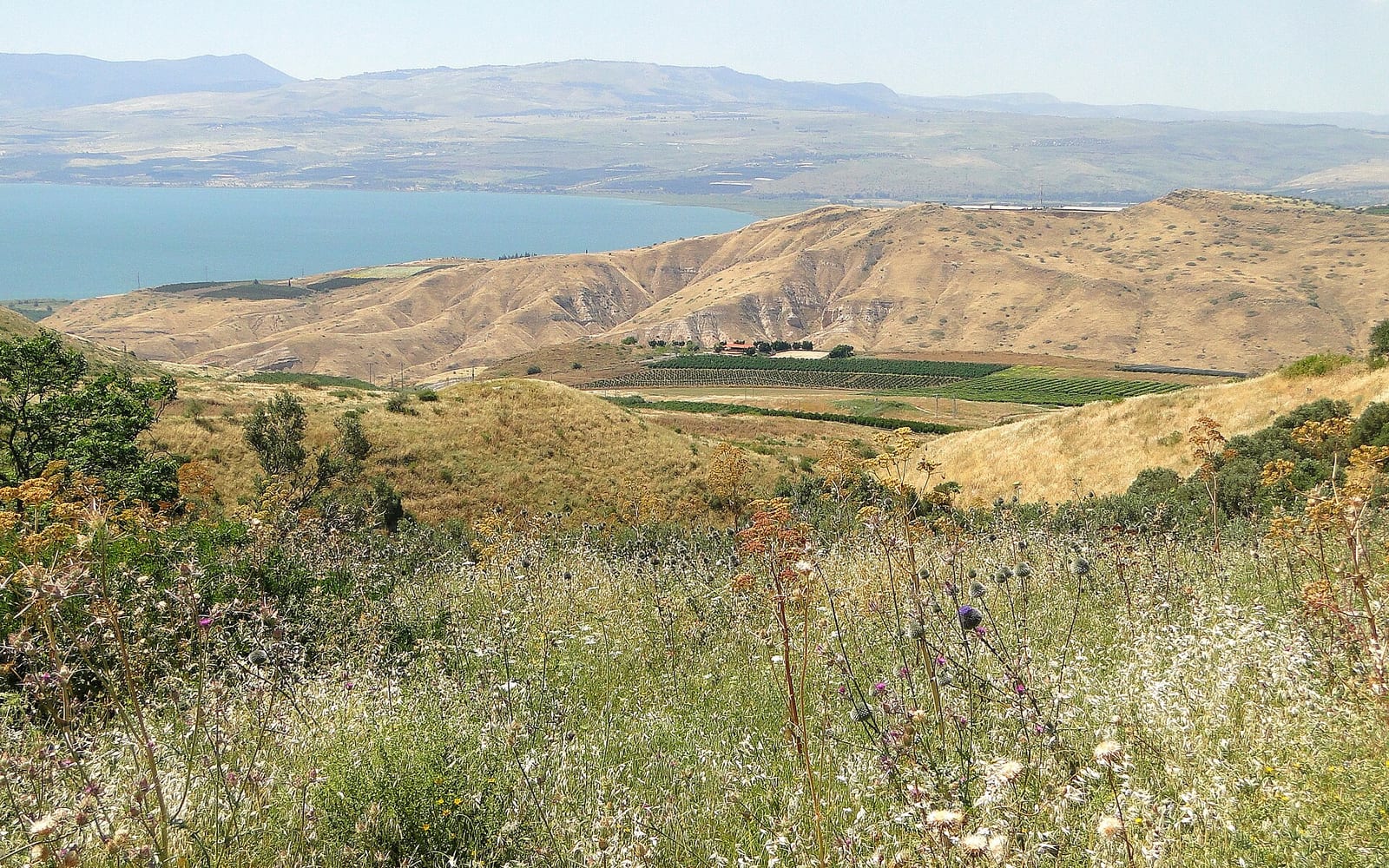
The view from Mount Tabor’s summit is one of the great landscape perspectives in Israel. The Jezreel Valley — in biblical tradition the Valley of Armageddon (Hebrew: Har Megiddo) — spreads across the entire horizon, a broad agricultural plain bordered by:
- Mount Carmel ridge to the west (Haifa and Muhraqa visible on the ridge)
- Mount Gilboa to the southeast (site of Saul’s last battle)
- Mount Moreh / Hill of Moreh to the north (Nain and Endor at its foot)
- Nazareth ridge to the northwest (the city where Jesus grew up, 10 km away)
- Sea of Galilee / Kinneret visible on clear days to the northeast
The scale of the valley — flat, enormous, criss-crossed by irrigation channels — makes the geographical logic of Mount Tabor’s importance immediately apparent: it dominates the entire region visually, making it a strategic and sacred landmark from the Bronze Age onward. The Canaanites used it, Deborah and Barak mustered forces here against Sisera (Judges 4–5), and Greco-Roman writers described it as an island in a sea of plain.
Dawn and early morning offer the clearest visibility; afternoon haze from the valley floor can reduce the range in summer.
| Detail | Information |
|---|
| Getting to the base | Daburiyya village: Route 65 from Nazareth (8 km) or Route 717 from Afula |
| Summit access | Servee or taxi only — no private vehicles beyond Daburiyya |
| Return taxi cost | ₪40–60 per car (agree before ascending) |
| Basilica hours | 8 am–12 pm and 2–5 pm (check for feast day closures) |
| Basilica entry | Free (donations welcomed) |
| Greek Orthodox church | Variable hours — check at the gate |
| National Parks Pass | Not valid — Mount Tabor is not an INPA site |
| Dress code | Covered shoulders and knees inside the Basilica |
| Visit duration | 1.5–2 hours at the summit |
| Nearest city | Nazareth (10 km NW), Afula (10 km SW) |
Best visiting time: weekday mornings, before group tours arrive from Nazareth and Tiberias. The summit becomes noticeably busier between 10 am and 1 pm when coach groups congregate. Arriving at 8–8:30 am gives you the basilica largely to yourself and the best morning light across the valley.
Combining with nearby sites
Nazareth (10 km northwest): the natural companion site for a Mount Tabor visit. The Church of the Annunciation — built over the traditional site of Mary’s home, where Gabriel appeared to her — is the largest church in the Middle East and one of Christian pilgrimage’s most significant stops. The Old City Souk and White Mosque add a vibrant Arab character. Plan Nazareth in the morning, Mount Tabor in the early afternoon.
Megiddo National Park (20 km southwest via Routes 65 and 70): the tel of ancient Megiddo — the “Armageddon” of Revelation — preserves 7,000 years of occupation across 26 strata, including Solomon’s Gate, Ahab’s water tunnel, and a Bronze Age altar. The Israel National Parks Pass is valid here. Megiddo + Mount Tabor makes a full Lower Galilee archaeology day.
Beit She’an (30 km southeast via Route 71): Israel’s best-preserved Roman city, with colonnaded streets, a theatre, bathhouses, and dramatic Byzantine mosaics from the destruction earthquake of 749 CE. Better suited as a separate day from Tiberias than as a same-day addition to Mount Tabor.
Sea of Galilee / Tiberias (30 km northeast via Route 65): a viable day circuit from the Sea of Galilee — drive southwest to Mount Tabor and Nazareth, then return northeast. The Christian sites of Tabgha, Capernaum, and the Mount of Beatitudes are 45–60 minutes from Mount Tabor.
Cross-links and further reading