Three days in Israel is tight but possible for a genuine first-timer experience. This itinerary concentrates on the country’s three most important stops — Jerusalem, the Dead Sea, and Tel Aviv — and is designed to be done without a rental car, though Day 2 offers a car-driving option if you want independence.
A note on pacing. This plan assumes full days and minimal slow mornings. If you want to linger over coffee or take a half-day at the beach, you will need to cut something. The bracketed [optional] items throughout are the first candidates to drop if your pace is slower or energy is lower than expected.
Before you arrive
Where to base. Jerusalem for all three nights is the most efficient base: the Dead Sea is 45 minutes east by car or tour coach, and Tel Aviv is 32–35 minutes by train. Mamilla, the German Colony, Rehavia and the Jerusalem city centre hotels are the best-placed areas for this itinerary.
Getting to Jerusalem from the airport. The train from Ben Gurion Airport’s underground station (Terminal 3) runs to Jerusalem Yitzhak Navon in about 25–30 minutes; trains run frequently. Alternatively, shared sheruts (taxis) and private transfers are available from the arrivals hall.
What to read first. The first-time-in-Israel guide covers essentials: ETA-IL entry requirement (₪25, apply 72 hours ahead at iaa.gov.il), currency (shekel, widely card-friendly), Shabbat timing (Friday sunset to Saturday night — affects public transport and some restaurant closures), and security routine at the airport.
Day 1: Jerusalem Old City
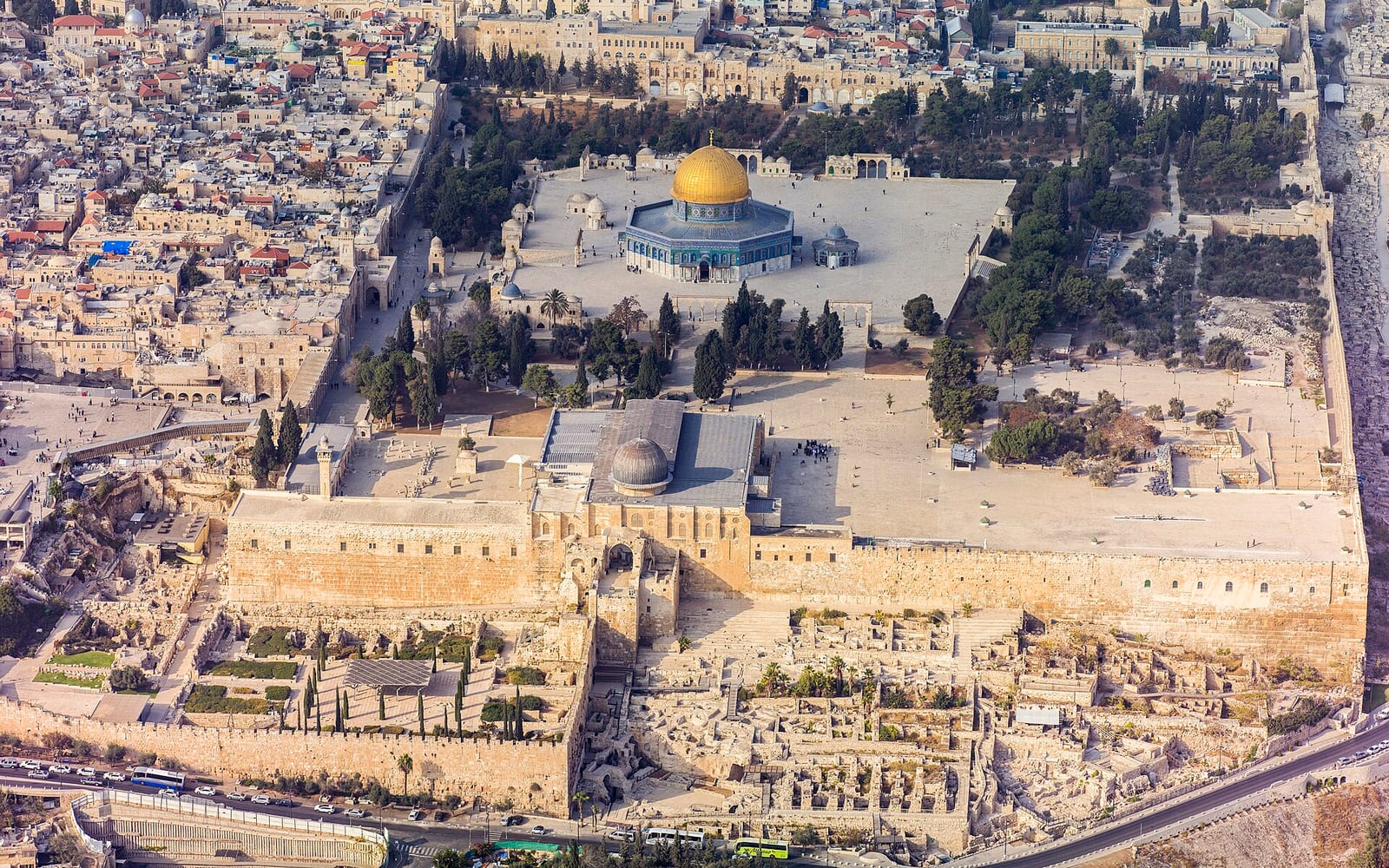
Jerusalem’s Old City is one of the densest concentrations of significant human history on the planet — four quarters, six religions with active sites, and 2,000+ years of visible archaeology within 1 square kilometre. One day is not enough to see everything; the goal today is the essential circuit.
Morning: Jewish Quarter and the Western Wall
Start early (8am) at the Western Wall — the holiest accessible site in Judaism, the surviving retaining wall of Herod’s Second Temple complex. The broad plaza is accessible freely at all times. Men and women pray in separate sections; modest dress is required (free coverings available at the entrance). Arrive early to avoid the crowds that build from mid-morning.
From the Western Wall plaza, walk into the Jewish Quarter — the most recently rebuilt of the four quarters (destroyed in 1948, reconstructed after 1967). Key stops:
- Cardo — the main Byzantine and Roman colonnaded street, partially excavated in the open air; evocative of ancient Jerusalem beneath the current surface.
- Hurva Synagogue — rebuilt in 2010 on the site of a synagogue destroyed multiple times over the centuries; the dome is a Jerusalem landmark visible from the rooftops.
- Broad Wall excavation — Israelite fortification from the 8th century BCE, exposed in an outdoor archaeological park on HaYehudim Street.
Late Morning: Via Dolorosa and Church of the Holy Sepulchre
Walk north through the Muslim Quarter into the Via Dolorosa — the traditional 14-station route of Christ’s crucifixion procession. The route ends at the Church of the Holy Sepulchre, Christianity’s most sacred site, containing both the site of the crucifixion (Golgotha/Calvary) and the tomb (the Edicule). The church is free to enter; lines for the Edicule can be 45–90 minutes on busy days — arrive early or join toward late afternoon.
The church is shared by six Christian denominations (Catholic, Greek Orthodox, Armenian, Coptic, Ethiopian, Syriac) — each with its own section and schedule. Cover shoulders and knees.
Lunch: Mahane Yehuda or the Muslim Quarter
For lunch, you have two good options near the Old City:
- Muslim Quarter — seek out the hummus stalls and bakeries near the Damascus Gate area. Ka’ak al-Quds (Jerusalem sesame bagels sold by cart vendors) are the iconic snack.
- Mahane Yehuda Market (20 minutes by light rail) — Jerusalem’s main open-air market; vibrant, chaotic, and full of good-value lunch options from shakshuka restaurants to falafel counters and fresh juice. Also worth visiting before the Day 3 Tel Aviv visit for comparison with Carmel Market.
Afternoon: Mount of Olives and Jewish Quarter Rooftops
Take a sherut taxi or walk up to the Mount of Olives — the ridge east of the Old City with the most photographed view of Jerusalem: the Temple Mount, the Dome of the Rock’s gold dome, and the Old City roofscape spread below. The view is best in afternoon light. Also here: the Church of All Nations (Garden of Gethsemane) and the panoramic Jewish cemetery, the largest in the world.
[Optional] Return to the Jewish Quarter rooftops before sunset — several Old City buildings offer rooftop access with views over the Western Wall plaza and the Dome of the Rock.
Evening: Mahane Yehuda at night
Mahane Yehuda transforms after dark: by 8pm, the market stalls close and the bars and restaurants that occupy the same spaces (and former lockups) fill with locals. This is one of Jerusalem’s most atmospheric evening options. The Rachmo and HaShakshukia restaurants here are consistently well-regarded for a sit-down dinner.
Day 2: Masada and the Dead Sea
This is the early-start day. Masada and the Dead Sea are both in the Jordan Valley east of Jerusalem — about 45 minutes to Masada by car, and another 20 minutes north to Ein Bokek (the main Dead Sea beach resort strip) on the return.
Depart by 5:00–5:30am
The logic for the early start is heat and timing: the Snake Path ascent at Masada is best completed before sunrise, when temperatures are cool and the summit plateau bathed in golden desert light is one of the most striking scenes in Israel. By 9–10am, the crowds arrive and the cable car opens; by midday, the platform is hot and congested.
If you are joining a guided tour (the most common approach without a car), your pick-up from Jerusalem hotels is typically 5:15–5:30am.
Masada: the Snake Path or cable car
Masada is Herod the Great’s desert fortress-palace, built on an isolated plateau 450 metres above the Dead Sea valley. The site is most famous for the 73 CE Roman siege that ended with the collective death of the Jewish Zealot defenders — the event that gave rise to the phrase “Masada shall not fall again.”
The Snake Path — the original ancient access trail — takes 45–60 minutes to ascend on a maintained switchback path. The summit plateau reveals Herod’s extraordinary construction: the three-tier hanging palace, the Byzantine church, Herod’s bathhouse and the large water cisterns. The panorama extends across the Dead Sea to Jordan.
The cable car runs from approximately 8am and is faster but misses the sunrise timing. For those who cannot or prefer not to hike, the cable car still delivers the same summit experience.
Allow 90 minutes on the plateau before descending.
Dead Sea: floating and mud ritual
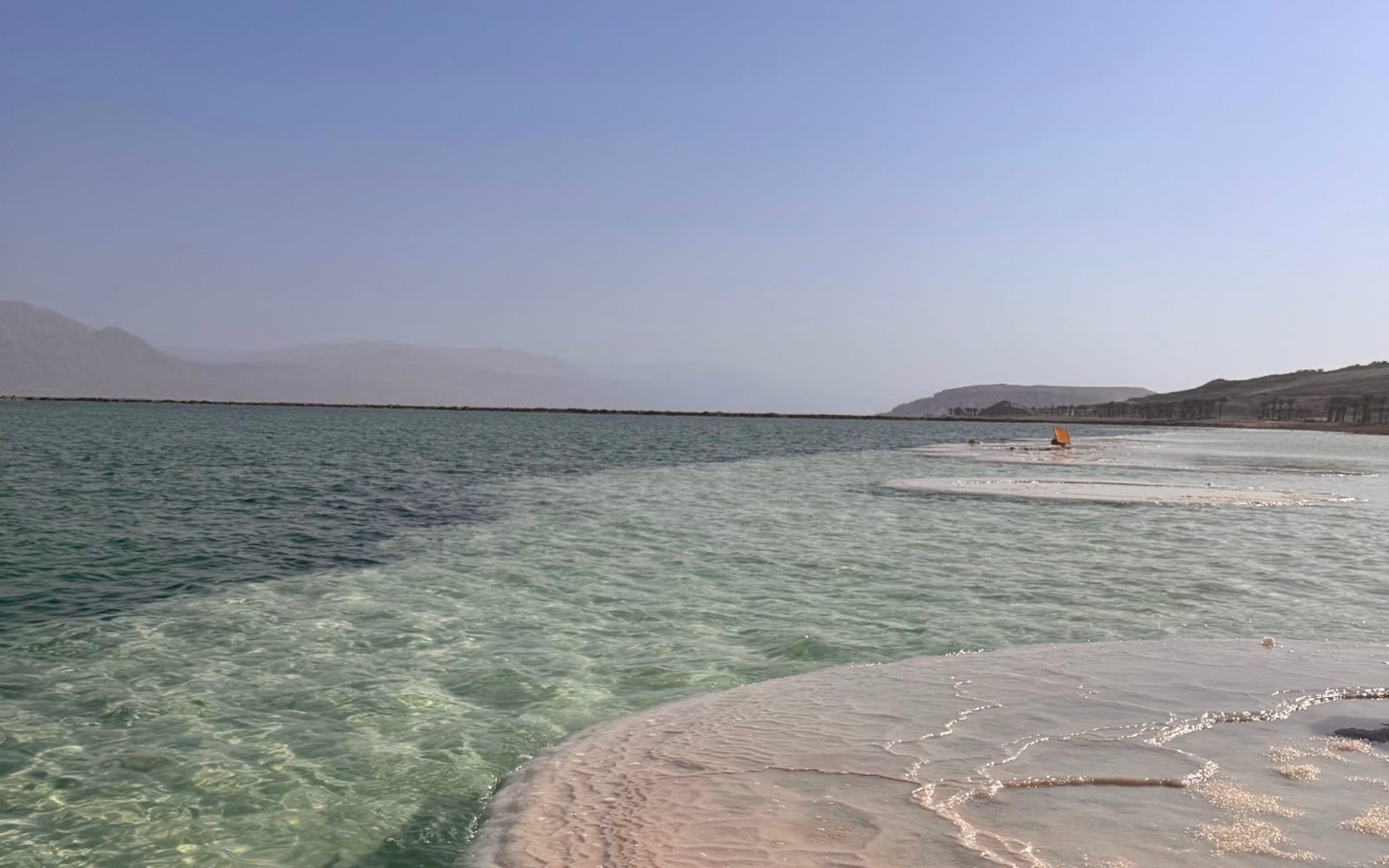
From Masada, the Dead Sea beach strip at Ein Bokek (the main resort area) is about 20 minutes north. The Dead Sea is the lowest point on Earth at 430 metres below sea level; its water is approximately 34% dissolved salts — 10 times saltier than the ocean — which makes floating effortless and involuntary.
Key points for your visit:
- How to enter: wade in to knee depth, then squat back into the water. Do not try to swim forward or put your face in the water — the salt concentration causes severe stinging.
- 15–20 minutes maximum per session (the salt draws moisture from skin; longer soaks cause discomfort).
- Mud: mineral-rich black Dead Sea mud is available at the waterline or from vendors. Slather on, wait 15 minutes, rinse with fresh water. A well-established ritual with widely claimed therapeutic properties.
- Bring: old swimsuit (salt bleaches), water shoes (the shoreline is sharp salt crystals), two bottles of fresh water for rinsing, SPF 50 sunscreen (the water reflects UV intensely), and a change of clothes.
Return to Jerusalem in the late afternoon (arrive back 4–5pm if departing the Dead Sea at 2–3pm).
Day 3: Tel Aviv and Jaffa
The high-speed train from Jerusalem Yitzhak Navon to Tel Aviv HaShalom takes 32–35 minutes. Take the first convenient departure after 7am — this gives you a full day in the city. Return trains run until approximately 9pm.
Morning: Old Jaffa
Start in Jaffa (Yafo) — the ancient port city that predates Tel Aviv by several thousand years. From Tel Aviv HaShalom, take the light rail (Red Line) toward Jaffa or take a taxi (10–15 minutes).
Jaffa’s key stops:
- Clock Tower Square — the 1903 Ottoman clock tower at the entrance to old Jaffa; the gathering point for walking tours.
- Jaffa Port — the ancient harbour used from the Bronze Age through the 20th century; today a working fishing port with restaurants and a morning fish market.
- Old Jaffa hill — the excavated archaeological mound with views back to the Tel Aviv skyline (one of the most-photographed angles in Israel).
- Flea Market (Shuk HaPishpeshim) — open Sunday through Friday; antiques, Judaica, vintage clothing, and crafts in a warren of alleys and converted courtyards.
- Andromeda’s Rock — the reef formation in the harbour water, visible from the hilltop lookout.
Late Morning: Carmel Market and lunch
Walk or take the light rail north to Carmel Market (Shuk HaCarmel) — Tel Aviv’s main open-air market. The market is noisier and more city-paced than Mahane Yehuda in Jerusalem; the produce section at the south end gives way to cheap clothing and household goods toward the north. For lunch, eat at the market stalls or at the HaCarmel Street restaurants immediately adjacent.
Nahalat Binyamin Craft Market runs Tuesday and Friday alongside Carmel Market — artisan jewellery, ceramics and art from Israeli makers.
Afternoon: Rothschild Boulevard and the White City
Walk or take the light rail to Rothschild Boulevard — the spine of Tel Aviv’s UNESCO-listed International Style (Bauhaus-influenced) district. The boulevard is tree-lined and café-dense; the architecture along it and on surrounding streets (Bialik, Allenby, Dizengoff) is the most significant concentration of International Style buildings in any single city in the world (4,000+ structures built by German-Jewish architects who fled Nazi Germany from the 1930s).
Key buildings: Engel House (84 Rothschild, first “pilotis” building in Israel, 1933), Cinema House cultural centre (1939), and any of the curved-balcony, flat-roof buildings that line the streets between Allenby and King George.
[Optional] Tel Aviv Museum of Art (27 Shaul HaMelech, near Habima Square) — Israel’s largest art museum, with strong Israeli modernism and an Impressionist collection. Allow 90 minutes minimum; closed Monday.
Evening: Gordon Beach and the Tayelet promenade
Tel Aviv’s beachfront promenade (Tayelet) runs 13km along the Mediterranean. Gordon Beach, Frishman Beach and the area between HaYarkon Street and the sea are the main tourist strip. In summer, sunset here (around 7:30–8pm) is one of the better free experiences in the country — the beach fills with locals, the water turns gold, and the horizon is open ocean.
From Gordon Beach, walk south along the promenade toward Neve Tzedek for dinner options — the neighbourhood has the highest concentration of good restaurants per block in Tel Aviv. Alternatively, the Tel Aviv food guide covers the full city dining map.
The train back to Jerusalem runs from HaShalom; last trains are approximately 9–9:30pm on weekdays (earlier on Fridays due to Shabbat).
Planning notes
If you fly out on Day 4, the Ben Gurion Airport guide recommends arriving 3.5 hours before departure; the train from Tel Aviv HaShalom to the airport takes 20 minutes. If you return to Jerusalem the evening of Day 3 and depart from Ben Gurion, allow 75–90 minutes from Jerusalem to the airport by train.
Extending to 5 or 7 days? A natural Day 4 is the Galilee — Nazareth, the Sea of Galilee, Tiberias and Safed are a full day from Jerusalem or Tel Aviv with a rental car. Day 5 could add Caesarea (Roman amphitheatre + aqueduct), Akko (Crusader city) and Haifa (Bahá’í Gardens). See the 7-day Israel itinerary and the 14-day itinerary for structured plans that build on this 3-day core.
Three days, two cities, one desert site is the minimum meaningful Israel trip. Allow more days if at all possible — the Galilee, the Negev, Eilat and the northern coast each deserve dedicated time that three days cannot accommodate.
Cross-links: 3 days in Jerusalem · 2 days in Tel Aviv · Dead Sea visitor guide · Masada visitor guide · Jaffa travel guide · Is Israel safe?