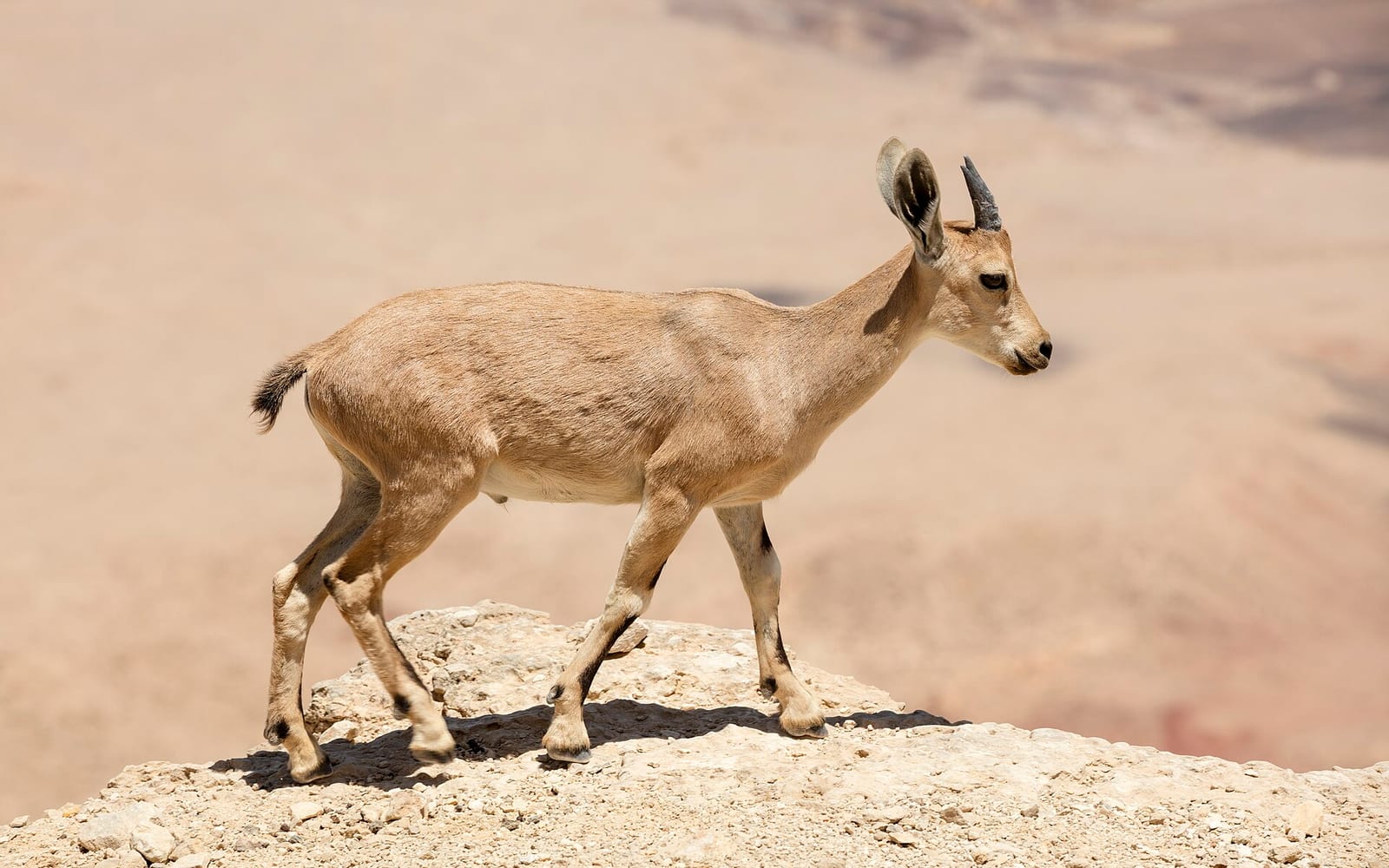
Israel’s largest desert — the Negev — covers more than half the country’s land area yet remains its least-visited region. The centrepiece is the Makhtesh Ramon erosion crater: 40 km long, 2–10 km wide and 500 metres deep, it is the world’s largest erosion crater and the geological formation that defines the Negev Highlands. Around it, Nabataean desert cities traded frankincense for 600 years along a UNESCO World Heritage trade route, Ben-Gurion spent his last years beside a kibbutz on the crater rim, and some of the darkest night skies in the Middle East open above the desert every clear night. Here is an honest comparison of the main Negev tour formats, what each covers and how to decide.
Negev tours compared
| Tour type | Duration | What you get | Best for |
|---|
| Ramon Crater day trip from Tel Aviv | 14–16 hrs | Makhtesh Ramon viewpoint + jeep crater descent + Avdat | First visit; maximum distance from TLV in one day |
| Mitzpe Ramon + Sde Boker day | 10–12 hrs | Crater viewpoint, Ben-Gurion grave, Ein Avdat oasis | Heritage + landscape combination; no jeep needed |
| Negev jeep safari | Half-day or full day | Crater floor: fossil beds, coloured sands, canyon walls | Geology + adventure; crater interior access |
| Negev overnight: Bedouin camp + stargazing | 2 days / 1 night | Above + Bedouin dinner, desert stars, sunrise crater | The definitive Negev experience; repeat visitors |
| Nabataean heritage circuit | 7–9 hrs | Avdat, Shivta or Mamshit ruins, Ein Avdat | Archaeological travellers; UNESCO focus |
| Self-drive Negev | 3–5 days | Full Highway 40 corridor at your own pace | Independent travellers with a rental car |
Prices are per-person ranges and vary by operator, group size and season. Book well ahead for spring (March–April) and Hanukkah–New Year when the Negev peaks.
Ramon Crater day trip from Tel Aviv
The most-booked Negev format and, logistically, Israel’s most ambitious single-day excursion. Departures from Tel Aviv or Jerusalem at 06:30–07:30; the ~2.5-hour drive south via Route 40 reaches Mitzpe Ramon by late morning. The typical day opens with the Makhtesh Ramon viewpoint — the Ilan Ramon Visitor Centre (named for Israel’s first astronaut, a Mitzpe Ramon native) sits at the crater rim with panoramic views across the 40-km crater floor — followed by descent into the Makhtesh by 4WD jeep for the geological highlights: the coloured-sand cliff layers (reds, yellows and purples formed from different mineral deposits), the ammonite wall fossil exposure, and the Nabataean camel-trail fragments still visible on the crater floor.
Most full-day tours add Avdat on the return north — a 40-minute detour to the best-preserved Nabataean acropolis in Israel, with Byzantine church ruins, a Nabataean wine press and a Roman bathhouse at 600 m elevation. The drive back reaches Tel Aviv by 21:00–22:00.
The format is genuinely long but rewarding. The main limitation is time pressure: each stop gets roughly 1.5–2 hours, and the drive is too long to allow for spontaneous detours. If you have any flexibility in your itinerary, extending to one night in Mitzpe Ramon converts this from a very full day into a relaxed two-day experience.
Mitzpe Ramon and Sde Boker heritage day
A slightly shorter format that pairs the crater with the Sde Boker kibbutz — the remote desert settlement where David Ben-Gurion spent his final years and is buried — and the Ein Avdat canyon: a dramatic cliff-lined ravine with a spring-fed pool, ibex and the ancient hermit monks’ cells carved into the chalk walls.
This format suits visitors who want geological scenery and historical context without the intensity of a jeep descent. The crater viewpoint, a walk to the Makhtesh rim, Ben-Gurion’s modest grave overlooking the desert, and the Ein Avdat canyon floor can all be done from a standard rental car without 4WD. The round trip from Tel Aviv is shorter than the full crater day because Sde Boker is about 40 km further north than Mitzpe Ramon.
For first-time visitors with limited time, this format gives the iconic Negev landscape photograph (the crater rim panorama), a powerful connection to Israel’s founding history (Ben-Gurion deliberately chose this remote spot “to make the desert bloom”), and one of the most beautiful short hikes in the country.
Negev jeep safari into the Makhtesh Ramon
The tour format designed specifically for the crater interior. A half-day jeep safari departs from Mitzpe Ramon in early morning (typically 07:00–07:30 to avoid midday heat) and descends by 4WD to the crater floor, reaching terrain that is inaccessible on foot or by standard vehicle: the coloured sand canyon (a narrow ravine where sandstone strata in six distinct mineral colours are exposed at eye level), the fossil ammonite beds (marine fossils from when the Tethys Sea covered the Negev 200 million years ago), and the geological museum outdoors of volcanic rock formations that erupted through the seafloor sediments.
Local Mitzpe Ramon operators who live at the crater offer a more immersive experience than large Tel Aviv–based tour buses: smaller groups (typically 6–12 people), genuine geological knowledge from guides who have spent years in the Makhtesh, and flexibility to follow the morning’s conditions. Full-day jeep safaris extend into the southern reaches of the Makhtesh and sometimes add the Carpentry Workshop formation — a volcanic-rock pattern that resembles stacked planks.
Booking directly with a Mitzpe Ramon operator, or through GetYourGuide filtering for crater-based departures, typically gives better crater time than Tel Aviv–based operators who spend 5 of their 14 hours on the highway. For a detailed breakdown of jeep circuits, self-drive 4WD tracks, and what to look for when comparing operators, see the Negev jeep tours guide.
Negev overnight: Bedouin camp and desert stargazing
The Negev’s most-praised experience. Departing Tel Aviv in the morning, the tour follows the standard crater-day format until late afternoon; rather than returning north, the group continues to a Bedouin hospitality camp in the desert for a traditional dinner: lamb and rice cooked in a taboun underground oven, bread baked on an open fire, and tea served in a black-goat-hair tent. After dinner, the camp moves to a dark-sky observation area for a guided stargazing session with a large-aperture telescope.
The Mitzpe Ramon region carries International Dark-Sky Association certification — the first IDA-certified dark-sky park in the Middle East — with Bortle Class 2 sky quality on clear moonless nights. The Milky Way core is visible to the naked eye from June to August; the full stellar band appears with naked-eye clarity from October to March. The guided session typically includes identification of constellations, deep-sky objects through the telescope (Andromeda galaxy, Orion Nebula, open star clusters), and photography coaching for astrophotography beginners.
The following morning: sunrise from the crater rim (qualitatively different from the midday view — the crater fills with orange-pink light as the sun clears the eastern edge), followed by breakfast and the return to Tel Aviv by early afternoon.
This two-day format is consistently the most highly rated Negev tour experience. The Bedouin hospitality component connects to Israel’s desert culture in a way that a day trip cannot; the stargazing session is something most urban visitors have never experienced. For repeat Israel visitors or anyone with more than one week in the country, it is the strongest recommendation in this guide. See Bedouin experience guide and Israel stargazing guide for background.
Nabataean archaeological heritage circuit
The Negev is the heart of Nabataean civilisation in Israel. The Nabataeans were an Arab trading people who controlled the frankincense and myrrh routes from Arabia to the Mediterranean between the 3rd century BCE and 2nd century CE, and their ability to harvest rainwater in one of the world’s driest landscapes enabled permanent agricultural settlement in conditions modern engineers still study. The UNESCO-designated Incense Route runs through four Negev cities, three of which are easily accessible:
- Avdat (Route 40 south of Sde Boker): the most developed site; the Nabataean acropolis with two Byzantine churches, a wine press producing 200,000 litres annually, a Roman fort, and the partially reconstructed Nabataean residential quarter. INPA admission applies; audio guide available; 2 hours.
- Shivta: less visited but remarkably intact — three Byzantine churches including one with an intact nave, Nabataean street-level housing, and the town’s water-harvesting channels still visible. Free entry; signposted from Route 40.
- Mamshit: compact but well-interpreted; the Eastern Church mosaic floors (geometrically intact), the Nabataean stable complex, and a visitor centre with artefacts. INPA admission.
This circuit is best done by rental car from Beer-Sheva or Tel Aviv. Add Ein Avdat canyon (between Avdat and Sde Boker) for the water-harvesting landscape demonstration — the oasis canyon is a direct product of Nabataean engineering. Allow 6–8 hours for Avdat + Shivta + Ein Avdat as a day circuit.
Self-drive the Negev: Highway 40
For independent travellers with a rental car, the Highway 40 corridor from Beer-Sheva to Eilat (315 km) is one of Israel’s most rewarding multi-day drives. The road passes through the Negev Highlands in an almost straight line, the landscape emptying progressively as you drive south. A 3–5 day Negev self-drive:
Day 1: Tel Aviv or Jerusalem → Beer-Sheva (Bedouin market, Old City, Ben-Gurion University campus) → Sde Boker → Ben-Gurion’s grave + Ein Avdat canyon → overnight Mitzpe Ramon.
Day 2: Sunrise at the crater rim → Mitzpe Ramon crater viewpoint → jeep or foot trail descent → Avdat ruins (afternoon) → overnight Mitzpe Ramon or push south.
Day 3+: Continue south via Route 40 through the Arava valley toward Eilat; add Timna Park copper mines (30 km north of Eilat) and the dramatic Red Canyon.
The south Israel itinerary gives a worked 4–5 day version. A 4WD is not legally required for Route 40 but greatly enhances the crater floor options; standard cars handle all paved roads including the Avdat and Mitzpe Ramon sites without difficulty.
Practical tips
- Heat. July and August on the crater floor regularly reach 40–45°C with no shade inside the Makhtesh. If visiting in summer, book tours that start before 07:00 and finish by noon, or shift the Negev to a shoulder-season itinerary. October to April is ideal.
- Water. Bring substantially more water than you think you need — 1.5–2 litres per person per hour of activity in warm weather. There are no water sources on the crater floor. Most guided tours supply water; on self-drive, stock up in Mitzpe Ramon.
- Booking ahead. Spring weekends (late March–April) and Jewish school holidays (Hanukkah, Passover, Sukkot) push Negev tour bookings to capacity. Peak-season jeep safaris from Mitzpe Ramon operators can fill 2–3 weeks ahead.
- Public transport. Egged bus 60 runs Beer-Sheva → Mitzpe Ramon several times daily (~2 hours); from Mitzpe Ramon town, the crater viewpoint is a 2 km walk. For anywhere beyond the viewpoint, a rental car or organised tour is the practical option — the crater floor sites are not accessible by bus.
- Shabbat. Most Mitzpe Ramon operators and Tel Aviv–departure tour operators do not run on Friday night or Saturday. The INPA visitor centre and Avdat close at sunset Friday and reopen Saturday night/Sunday. Bedouin camp operators typically run Thursday overnight departures for the Friday-morning return.
For the full destination picture — town orientation, trails, accommodation and restaurants — see the Mitzpe Ramon guide and the Negev region guide. For the complete comparison of how the Negev fits within a wider itinerary, see our best tours in Israel guide.