Two of the Negev’s most rewarding stops sit 5 kilometres apart on Route 40, making them a natural pairing for a half-day in the desert. At Kibbutz Sde Boker you’ll find the modest home where Israel’s first Prime Minister David Ben-Gurion chose to spend his retirement — a powerful statement about the desert vision he held for the state. Five minutes south, Ein Avdat National Park hides a canyon of white chalk cliffs carved over millennia by the seasonal floods of Nahal Zin, ending at a cold permanent spring that feels miraculous in this landscape.
Ben-Gurion’s Desert Dream: Sde Boker
David Ben-Gurion resigned as Prime Minister in 1953 and, to the nation’s astonishment, moved to Kibbutz Sde Boker — a small agricultural collective 50 kilometres south of Beer Sheva. The choice was deliberate. Ben-Gurion believed Israel’s future lay in making the Negev bloom, and he wanted to demonstrate that leading Israelis into the desert was more than rhetoric.
The Ben-Gurion House at the kibbutz preserves his home almost exactly as it was. The interior is remarkably spare: a simple wooden desk piled with books, a narrow bed, Bedouin rugs on stone floors. Ben-Gurion and his wife Paula lived here with few concessions to his former status, surrounded by a vast personal library. Guided tours (Hebrew, with English text panels) explain the political context of his resignation and what he actually accomplished during his Negev years — including founding Ben-Gurion University of the Negev.
A short drive south of the kibbutz (follow signs to Midreshet Ben-Gurion, the academic campus attached to the site) brings you to the grave of David and Paula Ben-Gurion. Entry is free. The grave sits on a plateau at the edge of the Ein Avdat canyon, and the view across the white chalk walls and the Zin valley below is extraordinary — one of the most dramatic memorial settings in Israel. Standing here, it’s easy to understand why Ben-Gurion wanted to be buried looking out over the Negev he worked to populate.
The Ben-Gurion Heritage Institute at Midreshet Ben-Gurion has a permanent exhibition on his life and vision, supplemented by rotating displays on Negev ecology and desert settlement. It’s worth 45 minutes if you want historical depth beyond what the house museum provides.
Ein Avdat National Park: Canyon, Cliffs, and a Desert Spring
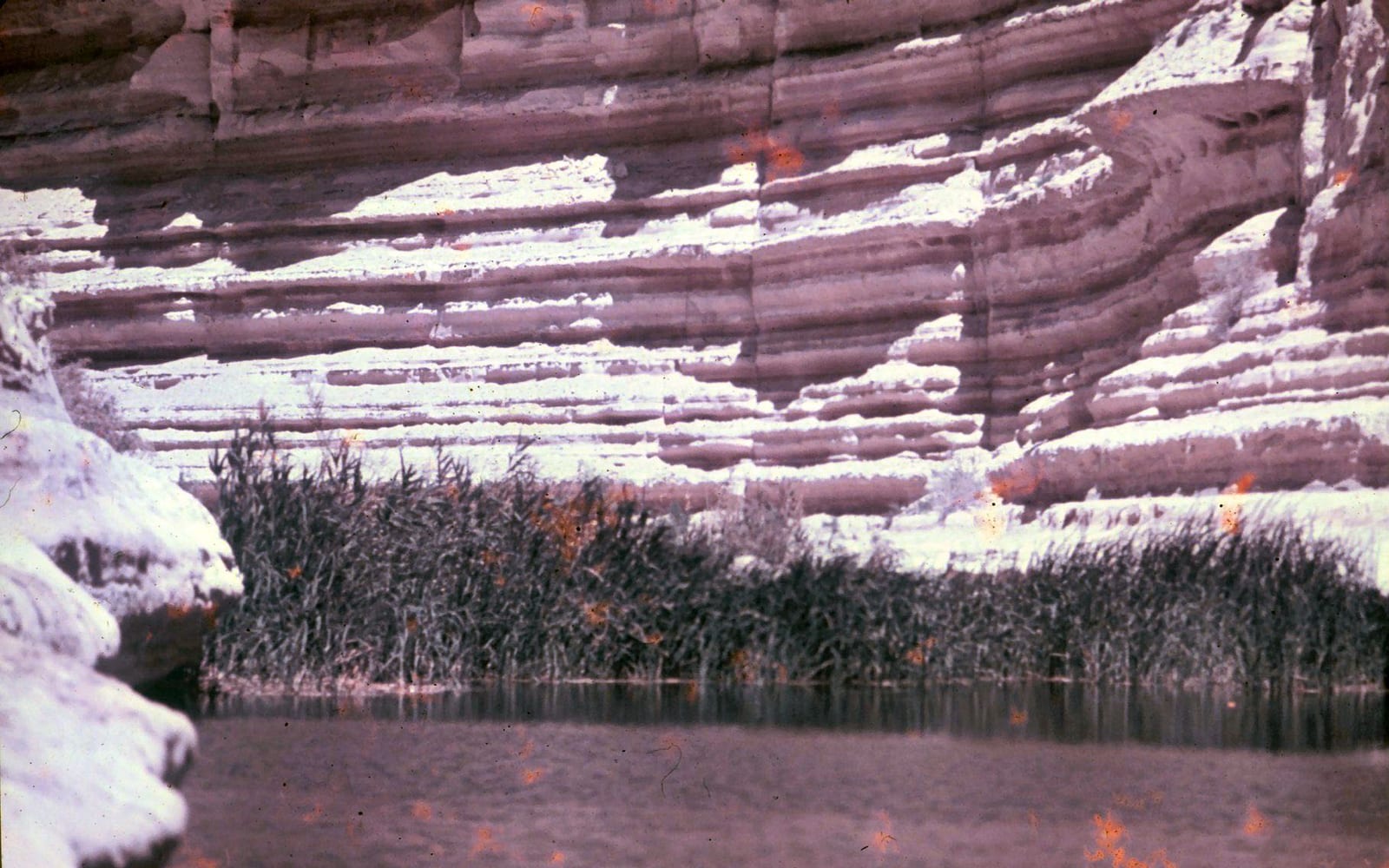
Ein Avdat (עֵין עַבְדָת) is one of the geological wonders of the Negev. Over thousands of years, the seasonal floods of Nahal Zin cut through layers of chalk and flint, carving a canyon whose cliffs glow white in the morning sun and turn amber at sunset. Vultures nest in the cliff faces. Ibex pick their way along impossible ledges. And at the canyon floor, a cold spring feeds a clear pool — the only permanent above-ground water source in this stretch of the desert.
The Lower Trail (Easy — 1.5km one way)
The lower trail starts from the southern (lower) car park and follows the canyon floor along the stream bed to the spring pool and the cave dwellings cut into the cliff above it. The path is signed and relatively flat with some stepping over rocks. Expect to take 40–60 minutes at an unhurried pace. The spring pool is a legitimate surprise: cold, clear water in the middle of the Negev, shaded by Euphrates poplar trees (the white-barked Populus euphratica that grows nowhere else in Israel this far south).
The cave dwellings above the pool were occupied by Byzantine-era monks in the 6th–8th centuries CE. You can see the carved niches where they slept and stored supplies. The site was later a Nabataean waystation on the Incense Route — the UNESCO-listed trade network that ran from Petra through the Negev to the Mediterranean.
This trail is a dead end: the path up the cliffs via metal-rung ladders is one-way (upward only). Return the same way to the lower car park.
The Upper Trail (Moderate — 3.5km loop)
The upper trail begins at the northern (upper) car park, roughly 3km further north on Route 40. It descends into the canyon via a viewpoint plateau, then follows the cliff edge before joining the metal-rung ladder section that links to the spring. This is a one-way descent — you exit via the lower car park and either arrange a car shuttle between the two parks or walk the 3km along the road (dusty, not recommended in summer).
The ladder sections are fixed metal rungs and chains bolted into the cliff. They’re safe for fit adults comfortable with heights but not suitable for young children, anyone with knee issues, or heavy backpacks. INPA occasionally closes the upper section after rain when the chalk becomes slippery — check trail conditions before your visit.
The full upper trail takes 2–3 hours depending on pace and how long you linger at the spring.
Practical Details
| Info |
|---|
| Opening hours | Daily 8:00–17:00 (winter); 8:00–18:00 (summer); Friday close 16:00 |
| Entry fee | ₪29/adult, ₪15/child; INPA pass accepted |
| Parking | Two separate car parks (upper and lower) — plan your route before you start |
| Water | Carry at least 1.5L per person; no facilities on the trail itself |
| Shade | Minimal until the canyon floor; start early |
Combining Both Sites
The most logical itinerary runs north to south on Route 40:
- Ben-Gurion House at Kibbutz Sde Boker (45 min)
- Midreshet Ben-Gurion and the grave (30 min)
- Drive 5km south to Ein Avdat northern car park and pick up the upper trail
- Exit via the lower car park; drive 3km south on Route 40 to collect your car at the upper park, or arrange a shuttle
From Beer Sheva, the drive to Sde Boker is about 50km (45 minutes). The two sites are 5km apart. Mitzpe Ramon — home of the Makhtesh Ramon crater — is 35km further south on the same road and makes a natural overnight stop. The Nabataean city of Avdat (also UNESCO-listed) sits 12km south of Ein Avdat and is well worth adding if you have an extra hour.
Where to Eat Nearby
There are no restaurants inside the national park and only a basic cafeteria at Midreshet Ben-Gurion campus. Pack lunch. For dinner, Mitzpe Ramon has several good options: Chez Eugene (French-Israeli) and the Carmey Avdat Farm winery-restaurant (requires reservation) are the local favourites. Beer Sheva, 50km north, has a wider range if you’re heading back.
Getting There
Ein Avdat and Sde Boker are on Route 40 between Beer Sheva and Mitzpe Ramon. From Tel Aviv take Route 6 (Kvish 6 / Cross-Israel Highway) south, then exit onto Route 40 south at the interchange near Mishmar HaNegev. Total drive from Tel Aviv: 1h40m. From Jerusalem: 1h45m via Route 6 bypass or slightly faster via Route 1 to Route 35 to Route 40.
A car is essential. Public buses run but are infrequent and don’t serve the trailheads directly. For the most flexibility — particularly for managing the two separate parking areas at Ein Avdat — drive yourself or join an organised Negev day tour.
Cross-Links