Israel’s wildflower season is one of the most visually spectacular and least-known tourism draws in the Middle East. From late January through April, carpets of red anemones blanket the western Negev, cyclamen forests colour the Galilee hills, and the Golan Heights transforms from winter brown to Mediterranean spring. This guide covers when to go, where to go, and how the bloom works — region by region.
The kalanit: Israel’s national wildflower
The kalanit (כלנית — Anemone coronaria, poppy anemone) is Israel’s national wildflower. It blooms in red, pink, white, purple, and bicolour forms — but in the western Negev, red dominates, and when conditions are right, the carpets are breathtaking.
The kalanit was nearly lost. Picking wildflowers was a normal family excursion in the 1950s and 1960s, and populations collapsed by the 1970s. The Israel Nature & Parks Authority (INPA) designated the kalanit a protected species and ran a decades-long public-education campaign. Today picking carries a ₪730 fine and, more importantly, the conservation effort worked: the carpets return each year.
The bloom timing is entirely rainfall-dependent. A wet October–December sets up a January–February spectacle; a dry winter produces scattered flowers. INPA publishes weekly bloom updates from mid-January at inpa.gov.il/flowers — check before you travel.
The Negev: Darom Adom and the anemone belt
The Darom Adom (“Red South”) festival
Darom Adom is the annual celebration of the kalanit bloom in the western Negev’s Eshkol region. Run jointly by the Eshkol Regional Council and INPA, the festival typically runs from mid-January through late February, with dates tracking the actual bloom rather than a fixed calendar.
- Guided walking routes through the best-carpeted fields
- A visitor centre with daily bloom-status updates and trail maps
- Shuttle bus services from staging areas to the bloom sites (important on peak weekends when the roads fill)
- Family events and educational programmes
- Free admission to most routes
Dates change every year and depend on rainfall — check daromadom.co.il for the current year’s programme. A good year with February rain produces extraordinary displays; a drought year may see the festival scale back. Never rely on last year’s dates. For a dedicated guide covering the festival programme, Eshkol region bloom sites, shuttle logistics, and the security situation in the area, see the Darom Adom festival guide.
Top Negev wildflower sites
Nitzanim Nature Reserve (between Ashdod and Ashkelon, coastal plain): One of the most accessible anemone sites in Israel, reachable by car from Tel Aviv in under an hour. The dunes and sand-plain ecosystem produces mixed anemone carpets alongside other spring annuals in a setting different from the inland Negev.
Shokeda Forest (northern Negev): A forested clearing with picnic facilities that becomes one of the most-photographed wildflower sites in Israel during the bloom. Millions of red anemones spread through the pines; the combination of forest edge and open field is excellent for photography. Reachable by car from Beer Sheva (~40 km).
Eshkol region fields (western Negev): The heartland of Darom Adom. Open agricultural fields and hillsides that in bloom years produce the carpet effect most associated with the kalanit season. Access is via the Darom Adom shuttle route during the festival.
Halutza Sands (central Negev): A more remote dune landscape where desert annuals bloom in January–February after good rains — less intense than the Eshkol region but beautiful and much less crowded. Four-wheel drive recommended for the deeper tracks.
Mitzpe Ramon crater rim: The crater vegetation at Makhtesh Ramon produces desert annuals in late January–February after winter rain. Less a carpet bloom than isolated patches of desert colour — more subtle but combined with the dramatic crater landscape, a striking experience. See the Mitzpe Ramon guide for the full visitor picture.
The Judean Hills and coast: cyclamens and lupines
Kikar Haarmonim (Cyclamen Valley)
Near Jerusalem in the hills below Abu Gosh, Kikar Haarmonim becomes one of the most beautiful cyclamen sites in the country from December through February. Pink and white Cyclamen persicum carpets the shaded terraces of the valley. Access by car from Jerusalem (approximately 20 km west, off Route 1).
Elah Valley (Givat HaTurmasim)
Known as “Lupine Hill,” the Elah Valley hillside near Beit Shemesh produces intense purple lupine carpets from late February through March alongside anemones and other spring flowers. The setting — a working agricultural valley with views to the hills where the David and Goliath story is set — adds historical resonance. Accessible by car from Jerusalem (~40 km) or Tel Aviv (~50 km).
Adulam-France Regional Forest
In the Judean foothills near Beit Guvrin, this forest produces a mixed wildflower display along easy walking loops in February–March. The short 2 km marked trail is suitable for all ages and can be combined with a visit to the Beit Guvrin caves nearby.
Ramat Hanadiv (Zichron Yaakov)
The memorial gardens and nature reserve on the Carmel ridge at Zichron Yaakov produce spring wildflowers from February through April against a Mediterranean hillside landscape. The reserve is free to enter and features marked walking routes. Accessible by bus from Haifa or Zichron Yaakov town. See the Zichron Yaakov guide for the town itself.
Yarkon Park (Tel Aviv)
In the heart of Tel Aviv, Yarkon Park’s wilder margins host wild cyclamen in March — a surprising patch of spring in an urban setting. No trip needed; it’s walkable from central Tel Aviv for anyone already in the city.
The Galilee and Golan: a different bloom
The north blooms later and differently — less carpet-field monoculture, more species diversity.
Sasa forest (Upper Galilee)
Dense Cyclamen persicum carpets the forest floor at Sasa, near Meron in the Upper Galilee, from December through February. The shaded forest setting produces a different photographic atmosphere to the open Negev fields.
Mount Meron and the Galilee highlands
Spring orchids — Orchis italica (the naked man orchid), Anacamptis morio (green-winged orchid), and others — appear on open slopes in March–April. The Galilee highlands have one of the highest orchid diversities in the eastern Mediterranean. A botanically-oriented day trip in April can turn up 10–15 species in a morning.
Golan Heights
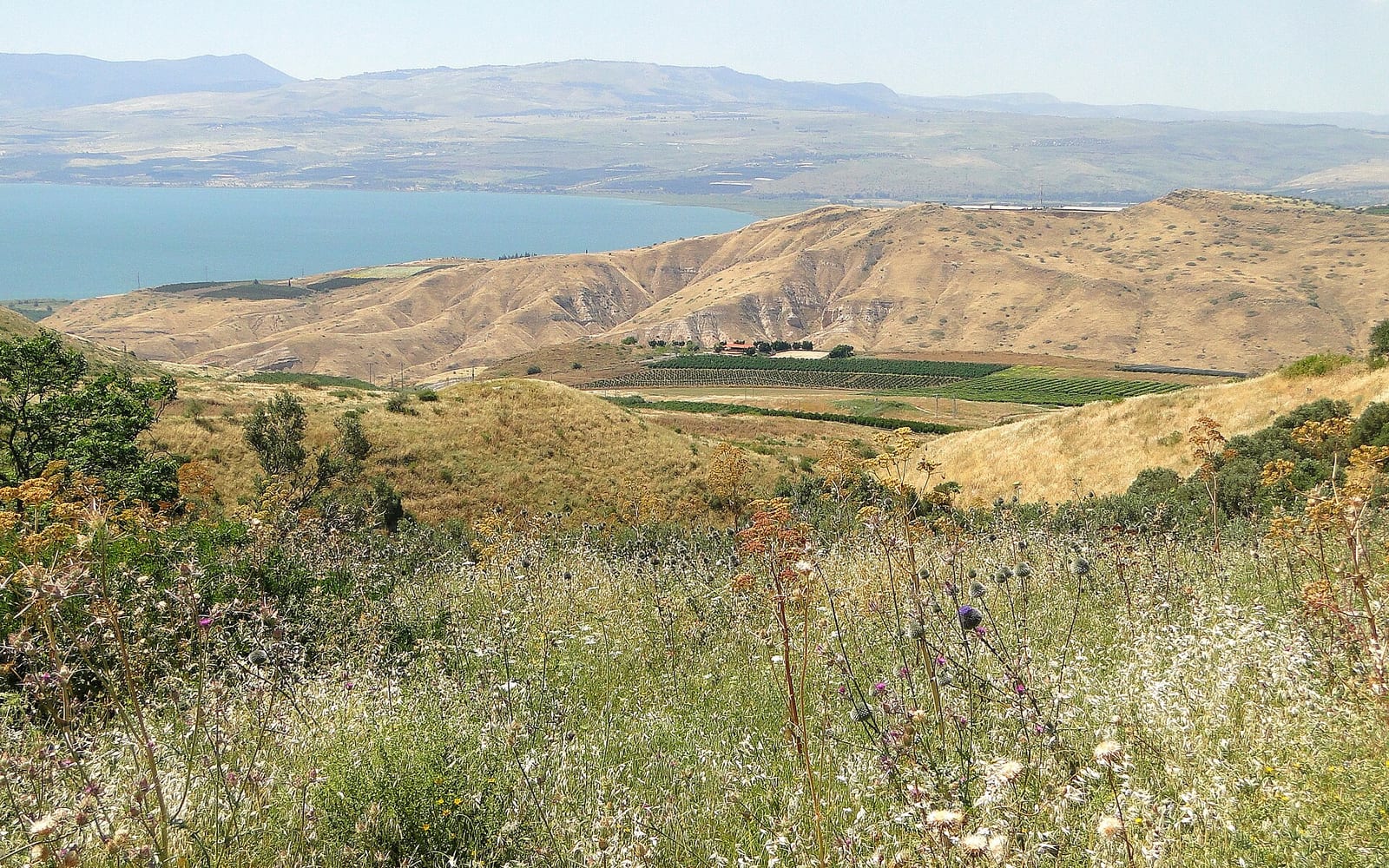
The Golan plateau blooms from late March through late April, later than the Negev and Judean Hills due to altitude (700–1,200m). Irises, especially Iris atropurpurea (which grows in Israel’s coastal areas and adjacent regions), and various Galilee-specific spring flowers appear along hiking trails. The Yehudiya Forest Reserve has spring orchid and iris sightings into April. Combine with the Golan Heights guide for a full-season visit.
Hula Valley
The Hula Valley’s late-winter and spring period pairs the tail end of the crane season (flocks remain through February) with the valley’s own spring flora. Agamon HaHula bird reserve produces marsh flowers alongside the birdwatching. See the birdwatching guide for the dual-season combination.
Bloom-tracking essentials
| Resource | What it offers |
|---|
| inpa.gov.il/flowers | Weekly official INPA bloom status reports, January–April |
| daromadom.co.il | Darom Adom festival dates, routes, shuttle schedules |
| Hebrew Facebook groups (search “פריחה” — “bloom”) | Real-time local sightings updated daily |
| Instagram #kalanit, #daromadom | Photo-based real-time status |
The key rule: check before you drive. A good year is spectacular; a poor year is disappointing if you’ve driven 2 hours to a site that barely bloomed. The INPA weekly update is the most reliable official source.
Photography tips
The anemone bloom photographs best in early morning light — lower sun angle, richer red tones, and dew still on the petals. The standard midday landscape shot washes out the red in direct overhead sun.
For the carpet effect, get low — shoot from ground level or just above the flowers looking across the field rather than down at them. The red carpet requires a vantage point that shows the field extending to the horizon.
Cyclamen in forest settings reward a longer lens: individual flowers photographed against the shaded forest floor, with a shallow depth of field, produce a gentler result than wide-angle carpet shots.
Conservation rules
- Do not pick wildflowers. This applies to kalanit, cyclamen, orchids, and all INPA-protected species. The fine is ₪730.
- Stay on marked trails at all times. Off-trail walking crushes underground bulbs.
- Do not bring dogs to INPA reserves during bloom season in most areas — check each reserve’s rules.
- Leave no trace: no litter, no campfire in open areas, no removing stones or soil.
The kalanit recovery is a genuine conservation success story. The pickable carpets that exist today are the direct result of 40+ years of protection. The rule exists because it worked.
Best season summary
| Region | Species | Peak window |
|---|
| Negev / Eshkol | Kalanit (red anemone) | Late January – late February |
| Negev (Halutza) | Desert annuals | January – February |
| Coastal plain (Nitzanim) | Mixed anemones | January – March |
| Jerusalem hills | Cyclamen, lupines | December – March |
| Judean foothills (Elah) | Lupines, anemones | February – March |
| Galilee (Sasa forest) | Cyclamen | December – February |
| Galilee highlands | Orchids | March – April |
| Golan Heights | Irises, mixed spring | March – April |
See best time to visit Israel for the full seasonal comparison, Israel in winter for the complete December–February picture (including the Negev bloom and Dead Sea season), hiking in Israel for trail access to the best bloom sites, and Israel national parks pass for INPA reserve entry discounts.