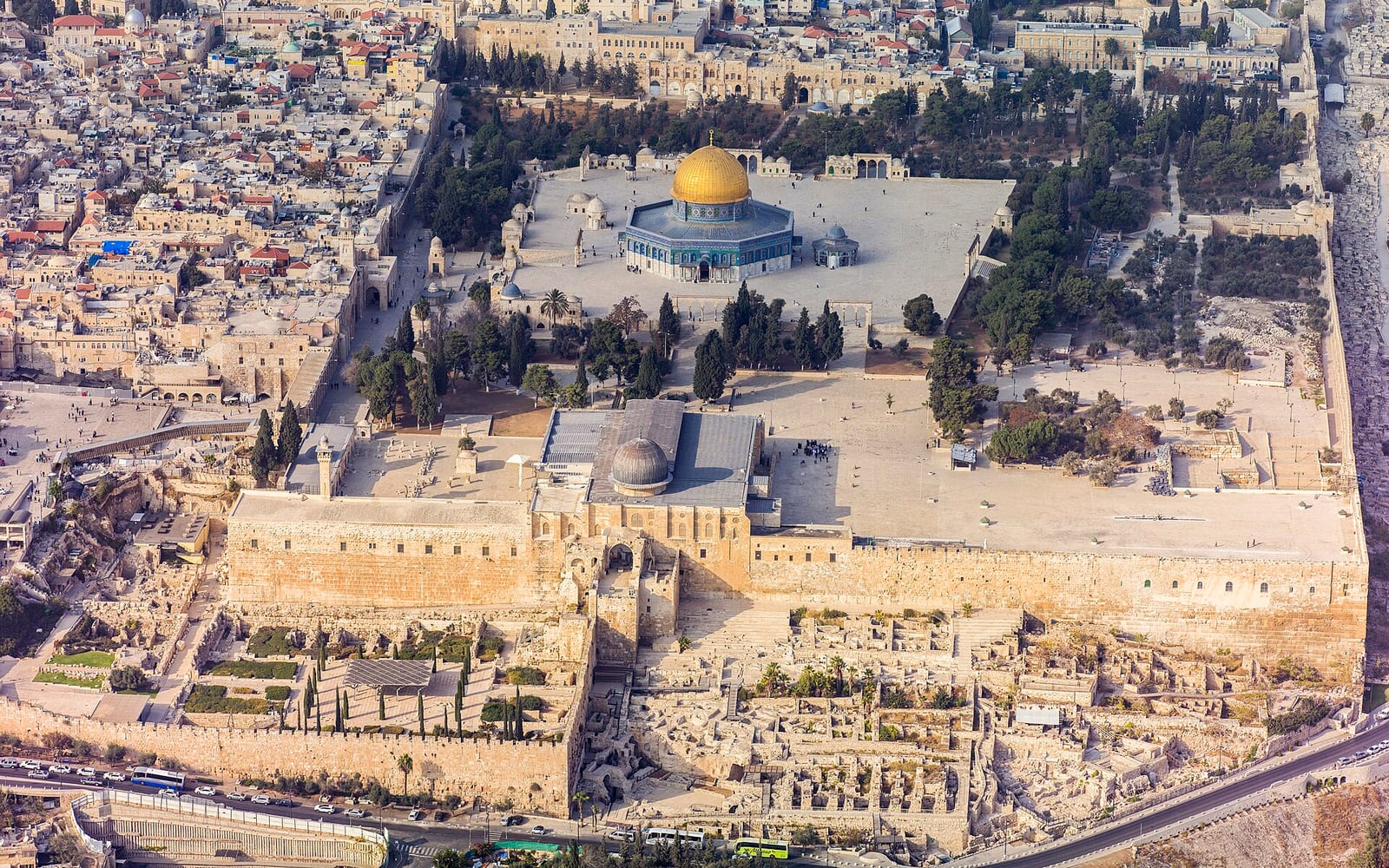
The Jewish Quarter (Hebrew: הרובע היהודי, HaRova HaYehudi) is the most archaeologically dense quadrant of Jerusalem’s Old City. Within a 400-metre walking radius of Hurva Square, visitors can descend into Herodian-era mansions preserved 8 metres below street level, stand in the remains of a house destroyed by Roman fire in 70 CE, walk a section of the Roman main street of the Byzantine city, examine an Iron Age fortification wall from King Hezekiah’s reign, and pray or photograph the reconstructed Hurva Synagogue — all without leaving the quarter. For visitors with any interest in Jewish history, archaeology or the layers of Jerusalem itself, the Jewish Quarter is the most rewarding 4–5 hours available anywhere in the city.
Historical overview
Destruction and reconstruction
The Jewish Quarter’s character is shaped by extraordinary cycles of destruction and rebuilding. The earliest destruction visible to visitors is the Broad Wall — a section of city wall from the 8th century BCE, built under King Hezekiah to protect the expanding city against the Assyrian threat. Hezekiah’s expansion of Jerusalem (confirmed in 2 Chronicles 32:5 and visible in the archaeology) swallowed the neighbourhoods that grew beyond the earlier city walls; the Broad Wall was the new fortification perimeter.
The neighbourhood was destroyed and rebuilt repeatedly during the Second Temple period, Byzantine and Crusader eras, and the Ottoman period. The most dramatic modern destruction came in May 1948, when Jordanian Arab Legion forces captured the Jewish Quarter after a 10-day siege — the last Jewish defenders surrendered on 28 May 1948. Jordanian authorities then systematically demolished the quarter’s synagogues and much of its residential fabric.
After the 1967 reunification of Jerusalem, Israeli archaeologists began excavating the rubble of the demolished quarter before reconstruction began. The demolition had inadvertently stripped the modern building layer from the site, exposing Second Temple period, Byzantine, Crusader and Mamluk remains that would otherwise have remained hidden. The rebuilt Jewish Quarter is thus newer than most of the Old City — its clean limestone streets and uniform architecture date from the 1970s and 1980s — but its underground archaeology is older and better preserved than almost anywhere else in Jerusalem.
Key archaeological sites
Wohl Archaeological Museum
38 Hayehudim Street, beneath Yeshivat HaKotel; entrance from Hurva Square via the steps descending into the museum courtyard.
The Wohl Archaeological Museum (also called the Herodian Quarter Museum) preserves six mansions of priestly and aristocratic families from first-century BCE Jerusalem. Excavated after 1967, the mansions survive to remarkable depth — walls still standing, mosaic floor panels intact, ritual bathing pools (mikvehs) filled with plaster and debris that protected them for 1,900 years.
The mansions’ interiors reveal the lifestyle of Jerusalem’s priestly elite in the decades before the Temple’s destruction:
- Reception rooms with black-and-white geometric mosaic floors
- Painted plaster walls imitating marble and stone panelling
- Stone vessels (stone could not contract ritual impurity, making it the prestige domestic material for observant Jewish households in this period)
- Multiple mikvehs per mansion — indicating households deeply committed to purity observance
- Storerooms with intact pottery assemblages
A large mosaic fresco panel — the only intact figurative fresco known from Second Temple Jerusalem — depicts architectural forms. A scale model of the Upper City in the Herodian period contextualises the mansions within their original neighbourhood.
Honesty note: Entry fee is approximately ₪18 per adult (subject to revision — verify at jewishquarter.org.il). Opening hours are typically Sunday to Thursday 9:00–17:00, Friday 9:00–13:00; closed Shabbat and most Jewish holidays. Allow 60–75 minutes.
The Burnt House
Tiferet Yisrael Street, Jewish Quarter; signposted from Hurva Square.
The Burnt House is the most viscerally compelling site in the Jewish Quarter. On 9 Av 70 CE, Roman forces under Titus burned the Upper City of Jerusalem — the last section of the city to fall after the destruction of the Temple. Archaeologists excavating in 1970 found the carbonised debris of the fire intact beneath the medieval layers: collapsed wooden ceiling beams reduced to charcoal, iron cooking pots, stone vessels, an iron spear tip, coins — and the skeletal forearm and hand of a young woman, her arm extended toward the door, never reaching it.
A 15-minute multimedia presentation (available in English) explains the 70 CE siege, the identification of the Katros priestly family from an inscribed stone weight, and the social context of the Upper City neighbourhood before entering the excavation space.
The preserved rooms are small — this was a working quarter of a larger house, not a grand mansion — but the intimacy of the preserved destruction is extraordinary.
Honesty note: Approximately ₪18 per adult. Same hours as the Wohl Museum. The multimedia presentation runs at set intervals; check the time of the next showing at the entrance desk.
Jerusalem Archaeological Park (Davidson Center)
South wall of the Temple Mount, accessed from the Dung Gate (exterior to the Jewish Quarter, a short walk east).
The Jerusalem Archaeological Park — also known as the Davidson Center — covers the southern and southwestern edge of the Temple Mount compound. This is where you can see:
- Robinson’s Arch: the surviving spring of a massive stone arch that supported a staircase from the Herodian main street up to the Royal Stoa on the Temple Mount’s southern esplanade. The arch’s surviving voussoir stones are among the largest cut stone blocks in the ancient world.
- The Herodian main street: the wide paved pedestrian street that ran along the base of the western and southern walls. In 70 CE, when Roman forces toppled the Temple Mount’s parapet stones, they fell here — some of these enormous blocks lie exactly where they landed, undisturbed since 70 CE.
- Southern Wall stairs: the monumental entry staircase for worshippers ascending to the Temple via the Hulda Gates (now blocked).
- Byzantine and early Islamic remains: occupation layers across the plaza from the 4th to 11th centuries CE.
Honesty note: Approximately ₪30 per adult; verify at antiquities.org.il. Allow 60–90 minutes for the full circuit.
The Cardo
Rehov HaYehudim (Jewish Quarter Road), accessible on foot through the Jewish Quarter without entry fee.
The Cardo Maximus was the main north–south street of Byzantine Jerusalem (4th–7th centuries CE), built on the alignment of Hadrian’s Roman city of Aelia Capitolina (2nd century CE). The archaeological section — original column bases and 6th-century CE paving exposed at a lower street level — is visible from the street above.
The Madaba Map (a 6th-century Byzantine mosaic map of the Holy Land, discovered in Jordan) shows the Cardo in plan: a broad colonnaded street running from the Damascus Gate south through the city. Fragments of the map’s depiction are displayed on a wall panel near the Cardo excavation.
The southern portion of the Cardo has been converted into an upscale gallery arcade at street level — the colonnaded walkway framing contemporary art and Judaica shops. This section is free to walk and offers one of the more atmospheric passages in the Jewish Quarter.
Hurva Synagogue
Hurva Square (Kikar HaHurva), Jewish Quarter.
The Hurva Synagogue — Hurva means “ruin” in Hebrew — has been destroyed and rebuilt three times. The current structure, completed in 2010, is an exact architectural recreation of the 19th-century neo-Byzantine synagogue built by Ashkenazi Jews in 1864 and destroyed by Jordanian forces in 1948. Its white stone dome is the most recognisable roofline in the Jewish Quarter, visible from the Western Wall Plaza below.
The synagogue is active for prayer; access for non-Jewish visitors and tourists is available between services. A rooftop observation deck offers the best non-roof views of the Western Wall Plaza and Temple Mount compound available to general visitors. Entry to the interior and roof is approximately ₪25 per adult; verify at jewishquarter.org.il.
Four Sephardic Synagogues
Mishmerot HaKehunah Street, near the Hurva; signposted from Hurva Square.
Four Sephardic congregations — Ben Zakkai, Ramban, Eliyahu Hanavi and Istanbul — share an interconnected courtyard complex in the Jewish Quarter. The oldest elements date to the 16th century; all were restored after severe damage in 1948.
These are functioning synagogues still used for daily and Shabbat prayer. Visitors are welcome outside of prayer services. The interiors are intimate and elaborately decorated — ornate wooden Torah arks, Levantine-style tile work, hanging oil lamps. Entry is approximately ₪18 per adult.
The Broad Wall
Plugat HaKotel Street, accessible free from the street.
An 8th-century BCE defensive wall built under King Hezekiah — 7 metres wide and preserved to several metres in height — is displayed in an open-air section of the Jewish Quarter archaeological park. A viewing walkway allows visitors to see the wall’s full section from street level.
The attribution to Hezekiah is the archaeological and scholarly consensus, supported by the pottery assemblage in the destruction debris beneath it. The wall is mentioned in the Book of Nehemiah (3:8), which refers to it as the wall repaired after the Babylonian destruction.
Neighbourhood logistics
The Jewish Quarter’s core sites fall within a 400-metre radius of Hurva Square. The streets are pedestrian-only and car-free; the main spine is Rehov HaYehudim (Jewish Quarter Road).
Street surfaces are rough limestone cobblestone throughout; there are steps and level changes at most site entrances and between streets. Not stroller-friendly; limited accessibility for wheelchairs (see FAQ).
Toilets are available at the Wohl Museum and Davidson Center; otherwise limited inside the quarter.
Food and drink: cafés and light-meal restaurants are concentrated around Hurva Square and along Rehov HaYehudim. Most are kosher; hours vary — many close early Friday afternoon for Shabbat and all are closed Saturday. The quarter is quieter than the Christian or Muslim quarters and does not have a market atmosphere.
Photography: permitted in public areas and in the Cardo. Individual sites have their own rules — the Wohl Museum allows photography; the Burnt House requests no flash; the Four Sephardic Synagogues restrict photography inside during prayer times. Check at each entrance.
Best visiting time: Sunday to Thursday mornings, before the midday heat (summer) and tour group peak. The Jewish Quarter receives significantly fewer tourists than the Christian and Muslim Quarters. Friday afternoon is not recommended: sites close early for Shabbat (hours vary by season and site).
Getting here
The Jewish Quarter is entered via Jaffa Gate (west side of the Old City) and walking southeast through the Armenian Quarter, or via the Zion Gate (south), which enters the Jewish Quarter directly. From the Western Wall Plaza, the Jewish Quarter is reached by the internal steps ascending from the Dung Gate direction.
The nearest bus stops are outside the Old City walls. Most visitors arrive by light rail to City Hall station (a 5-minute walk to Jaffa Gate) or by taxi from central Jerusalem hotels to the Jaffa Gate drop-off point. See the transportation guide for details.
See the Jerusalem Old City walking tour · Western Wall Tunnels guide · Jewish heritage in Israel · 1-day Jerusalem itinerary · Best hotels in Jerusalem · Holy sites dress code