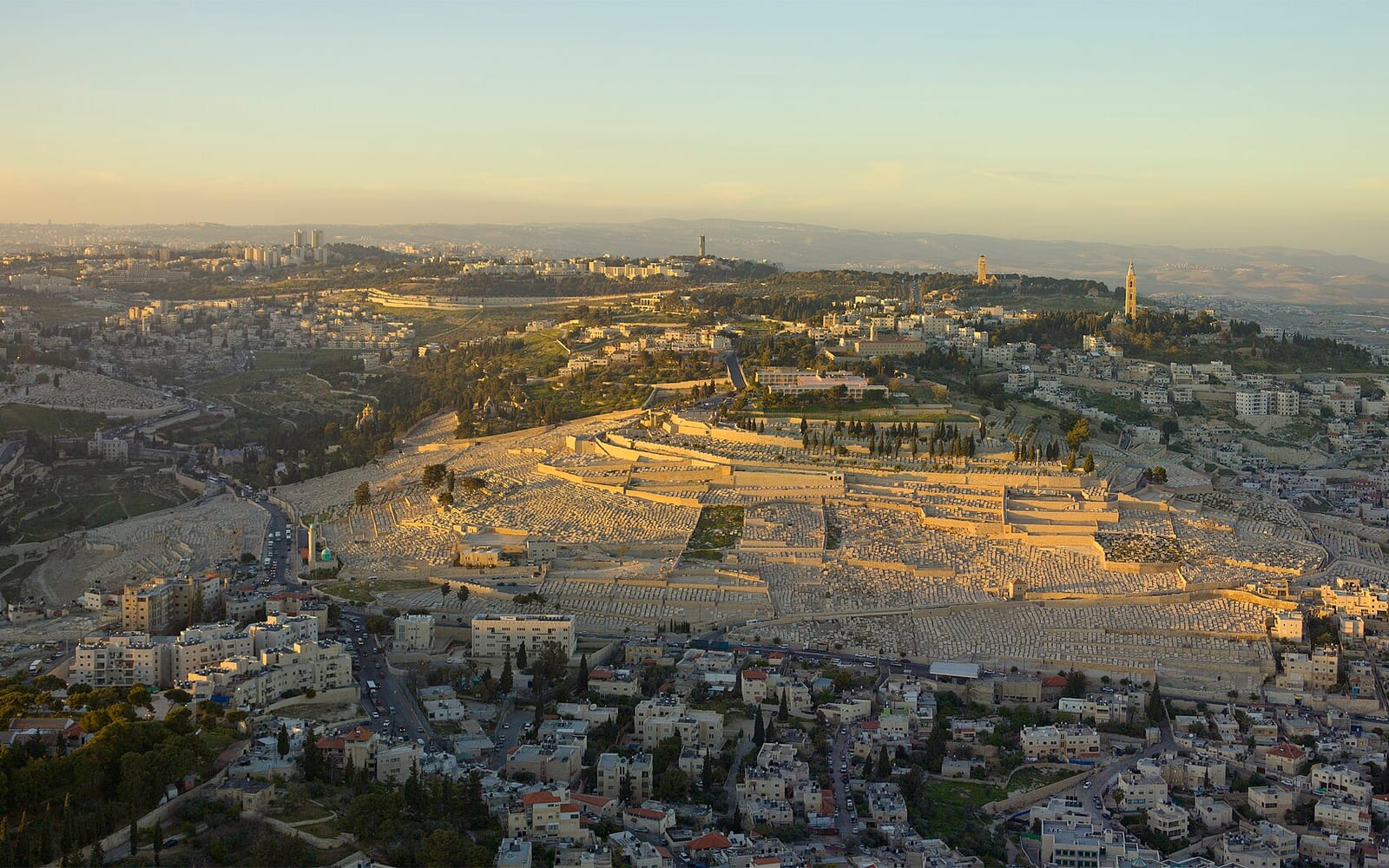
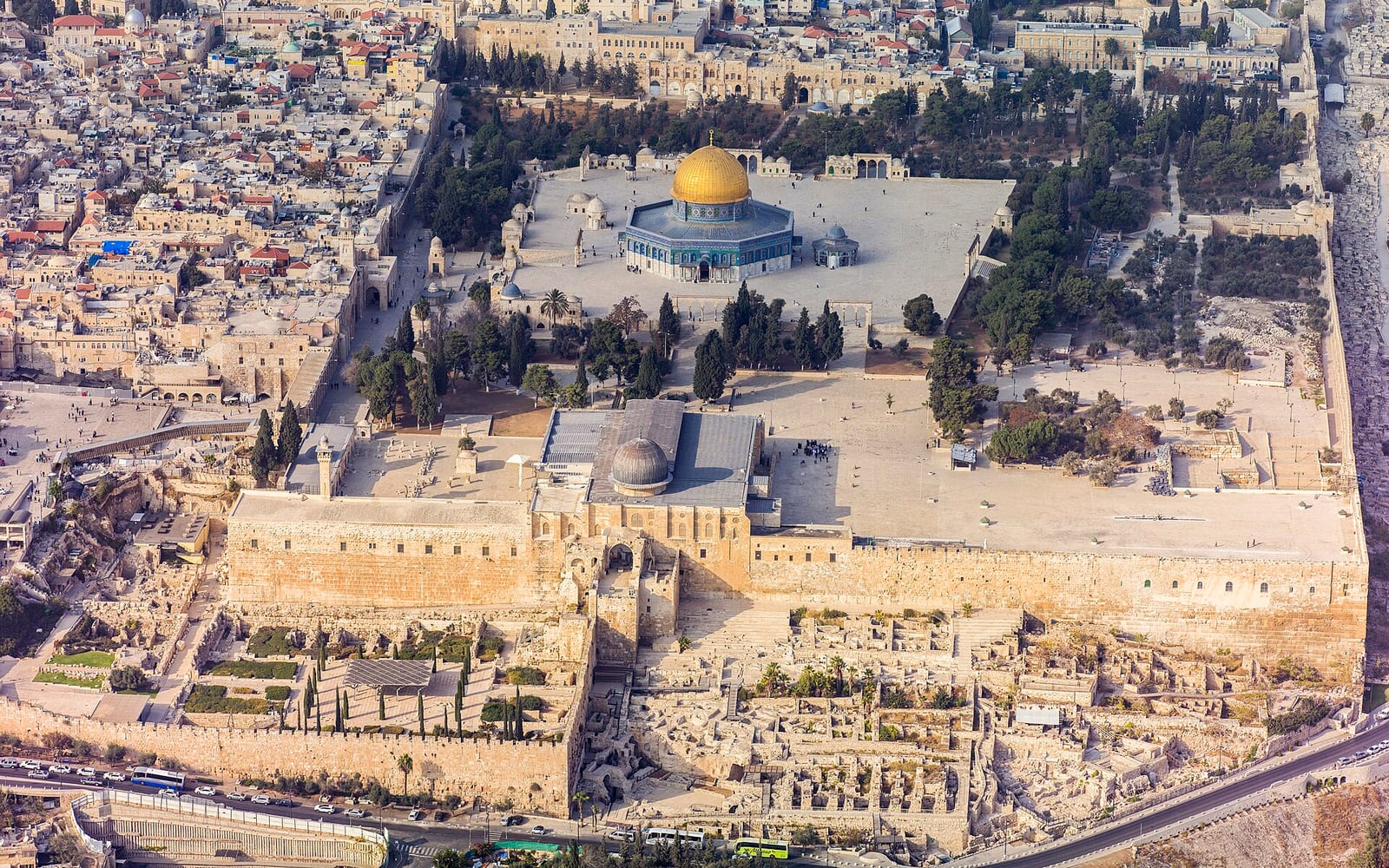
The Mount of Olives — Har HaZeitim in Hebrew, Jabal az-Zaytun in Arabic — is the ridge that faces Jerusalem’s Old City across the Kidron Valley from the east. It rises to approximately 826 metres, some 65 metres above the Temple Mount platform. From its crest, the Seven Arches viewpoint frames the most photographed panorama in Jerusalem: the golden Dome of the Rock / Qubbat as-Sakhrah, the Al-Aqsa Mosque compound, and the walls of the Old City spread across the valley below.
The ridge means different things to different visitors. For Jewish pilgrims, the hillside is one of the holiest burial grounds on earth — a cemetery in continuous use for three thousand years, where interment is sought by those who believe the resurrection of the dead will begin here. For Christian pilgrims, the Mount of Olives is inseparable from the Passion narrative: Jesus prayed in the Garden of Gethsemane at its base on the night of his arrest; a Crusader-era chapel near the summit marks the traditional site of the Ascension. For photographers and first-time visitors, it is simply the place that makes Jerusalem legible — the viewpoint from which everything else falls into place.
Quick facts
| |
|---|
| The viewpoint | Free, open 24/7 |
| Garden of Gethsemane | Free; open 08:00–12:00 + 14:00–17:00/18:00 (seasonal) |
| Church of All Nations | Free; same hours as Gethsemane |
| Dominus Flevit | Free; 08:00–11:45 + 14:30–17:00 |
| Church of the Pater Noster | Small entry fee; 08:30–12:00 + 14:30–17:00 Mon–Sat |
| Chapel of the Ascension | Small entry fee; open daily |
| Time needed | 30 min (viewpoint only) — 3 hours (full descent) |
| Getting there | Taxi from Old City 10 min (₪40–60); Bus 75 from Damascus Gate; walk from Lion’s Gate ~25 min uphill |
| Dress code | Covered shoulders and knees for all churches; respectful dress at the cemetery |
| Accessibility | Viewpoint accessible by vehicle; descent path steep and uneven |
The Seven Arches viewpoint
The viewpoint takes its name from the seven arches of the terrace in front of the InterContinental Hotel. It is the single most photographed location in Jerusalem and one of the most photographed viewpoints in the world.
Stand at the stone balustrade and the Old City spreads west across the Kidron Valley. The gold dome in the centre is the Dome of the Rock (Qubbat as-Sakhrah), built in 691 CE and one of the oldest surviving works of Islamic architecture. To its south is the dark lead dome of the Al-Aqsa Mosque; the flat platform they share is the Temple Mount (Har HaBayit) / Haram al-Sharif — one of the holiest precincts on earth to both Judaism and Islam. The Armenian, Jewish, Christian and Muslim quarters of the Old City are arranged in the walled rectangle beyond.
Best times: Arrive 20–30 minutes before sunrise for the most powerful light — the Dome catches the first rays directly and the viewpoint is almost empty. The 30 minutes before sunset produce equally warm light and are busier; weekday evenings are calmer than weekends. Midday offers flat, harsh light for photography and the largest coach-tour crowds. In summer the ridge has no shade — carry water.
Photography: A medium telephoto (50–150mm equivalent) isolates the Dome and the Old City details; a wide angle captures the full sweep of the valley. Sunrise gives a warm golden cast; blue hour (just before sunrise) gives the Dome a deep blue silhouette against a lighter sky — less dramatic but unusually serene. Filters are rarely needed.
The InterContinental Hotel terrace café behind the viewpoint serves coffee and light food with the same view — useful for an early-morning arrival before the churches open.
The descent walk
The classic Mount of Olives visit descends on foot from the viewpoint to the Garden of Gethsemane at the valley floor — about 1.5 kilometres of steep, winding path. Wear closed shoes with grip: the path is cobbled in places and gravelly in others, and pitches sharply in sections. Taxis wait at both the top and bottom; most guided tours walk down and ride back.
The path passes through the Jewish cemetery on the hillside before reaching the lower level where the Christian sites are clustered near the Gethsemane garden. Allow 20–25 minutes of walking time, more if you stop to read inscriptions or photograph the cemetery.
The Jewish cemetery
The slope between the viewpoint and Gethsemane is covered by one of the world’s oldest continuously used Jewish cemeteries — over 150,000 graves dating back approximately three thousand years to the First Temple period. Burial here is sought by observant Jews who connect the site to the prophecy in Zechariah 14:4 that the Messiah will arrive on the Mount of Olives and the resurrection of the dead will commence on this hillside.
Walk respectfully on the marked paths through the cemetery. Do not stray onto the grave plots. Photography is permitted but treat the space with the same respect you would give to any active religious burial ground — this is not a historic ruin but an ongoing site of mourning and memory. Several notable rabbis and scholars are buried on the slope; families visit regularly.
Garden of Gethsemane and Church of All Nations
At the base of the descent, below the cemetery and beside the road, eight ancient olive trees stand in an enclosed garden. These are the trees of the Garden of Gethsemane — the location, named in the Gospels of Matthew and Mark, where Jesus prayed on the night before his arrest. Carbon-dating of the tree trunks has placed them at approximately 900 years old; the root systems are likely considerably older, though the claim that any individual tree dates to the first century CE cannot be scientifically verified. Frame them as among Jerusalem’s oldest living trees — remarkable in any case.
Adjacent to the olive grove, the Church of All Nations (formally the Basilica of the Agony) is one of the most beautiful churches in Jerusalem. The Franciscan basilica was completed in 1924 to designs by Antonio Barluzzi and funded by Catholic communities across multiple nations — hence the name. Its gold Byzantine mosaic facade depicts Christ presenting the sorrows of the world to God. Inside, the windows are glazed in deep amber and violet, creating a dim, luminous atmosphere unlike any other church in the city. At the sanctuary’s centre, the bare Rock of the Agony — the natural bedrock where Jesus is believed to have prayed — is enclosed within a low iron crown of thorns. Photography inside the church is not permitted.
Hours: The Garden of Gethsemane and Church of All Nations are open 08:00–12:00 and 14:00–17:00 (winter) or 18:00 (summer). Both close on Sunday mornings during Mass. Admission is free; a donation to the Franciscan Custody of the Holy Land is appreciated.
Dominus Flevit
Partway down the descent, the teardrop-shaped chapel of Dominus Flevit (“the Lord Wept”) is one of the most moving stops on the ridge. The Franciscan chapel was designed in 1955 by Antonio Barluzzi — the same architect as the Church of All Nations — in the form of a stone teardrop, commemorating the Gospel account of Jesus weeping over Jerusalem as he descended the Mount of Olives toward the city.
The interior is intentionally simple. At the far end, the altar is set against a large window that frames the entire Old City directly ahead — the Dome of the Rock, the walls, the towers — in one of the most celebrated architectural photographs in Jerusalem. A mosaic of a hen gathering her chicks (from Matthew 23:37) is the only other significant decoration. The effect is quiet and precise.
Hours: 08:00–11:45 and 14:30–17:00. Free entry.
Russian Orthodox Church of Mary Magdalene
Above the descent path, visible from the valley by its seven golden onion domes, the Church of Mary Magdalene was built in 1888 by Tsar Alexander III in memory of his mother, Empress Maria Alexandrovna. The domes are among the most recognisable landmarks on the Mount of Olives skyline.
The church is run by the Russian Orthodox Church in Exile (ROCA) and has more restricted visiting hours than the Franciscan sites — typically Tue and Thu 10:00–12:00, though these change seasonally. If visiting the Mary Magdalene church is a priority, confirm current hours before planning your descent. Entry is free.
Church of the Pater Noster
Near the upper ridge, the Church of the Pater Noster (Our Father) marks the traditional site where Jesus taught his disciples the Lord’s Prayer. The Carmelite church and adjacent cloister are lined with ceramic tiles inscribed with the Lord’s Prayer in over 140 languages — including Hebrew, Arabic, English, Latin, Swahili, Mandarin and Braille. Finding your own language among the tiles is a small, moving detail that most visitors remember.
The site also contains ruins of the fourth-century Eleona Church, built by Emperor Constantine and Queen Helena over the traditional teaching site, which was destroyed in 614 CE and never fully rebuilt. Excavated sections of the original basilica are visible in the courtyard.
Hours: Mon–Sat 08:30–12:00 and 14:30–17:00. Small entry fee.
Chapel of the Ascension
Near the summit of the ridge, within a courtyard that has been an Islamic endowment (waqf) since the Crusader period, the Chapel of the Ascension is a small octagonal structure — originally built by the Crusaders, converted into a mosque after Saladin’s conquest of Jerusalem in 1187, and now jointly used as both. The interior floor contains a stone alleged to hold the footprint of Jesus at the moment of his ascension into heaven.
The site is managed by the Muslim Waqf; a small fee is charged for non-Muslim visitors. The octagonal architectural form is visible from outside; Muslim visitors may also pray in the adjoining mosque. Hours vary — check locally before visiting.
Palm Sunday route
On Palm Sunday — the Sunday before Easter, observed by Catholic, Protestant, Armenian, and some Orthodox Christian communities — a large procession descends the Mount of Olives from near the Bethphage chapel (higher on the ridge) to the Lion’s Gate of the Old City, retracing the Gospel account of Jesus’s entry into Jerusalem. The procession draws tens of thousands of pilgrims and closes the main descent path to other visitors for several hours in the early afternoon.
If you are visiting Jerusalem during Holy Week and do not wish to join the procession, plan your Mount of Olives visit for the morning (before noon) or visit the following day. If you do wish to join, no ticket is required — the procession is open to all; bring water and be prepared for very large crowds on a narrow path in April sun.
Photography guide
| Light condition | Best shots |
|---|
| 30 min before sunrise | Dome of the Rock lit gold; empty viewpoint |
| Blue hour (pre-dawn) | Dome as silhouette; city lights still on |
| 30 min before sunset | Warm golden cast on the Dome and Old City walls |
| Inside Dominus Flevit | Window-frame composition with the Old City beyond |
| Jewish cemetery | Wide angle across the slope toward the Old City |
Avoid midday in summer: harsh overhead light bleaches the Dome’s gold and creates heavy shadows in the cemetery. The light on the west-facing Old City improves throughout the afternoon as the sun moves.
Getting there and getting around
By taxi or Gett: The fastest and most practical option from any Old City hotel or the city centre. Ask for the Seven Arches viewpoint or InterContinental Hotel; both name the same destination. Journey time from Jaffa Gate or Damascus Gate is 8–12 minutes; fare approximately ₪40–60.
By bus: The Arab bus 75 from the East Jerusalem bus hub near Damascus Gate serves the ridge. Frequency is variable; the route is reliable but less comfortable than a taxi for most visitors.
Walking from Lion’s Gate: A steep 25-minute climb from the Lion’s Gate entrance on the Old City’s eastern face. Manageable in the morning when it is cooler; inadvisable in summer midday. The descent the other direction — from the viewpoint down to Lion’s Gate — is a classic finish to a guided tour.
From Gethsemane back: Taxis and sheruts wait on the road outside the Garden of Gethsemane. A Gett from this point back to most Jerusalem hotels costs approximately ₪25–40.
Combining the Mount of Olives with the Old City
The Mount of Olives and the Old City form a natural full-day pairing: viewpoint at sunrise, then descend to Gethsemane for the opening of the churches at 08:00; walk across through Lion’s Gate into the Muslim Quarter for a late-morning souq wander; reach the Western Wall Plaza before noon; cross to the Jewish Quarter and the Church of the Holy Sepulchre in the afternoon.
Alternatively, a guided walking tour handling the logistics (transport to the viewpoint, the descent, and the Old City entry) compresses the journey and adds context that is difficult to replicate independently.
Cross-links for planning: