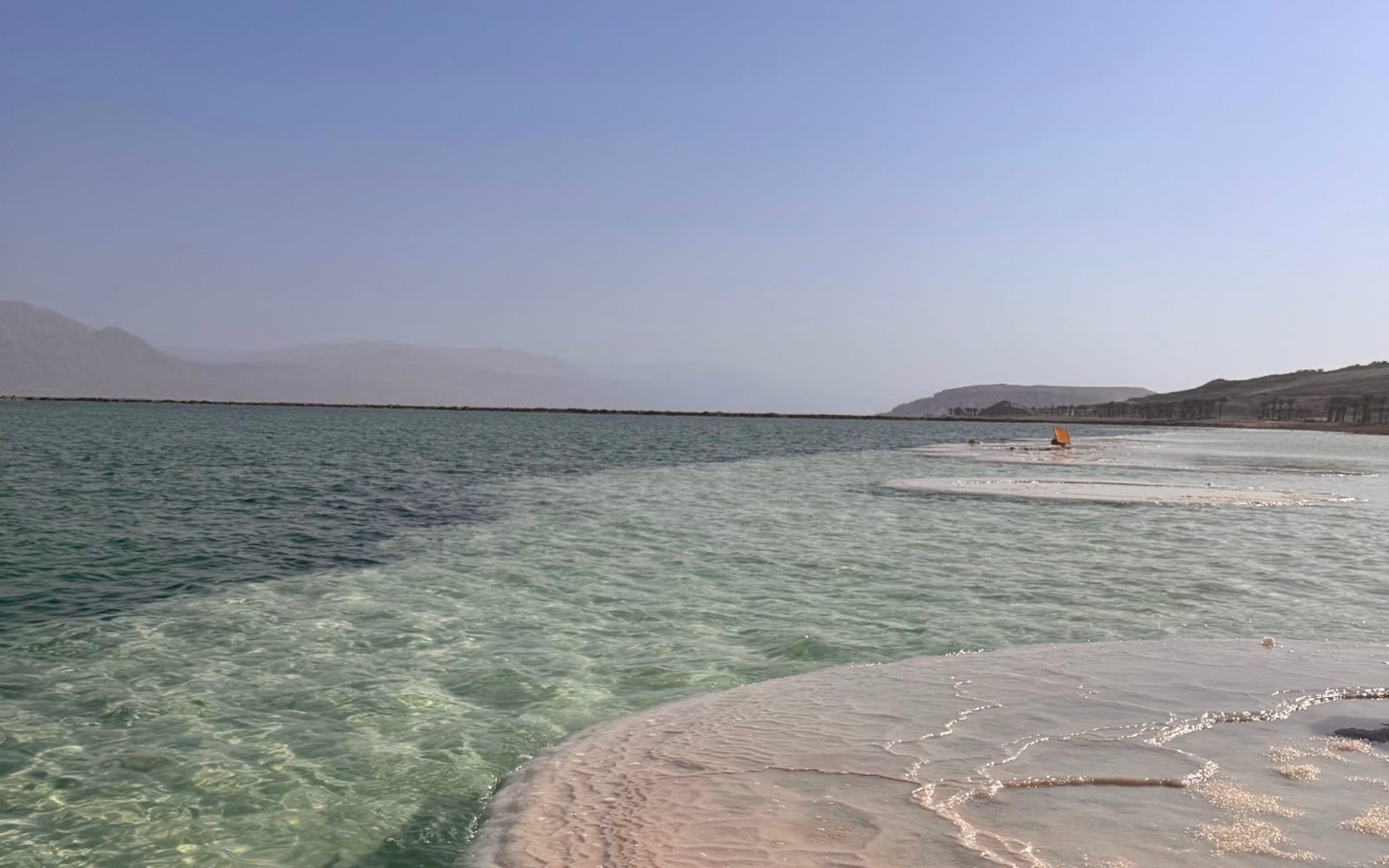
Mount Sodom (Har Sedom in Hebrew) is one of the strangest landforms in Israel — a 225-metre ridge on the southwest shore of the Dead Sea composed almost entirely of halite, or rock salt, with layers of softer gypsum and marl. Over thousands of years, the rare rains of this desert environment have carved Nahal Pratzim (the Pratzim Stream) into a narrow white slot canyon through the mountain’s salt body, and hollowed out the Flour Cave (Mearath HaKemah) — a chamber whose floor and walls are coated in fine white salt and calcium-sulphate dust, making it look like a room dusted with flour.
Most Dead Sea visitors never make it this far south. The resort strip at Ein Bokek sits 5 km to the north and captures almost all tourist traffic. Nahal Pratzim is a 20-minute drive past the resorts on Route 90, and it rewards the detour with one of the most visually striking short hikes in the country.
At a Glance
| Detail | Information |
|---|
| Location | Route 90, km 193–194, near Neve Zohar |
| Distance from Ein Bokek | ~5 km south; about 10 minutes by car |
| Entry fee | Free; no ticket booth |
| Facilities | None on site; nearest services at Neve Zohar (Ein Bokek area) |
| Nearest town | Ein Bokek / Neve Zohar, 5 km north |
| Seasons | October to April; avoid May–September heat |
| Navigation | Download AllTrails or Amud Anan GPS tracks offline |
Three Trail Options
Option 1 — The Flour Cave (Easiest; 15 min return)
The Flour Cave entrance is a short walk from the Route 90 pull-off. A low tunnel leads into a chamber where every surface — floor, walls, ceiling — is covered in white salt and calcium-sulphate dust. The effect is eerie and otherworldly: a purely white room hollowed out of a salt mountain.
What you need:
- A headtorch or a phone torch set to maximum brightness — there is no installed lighting
- Old clothes you do not mind dusting white
- 1 litre of water minimum
No climbing is required. The floor is flat. The cave is suitable for children and adults of all fitness levels. Allow 15 minutes for the full chamber exploration.
The Flour Cave’s white interior photographs exceptionally well with a headtorch for primary light; bring a spare light source since the chamber is completely dark if your phone battery fails.
Option 2 — The Nahal Pratzim Canyon Loop (Moderate; 0.9 miles / 1.5 km; 1–2 hours)
The canyon loop descends into Nahal Pratzim itself — a slot canyon carved through the salt ridge, with walls that glow cream and white in direct sun and turn amber and gold in late afternoon. The path follows the canyon bed, passes through a section narrow enough to require turning sideways (the “slot” section), visits the Lot’s Wife salt pillar — a natural column shaped by water erosion of the ridge — and climbs out to a viewpoint looking across the Dead Sea to the Jordanian plateau.
Trail conditions:
- AllTrails lists this as 0.9 miles; allow 1.5–2 hours for stops and photography
- The slot section is navigable for adults and older children; not accessible for pushchairs or walkers
- Canyon floor may be muddy or wet in winter (December–February) — some sections become impassable after rain
What you need:
- 2–3 litres of water per person
- Sturdy closed-toe shoes or hiking boots (not sandals)
- Headtorch for the Flour Cave if you combine both
- Downloaded offline GPS on AllTrails or Amud Anan (the trail is marked but mobile signal is patchy)
Option 3 — The Amiaz Plateau Full Day (Hard; 12.3 miles / 20 km; 5.5–6 hours)
AllTrails rates this route as hard: the Amiaz Plateau involves climbing the full Sodom ridge, traversing the exposed limestone plateau above the canyon, and gaining 1,597 ft (487 m) of elevation. The views across the Dead Sea are exceptional — the rift valley stretching north toward Masada, the Judean Hills on the western horizon, Jordan’s red and ochre mountains across the water.
This route is for experienced hikers only. It is remote, has no facilities, and emergency rescue beyond Timna Park boundaries is slow. Requirements:
- 5 litres of water per person (carry from the car — no sources on the plateau)
- Full day — start no later than 07:00 in October–April; earlier in shoulder-season months
- Hiking partner strongly recommended — do not do this route solo
- Offline GPS on Amud Anan downloaded before you start
- Power bank for navigation devices
- Check ims.gov.il the day before for rain or thunderstorm forecasts — abandon the route if rain is forecast
Getting There
By car: From the Ein Bokek resort area, drive south on Route 90 for approximately 5 km. The pull-off for Nahal Pratzim and the Flour Cave is on the right (west side of the road) at km-marker 193–194, near the sign for Neve Zohar. There is an informal parking area at the trailhead.
Public transport: There is no public bus stop at Mount Sodom. A hire car is essential.
From Jerusalem: Drive east on Route 1 to the Dead Sea junction, then south on Route 90. Total journey: approximately 1 hour 20 minutes.
From Tel Aviv: Route 1 east or Route 443 to Jerusalem, then Route 90 south. Total journey: approximately 2 hours.
Combining Nahal Pratzim With Other Dead Sea Stops
Nahal Pratzim sits at the southern end of the Dead Sea area — it makes most sense as part of a day itinerary that works its way south from the main resort area:
Full Dead Sea south day itinerary:
- 06:00 — Masada (30 km north of Nahal Pratzim): Snake Path before the heat builds; summit views; cable car down
- 09:30 — Drive south along Route 90
- 10:00 — Nahal Pratzim: Flour Cave + canyon loop; 2 hours
- 13:00 — Return to Ein Bokek: floating at the resort beach; lunch at one of the Ein Bokek hotels
- 15:30 — Head north toward Jerusalem or Tel Aviv
This itinerary is also the natural structure of the Masada and Dead Sea day trip with the Nahal Pratzim extension tacked on at km 193 on the drive back.
Safety and Flash Flood Risk
The Dead Sea region looks dry — and usually is — but the Negev and Judean Desert are flash-flood terrain. Narrow canyons like Nahal Pratzim can fill with water within minutes when rain falls upstream, which may be kilometres away and invisible from the canyon floor.
Before any canyon hike:
- Check ims.gov.il for the day’s rainfall forecast for the entire Dead Sea region
- Do not enter the slot canyon if any rain is forecast within 24 hours
- If you see fast-moving water or the sky suddenly darkens while you are in the canyon, climb the canyon walls immediately and do not attempt to walk through water flow
Flash floods in the Dead Sea area have caused fatalities — this is not a theoretical risk. The free access and lack of facilities at Nahal Pratzim means there is no ranger or warning system on site.
The Geology: Why Is Everything White?
Mount Sodom’s whiteness has a direct explanation. The mountain is a salt diapir — a body of rock salt that has pushed upward through the earth’s surface under pressure over millions of years. As the salt ridge erodes, it releases halite (sodium chloride), gypsum (calcium sulphate) and anhydrite, which coat canyon surfaces in white mineral deposits. The Flour Cave’s “flour” is primarily fine calcium-sulphate dust — the same mineral found in common plaster and chalk.
This makes Mount Sodom one of the few places in the world where you can walk through a canyon carved entirely through a salt body. The Dead Sea shore has other salt formations, but none as accessible or as dramatically sculpted as the Nahal Pratzim canyon.
The Lot’s Wife pillar on the canyon loop is a natural erosional feature named for the Genesis narrative (Genesis 19:26). It is a geological column, not an archaeological site — the name is traditional and widely used by Israeli guides and hikers. The biblical association is part of the mountain’s cultural context, not a scientific claim.