The National Library of Israel — the country’s official national library and one of its most significant cultural institutions — moved into its purpose-built home in Jerusalem in 2023–2024, in a building designed by the Swiss firm Herzog & de Meuron. The result is one of the most architecturally striking public buildings in the country: a structure clad in Jerusalem stone that opens up inside into a radially organised interior inspired, according to the architects, by the cross-section of a pomegranate.
The library holds more than five million books, over 50,000 manuscripts (including some of the oldest surviving Hebrew manuscripts in the world), the personal archive of Albert Einstein (donated by Einstein himself to the Hebrew University of Jerusalem), the personal library of the Kabbalist scholar Gershom Scholem, extensive Jewish music archives, and historical records spanning Jewish communities from Yemen to Poland to Morocco. It is a significant research destination — and, in its new building, a visitor destination in its own right.
The building: what to expect
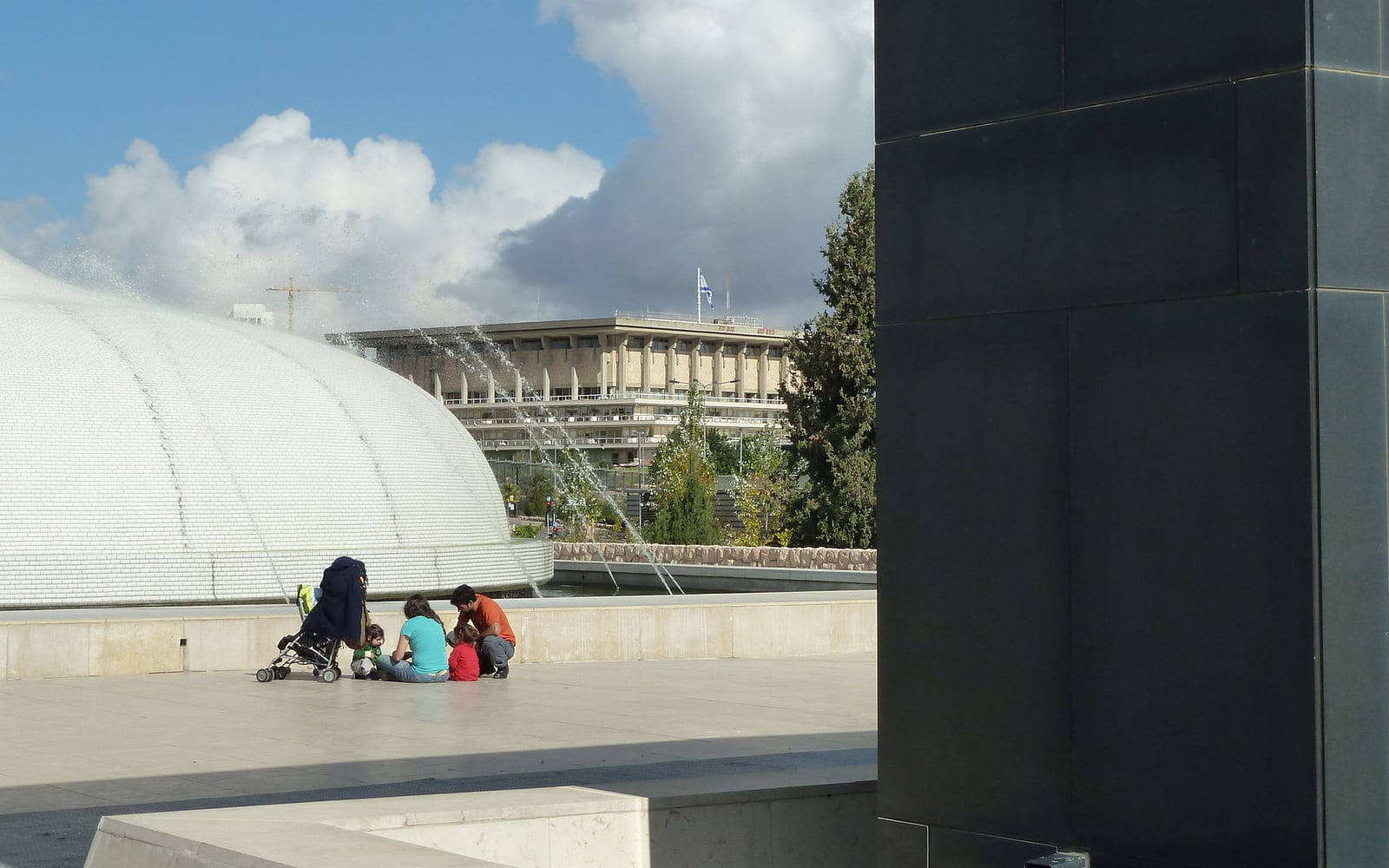
The approach to the library from Eliezer Kaplan Street — past the Wohl Rose Garden that links it to the Israel Museum campus — gives you the exterior: long horizontal planes of Jerusalem limestone, referencing the vernacular materials of the city while giving the building a distinctly contemporary mass. Inside, the geometry shifts: the central reading hall is arranged radially, its arcs of bookshelves and workstations fanning out from a central point. Natural light enters through carefully controlled apertures. The effect is calm, ordered and — for anyone who has spent time in the city’s ancient stone structures — in dialogue with them without imitating them.
The building also houses exhibition galleries, a café, and public-access spaces that do not require a reader registration to enter.
What the public can access
Open areas: The main entrance hall, the public exhibition galleries and the building’s common spaces are accessible to all visitors. No registration is required for a general visit during opening hours.
Rotating exhibitions: The library mounts changing exhibitions drawn from its own collection — rare manuscripts, historical maps, musical scores, archival photographs, letters and objects. The specific content varies; check the library’s website before visiting to see what is currently on display.
Reading rooms: Access to the physical collection — manuscripts, rare books, archival boxes — is limited to registered researchers and requires advance registration at nli.org.il/en/visit. Walk-in reading room access is not available.
Guided tours: English-language guided tours are offered on select days, subject to availability. Check current scheduling at nli.org.il.
Photography: Permitted in public areas. Not permitted inside the reading rooms.
The collections: highlights
Hebrew manuscripts: The library holds one of the world’s largest collections of Hebrew manuscripts, including illuminated medieval codices and liturgical texts spanning twelve centuries of Jewish literary production across three continents.
The Einstein Archive: Albert Einstein bequeathed his personal papers — correspondence, scientific manuscripts, unpublished notes — to the Hebrew University of Jerusalem, which administers them through the National Library. The archive contains more than 80,000 documents. Selected items are displayed or accessible digitally through the library’s online portal.
Gershom Scholem’s library: The collection of Gershom Scholem (1897–1982), the founder of the modern academic study of Jewish mysticism and Kabbalah, was donated to the National Library and constitutes a major resource for scholars of Jewish esotericism, rabbinical history and the Kabbalistic tradition from Safed to German Romanticism.
Jewish music archives: The library’s sound archives contain recordings and scores from Jewish musical traditions worldwide — liturgical, folk, Yiddish theatre and early Israeli popular music.
Genealogical records: The library holds community-level Jewish historical records — newspapers, landsmanshaft publications, memorial books (yizkor bikher), and regional Jewish community records — that can be invaluable for diaspora genealogical research. Librarians with genealogy expertise are available by appointment. For a guide to combining this with other institutions in Israel, see the Jewish genealogy research guide.
Address: Eliezer Kaplan Street 1, Jerusalem (Givat Ram campus, adjacent to the Knesset). The library is well signed from Ruppin Boulevard.
Getting there: Take the Jerusalem Light Rail (Line 1) to the Knesset stop, then walk five minutes to the library entrance. By car, parking is available on the Givat Ram campus (limited; arrive early). The Israel Museum shuttle bus from the Jerusalem Central Bus Station stops near the campus.
Hours: The library is open Sunday through Thursday. Hours vary seasonally — check nli.org.il/en/visit before traveling. The library is closed on Fridays, Saturdays, Jewish holidays and some Israeli national observance days.
Entry: The public areas, including exhibitions, are free to enter. Some special exhibitions may carry a separate admission charge. Reading room access requires registration (free but must be arranged in advance).
Language: The library’s website and most visitor-facing signage are available in English alongside Hebrew. English-speaking staff are available at the information desk.
Planning a Givat Ram campus day
The National Library sits within a cluster of major Jerusalem cultural institutions that together make up the Givat Ram campus — one of the most concentrated areas of serious cultural infrastructure in the country. A practical day route:
Morning (3 hours): National Library of Israel — arrive at opening for the architecture and exhibitions; allow time to browse the catalogue terminals in the public areas if interested in the collection; photograph the interior before visitors arrive.
Midday: Walk through the Wohl Rose Garden (the tree-lined parkway connecting the library to the Israel Museum), stopping at the Bloom Garden for the view back towards the library’s limestone facade.
Afternoon (4–5 hours): Israel Museum — the Shrine of the Book (housing the Dead Sea Scrolls and other ancient manuscripts) and the Holyland Model of Second Temple Jerusalem are essential. The archaeology and impressionist wings take additional hours. See the full Jerusalem museums guide for scheduling advice.
Optional addition: The Knesset (Israel’s parliament) is a five-minute walk from the library entrance; guided public tours are available on select weekdays (check knesset.gov.il for the current schedule).
Who should visit
The National Library is well suited to visitors who are interested in one or more of the following:
- Jewish intellectual history — the library is the custodian of the accumulated textual culture of world Jewry across three millennia
- Architecture — the Herzog & de Meuron building is worth visiting independently of the exhibitions; it is one of the most successful new public buildings in Jerusalem
- Genealogical research — the collections of community records, regional newspapers and landsmanshaft materials make the library one of the key resources for Jewish genealogy research in Israel
- Rare book and manuscript culture — the rotating exhibitions regularly feature items from the manuscript collection that are rarely accessible elsewhere
- Photography — the interior geometry of the reading hall and the play of natural light through the stone-framed windows make for compelling architectural photography
It is not primarily a children’s destination, and is best suited to visitors comfortable with a calm, intellectually oriented environment.
Before you go
- Confirm current opening hours and exhibition listings at nli.org.il/en/visit before your trip — hours and exhibitions change seasonally
- If you intend to access the reading rooms for research, register in advance; same-day registration is not available
- The library is closed on Shabbat (Friday evening through Saturday night); plan accordingly — see the Shabbat guide for help navigating Jerusalem on Shabbat
- Book accommodation well ahead if visiting during July–August or around major Jewish holidays (Rosh Hashanah, Passover), when Jerusalem hotels fill quickly — see the Jerusalem museums guide for notes on best-value areas to base yourself near the Givat Ram campus
- For a broader Jewish heritage itinerary in Israel, the National Library pairs naturally with the ANU Museum of the Jewish People in Tel Aviv (world’s largest Jewish genealogy database) and Yad Vashem in Jerusalem