Southern Israel is the part of the country most travellers see only from a bus window or an airport approach. The Negev covers more than half of Israel’s land area, yet the usual itinerary leaves it to a single day trip at most. This four-to-five-day self-drive circuit from Beer-Sheva to Eilat changes that: it moves through the geological and historical layers of the Negev at a pace that lets the desert make its case — the erosion crater at Makhtesh Ramon, the spring-fed canyon at Ein Avdat, the Nabataean trade city at Avdat, the ancient copper workings at Timna, and the Red Sea at Eilat.
A car is essential. The desert is not built for public transport, and the distances between sites require flexibility. See the Israel car rental guide for operator comparisons, and the driving in Israel guide for tolls, fuel and Israeli road norms before you set off.
The circuit at a glance
Total driving: ~350 km (Beer-Sheva to Eilat, one way)
Overnight stops: Beer-Sheva or Mitzpe Ramon (night 1) · Mitzpe Ramon (night 2) · Eilat (nights 3–4)
Core route: Route 40 south from Beer-Sheva through Sde Boker → Mitzpe Ramon → Route 40 further south → Timna → Eilat
Extensions: Petra day trip from Eilat via Wadi Araba border crossing
Day 1 — Beer-Sheva: Negev Gateway
Beer-Sheva is the capital of the Negev and the practical starting point for the southbound circuit — the last city with good fuel, supermarkets, and wide accommodation choice before the desert thins out.
Tel Beer-Sheva UNESCO site
Begin with the Tel Beer-Sheva archaeological site, 6 km east of the modern city. The reconstructed ancient city — a well-preserved example of Iron Age Israelite urban planning, built on a tell (mound) overlooking the Beersheba River valley — is a UNESCO World Heritage Site. The stepped well at the centre of the excavation is one of the deepest ancient wells in Israel. An INPA pass is valid here; the site takes 1–1.5 hours. The view from the tel across the northern Negev gives a sense of the desert terrain ahead.
Bedouin Market (Wednesday and Thursday mornings only)
If your Day 1 falls mid-week, Beer-Sheva’s Bedouin market (Thursday morning is larger; Wednesday also active) operates on the eastern edge of the city. Fabric, spices, livestock, and local produce — it is genuinely a working market, not a tourist reconstruction. It winds down by noon; arrive by 09:00 for the best of it. The Bedouin experience guide has context on Bedouin culture and the Negev communities you will see on the drive south.
Evening in Beer-Sheva or drive to Mitzpe Ramon
Beer-Sheva has enough restaurants and hotels to justify an overnight stop, particularly if you want to hit the Bedouin market early. Alternatively, drive the 85 km south to Mitzpe Ramon on Route 40 this afternoon — it takes 1 hour and arrives in time for dinner on the crater rim. If you make this drive, stop at the Makhtesh Gadol (Medium Crater) viewpoint, about 20 km before Mitzpe Ramon, for a first view of the geological formations ahead.
Beer-Sheva to Mitzpe Ramon: 85 km, Route 40 south, approximately 1 hour.
Day 2 — Sde Boker, Ein Avdat & Avdat
Day 2 covers three of the most significant sites in the northern Negev, all within 35 km of each other on Route 40.
Morning — Ben-Gurion’s Desert Home at Sde Boker
Kibbutz Sde Boker, 50 km south of Beer-Sheva, was the deliberate retirement and burial choice of David Ben-Gurion, Israel’s first prime minister. He moved to this remote Negev kibbutz in the early 1950s rather than staying in Jerusalem or Tel Aviv — a symbolic act about what he believed Israel’s future required (settling the desert). His simple two-room wooden hut is preserved exactly as it was at his death in 1973: a camp bed, a small desk, a wall of books in multiple languages.
Ben-Gurion’s grave stands on a platform above the Zin Valley, facing the open Negev Highlands that extend to Ein Avdat’s white cliffs. The site is quiet, accessible at all times, and requires no advance booking. The museum in the hut has standard INPA park opening hours. Allow 45–60 minutes. This is one of the more honest historical sites in Israel — a man of enormous historical weight in an entirely unmonumental setting.
If you overnighted in Beer-Sheva rather than Mitzpe Ramon, Sde Boker is 50 km south: 40 minutes on Route 40.
Midday — Ein Avdat National Park
Ein Avdat is a spring-fed canyon cut through white chalk cliffs in the northern Negev. The canyon walls reach 30–50 metres; a small waterfall feeds a clear pool beneath Euphrates poplars and desert vegetation that exists nowhere else in the surrounding landscape.
Access. The park has two entry points — the lower entrance (Route 40, near Sde Boker) and the upper entrance (3 km further north on Route 40). The recommended loop visits the lower canyon first, ascending through the main spring and pool section via metal ladders and a narrow cliff-side path, then exiting at the upper entrance. Arrange a car at the upper entrance before starting, or walk back the way you came.
Timing. Arrive as early as the park opens (typically 08:00 in summer, check parks.org.il for current hours). The spring pools and ladder sections require physical effort; shade disappears once the sun is overhead. In autumn and winter, the waterfall flows substantially; in late summer the flow is minimal.
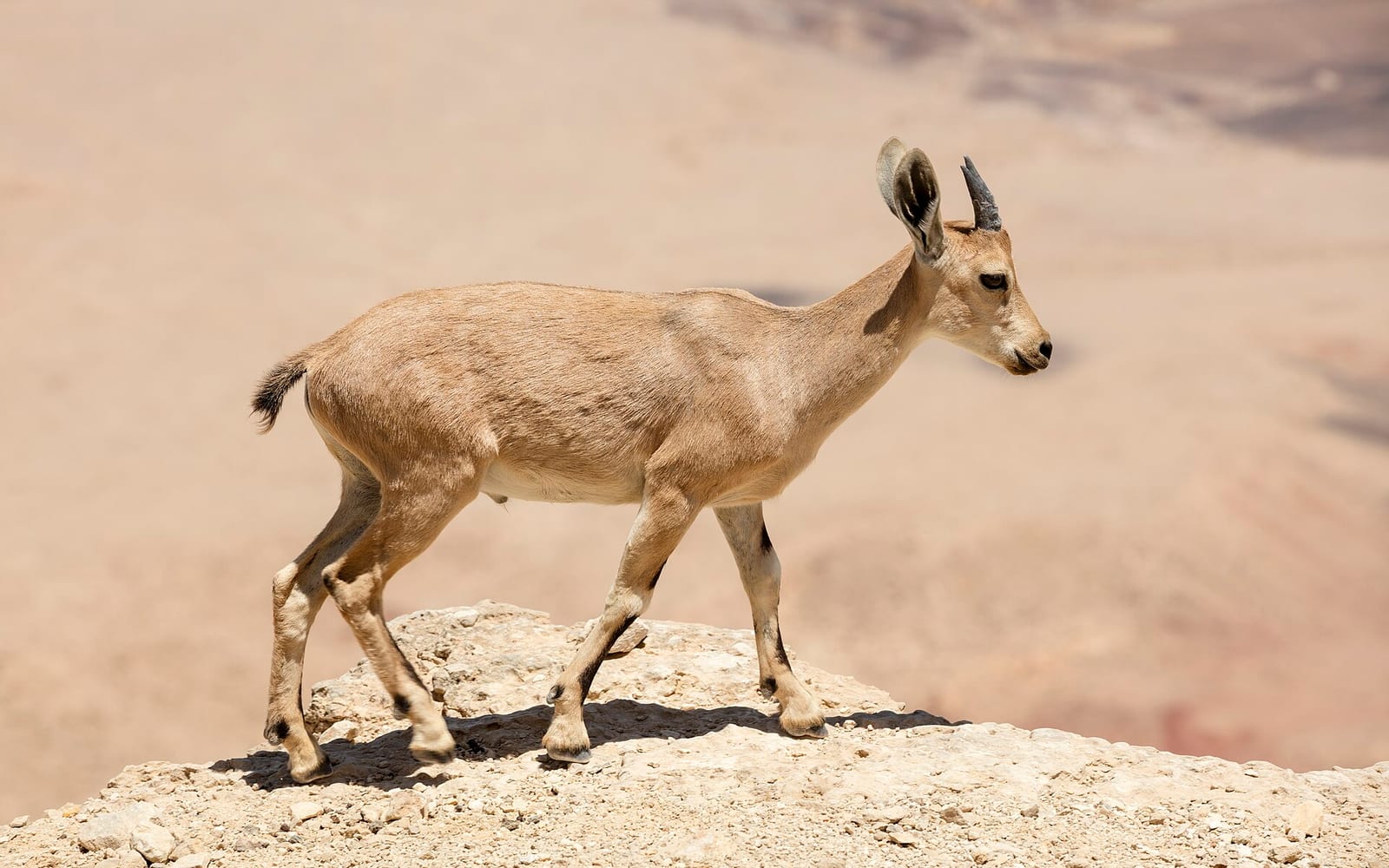
Wildlife. Nubian ibex are semi-permanent residents of the canyon cliffs and appear regularly at the spring. Egyptian and Griffon vultures circle overhead. INPA pass is valid. See the Sde Boker & Ein Avdat guide for detailed trail options, opening hours, and how to combine both sites in a half-day.
Trail note. The upper canyon section requires good footwear and moderate fitness — the ladders and cliff path are vertical in places. There is no bypass for visitors who cannot manage them.
Afternoon — Avdat Nabataean Ruins (UNESCO)
Avdat is 20 minutes south of Sde Boker on Route 40 — the best-preserved city on the Nabataean Incense Route, a UNESCO World Heritage Site. The Nabataeans ran a trade network stretching from the Arabian Peninsula to the Mediterranean 2,000 years ago; Avdat was a waystation on the route carrying frankincense, myrrh and spices to Roman ports. The visible remains — a Roman-Byzantine overlay on Nabataean foundations — include a winery, bathhouse, temple complex, and a fort that commanded the desert valley below. INPA pass valid. Allow 2 hours.
Beer-Sheva to Avdat: approximately 70 km south via Route 40.
Evening — Mitzpe Ramon
Continue south 20 km from Avdat to Mitzpe Ramon. This puts you on the crater rim by late afternoon: enough time to watch sunset from the designated viewpoints along Yotam Road before dinner. See the Mitzpe Ramon guide for accommodation and restaurant options — both are limited, so book in advance. The Beresheet Hotel on the crater rim is the most striking property; Selina Ramon offers eco-glamping tents with crater views at a mid-range price point.
Day 3 — Makhtesh Ramon: Crater Day
Day 3 is about the makhtesh itself — the largest erosion crater in the world, 40 km long, up to 10 km wide, and 500 m deep.
Morning — Ilan Ramon Space Center & Crater Rim
The Ilan Ramon Space Center (MARD) on the crater rim explains the geology correctly: Makhtesh Ramon is not a meteor crater and not a volcano. It is a makhtesh — a geological formation unique to the Negev and Sinai, formed by tectonic uplift and millions of years of water erosion hollowing out a natural dome. The Hebrew word makhtesh means something like “mortar.” The Space Center also commemorates Israeli astronaut Ilan Ramon (the crater name and town name derive separately from the Hebrew root for “height”), who died in the Columbia disaster in 2003. INPA pass valid.
The crater rim promenade outside the Space Center gives the first full view. Photographs do not convey the scale. The Prism viewpoint — access road off Yotam Road — shows the multicoloured volcanic strata of the crater wall in cross-section.
Midday — Wadi Ardon Hike (crater floor)
Important. Wadi Ardon is a moderate-to-demanding trail, not a nature walk. The full loop from the town edge runs 10–12 km with significant elevation change on rocky terrain. In summer (June–September), the crater floor reaches dangerous heat within two hours of sunrise — start by 07:00 and be back by 10:00 if the temperature is forecast above 32°C. The trail is substantially better in March–May or September–November.
The route descends from the town’s southern edge via the Prism viewpoint down to the crater floor, then follows Nahal Ardon’s dry riverbed. The Carpenter’s Workshop — columns of basalt that formed as lava cooled vertically — is the most photographed geological feature on the floor. In spring, desert tulips and anemones cover the crater; Nubian ibex move freely across the walls year-round.
Carry 3 litres of water per person minimum. No shade, no water sources, limited mobile signal in places. Download the GPX from Wikiloc or AllTrails before entering the crater.
Alternative: Crater Jeep Tour
If the Wadi Ardon trail is not suitable (heat, fitness level, group composition), a crater jeep tour covers sections of the makhtesh floor accessible only by 4x4 — the inner sand canyons, the remote basalt field in the crater’s western end. Licensed operators depart from Mitzpe Ramon town and can run half-day or full-day circuits.
Evening — Negev Highland Wine & Stargazing
The Negev Highlands have emerged as a serious wine region. Several wineries operate within 20–30 minutes of Mitzpe Ramon — Boker Valley Winery, Carmey Avdat, Matar among them; advance booking required at most estates. The Israel wine guide covers the full regional overview.
Makhtesh Ramon sits within an IDA-certified International Dark Sky Park — the largest in Israel, with the Milky Way visible to the naked eye on clear nights. Guided stargazing sessions with a telescope and astronomer guide depart from town; weather-dependent, book in advance. See the Israel stargazing guide for seasonal sky conditions and operator recommendations.
Day 4 — Timna Park & Eilat
Day 4 drives the remaining 170 km south from Mitzpe Ramon to Eilat, with a stop at one of Israel’s most underrated archaeological sites.
Morning — Timna Park
Timna Park sits 25 km north of Eilat in the Arava Valley — ancient copper mines worked by the Egyptians and the Canaanites from roughly 6,000 years ago, with a landscape of red sandstone shaped into formations unlike anything else in Israel.
Key stops inside the park:
- Mushroom Rock — sandstone weathered into an unmistakable silhouette; the most photographed formation in the park; 5-minute walk from the car park
- King Solomon’s Pillars — a row of 50-metre sandstone columns named by the 19th-century geographer Edward Henry Palmer; imposing at any time of day but photographed best in early morning side-light
- Egyptian Temple of Hathor — remains of a New Kingdom Egyptian temple, roughly 3,300 years old, built by miners working the copper deposits; one of the most intact Egyptian religious structures in Israel
- The Tabernacle replica — a full-scale reconstruction of the biblical Tabernacle (mishkan), cloth-walled and torchlit inside; it is operated as an experiential exhibit rather than a museum and works best with the guided context
Timna admission note: Timna Park is not covered by the standard Israel National Parks Authority (INPA) pass. It is operated by a separate foundation and has its own admission fee. Check current rates at parktimna.co.il.
Heat warning. Timna’s valley floor reaches extreme temperatures from June to August — plan morning entry (open 08:00) and leave by 11:00 at the latest. The formations that require walking between car parks are fully exposed.
Mitzpe Ramon to Timna: approximately 155 km, 1 hour 45 minutes via Route 40 south.
Afternoon — Eilat
Arrive Eilat in the early afternoon. The city sits at the northernmost tip of the Red Sea (Gulf of Aqaba), between the Jordanian port of Aqaba to the east and the Egyptian Sinai coast to the west.
North Beach promenade is the main tourist beach strip — accessible on foot from most hotels, with calm Red Sea water and a relaxed late-afternoon atmosphere. Coral Beach Nature Reserve (6 km south of North Beach, separate entry fee) has the best snorkelling reef directly off the shore; INPA pass is valid here. See the Eilat beach guide and Eilat diving and snorkelling guide for full breakdowns.
See Eilat hotels guide for accommodation by beach zone, budget tier, and early-booking recommendations.
Day 5 — Eilat Extensions
Eilat is a natural endpoint with several half-day add-ons worth building in if your schedule allows.
Option A — Petra day trip from Eilat (Jordan)
The ancient Nabataean city of Petra lies roughly 100 km north of Eilat via the Wadi Araba border crossing (Yitzhak Rabin/Wadi Araba border terminal, open daily). Guided day tours handle the border transfer, a Jordanian guide, and the return crossing. Most tours depart Eilat by 06:30 and return by 22:00 — a long but manageable day for fit walkers. See the Petra from Israel guide for the full crossing logistics, what to expect inside Petra, and the visa situation.
Option B — Aqaba from Eilat (Jordan)
The Jordanian Red Sea city of Aqaba is 15 minutes from central Eilat by road via the same border terminal. Less dramatic than Petra but far less exhausting — useful for a half-day, especially for families or travellers who want the Jordanian Red Sea reef diving (Aqaba’s reefs are generally less crowded than Eilat’s). See the Aqaba from Eilat guide for the crossing details.
Option C — Dolphin Reef or underwater observatory
Dolphin Reef Eilat is a marine park on the southern end of the North Beach promenade — a mixed snorkelling and dive site where a resident pod of bottlenose dolphins swims freely in a protected bay; access is by foot from the hotel strip. The Eilat Underwater Observatory Marine Park (Coral World) combines a glass observatory built 6 metres below the surface with aquarium tanks and a yellow submarine. Both work well for families with children.
Practical planning notes
Fuel. Fill up before leaving Beer-Sheva. Refuel in Mitzpe Ramon. The section from Mitzpe Ramon south to Eilat on Route 40 has extremely limited infrastructure — do not attempt it on less than half a tank.
Water. Carry a minimum of 3 litres per person per outdoor day. Desert dehydration progresses faster than thirst indicates. Add electrolyte tablets in summer.
Heat schedule. May to September: all outdoor activity must be finished by 10:00 or resumed after 16:00. The crater floor, Timna Valley, and Ein Avdat canyon are not safely hikeable in midday summer heat.
Shabbat. If the circuit spans a Friday evening, confirm accommodation check-in times in advance. National parks generally remain open on Shabbat; the Bedouin market does not. Waze is more reliable than Google Maps for Israeli road conditions.
INPA pass reminder. Covers: Tel Beer-Sheva, Ein Avdat, Avdat, Ilan Ramon Space Center, Coral Beach Eilat. Does NOT cover: Timna Park (separate operator).
Driving time summary:
- Beer-Sheva → Sde Boker: 50 km, ~40 min
- Sde Boker → Mitzpe Ramon: 35 km, ~30 min
- Mitzpe Ramon → Timna Park: 155 km, ~1h 45 min
- Timna Park → Eilat: 25 km, ~25 min
- Total Beer-Sheva → Eilat: ~265 km, ~3h 20 min driving time (without stops)
Budget reference
| Travel style | Per person per day | 4 nights |
|---|
| Budget | ₪250–400 | ₪1,000–1,600 |
| Mid-range | ₪500–900 | ₪2,000–3,600 |
| Boutique / resort | ₪1,100–2,500+ | ₪4,400–10,000+ |
Mitzpe Ramon accommodation is the tightest constraint — supply is limited and the Beresheet Hotel commands premium pricing. Eilat has significantly more hotel inventory across all budget tiers. See the Israel cost and budget guide for the full breakdown.
Cross-links
- Negev desert region guide — region overview, all Negev destinations and best time to visit
- 3 days in the Negev — Mitzpe Ramon-focused short break, overlapping Day 2–3 of this circuit
- Mitzpe Ramon guide — crater town hotels, jeep operators, and wineries
- Beer-Sheva guide — Negev capital: Tel Beer-Sheva UNESCO, Bedouin market, and galleries
- Bedouin experience in Israel — Negev Bedouin culture, desert camps and hospitality
- Israel stargazing guide — IDA dark sky parks and telescope tours
- Eilat travel guide — complete guide to the Red Sea city
- Eilat beach guide — North Beach, Coral Beach, Dolphin Reef
- Eilat hotels guide — accommodation breakdown by zone and budget
- Petra from Israel guide — Jordan crossing logistics and Petra itinerary tips
- Israel road trip guide — full national circuit including Negev, Dead Sea, Masada and north
- Car rental Israel — operator comparison, age restrictions, toll setup
- Driving in Israel — Route 40, Rav-Kav, rental car practicalities
- Israel National Parks Pass guide — INPA pass coverage and current prices
- Israel safety guide — current conditions and Negev-specific guidance