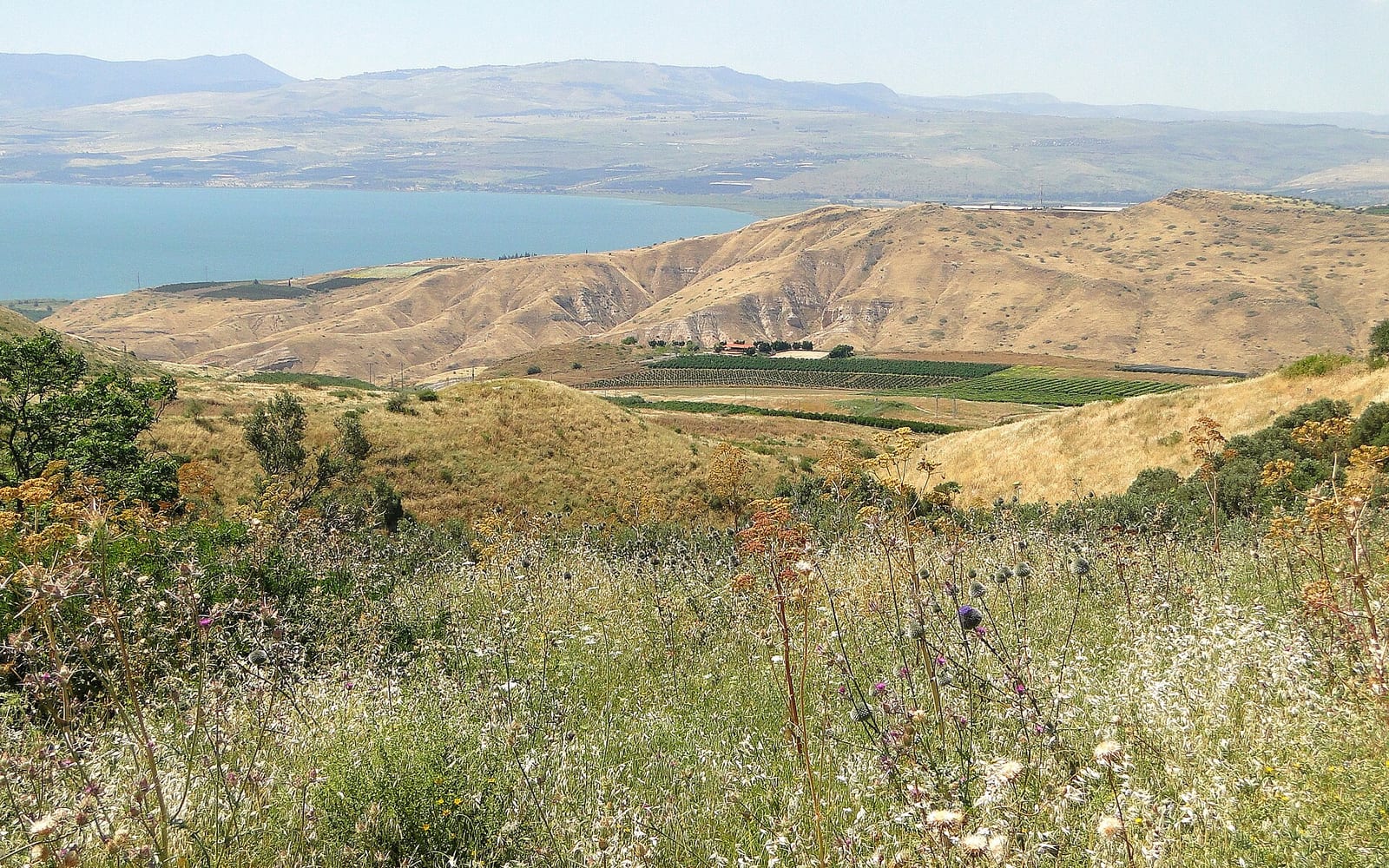
The Sea of Galilee — the Kinneret in Hebrew — is Israel’s only major freshwater swimming destination. Unlike the saltwater Mediterranean or the hyper-saline Dead Sea, the Kinneret offers ordinary freshwater lake swimming: calm, clear, safe for children, and warm enough from late May through October. At 209 metres below sea level in the Jordan Rift Valley, the lake sits at the heart of northern Israel, ringed by four distinct shores with different beach characters and access options.
This guide covers the beaches and swimming spots beach by beach, with practical notes on facilities, entry fees, and how to reach each. For the full circuit of Christian sites, boat tours, and the Galilee region’s wider picture, see the Sea of Galilee complete guide and the Sea of Galilee boat tours guide.
Swimming conditions and water quality {#conditions}
The Kinneret is a freshwater reservoir managed by the National Water Authority. The Israel Water Authority and the Kinneret Authority jointly monitor water quality; current reports are published at kinneret.co.il. The lake is safe for swimming throughout the monitored season and has had no major pollution incidents in recent years.
Seasonal water temperature:
- January–March: 14–17°C (cold; mainly for cold-water swimmers)
- April–May: 17–21°C (chilly but manageable for most)
- June–September: 24–27°C (warm; peak swimming season)
- October–November: 21–24°C (pleasant; crowds thin after September)
There are no significant currents, no tidal forces, and no dangerous marine life. The lake bottom near beaches is generally sandy or pebbled. In the open water away from developed beaches, the bottom becomes silty — fine but less pleasant underfoot. Water shoes are useful on some rocky entry points, particularly on the eastern shore.
Lifeguards operate at main beaches from approximately late June through early September (Israeli school summer holiday period). Outside those dates, swimming is at your own judgement and risk. The smaller, free-access spots have no lifeguards at any time of year.
Beach by beach {#beaches}
Gei Beach — Tiberias city waterfront
Best for: city visitors without a car; quick access from Tiberias accommodation.
Gei Beach is the main municipal beach in Tiberias, located on the city’s western-shore promenade. It is the easiest beach to reach without a car — approximately 15 minutes on foot from the Tiberias central bus station. The facility includes a supervised lifeguarded beach with changing rooms, showers, sun loungers, and food stands. A promenade runs alongside the beach, which is busy in the evening regardless of whether you swim.
Entry is paid (approximately ₪30–45 per adult in season; verify current pricing at the gate). The beach is open June through September under full lifeguard supervision. The Tiberias promenade waterfront also has informal, unguarded access points for wading outside the paid area, though facilities there are none.
From Tiberias, the Tiberias travel guide covers the city’s markets, historical sites, and restaurant options for a full day alongside the beach.
Luna Gal Water Park {#luna-gal}
Best for: families with children; the most complete water-recreation facility on the lake.
Luna Gal is a commercial water park and beach complex approximately 10 kilometres north of Tiberias city, on the western shore between Tiberias and Kibbutz Ginosar. It offers the highest concentration of water-leisure infrastructure on the Kinneret: water slides (multiple slides for different age groups), a wave pool, a direct beach with gentle slope into the lake, sun-lounger hire, changing rooms with showers, lockers, food stalls, and a lifeguarded swimming section.
Entry fees are substantially higher than a standard public beach (approximately ₪80–120 per adult, depending on season and day; children at a reduced rate — verify current pricing at luna-gal.co.il). Luna Gal is closed in winter and operates from approximately late April or May through September. On Israeli national holidays and during summer school holidays, the park is extremely busy — arriving by 9:00 is advisable.
Luna Gal is reachable by car from Tiberias in 15 minutes via Route 90 north. The park has a large car park (paid). No regular bus serves the site directly; a car or taxi from Tiberias is required.
Kibbutz Ginosar (Nof Ginosar Hotel) — private kibbutz beach {#ginosar}
Best for: guests of Nof Ginosar Hotel; visitors wanting a calm beach combined with the Ancient Boat Museum.
The Nof Ginosar Kibbutz Hotel, 12 kilometres north of Tiberias, has a private beach on the western shore: clean, calm, and sheltered, with direct hotel access. The beach is available to hotel guests and is the most pleasant swimming spot on the western shore for those staying there. Day visitors are not generally admitted to the hotel beach; the best hotels on the Sea of Galilee guide covers the Ginosar property’s accommodation options.
The kibbutz also houses the Ancient Boat Museum (Yigal Alon Museum), where a genuine 1st-century CE fishing vessel excavated from the lake bed in 1986 is on permanent display. Museum entry is paid separately from hotel accommodation. The museum visit pairs naturally with a swim from the hotel beach if you are staying there, or with a boat tour from the Kinneret Sailing Company’s Ginosar jetty. See the Sea of Galilee boat tours guide for boat-crossing details.
Ein Gev Beach — east shore {#ein-gev}
Best for: east-shore seclusion; combining with the Kinneret lake crossing and St. Peter’s fish lunch.
Ein Gev Kibbutz, on the eastern shore at the foot of the Golan Heights, has a public beach with basic facilities — changing areas, showers, and a lifeguarded zone in season. The water is calm and clear, and the views across the lake to Tiberias with the Jordan Hills behind are striking. This is the most atmospheric swimming spot on the lake: quieter than the western shore beaches, with Golan panoramas above.
Ein Gev is the eastern terminus of the Kinneret Sailing Company’s lake crossing from Tiberias and Ginosar; arriving by boat and swimming before eating lunch at the Ein Gev Fish Restaurant (St. Peter’s Fish — amnun tilapia, the species native to the Kinneret) is one of the most complete half-day itineraries on the lake. See the Sea of Galilee boat tours guide for ferry booking.
By car, Ein Gev is a 50-minute drive from Tiberias around the top of the lake (Route 90 north, then Route 92 south on the eastern shore). Entry to the beach area is typically free or a small vehicle charge at the kibbutz gate — verify current access policy when you arrive.
Tsemach and the southern shore — Ma’agan beach area {#tsemach}
Best for: quieter swimming; families wanting more space; combining with the Jordan River exit point.
The southern shore of the Kinneret, around the village of Tsemach (Route 92 junction) and the Ma’agan Holiday Village, has several swimming options with a different character from the busier western shore. The area is less developed than Tiberias and attracts Israeli families seeking space rather than facilities.
Ma’agan beach / Holiday Village (operated by the kibbutz movement) has a supervised beach with facilities: changing rooms, showers, kayak hire, and a campsite. The beach has a flat, accessible entry into the water. Entry is paid, typically in the ₪25–40 range for day visitors. The Ma’agan area is a popular destination for Israeli families who camp or stay in on-site accommodation over a weekend.
Gofra Beach (sometimes signed as Nahal Gofra) is a smaller, free public-access spot nearby. Facilities are basic — there may be toilet blocks but no changing rooms or food stalls. The water is clean. This is the best genuinely free option on the Kinneret if you are willing to manage without lifeguards and full amenities.
The nearby Jordan River exit point at the southern tip (near Kibbutz Kinneret) allows wading into the river itself where it leaves the lake — a different experience from lake swimming, and a site with significance in Jewish history (Joshua 3 describes crossing the Jordan here). Entry is free; the banks are muddy and shoes are advisable.
Nahal Meshushim — Golan plateau swim spot {#nahal-meshushim}
Best for: hikers; a pool-and-waterfall swimming experience distinct from the open lake.
Nahal Meshushim is technically a Golan Heights nature reserve rather than a Kinneret beach, but it is the closest and most dramatic freshwater swimming hole to the Sea of Galilee basin. Located approximately 12 kilometres from Ein Gev, the river canyon leads to a series of deep, clear pools below hexagonal basalt columns (“meshushim” = hexagons in Hebrew) — the most striking swimming location in the entire Galilee region.
The circular canyon hike is approximately 4 km and reaches the main pool after about 45 minutes on foot. The INPA National Parks Pass is valid here (one of the few lake-adjacent swim spots where it applies). Entry fee without a pass is approximately ₪28–35 per adult. The trail descends into the canyon and requires a rope-assisted section at one point — comfortable footwear is essential; sandals are not suitable.
Nahal Meshushim requires a car — there is no public transport to the trailhead. From Ein Gev, take Route 789 north toward the Golan plateau; the car park is signposted. Visit in the morning to beat the afternoon heat.
The Shvil Sovev Kinneret — the lake circuit trail {#ssk}
The Shvil Sovev Kinneret (SSK) is a 55-kilometre marked trail that encircles the entire Sea of Galilee. It is divided into nine day-hike sections, each between 5 and 8 kilometres, with trailheads accessible by car at most junction points. The full circuit takes 4–5 days for walkers; cyclists can complete it in 1–2 days, though road sections mix with trail sections.
The trail is marked with orange-and-white trail markers (the SSK’s own colour scheme, distinct from the Israel National Trail’s orange-blue-white). Official trail maps are available from the Israeli Hiking Association (Israel Trail Committee at israeltrail.net) and from GPS mapping apps including Amud Anan.
Highlights by shore segment:
- Western shore (Tiberias → Ginosar → Migdal): Passes the Tiberias promenade, Ginosar Beach, and the Magdala archaeological site. Mostly flat and accessible; popular for evening walks.
- Northern shore approach: Passes near Capernaum and the Tabgha mosaic church; brief road sections.
- Eastern shore (Jordan River inlet → Ein Gev → south): The most scenic segment — undeveloped shoreline with Golan plateau views, birdwatching at the Jordan River inlet, and a quiet gravel path along the eastern waterline.
- Southern shore (Tsemach → Tiberias via Route 90): Agricultural and historically rich; passes the Jordan River exit point and the Kibbutz Degania area (first kibbutz in Israel, founded 1910).
The trail is hikeable year-round but is best in spring (March–May) and autumn (October–November), when temperatures are moderate. Summer walking is possible in early morning only; shade is limited on the eastern shore.
Getting to the Kinneret beaches {#getting-there}
By car: A rental car is the most practical approach for reaching the southern and eastern shore beaches. From Tiberias: Gei Beach is in the city centre (walkable); Luna Gal is 15 minutes north; Ginosar 20 minutes north; Ein Gev 50 minutes (drive north then south on the eastern shore). Tsemach/Ma’agan is 20 minutes south on Route 90. See the car rental Israel guide for options.
By bus from Tiberias: Egged bus services run from Tiberias to several Galilee destinations. Gei Beach and the Tiberias promenade are walkable from the central bus station. There is no direct, usefully timed bus to Luna Gal, Ein Gev beach, or the southern-shore beaches — a car is needed for those sites.
From Tel Aviv or Jerusalem: Egged express buses (route 836/841) reach Tiberias from Tel Aviv in approximately 2 hours 15 minutes. From Jerusalem, buses take approximately 2.5 hours. From Tiberias, use local buses for the promenade or a rental car for the wider circuit.
The Sea of Galilee complete guide covers regional transport, the full four-shore circuit, and the Christian pilgrimage sites. The best hotels on the Sea of Galilee covers accommodation options across all shores.