The Temple Mount / Haram al-Sharif (Hebrew: הר הבית; Arabic: الحرم الشريف) is the most frequently asked-about site in Jerusalem by international visitors, and also the one most commonly misunderstood before arrival. The question “Can I visit the Dome of the Rock?” usually means different things to the tourist who asks it and the reality on the ground.
This guide gives the honest answer: yes, non-Muslim tourists can enter the open-air compound; no, mosque interiors are not accessible; and the visit is governed by conditions that can change without warning.
Quick reference
| |
|---|
| Location | Old City of Jerusalem, eastern edge |
| Entrance for non-Muslims | Mughrabi Gate only (wooden ramp from Western Wall plaza) |
| Hours (non-Muslims) | Mon–Thu + Sat, approx 7:30–11:00am & 1:30–2:30pm |
| Closed | Fridays, Islamic holidays, Ramadan, unannounced closures |
| Entry fee | Free |
| Mosque interiors | Not accessible to non-Muslims (no exceptions) |
| Dress code | Full coverage required; women must cover hair |
| Religious items | No prayer books, Bibles, or visible religious symbols |
What you can and cannot access
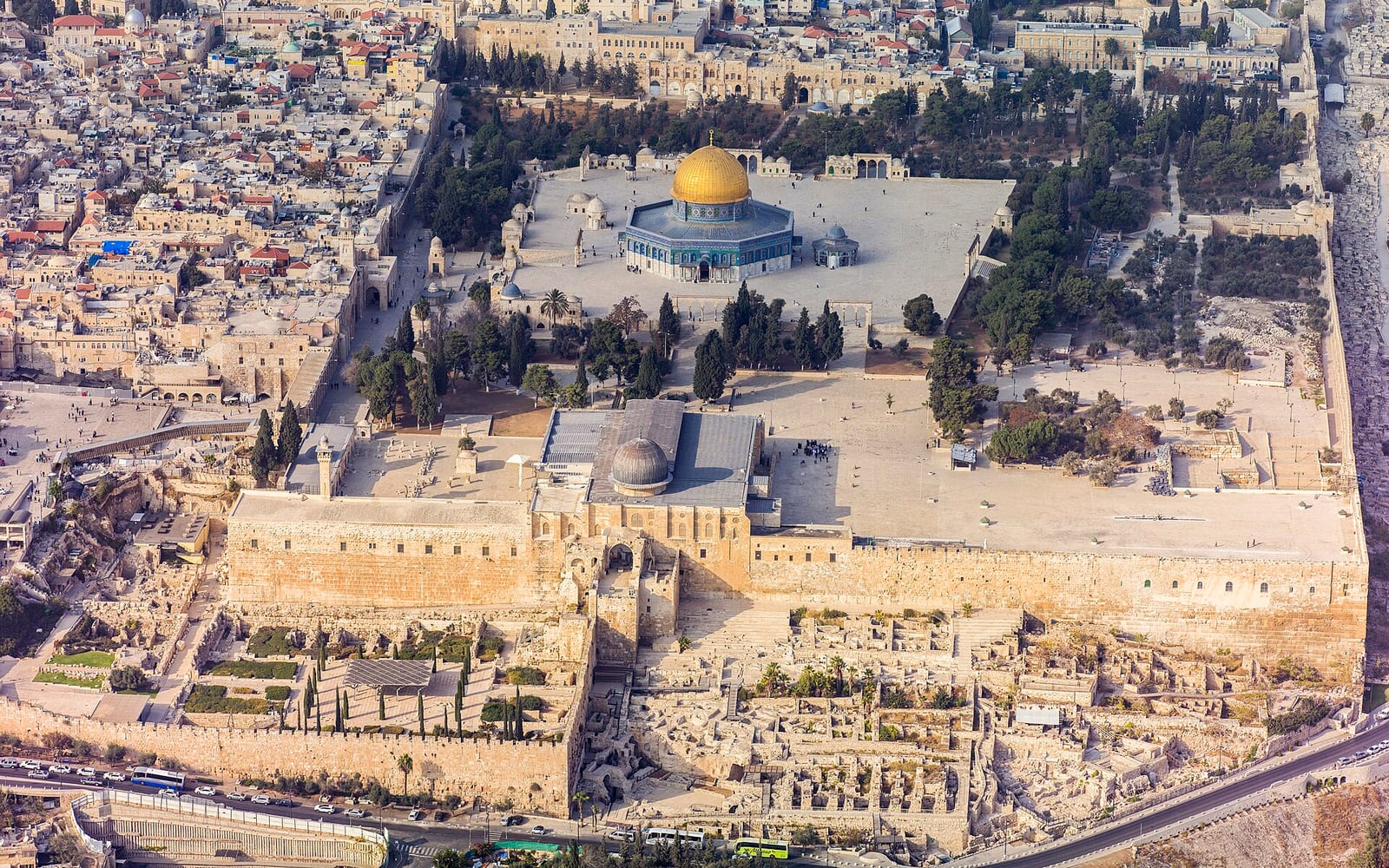
The Temple Mount / Haram al-Sharif is a large raised esplanade — roughly 144 dunams (14.4 hectares) — that sits above and adjacent to the Western Wall plaza. The esplanade itself is the principal open-air area of the Noble Sanctuary.
Non-Muslim visitors access:
- The open-air stone plaza surrounding the Dome of the Rock and Al-Aqsa Mosque
- The exterior of the Dome of the Rock (close-range views from the plaza)
- The exterior of Al-Aqsa Mosque (viewed from the plaza; interior closed)
- The ornamental ablution fountains, Quranic inscription archways, and other plaza structures
- Views south across the Old City and east over the Mount of Olives from the esplanade
Non-Muslim visitors do not access:
- The interior of the Dome of the Rock
- The interior of Al-Aqsa Mosque
- Any prayer hall or mosque interior on the compound
- The underground Solomon’s Stables area (below the esplanade; not publicly open)
This distinction is not a question of tour-operator arrangements or special permits. No access to mosque interiors exists for non-Muslims, and that is not expected to change.
The Dome of the Rock
The Dome of the Rock is the structure that dominates the Jerusalem skyline in almost every photograph — the golden cupola visible from the Mount of Olives, from West Jerusalem, and from the roof terraces of the Old City. Built in 691–692 CE by the Umayyad Caliph Abd al-Malik ibn Marwan, it is among the oldest surviving Islamic monuments in the world and one of the earliest expressions of Islamic architectural ambition.
The structure protects and enshrines the Foundation Stone (in Jewish tradition, Even HaShetiyya — the stone from which the world was created and the site of the Holy of Holies; in Islamic tradition, the stone from which the Prophet Muhammad ascended to heaven during the Night Journey). The octagonal structure with its gilded aluminum dome (the original gold leaf was replaced in 1994 using Jordanian and Saudi funding) is decorated with Byzantine-style mosaics and Quranic inscriptions from the 7th and 8th centuries.
From the plaza, non-Muslim visitors can view the exterior tile work, the dome, and the structure’s proportions from close range — typically within 20–30 metres of the building at the nearest approach points.
Al-Aqsa Mosque
Al-Aqsa Mosque (the “Farthest Mosque”) is the third holiest site in Islam and the primary congregational mosque of the Noble Sanctuary. The current structure dates primarily from the 11th–12th centuries, though the mosque has been rebuilt multiple times following earthquakes. It is the site of the Friday noon prayer (Salat al-Jumu’ah) that draws thousands of Muslim worshippers and is the focus of significant geopolitical attention during periods of tension.
Non-Muslim visitors cannot enter Al-Aqsa Mosque at any time. During the non-Muslim access windows, the mosque is visible from the plaza — a large rectangular structure at the southern end of the esplanade with its distinctive silver dome. During the two daily visitor windows (morning and early afternoon), Muslim worshippers also use the compound — the site is not closed to Muslims during non-Muslim access hours, and respectful coexistence of tourists and worshippers on the plaza is the normal situation.
Practical planning: getting in
Queue at the Mughrabi Gate. Non-Muslim visitors access the compound via the Mughrabi Gate (Bab al-Maghariba) — a wooden ramp structure rising from the area to the right of the Western Wall as you face the Wall. There is typically a visible queue of tourists at the base of the ramp. Israeli police and plainclothes security personnel are present; bags go through screening. The queue is first-come, first-served; no advance booking exists.
Timing matters. The morning session (approx 7:30–11:00am) is longer and generally better for photography of the Dome in morning light. The afternoon session (approx 1:30–2:30pm) is shorter and busier. Aim to be in the queue by 7:15am for the morning session.
Verify the day before. Access can be suspended without notice — for Islamic calendar events, security assessments, or political tensions. Before building your Jerusalem itinerary around this visit, ask your hotel or check current conditions via the Jerusalem Tourism portal. Do not assume access is guaranteed.
What to bring (and leave out):
- Bring: a water bottle, a scarf or wrap (essential for dress code; lightweight cotton works)
- Leave out: religious texts of any kind (Bible, prayer book, Siddur), visible religious symbols (cross necklaces are fine inside clothes but not visibly displayed), bags with prayer items
Jewish prayer on the Temple Mount is not permitted — this has been the official Israeli government position since 1967 (the “status quo” arrangement) though it has been subject to periodic political controversy.
Historical and religious context
The Temple Mount / Haram al-Sharif has been one of the most fought-over pieces of ground in recorded history. Understanding why requires knowing the three traditions that regard it as sacred.
Jewish tradition: The First Temple — Solomon’s Temple — was built here in the 10th century BCE and destroyed by the Babylonian king Nebuchadnezzar in 586 BCE. The Second Temple was constructed from approximately 516 BCE, extensively enlarged by Herod the Great beginning around 19 BCE, and destroyed by the Roman general Titus in 70 CE. The Western Wall — the broad stone retaining wall visible from the plaza below — is the last surviving element of the Second Temple’s outer enclosure wall and has been a site of Jewish prayer and mourning for nearly two millennia.
Islamic tradition: The Noble Sanctuary (Al-Haram al-Sharif) is where, according to Islamic tradition, the Prophet Muhammad was transported from Mecca to Jerusalem during the Night Journey (Al-Isra’), and from where he ascended to heaven to receive the commandments for prayer (Al-Mi’raj). Al-Aqsa Mosque is mentioned in the Quran; the site predates the founding of Mecca’s Ka’ba in its sanctity for the early Muslim community. The Dome of the Rock was built not as a mosque but as a commemorative shrine over the Foundation Stone.
The current administration: Since Israel captured East Jerusalem in the 1967 Six-Day War and applied Israeli law to the city, the Temple Mount has been under Israeli sovereignty but WAQF administrative control — an arrangement known informally as the “Status Quo.” The Islamic WAQF, historically funded by Jordan, administers the mosques and compound. Israeli authorities control access to the compound from the outside (gates, security). This dual-authority arrangement has been the source of numerous crises, most recently over Israeli politicians visiting the compound in recent years, which have triggered diplomatic incidents and periodic closures.
Combining with nearby sites
Western Wall (Kotel): directly below the Mughrabi Gate access point; free; accessible daily and evenings; central to any Jerusalem itinerary. Men and women have separate prayer sections. See the Western Wall Tunnels guide for the underground tour of Herodian-era street level below the Wall.
Church of the Holy Sepulchre: approximately 15–20 minutes on foot through the Old City. The site of the Crucifixion and burial of Jesus Christ, shared by six Christian denominations. See the Church of the Holy Sepulchre guide for queue strategy and opening hours.
Jerusalem Old City walking tour: the most efficient way to connect the three main sacred sites, the Jewish and Armenian Quarters, and the Via Dolorosa is with a licensed guide. A structured half-day tour prevents the disorientation of the Old City’s unlabelled alleyways and gives the religious and historical context needed to make sense of what you are seeing. See the Jerusalem Old City walking tour guide.
Jewish heritage sites and the Jewish Quarter: The Old City Jewish Quarter — accessible from the Dung Gate or from within the Old City — contains the Cardo (reconstructed Roman-era main street), the Burnt House, and the Wohl Archaeological Museum, all giving ground-level access to Second Temple period archaeology. See the Jewish heritage Israel guide.
Jerusalem Museums: For historical depth before your Old City day — including the context of the Temple Mount periods — the Jerusalem museums guide covers the Israel Museum, Tower of David Museum, and smaller specialist institutions.
Visitor notes
Photography: Photography of the Dome of the Rock exterior and the plaza is permitted. Avoid photographing worshippers, especially during prayer. No commercial photography without WAQF permission.
Language: WAQF officials on the compound may speak Arabic and sometimes English; Israeli police speak Hebrew and English. Basic English signage exists at the Mughrabi Gate access point.
Children: The compound is accessible with children of any age. The area is large and open. Be aware that access windows are often shorter than a full morning — plan accordingly if travelling with young children who need predictable timing.
Guided tours: Licensed guides cannot accompany their groups if access is denied on the day. Many Jerusalem Old City walking tours include the Temple Mount / Haram al-Sharif compound as a planned stop — confirm with your operator whether they have flexibility if access is closed and whether they offer an alternative programme.
Security: Israeli security presence throughout the compound is visible and active. Follow instructions from police and security personnel immediately. The compound has been a focal point for violent incidents in the past; this is not a reason to avoid visiting, but it is a reason to be situationally aware and to comply without question with any instructions from security.
Accessibility: The Mughrabi Gate ramp is a wooden inclined walkway. Wheelchairs and pushchairs can access the compound — the ramp has a moderate slope. The plaza surface is stone-paved and generally even, though not perfectly flat. Israeli police can assist visitors with mobility needs at the gate if approached.