The Negev covers more than half of Israel’s land area and most visitors see almost none of it — a flight window, a day trip to the Dead Sea, and a glance from the road south to Eilat. Three days changes that. Based in Mitzpe Ramon on the rim of the Makhtesh Ramon crater, this itinerary moves through the main geological and historical layers of the central Negev: the crater itself, the desert canyons of Ein Avdat, and the kibbutz hillside at Sde Boker where Israel’s first prime minister chose to live out his final years.
The Negev rewards honest expectations. It is not a polished destination. Restaurant options in Mitzpe Ramon are limited and book out on busy weekends. The Wadi Ardon trail is a serious hike that requires planning in summer heat. Ein Avdat’s waterfalls shrink dramatically between June and October. What the Negev offers in return — night skies that are legally protected from light pollution, geological formations that exist nowhere else on earth, and an almost complete absence of other tourists on the canyon trails — is specific to this place.
Three days is the minimum that gives the Negev room to be itself.
Before You Go: Practical Prep for Three Days in the Negev
Getting there. A car is essential for this itinerary — see the FAQ below for why public transport is insufficient. From Tel Aviv, take Route 1 east, then Route 6 south (toll; pay by credit card or Rav-Kav at barriers), then Route 40 south through Beer-Sheva, continuing to Mitzpe Ramon. Total distance approximately 240 km; allow 2 hours 30 minutes including a short stop. From Jerusalem, Route 60 south through the Judean Desert connects to the Negev Highlands in about 2 hours. Petrol is available in Mitzpe Ramon town — fill up before any crater floor excursion. See the Israel transportation guide for Rav-Kav cards and road-toll practicalities.
Where to stay. Mitzpe Ramon is the only practical base for this itinerary. Options are genuinely limited: the Beresheet Hotel sits on the crater rim and is one of Israel’s most striking properties; Selina Ramon offers eco-glamping tents with crater views at a mid-range price point; a handful of guesthouses and B&Bs cluster in the town. Book well in advance — the town fills completely on spring and autumn weekends, school holidays, and the Sukkot festival week. See hotels in Mitzpe Ramon for the full breakdown.
Water and heat safety. This is a desert. Carry a minimum of 3 litres of water per person per day for any outdoor activity. In summer (June–August), plan all hiking and outdoor time between 7:00–10:00am and 16:00–18:00; the crater floor exceeds 38°C by mid-morning and heatstroke risk is real. A sun hat, SPF 50 sunscreen, and electrolyte tablets are not optional in any month above April.
INPA pass. If you plan to visit more than two national parks during your Israel trip, the Israel Nature and Parks Authority (INPA) pass covers Ein Avdat, Avdat ruins, and the Ilan Ramon Space Center entry. See the Israel National Parks Pass guide for current prices.
Day 1 — Arrival, Crater Rim & Stargazing
Day one is about arrival and orientation: the drive south through the Negev, the first view of the crater, and an evening under the darkest skies in Israel.
Drive South via Route 40
Route 40 is the spine of the Negev, running south from Beer-Sheva through increasingly sparse desert terrain to Mitzpe Ramon. About 35 km before Mitzpe Ramon, a signed junction on the right leads to a Makhtesh Gadol (Medium Crater) viewpoint — a five-minute detour that provides context for the geological scale of what you will see at Makhtesh Ramon. The two craters look superficially similar from the rim, which makes the size difference at Makhtesh Ramon all the more striking when you arrive.
Arriving in Mitzpe Ramon by early afternoon gives you time to check in before the main event.
Ilan Ramon Space Center & First Crater View
The Ilan Ramon Space Center (MARD) sits on the crater rim at the entrance to Mitzpe Ramon. The exhibits explain the geology of the makhtesh — correctly: Makhtesh Ramon is not a meteor impact crater and not a volcanic crater. It is a unique geological formation found only in the Negev and Sinai, produced by tectonic uplift and millions of years of water erosion. The Hebrew word makhtesh means something like “mortar” or “box.” The Space Center also commemorates Israeli astronaut Ilan Ramon (no relation to the crater name — the town is named after the crater, not a person), who died in the Columbia disaster in 2003.
The crater rim promenade outside the Space Center provides the first full view of Makhtesh Ramon: 40 kilometres long, 2–10 kilometres wide, 500 metres deep. Photographs consistently fail to convey the scale. The first view works better before sunset, when the light is still overhead and the full depth of the crater floor is visible. Sunset itself is best watched from the designated viewpoints along Yotam Road, which runs west along the rim from the town centre.
Evening — Negev Highland Wine Route & Dinner
The Negev Highlands have emerged as a serious wine region over the last two decades, with volcanic soil, large diurnal temperature swings, and low humidity producing wines distinctive from Israel’s Mediterranean coast. Several small wineries operate within 20–30 minutes of Mitzpe Ramon — Boker Valley Winery, Carmey Avdat, and Matar among them. A tasting stop before dinner is straightforward to add; most wineries require advance booking.
Dinner in Mitzpe Ramon is limited but not bad: a handful of restaurants serve Israeli and local Negev cuisine; the Beresheet’s restaurant is open to non-guests. Book whichever option you prefer in advance — the town is small and tables fill quickly on weekends.
Night — Stargazing
Makhtesh Ramon sits within an IDA-certified International Dark Sky Park — the largest in Israel and one of the most protected from light pollution in the Middle East. The crater rim on a clear night, particularly between September and April, offers genuinely exceptional stargazing: the Milky Way is visible to the naked eye, and planets and star clusters are bright enough to see without equipment.
Guided stargazing sessions depart from Mitzpe Ramon town with an astronomer guide, telescope, and typically a hot drink in the desert. Book a tour in advance — sessions are weather-dependent and popular. Check the Israel stargazing guide for operator recommendations and seasonal sky conditions.
Day 2 — Wadi Ardon & the Crater Floor
Day two descends into the crater: a serious hike through geological terrain that reads like a compressed version of the earth’s deep history.
Wadi Ardon Trail — Full Crater Day
Important before you start. Wadi Ardon is a moderate-to-demanding trail, not a gentle nature walk. The full loop from the Mitzpe Ramon town edge runs 10–12 km with significant elevation change on rocky terrain. In summer (June–September), the crater floor reaches extreme heat within two hours of sunrise — start no later than 07:00 and plan to be back at your car by 10:00 if the temperature is forecast above 32°C. The hike is substantially more enjoyable in March–May or September–November.
The trail descends from the town’s southern edge down the crater wall via the Prism viewpoint — multicoloured volcanic formations where the geological layers are particularly legible — then crosses the crater floor following Nahal Ardon’s dry riverbed. The canyon sections on the crater floor pass through limestone, granite, and sandstone in bands of red, orange, white and black. The Carpenter’s Workshop — an outcrop of columnar basalt columns resembling an angular stack of organ pipes — is the most photographed geological feature on the crater floor and appears approximately 2 km into the descent.
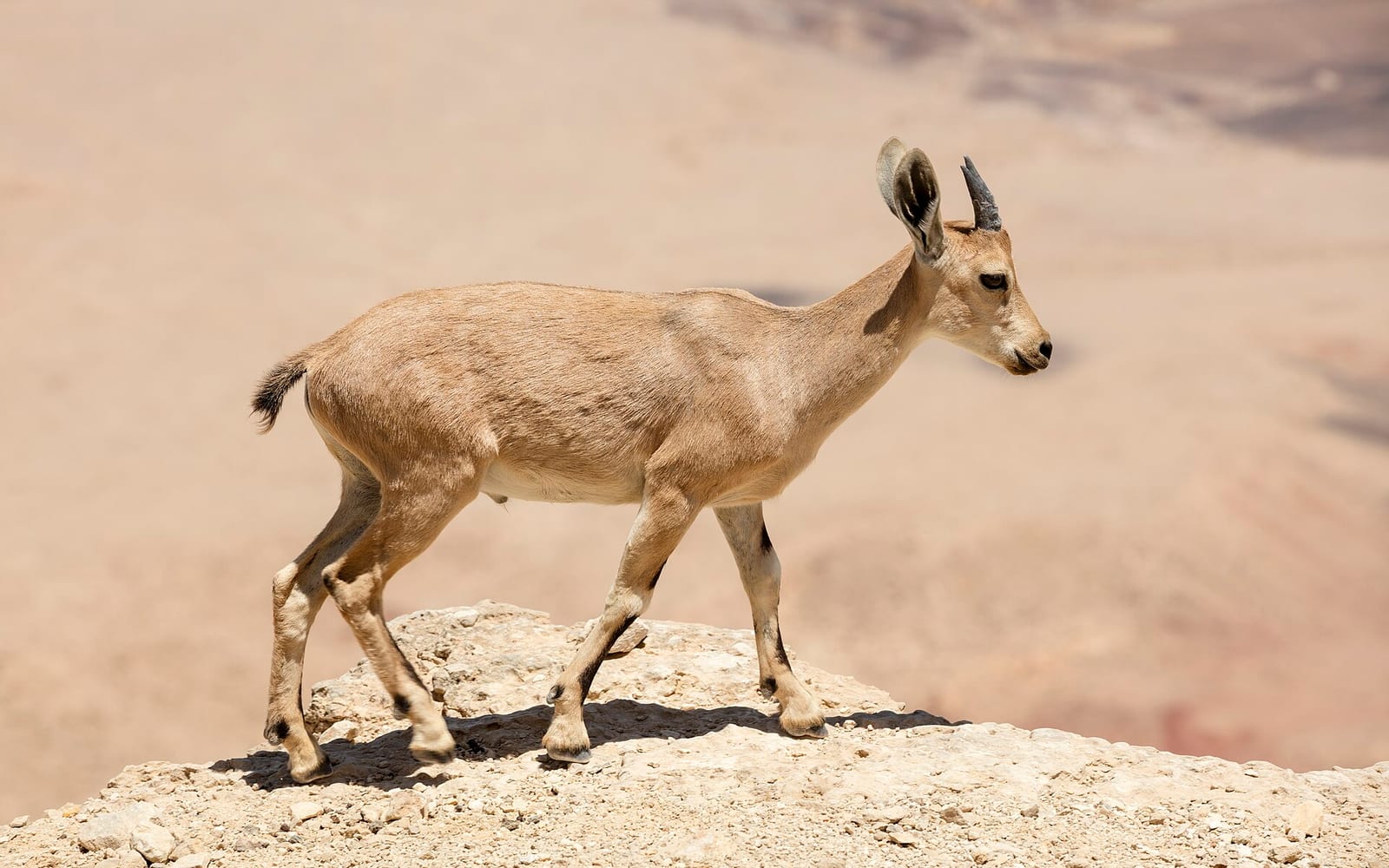
In spring (March–April), wildflowers cover the crater floor: desert tulips, anemones, and small iris species that bloom for a few weeks and then disappear. The ibex (Nubian ibex) are visible year-round on the crater walls — they move freely across terrain that would stop a human.
Carry the full 3 litres of water per person. The crater floor has no shade, no water sources, and no mobile signal in places. Download the Wikiloc or AllTrails GPX for the trail before entering the crater. The INPA warden at the Ilan Ramon Space Center can advise on current conditions.
Exit the trail at the southern trailhead and arrange a car drop-off via Waze from the end-point back to town if doing the full one-way descent (approximately 6 km). Or take the circular return trail back to the northern rim — add 2 hours.
Afternoon — Alpaca Farm
The Alpaca Farm (Ha-Meshek Be-Midbar), 5 minutes west of Mitzpe Ramon town, is worth the incongruity. A working farm with alpacas, llamas and camels on the crater-edge plateau, it has a designated feeding area and short trekking routes along the rim. It is genuinely popular with families and works as a counterpoint to the morning’s seriousness — the views from the farm’s plateau position are good, and it is one of the few afternoon activities that does not require sun exposure on the crater floor. Entry fee is modest; no advance booking required on weekdays.
Evening
Return to Mitzpe Ramon for dinner and, if the sky is clear, a second stargazing session — some visitors find the second night’s viewing better because they know what to look for and where.
Day 3 — Ein Avdat Canyon & Sde Boker
Day three moves north through the Negev Highlands: a canyon trail that is among the most beautiful in Israel, and a hillside grave that contains more Israeli identity than most museums.
Morning — Ein Avdat National Park
Ein Avdat is a spring-fed canyon carved through white chalk cliffs in the northern Negev — one of the most spectacular geological formations in the country. The canyon walls reach 30–50 metres in places; the spring at the canyon’s centre feeds a clear pool beneath a small waterfall, surrounded by Euphrates poplars and Sodom’s apple vegetation that exists nowhere else in the surrounding desert.
Access. The park has two entry points — the lower entrance (from Route 40, near Kibbutz Sde Boker) and the upper entrance (further north on Route 40). The standard loop visits the lower canyon from the lower entrance first, ascending through the main spring and pool section via metal ladders and a narrow cliff-side path, then exiting at the upper entrance. This direction gives the best visual experience: the spring and pool appear after a 30-minute walk through the canyon, the drama building as the cliffs close in. Arrange a second car at the upper entrance if possible; alternatively, walk back the way you came.
Timing. Arrive as early as the park opens (typically 08:00). The spring pools and ladder sections involve physical effort in a confined canyon — shade runs out quickly once the sun is overhead, and by 10:00 in summer the lower canyon is genuinely hot. In autumn and winter, a thin waterfall runs more substantially; in late summer the flow is minimal. Check current conditions via parks.org.il before visiting — the INPA website notes seasonal water levels.
Wildlife. Nubian ibex are semi-permanent residents of the canyon cliffs and appear regularly at the spring. Egyptian vultures and Griffon vultures circle overhead. Marsh frogs occupy the spring pool.
The INPA pass is valid at Ein Avdat.
Midday — Ben-Gurion’s Desert Home at Sde Boker
Kibbutz Sde Boker is 8 km north of Ein Avdat on Route 40. David Ben-Gurion, Israel’s first prime minister and founding father, chose to retire here in the Negev Desert rather than in Jerusalem or Tel Aviv — a deliberate symbolic act about what he believed was the country’s future (settling and cultivating the desert). He lived in a simple two-room wooden hut, which is preserved exactly as it was at his death in 1973: a small desk, a camp bed, a wall of books in multiple languages.
Ben-Gurion’s grave sits on a platform overlooking the Zin Valley, a sweeping panorama of the Negev Highlands that extends to Ein Avdat’s cliffs in one direction and to open desert in the other. The grave is shared with his wife Paula; the site is maintained by the Ben-Gurion Heritage Institute. Entry is free; the grave site is accessible at all times; the museum in the hut has standard park opening hours.
The combination of the simple hut, the vast landscape, and the political weight of the choice to be buried here — not in Herzl’s Mount Herzl cemetery in Jerusalem, but facing the Negev — makes this one of the more moving sites in Israel, precisely because it asks nothing of the visitor beyond standing in the right spot.
Allow 45–60 minutes at the Sde Boker complex.
Afternoon — Return to Tel Aviv or Jerusalem
Return north on Route 40 to Beer-Sheva, then Route 6 north to Tel Aviv (Route 1 west) or Jerusalem (Route 1 east). Beer-Sheva itself, if you have an hour to spare, has the Tel Beer-Sheva UNESCO site — the reconstructed ancient city from the biblical period — and the Bedouin market (Wednesday and Thursday mornings only). From Sde Boker to Tel Aviv is approximately 200 km; allow 2 hours in off-peak traffic.
Optional Add-Ons if Your Stay Extends
Avdat (Shivta) Nabataean ruins. 20 minutes south of Sde Boker on Route 40 — a UNESCO World Heritage Site and the best-preserved Nabataean-Byzantine city on the Incense Route. The winery, bathhouse, and temple complex cover a manageable 2-hour walk. INPA pass valid.
Jeep tour on the crater floor. The sections of Makhtesh Ramon reachable only by 4x4 — the multicoloured sand canyon near Nahal Ardon’s lower section, the remote basalt formations in the crater’s western end — require a licensed jeep operator. Half-day and full-day tours depart from Mitzpe Ramon. See the Mitzpe Ramon guide for current operators.
Timna Park. 25 km north of Eilat — ancient copper mines, the mushroom rock, King Solomon’s Pillars, and a reconstruction of the Tabernacle. Note: Timna is not covered by the standard INPA pass. It suits a day trip from Eilat more naturally than from Mitzpe Ramon. See the Eilat guide.
Budget Reference
| Travel style | Per person per day | 3 nights (hotels only) |
|---|
| Budget | ₪200–350 | ₪600–1,050 |
| Mid-range | ₪450–850 | ₪1,350–2,550 |
| Boutique / luxury | ₪1,000–2,500+ | ₪3,000–7,500+ |
The Negev is not a cheap destination relative to Tel Aviv or Haifa — accommodation supply in Mitzpe Ramon is limited and prices reflect demand. Budget travellers are best served by mid-week visits in the shoulder season, when guesthouse and B&B rates are at their lowest. The Beresheet Hotel is significantly more expensive than anywhere else in the region. See the Israel cost and budget guide for the full cost-of-travel breakdown.
Useful Cross-Links
- Negev Desert guide — region overview, best time to visit, and all Negev destinations
- Mitzpe Ramon guide — complete guide to the crater town, hotels, and jeep operators
- Israel stargazing guide — dark-sky sites, best months, and tour operators
- Negev multi-day hiking guide — 3–5 day on-foot circuit with water logistics and camping
- Hiking in Israel — rated trails including Ein Avdat and Makhtesh Ramon routes
- Arad Music Festival guide — Israel’s oldest Hebrew music festival (since 1982) held in late August in the Negev town of Arad, 25–35 km from the Dead Sea resort strip
- Beer-Sheva guide — the Negev capital, Tel Beer-Sheva UNESCO site, and Bedouin market
- Israel road trip guide — full national self-drive combining Negev, Dead Sea and north
- Israel transportation guide — Route 40 tolls, Rav-Kav, rental car practicalities
- Israel National Parks Pass guide — INPA pass coverage and current prices
- Israel safety guide — current travel conditions and Negev-specific guidance