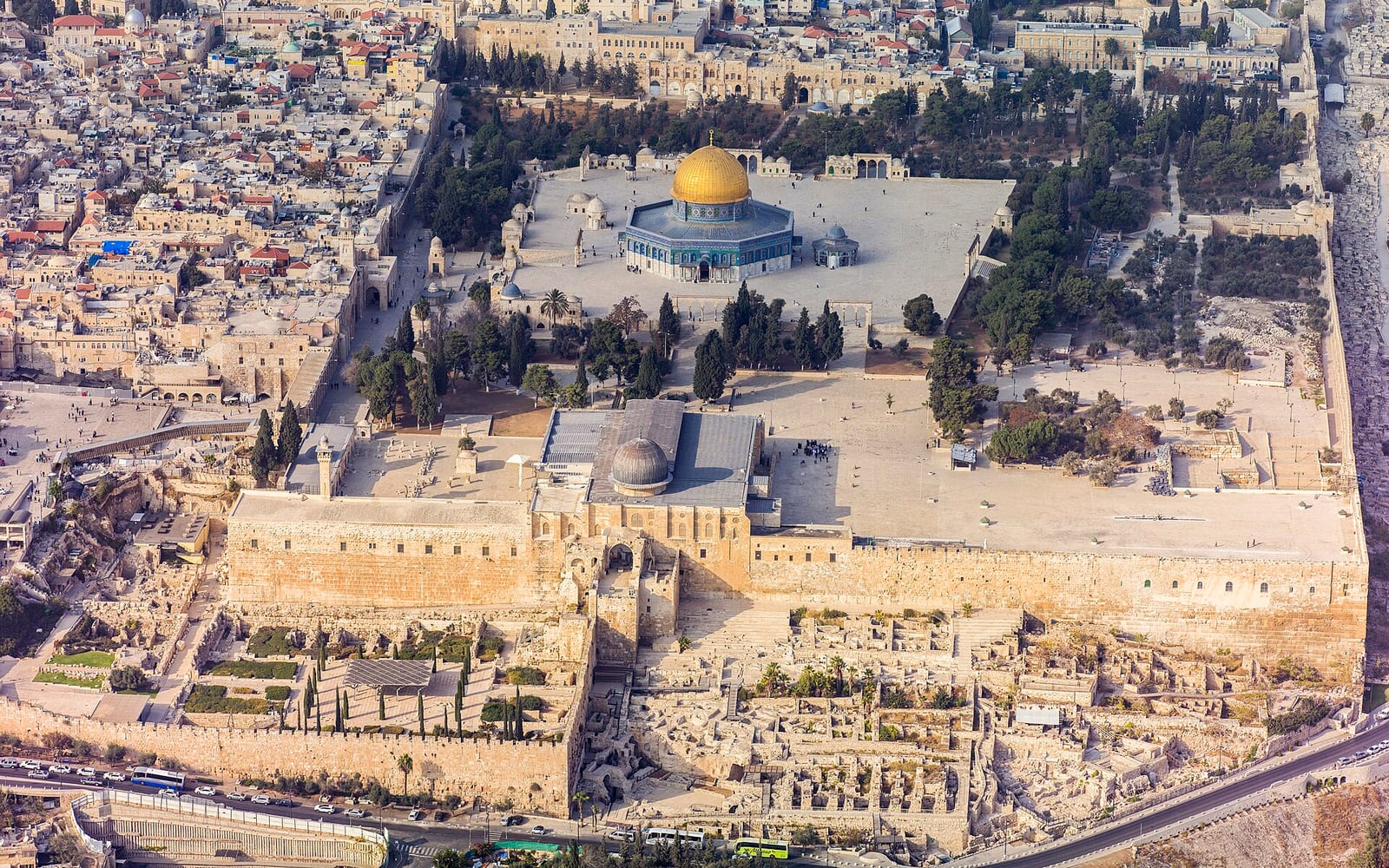
Israel holds three of Islam’s holiest sites — Al-Aqsa Mosque, the Dome of the Rock, and the broader Haram al-Sharif complex in Jerusalem — and has been a destination for Muslim pilgrims and travellers for over 1,400 years. Beyond Jerusalem, the country has a significant Arab Muslim population (approximately 17% of Israel’s total population), a rich Ottoman architectural heritage, and cities where Arabic is the daily language and halal food is the norm.
This guide covers the practical information Muslim visitors need most: how to access the Temple Mount, the Islamic sites to visit across the country, halal food and prayer logistics, Ramadan travel tips, and what to expect from airport security.
For the broader travel-planning picture, see the first-time visitor guide, the safety guide and the holy sites dress code guide.
The Temple Mount / Haram al-Sharif: essential access guide
The Temple Mount — known to Muslims as Haram al-Sharif (“the Noble Sanctuary”) — is Islam’s third holiest site and the geographical and spiritual centre of Muslim pilgrimage to Jerusalem. It encompasses Al-Aqsa Mosque (Al-Masjid al-Aqsā) and the Dome of the Rock (Qubbat al-Sakhrah) on a 35-acre elevated plaza in the Old City of Jerusalem.
Who administers the site?
The Haram al-Sharif is administered by the Jordanian-controlled Islamic Waqf (religious endowment), operating under a complex security arrangement with Israeli authorities. This arrangement affects access rules for all visitors and can change at short notice in response to religious calendar events, security situations, or political developments.
Access for Muslim visitors
Al-Aqsa Mosque is open for Muslim prayer throughout the day. Entry is from multiple gates within the compound. The Friday Jumu’ah prayer draws very large congregations — arrive early if attending. Wudu facilities are inside the compound.
The Dome of the Rock is open to Muslim visitors during most periods. As of mid-2026, the interior is accessible to Muslim worshippers; confirm current hours with the Islamic Waqf on arrival.
Ramadan: During Ramadan — especially the final ten days — access restrictions and crowd levels can be very high. Tarawih prayers and Laylat al-Qadr draw tens of thousands of pilgrims. Plan for long queues and limit large bags.
Access for non-Muslim visitors
Non-Muslims may visit the Temple Mount esplanade (but not the interiors of Al-Aqsa or the Dome of the Rock) via the Mughrabi Gate only, during designated morning and afternoon windows, typically Sunday–Thursday. These windows are suspended on Fridays, on Muslim holidays, on Jewish holidays, and at the discretion of security authorities.
Non-Muslim access is never guaranteed on any given day. Visit early in your trip rather than leaving it to the last morning.
Practical tips for all visitors
- Dress code: Modest dress required — shoulders and knees covered for all genders; women should have a headscarf available. Clothing loans are sometimes available at the gate.
- Shoes: Remove shoes before entering mosque interiors.
- Photography: Photography of the Dome exterior from the plaza is generally permitted; inside the mosque, check with Waqf staff before photographing.
- Current access hours: Check the Islamic Waqf website or call the Israeli police press office for current access windows — they change frequently.
Key Islamic sites across Israel
Al-Jazzar Mosque, Akko
One of the most magnificent Ottoman-era mosques in the entire region, Al-Jazzar Mosque was built in 1781 in Akko (Acre) by Ahmad Pasha al-Jazzar, governor of the Vilayet of Sidon. The mosque sits above a Byzantine crypt and contains, in a marble box beneath the main dome, a hair believed to be from the beard of the Prophet Muhammad (pbuh) — drawn out annually during Ramadan. The courtyard contains a fountain and the tomb of Al-Jazzar himself.
Visiting: Open to visitors outside prayer times (a modest entrance fee applies). Dress code strictly observed — modesty clothing and head covering for women are required; shoe covers are provided. Akko is approximately 25 km north of Haifa and easily combined with a visit to the Akko Old City.
Hassan Bek Mosque, Tel Aviv–Jaffa
Built in 1916 by the Ottoman governor Hassan Bek on the boundary between Jaffa and what would become Tel Aviv, this white-minaret mosque is now one of the most visually striking landmarks on the Tel Aviv seafront. It is an active mosque; visitors are welcome outside prayer times. The contrast between the historic mosque and the modern Tel Aviv beach promenade makes it one of the most photographed spots in the city.
White Mosque (Al-Abyad), Nazareth
Nazareth is Israel’s largest Arab city and approximately 30% of its population is Muslim. The Al-Abyad (White) Mosque in the city centre is an active place of worship dating to the Ottoman period. Nazareth’s old city market (Al-Suq) has excellent Arab restaurants and strong halal food options.
Sea of Galilee region
The area around the Sea of Galilee (Lake Tiberias) holds sites significant in Abrahamic tradition: Tiberias contains the tomb of Maimonides, but the broader Galilee landscape — including Capernaum, the Mount of Beatitudes, and the River Jordan baptism sites — is shared sacred geography mentioned in both Biblical and Quranic narratives. Muslim visitors with an interest in prophetic geography often combine Jerusalem with a Galilee loop.
Halal food in Israel
Halal food is widely available across Israel, particularly in Arab-majority areas.
Best areas for halal dining
Jerusalem – Muslim Quarter: The most reliable area for certified halal restaurants. The quarter’s main street, Al-Wad Street, and the area around the Damascus Gate have dozens of Arab-owned restaurants serving roast chicken, kofta, falafel, hummus and shawarma. During Ramadan, the entire area transforms at iftar into one of the most festive night markets in the Middle East.
Jaffa (Yafo), Tel Aviv: The Jaffa market area and Yefet Street have a dense concentration of Arab-Israeli restaurants. Abu Hassan (on Ha-Dolphin Street) is one of Israel’s most celebrated hummus institutions, owned by an Arab Muslim family.
Nazareth: Israel’s Arab cultural capital has excellent halal food across all price points. The old market area and streets around the Basilica of the Annunciation have a mix of Arab restaurants, many Muslim-owned.
Akko: The old city’s Arab market has strong halal food options, including freshly baked Arab bread and grilled meats.
Halal certification
Israel does not have a unified national halal certification system comparable to its extensive kosher certification infrastructure. In practice:
- Arab-owned restaurants in the areas above are typically halal by practice, even without formal certification.
- Muslim-owned restaurants in Nazareth and East Jerusalem often display Arabic-language halal markings; ask staff if unsure.
- Kosher food is not halal — while both systems prohibit pork, the slaughter method differs and kosher does not have a Muslim religious endorsement. Do not assume kosher = halal.
For grocery shopping, major Arab-owned supermarket chains (e.g. Rami Levy in East Jerusalem, independent chains in Nazareth) stock halal-certified imported products and local halal meat.
Prayer logistics
Finding prayer times
Prayer times vary daily by location and season. Apps such as Muslim Pro, Al-Aqsa (israely app with mosque-specific times), or Athan all provide Israel-specific prayer times. Note that Israel does not officially use Islamic calendar times — apps automatically calculate based on latitude and longitude.
Mosques across Israel
- Jerusalem Old City — the most concentrated area of mosques; multiple mosques within the Haram al-Sharif compound plus neighbourhood mosques throughout the Muslim Quarter.
- East Jerusalem — active neighbourhood mosques with regular daily prayers.
- Jaffa (Tel Aviv) — Hassan Bek Mosque (see above) and several neighbourhood mosques.
- Nazareth — multiple mosques; the White Mosque is central.
- Haifa — several mosques in the Wadi Nisnas Arab neighbourhood.
- Akko — multiple active mosques in the old city.
Qibla direction
Israel is northeast of Mecca, so the qibla (direction of prayer) faces southeast (roughly 150–160° from north) across most of the country. Qibla compass apps (or the direction marked in most hotels in Muslim-majority areas) are accurate.
Prayer facilities in hotels
Hotels in East Jerusalem and the Muslim Quarter often provide prayer mats and qibla direction markers in rooms as standard. Hotels in West Jerusalem and Tel Aviv may not. If this is important to you, confirm when booking or travel with your own prayer mat.
Ramadan in Israel
Ramadan is one of the best times to experience Muslim culture in Jerusalem and Nazareth, though it requires some practical adjustments.
What changes during Ramadan
Muslim-owned restaurants: Most Arab restaurants in the Muslim Quarter and Nazareth operate on adjusted hours — closed from pre-dawn (suhoor) until after iftar at sunset. After sunset, especially in Jerusalem’s Muslim Quarter, food stalls and restaurants operate well into the night.
Atmosphere: The Damascus Gate area of Jerusalem and Al-Wad Street in the Muslim Quarter become extraordinarily lively after iftar — lanterns, food, music and community. This nightly atmosphere is one of Jerusalem’s most memorable experiences for any visitor.
Al-Aqsa access: The final ten days of Ramadan (including Laylat al-Qadr) see the highest crowd levels of the year. Access to the compound can be restricted for non-Muslims during this period. Plan Muslim pilgrim visits accordingly.
Dates
Ramadan dates shift approximately 11 days earlier each year on the Gregorian calendar. Always confirm dates using an Islamic calendar resource such as islamicfinder.org — never rely on a fixed Gregorian date in any guide, including this one.
For a complete guide to visiting Israel during Ramadan — including Jaffa iftar culture, Nazareth Ramadan evenings, and detailed Temple Mount / Haram al-Sharif access notes — see the dedicated Ramadan travel guide.
Airport security at Ben Gurion
Israeli airport security is among the most thorough in the world and is applied to all passengers regardless of nationality or religion. Muslim travelers — particularly those with Arabic-sounding names, passports from Muslim-majority countries, or visible religious observance — may be subject to additional questioning or luggage screening. This is Israeli security policy applied broadly, not specific to Muslim visitors.
Tips for a smooth process:
- Arrive at Ben Gurion Airport at least three hours before departure (four hours for intercontinental flights).
- Have your hotel booking, tour bookings or invitation letter accessible.
- Be prepared to explain the purpose of your visit and the sites you plan to visit.
- Security officers are professional; polite, clear answers move the process faster.
See the full Ben Gurion Airport guide for check-in times, terminal layout and transport options.
Muslim pilgrimage vs cultural tourism
Muslim visitors to Israel broadly split into two groups, with many overlapping:
Pilgrimage-focused: Coming specifically to pray at Al-Aqsa and the Dome of the Rock, visit the sites associated with prophetic history in Jerusalem and the Galilee, and connect with the Muslim spiritual heritage of the Holy Land. For this group, proximity accommodation in East Jerusalem or the Muslim Quarter is strongly recommended; many choose guided group tours with Arabic-speaking licensed guides.
Cultural tourism: Arab Israeli and Muslim diaspora visitors exploring Israel’s living Arab communities — Nazareth, Jaffa, Akko, Haifa’s Wadi Nisnas, Druze villages on the Carmel — alongside the major tourist highlights. The Druze villages of Mount Carmel offer a fascinating perspective on a distinct Arab tradition; the Arab-Christian and Arab-Muslim mixed neighbourhoods of Akko and Nazareth show the remarkable cultural diversity within Israel’s Arab community.
Many visits combine both: a few days in Jerusalem for Al-Aqsa and the Old City, then a circuit through the Galilee, Nazareth and the coast.
Planning your visit
When to go: Spring (March–May) and autumn (October–November) offer the best climate for Jerusalem sightseeing. Summer is hot but manageable; winter can be cold and rainy in Jerusalem and the north while Eilat and the Dead Sea remain warm.
How long: Allow at minimum three nights in Jerusalem to give yourself multiple mornings at Al-Aqsa (to account for access variability) and time to explore the Muslim Quarter, the Old City markets and East Jerusalem. A week allows Nazareth, the Galilee and one other destination to be added.
Currency: Israeli new shekel (ILS/₪). ATMs widely available. See the Israel money and budget guide for tipping norms and costs.
Language: Arabic is an official language in Israel alongside Hebrew. In the Muslim Quarter of Jerusalem, Nazareth and Akko, Arabic is the primary spoken language. English is widely understood in tourist areas.
Dress code: Modest dress is expected at all religious sites, including mosques, churches and Jewish holy sites. See the holy sites dress code guide for the specific requirements at each type of site.
For the complete list of entry requirements, ETA-IL information and border crossing options, see the Israel visa and entry guide.