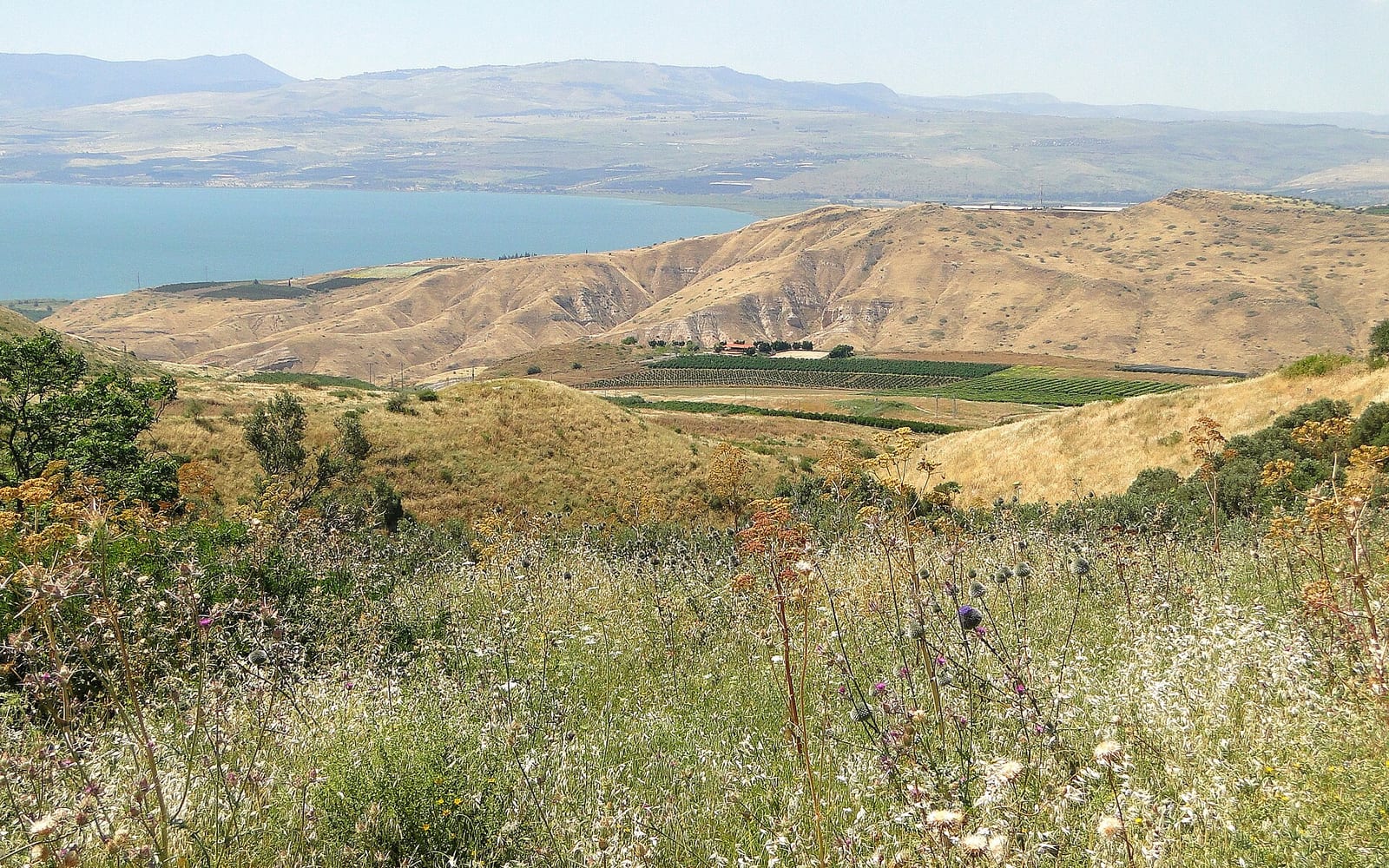
The Galilee is the most varied region in Israel in the smallest footprint: the densest cluster of New Testament sites on earth, a functioning Arab Old City in Nazareth, the Sea of Galilee surrounded by basalt hills, and hikes that look across a landscape described in both Testaments. Most visitors see it in fragments — a rushed morning at Capernaum, a boat on the lake, a drive through Nazareth without stopping. Three days changes that. Based in Tiberias on the Sea of Galilee shore, this itinerary moves through all three layers of what makes Galilee worth a dedicated trip: the city of Nazareth, the sacred western shore of the lake, and the volcanic rim above it.
Galilee rewards honest expectations. The Christian sites are in active religious use — coaches arrive early and the most popular sites (the Mount of Beatitudes, Capernaum) can be crowded by 10:00am. Nazareth’s Old City requires patience with the parking and willingness to walk its narrow streets without a GPS. The Mount Arbel trail in summer requires an early start. What Galilee offers in return — the specific quality of light on the Sea of Galilee in the morning, the perfectly preserved Byzantine mosaic floor at Tabgha, the 1st-century synagogue at Magdala that was excavated within living memory — is specific to this place and not available anywhere else in Israel.
Three days is the practical minimum that lets Galilee be itself.
Before You Go: Practical Prep for Three Days in Galilee
Getting there. From Tel Aviv, Haifa, or Ben Gurion Airport, the fastest approach is by car: Tel Aviv to Tiberias is approximately 140 km via Route 6 north then Route 77 east, around 1 hour 45 minutes in off-peak traffic. From Jerusalem, take Route 1 west to Route 6 north, then Route 77 east — approximately 175 km, 2 hours. By train, the closest station is Beit She’an (Afula junction area); Tiberias itself has no train station. Express buses from Tel Aviv Central Bus Station reach Tiberias in 2 hours 30 minutes. See the transportation guide for Rav-Kav card setup and live timetables.
A car is strongly recommended. The three days below are designed around a car. Capernaum, Tabgha, Magdala, and the Mount Arbel trailhead are all within 45 minutes of Tiberias but poorly served by public transport. If you do not have a car, guided tours from Tiberias or Tel Aviv can cover the Christian shore circuit on day two; see the Galilee tours compared overview. See the car rental guide for pick-up options at Tiberias, Haifa, and Ben Gurion Airport.
Where to stay. Tiberias is the optimal base for all three days. The lakeshore hotels sit on the water’s edge; hillside guesthouses above the promenade offer more character at lower prices. For a full breakdown by tier, see the Tiberias guide and best hotels in Tiberias. Nazareth has good guesthouses in the Old City area and works as an alternative base if your itinerary prioritises the city and western Galilee over the lake circuit.
Timing caution. The most popular Christian shore sites receive large coach tours starting around 09:30. Arriving at Capernaum and Tabgha before 09:00 makes a significant difference to the experience. Mount Arbel should be started no later than 07:30 in summer.
Day 1 — Nazareth Old City and the Basilica of the Annunciation
Day one is the city day: the Arab Old City souk, the largest church in the Middle East, and the hilltop from which the New Testament records the first dramatic confrontation of Jesus’s ministry.
Morning — The Basilica of the Annunciation
The Basilica of the Annunciation in the heart of Nazareth Old City marks the site traditionally identified as the home of Mary and the location of the Annunciation — the moment described in Luke 1 when the angel Gabriel appeared. It is the largest Christian church in the Middle East. The lower grotto level contains the cave traditionally venerated since at least the 3rd century; the upper church, completed in 1969, has a striking double-rotunda design with donations of mosaic panels depicting the Madonna from Catholic communities around the world — the Japanese panel and the Mexican panel are particularly striking.
Practical. The Basilica is open Monday to Saturday, typically 07:00–17:00 (reduced hours on Sunday and religious feast days — check basilicaannunciation.org before visiting). Dress code: covered shoulders and knees; free headscarves are available at the entrance. Free entry; guided tours depart from the entrance with multilingual guides. Photography is permitted in the exterior and upper church; restricted in the lower grotto during services.
Allow 60–90 minutes for a thorough visit.
Mid-Morning — Nazareth Old City Souk
From the Basilica, the Old City souk unfolds in the streets immediately to the east and north. This is a functioning Arab market — spice shops, butchers, fabric sellers, hummus institutions — not a tourist reconstruction. The street pattern has not substantially changed since the Ottoman period. Walking without a plan for 45–60 minutes is the most effective approach: the streets loop back on each other, vendors are accustomed to visitors who are browsing rather than buying, and the density of visual and olfactory detail rewards slow walking.
A few orientating landmarks: Mary’s Well (or Mary’s Spring) at the edge of the souk, traditionally identified as the second Annunciation site in the Eastern Orthodox tradition and accessible at street level; the Greek Orthodox Church of the Annunciation adjacent to it (often less crowded than the Catholic Basilica, and the interior is striking). The Nazareth travel guide has a full neighbourhood map and recommended stops by category.
Lunch. The Old City has several long-running hummus and Arabic bread establishments clustered near the souk. Lunch here — hummus, falafel, fresh pita from a taboon oven — is one of the more reliable meals in northern Israel. Ask at your hotel for current recommendations, as specific shops open and close.
Afternoon — Mount of Precipitation (Har Kippa)
On the southern edge of Nazareth, the Mount of Precipitation — also called Har Kippa or Mount of the Leap of the Lord — is the hilltop where Luke 4:29 records the residents of Nazareth attempting to throw Jesus off a cliff after his synagogue reading. A small Franciscan chapel sits near the edge; the view from the rim looks south over the Jezreel Valley toward Megiddo and, on clear days, Mount Gilboa.
The site is a 10-minute drive south of the Old City through residential Nazareth (signposted). A short walk from the car park reaches the chapel and the viewpoint. Allow 30–40 minutes. The site is not overrun with visitors, which makes it one of the more contemplative stops in Galilee.
Evening — Drive to Tiberias
The drive from Nazareth to Tiberias takes approximately 45 minutes east on Route 77. Arrive in time to walk the Tiberias promenade before dinner — the lakefront stretches for several kilometres along the western shore and the evening light on the Sea of Galilee, especially in summer, is worth arriving for. The waterfront has a range of restaurants from casual fish grills to mid-range Israeli-Mediterranean menus.
Day 2 — The Sea of Galilee Christian Shore Circuit
Day two is the lake day: the most significant concentration of New Testament sites in Israel, in a half-day circuit that leaves the afternoon for the boat.
An early start matters. Coach tours from Tel Aviv, Jerusalem, and Haifa all reach Capernaum by 09:30–10:00. Arriving at 08:00 or earlier gives you the sites in near-silence.
Morning — Tabgha, Capernaum and Magdala
Tabgha — Church of the Multiplication of the Loaves and Fishes. The 5th-century Byzantine church at Tabgha contains what may be the finest intact mosaic floor in Israel: water-birds, fish, and the iconic image of two fish flanking a basket of loaves (which all four Gospels associate with this shore). The church itself is simple and modern — the original 4th-century structure was destroyed; the present building dates from 1982 and was constructed to preserve the mosaic floor in situ beneath it. The mosaic is the entire point of the visit. Free entry; respectful dress required; no photography during services. Allow 30 minutes.
Capernaum — the home base of Jesus’s ministry. Capernaum is the site most associated with Jesus’s public ministry in the Synoptic Gospels: the calling of Peter and Andrew, the healing of the centurion’s servant, the synagogue where the Sermon on the Synagogue occurred. The present site contains a 4th-century white limestone synagogue (excavated) that almost certainly sits on top of the 1st-century black basalt synagogue where the Gospel incidents took place; the octagonal memorial church over the traditional site of Peter’s house is controversial in architectural terms but explains the layered history of the site.
Capernaum is a Franciscan site, open daily from 08:00. Entry fee (modest). Allow 45–60 minutes for a thorough walk. If you have a guide or audio guide, the excavations reward the additional context.
Magdala — the 1st-century synagogue. The Magdala excavation site (Mary Magdalene’s home town) is one of the most significant archaeological finds of the last 20 years in Israel: a 1st-century AD synagogue, discovered in 2009 when the Magdala Center was being built, that would have been standing during the period described in the Gospels. The stone decorated with a menorah carving in the centre of the hall — the Magdala Stone — is one of the oldest representations of the Temple Menorah known to exist. The site includes a pilgrimage center built around the excavation.
Open daily. Entry fee. Allow 45 minutes.
Midday — Boat on the Sea of Galilee
From Tiberias or the Ginosar landing (near Magdala), wooden boats operate regular crossings on the Sea of Galilee. The standard route crosses to the eastern shore (Ein Gev kibbutz) and returns — approximately 2 hours on the water. This is not a particularly dramatic experience in any objective tourist sense; it is a slow crossing of a freshwater lake. The specific quality is the quiet: the Galilee hills reflected on the water, the bass of the boat engine, the distant eastern shore. For visitors who have come primarily for the Christian shore circuit, this is where the geographic context becomes embodied rather than intellectual.
See the Sea of Galilee boat tour guide for current operators, departure points, and what the trip includes.
Afternoon — Church of the Beatitudes
The Church of the Beatitudes sits on a hilltop north of Capernaum, traditionally identified as the location of the Sermon on the Mount (Matthew 5–7). The present church is a 1937 Italian structure in an octagonal plan, with eight windows representing the eight Beatitudes. The gardens are maintained by the Franciscans; the view from the terrace across the Sea of Galilee is the widest panorama of the lake available from the northern shore.
This is the most visited site on the Christian shore — coaches dominate the car park from mid-morning onward. If you are visiting independently, either arrive with your Capernaum stop before 09:30 and reach the Beatitudes by 10:00, or visit after 14:00 when most tour coaches have moved on.
Free entry; respectful dress; photography permitted in the gardens, restricted inside the church during prayer. Allow 30–40 minutes.
Evening — Tiberias Waterfront
Return to Tiberias for the second lakeside evening. The Tiberias promenade is at its most active from 18:00 onward in summer — locals and visitors walking the waterfront, restaurants setting out terrace seating. Fish from the Sea of Galilee (called “Saint Peter’s Fish” on most menus — it is tilapia) is the local speciality; the fish restaurants on the northern promenade are well established, and a grilled tilapia dinner on the lake is a reasonable way to end the day of lake-focused tourism.
Day 3 — Mount Arbel and Departure
Day three is the landscape day: the extinct volcanic crater-rim trail above the Sea of Galilee, and a last view of the lake before departure.
Morning — Mount Arbel National Park
Mount Arbel is a dramatic basalt cliff face rising approximately 350 metres above the Sea of Galilee western shore, 15 minutes south of Tiberias. The summit trail ascends the cliff via iron rungs and handholds embedded in the rock face — genuinely vertical sections that require sure footing but no climbing equipment. The view from the top looks north across the entire Sea of Galilee basin: the lake below, Capernaum and the Golan hills visible to the north, the Jordan Valley opening to the south. The New Testament (Matthew 4:12) mentions “the region of Galilee” from the vantage point Josephus refers to as Arbel — this specific view, for historically interested visitors, is the view described in the sources.
Practical. INPA national park; entry fee applies (INPA pass valid). Trailhead car park off Route 77, well signposted. The ascent via the cliff route takes 45–60 minutes to the summit; descent via the back route through the Wadi Hamam valley adds another 45 minutes and is the recommended loop. Total loop: approximately 8 km, 3–4 hours.
Honest difficulty note. The cliff ascent involves a short (approximately 30-metre) section of iron rungs embedded in vertical rock. It is not technically climbing — no harness or equipment needed — but it requires physical confidence on exposed terrain and is not suitable for those with a significant fear of heights or mobility limitations. The back route descent (avoiding the cliff face) is a moderate trail suitable for most walkers. Check INPA’s parks.org.il for current trail conditions before visiting.
Summer timing. The basalt summit is exposed and heats quickly. Start the ascent no later than 07:30 in July–August; the crater ridge is unshaded and temperatures on the summit reach uncomfortable levels by 10:00.
Midday — Tiberias Promenade Lunch Before Departure
Return to Tiberias for a lakeside lunch before the drive back. The northern promenade is more relaxed at midday than in the evening; café-restaurants along the waterfront serve Israeli breakfast plates until mid-afternoon, the Israeli “aruchat boker” (morning meal) that functions as both breakfast and early lunch and is one of the better-value meals in the region.
Afternoon — Departure
From Tiberias, return south via Route 77 west to Route 6 south (toward Tel Aviv) or Route 77 west then Route 79 south to Route 65 (toward Haifa and the coast). Allow 1 hour 45 minutes to Tel Aviv and 1 hour to Haifa in off-peak traffic. If departure is from Ben Gurion Airport, allow 2 hours from Tiberias to the terminal in normal traffic conditions.
Optional Add-Ons if Your Stay Extends
Safed (Tzfat). 30 km north of Tiberias — the centre of Jewish mystical Kabbalah tradition, the highest city in Israel, medieval synagogues painted in distinctive Safed blue, and an artists’ quarter. Half-day from Tiberias; combines well with the western Galilee drive. See the Safed travel guide for specifics.
Golan Heights. 45 minutes east of Tiberias — Banias (Caesarea Philippi) waterfall and spring, Mount Bental volcanic crater overlook toward Syria, Syrian village ghost-town ruins, wineries on the plateau. An excellent fourth-day extension. See the Galilee vs Golan weekend guide for a balanced comparison.
Akko (Acre). 45 minutes west via Route 85 — Crusader fortress, underground halls, Old City souk, the best hummus in northern Israel. Natural complement to any Galilee trip. See the Akko guide.
Yardenit baptism site. 10 minutes south of Tiberias on the Jordan River — the most accessible baptism site in Israel, with changing facilities and a gift shop; used by pilgrimage groups and individual visitors. Not a natural site in the archaeological sense (the Jordan narrows here into a small canal-like channel) but important symbolically for many visitors. Free entry; walk-in.
Budget Reference
| Travel style | Per person per day | 3 nights (hotels only) |
|---|
| Budget | ₪200–300 | ₪600–900 |
| Mid-range | ₪400–700 | ₪1,200–2,100 |
| Boutique / lakeshore | ₪800–2,000+ | ₪2,400–6,000+ |
Tiberias is one of the more affordable overnight destinations in Israel for mid-range travellers; the budget end has genuinely acceptable hostels and guesthouses. The lakeshore spa hotels at the top tier are notably cheaper than equivalent-quality Tel Aviv seafront properties. See the Israel cost and budget guide for the full cost-of-travel breakdown.
Useful Cross-Links
- Galilee region guide — region overview, what to see, and when to go
- Sea of Galilee guide — the lake itself: history, practical info, and where to swim
- Galilee Christian sites circuit — detailed site-by-site guide to the western shore
- Sea of Galilee boat tour guide — current operators, departure points and what to expect
- Tiberias guide — the city, restaurants, promenade, and history
- Nazareth travel guide — Nazareth Old City in depth
- Galilee tours compared — guided tours if you are not driving
- Galilee vs Golan weekend guide — four-day extension options
- Rosh Pina wine village guide — Upper Galilee moshava, wineries and Nimrod Lookout
- Western Galilee guide — Akko, Rosh Hanikra, and the coast
- Christian pilgrimage planning guide — the full pilgrimage itinerary
- Israel transportation guide — Route 6 tolls, buses, Rav-Kav
- Car rental in Israel — rates, pick-up points, driving rules
- Israel safety guide — current travel conditions