Cruise call status — August 2026: Major cruise lines suspended scheduled port calls to Haifa and Ashdod from late March 2026 following regional security developments. The new Haifa terminal (opened 14 May 2026) is fully equipped, and summer 2026 is seeing a gradual resumption by some operators. Verify your cruise line’s current Israel itinerary before planning around a specific port day.
Israel appears on Eastern Mediterranean cruise itineraries for good reason: two distinct port cities give cruise passengers access to Jerusalem, the Sea of Galilee, Masada, the UNESCO Bahá’í Gardens and some of the oldest cities in the world — all within a single port day each. This guide covers how to choose your itinerary, what to expect at each port, and how to build a pre- or post-cruise extension that turns a fleeting port call into a deeper Israel experience.
Israel’s two cruise ports at a glance
Mediterranean cruises call at Haifa in the north or Ashdod in the south — or both, on longer itineraries. They are 130 km apart and serve completely different hinterlands.
| Haifa | Ashdod |
|---|
| Region | Northern Israel | Central-south Israel |
| Headline attraction | UNESCO Bahá’í Gardens | Jerusalem (45–60 min) |
| Other day-trips | Old Akko, Caesarea, Nazareth, Sea of Galilee | Masada, Dead Sea, Bethlehem |
| Terminal | New Haifa Cruise Terminal (May 2026) | Ashdod Cruise Terminal |
| Independent travel | Excellent — train to Akko, taxi to Gardens | Limited — hired guide or ship tour recommended |
| Best for | History lovers, independent travellers | Bucket-list pilgrims, Jerusalem-first visitors |
For full details on each port, see the Haifa cruise terminal guide and the Israel cruise shore excursions overview.
Which itinerary to choose
Eastern Mediterranean — the standard circuit
Most Israel port calls are part of a 10–14 night Eastern Mediterranean circuit, typically sailing from Civitavecchia (Rome) or Piraeus (Athens) with stops at 6–8 ports across Greece, Turkey, Cyprus and Israel. Common port sequences that include both Israeli ports:
- Rome → Naples → Messina → Corfu → Mykonos → Haifa → Ashdod → Limassol → Athens → Rome
If the itinerary includes only one Israeli port, Ashdod is more common because Jerusalem is the headline attraction for most passengers.
Fly-cruise from Ben Gurion
Several cruise lines offer fly-cruise packages that begin or end in Israel — fly into Ben Gurion Airport (TLV), spend 1–2 nights in Tel Aviv or Jerusalem, then board at Haifa or Ashdod. This is an excellent format if Israel is your primary destination and the Mediterranean cruise is a bonus.
World cruises and repositioning sailings
Larger vessels on world-cruise segments often include Israel as part of a Mediterranean leg in January–March. These sailings are good options for travellers who want more time in each port — world-cruise port calls are sometimes extended to 10–12 hours, allowing the Galilee from Haifa or both Jerusalem and the Dead Sea from Ashdod in a single day.
Haifa port: what to see
Haifa is Israel’s main northern port city and the most convenient port for independent shore excursions — public transport is easy and most highlights are close.
The four main day-trip circuits from Haifa
Half-day (4–6 hours ashore) — Haifa city
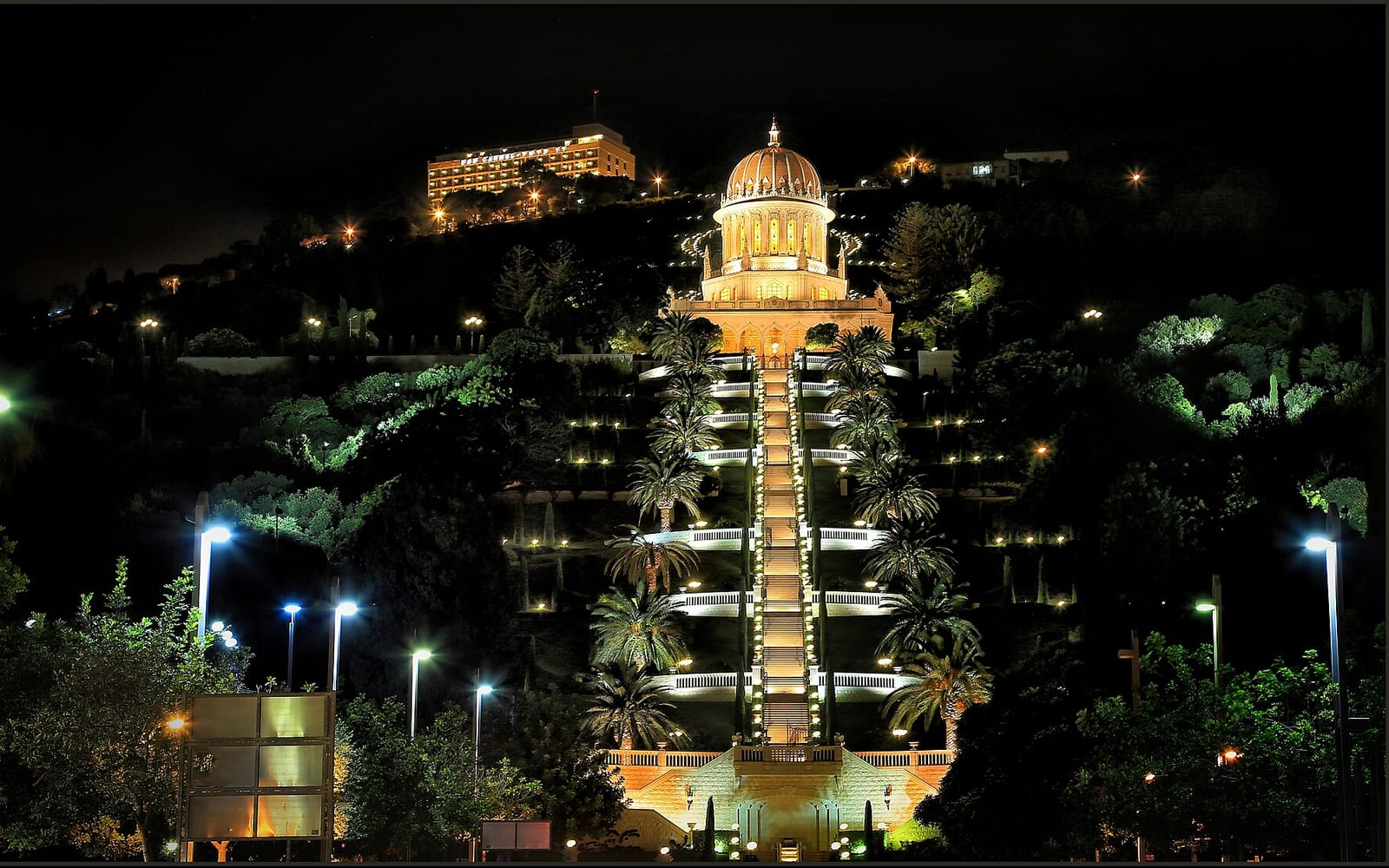
The UNESCO Bahá’í terraced gardens are 10–15 minutes by taxi from the port. The German Colony (19th-century Templar district, now a café boulevard) is an easy 15-minute walk downhill. Add Wadi Nisnas for street food and local colour. Comfortable even for passengers with limited mobility; no car needed.
Full day — Old Akko (Acre)
Akko is 20 minutes by train from Haifa HaMifratz station (5-minute walk or taxi from the terminal). The UNESCO-listed Crusader underground city, Ottoman souq, sea walls and lighthouse can absorb 3–4 hours easily. Return by train; add a Bahá’í Gardens stop on the way back to the ship. Perfect for independent travellers.
Full day — Caesarea + Bahá’í Gardens
Roman Caesarea (45 minutes south by car or tour) has an exceptional harbour, amphitheatre, hippodrome and aqueduct. Combine with the Bahá’í Gardens on return. Requires a hired car or pre-booked guide; not practical by public transport.
Full day — Galilee + Nazareth
The most popular guided circuit: Nazareth (Basilica of the Annunciation), Sea of Galilee boat tour, Mount of Beatitudes, Yardenit baptism site. About 1.5 hours from Haifa by car; most tour operators build in a 30–45 minute return buffer. This excursion absolutely requires a booked tour — do not attempt independently on a port-day time constraint.
For detailed logistics and timings, see the Haifa shore excursions guide.
Ashdod port: what to see
Ashdod is the gateway to southern and central Israel. The port itself is an industrial city with few tourist attractions — all the value is in what you can reach from it.
Jerusalem (the headline excursion)
Jerusalem is 45–60 minutes by coach from Ashdod. On a standard 8–9 hour port day you can fit:
- Old City walking tour: Jewish Quarter + Western Wall → Via Dolorosa → Church of the Holy Sepulchre (4–5 hours)
- Mount of Olives viewpoint + Garden of Gethsemane (1 hour)
- Yad Vashem Holocaust memorial (half day on its own — not easily combined with the Old City)
Independent travel note: Direct trains from Ashdod to Jerusalem are not practical for port-day travel (requires transfer and is slower than coach). Hire a guide with a car or book a shore excursion that specifically advertises Ashdod departure — transfer logistics are handled for you.
Masada + Dead Sea (a very full day)
Masada fortress and the Dead Sea are about 2.5 hours from Ashdod — this excursion requires an early departure and a tight schedule. If your port call is short (7 hours or less), prioritise one or the other, not both. The Dead Sea float experience is memorable; Masada needs at least 2–3 hours on site (cable car up, guided tour of the summit, cable car or snake-path descent). A dedicated Masada guide is strongly recommended — the history is much richer with context.
Bethlehem (15 minutes from Jerusalem)
If your tour stops in Jerusalem, adding Bethlehem (Manger Square, Church of the Nativity) is a natural extension — it is only 15 minutes south of the Old City. Note that Bethlehem is in the Palestinian Authority; Israeli guides typically hand over to a licensed Palestinian guide at the checkpoint. Most shore excursion operators include this seamlessly; if booking independently, confirm the Bethlehem segment is included.
Pre- and post-cruise extensions
A Mediterranean cruise port day gives you 7–10 hours ashore. To see Israel properly — especially Jerusalem and Tel Aviv — add nights before or after the cruise.
Recommended extension: 3–4 nights
Days 1–2: Jerusalem
Arrive via Ben Gurion Airport → Jerusalem by coach (45–55 minutes). Base yourself in Jerusalem for two full days: Old City, Yad Vashem, Mount of Olives, the Mahane Yehuda market. Boutique hotels in the German Colony or Mamilla neighbourhood put you close to the Old City walls. See the Jerusalem hotels guide for options at every price point.
Days 3–4: Tel Aviv
Transfer to Tel Aviv (55 minutes from Jerusalem by coach/train). Tel Aviv is Israel’s cosmopolitan beach city: the Carmel and Levinsky markets, Jaffa Old Port and sea views, the Bauhaus White City architecture tour, outstanding restaurants and the Mediterranean beach. Ben Gurion Airport is 20 minutes by rail from Tel Aviv central station — convenient for embarkation or departure.
For Haifa departures, substitute Day 4 with a drive north: Akko, Caesarea and the Carmel wine country are all within an hour of the port. For Ashdod departures, the Dead Sea and Negev are easy additions if you have a rental car.
Where to stay for a pre/post-cruise extension
For the most convenient access to both ports, Tel Aviv is the hub: 55 minutes by train to Haifa, 45 minutes by train and then coach to Ashdod. See the Israel accommodation guide for options across all budgets, from Abraham Hostel Tel Aviv (budget, great common areas) to The Norman (luxury, Bauhaus building on Nachmani Street).
Practical planning tips
Book shore excursions early
Popular Haifa excursions (Galilee circuit, Old Akko) and Ashdod excursions (Jerusalem) sell out 2–4 weeks before the sailing date, especially for large ships. The best guides work with small groups (8–12 passengers maximum) and fill up fastest. Book before your cruise departs, not onboard.
Travel insurance with cruise cover
Standard Mediterranean cruise insurance should cover missed port calls and flight-to-ship connections. For Israel specifically, check that your policy covers emergency medical evacuation and security-related disruption. Some insurers exclude Israel from standard policies; check the exclusions list before purchasing.
Currency and payments
Israeli currency is the New Israeli Shekel (₪). All tourist sites, restaurants and taxis accept major credit cards; cash is useful for market purchases and small tips. At the port, currency exchange booths are present but offer less favourable rates than ATMs. See the Israel money guide for current exchange-rate context and tipping norms.
Dress code at religious sites
Both Haifa port-day circuits and Jerusalem excursions include religious sites with dress requirements: shoulders and knees must be covered. Lightweight scarves and cover-up trousers pack easily. The Western Wall is gender-segregated; women should be prepared for this. See the holy sites dress code guide for specifics.
Security context
Israel has an active security situation; the FCDO and US State Department issue regular travel advisories. Most Mediterranean cruises that include Israel do so only when the commercial shipping lane is assessed as safe by the cruise line’s security teams — cruise lines pause Israel port calls when advisories recommend against travel. Check gov.uk/foreign-travel-advice/israel or travel.state.gov for current status in the weeks before your sailing. For current context on independent travel, see the Is Israel safe to visit? guide.
Combining Israel with other Eastern Mediterranean ports
Israel pairs naturally with the following ports on Eastern Mediterranean circuits:
Piraeus (Athens) — 2 days → Acropolis, Cape Sounion, day trip to Delphi or Delos. Athens is almost always the embarkation or disembarkation city for Eastern Med cruises.
Santorini / Mykonos — classic Greek islands for beaches and scenery; contrast well with Israel’s historical density.
Ephesus (via Kusadasi), Turkey — Roman ruins to rival Caesarea; pairs well with an Israel history itinerary. Check Turkey entry requirements separately.
Rhodes / Crete — medieval Old Town Rhodes complements Israel’s Crusader history (particularly Akko). Crete suits beach days and Minoan history.
Limassol (Cyprus) — convenient stop between Greece and Israel; Paphos Archaeological Park and Troodos Mountain villages.
For multi-destination trip planning, see the Israel vs Greece comparison guide and the Israel + Jordan itinerary.