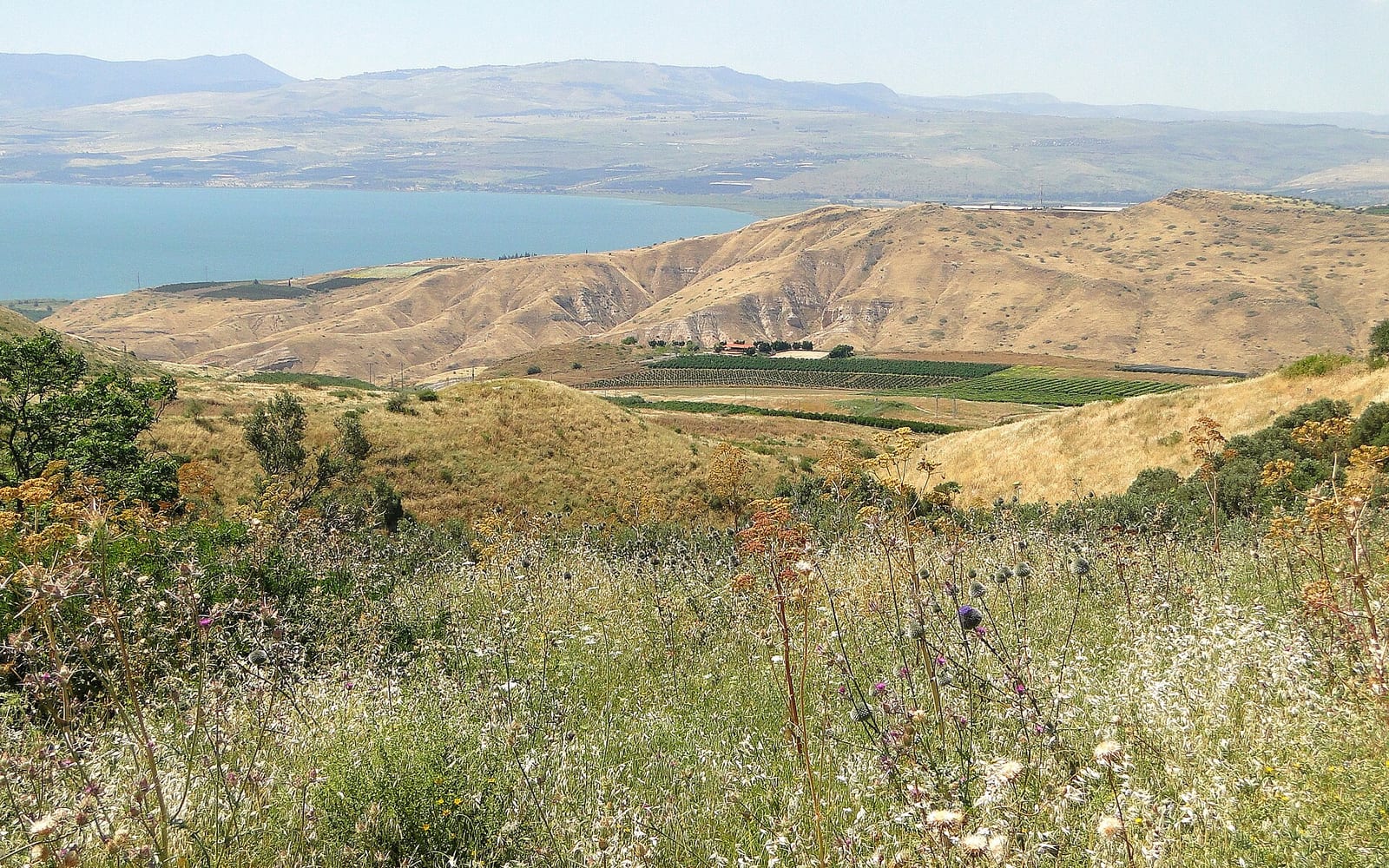
Every October, one of the world’s great wildlife spectacles begins in the upper Galilee. Eurasian Cranes — migrating south from breeding grounds across Scandinavia, Russia, and Eastern Europe — arrive at Agamon HaHula, a managed wetland in the Hula Valley north of the Sea of Galilee. By November, tens of thousands roost overnight on the open water and surrounding fields; at dawn, they take off in rolling waves that last for minutes. Up to 50,000 cranes can be present simultaneously at the seasonal peak.
The Hula Valley sits in the Jordan Rift Valley, one of the world’s great bird migration corridors. It is a natural funnel for hundreds of millions of birds moving between Europe and Africa each year. The crane migration is its most visually dramatic chapter — and the most accessible. Agamon HaHula is designed for visitors, with a signed self-guided trail, bicycle hire, a visitor centre, and the pre-dawn Sunrise Safari Wagon that gets you among the birds before they leave the roost.
Agamon HaHula and the Hula Nature Reserve
Agamon HaHula — the principal crane destination — is a KKL-JNF managed wetland created by the partial re-flooding of the Hula drainage project in the 1990s. The original Hula swamps were drained for agriculture in the 1950s; the ecological consequences were serious enough that a portion was re-flooded, creating the 780-hectare reserve that exists today. The result accidentally became one of the most important waterbird habitats in the Middle East.
The Hula Nature Reserve (Agam HaHula) is a separate site immediately north of Agamon, managed by INPA. It preserves a fragment of the original papyrus-swamp ecosystem and is covered by the Israel National Parks Pass. For crane watching, Agamon HaHula is the destination; the Nature Reserve is a quieter complement for visitors interested in the valley’s reedbed ecology and breeding wetland species.
The Sunrise Safari Wagon
The signature experience at Agamon HaHula is the Sunrise Safari Wagon: a tractor-drawn wagon that departs from the visitor centre before dawn — typically around 5:00–5:15am — and positions participants in the crane roost fields as the sun rises.
As the light strengthens, the cranes take off in waves. The sound — a combination of wing-beats and their distinctive bugling call — builds as thousands of birds lift simultaneously. The wagon is positioned for both viewing and photography. The morning light on cranes in flight, with the Galilee hills behind, is the defining image of the Israeli November wildlife calendar.
The wagon returns by approximately 8:00am, leaving the rest of the morning for the self-guided trail or the wider Galilee.
Booking: Advance reservation at agamon-hahula.co.il is essential. November weekend slots sell out 4–6 weeks in advance. Weekday slots are more available but still require booking ahead. Exact departure times vary seasonally — always confirm on the official KKL site rather than relying on third-party listings.
Honesty note: Sunrise Safari capacity is limited and fills at peak season. If the wagon is sold out, the self-guided circuit from the main entrance still allows excellent crane viewing — particularly in the evening hours when cranes return to the roost.
Self-guided 11km circuit
The 11km paved cycling and walking path around the reserve is open during standard reserve hours (check agamon-hahula.co.il for seasonal times). Bicycle hire is available at the entrance; the flat terrain is accessible to all fitness levels.
Key stops on the self-guided circuit:
- Main observation hides — raised wooden platforms overlooking the open water areas where crane flocks congregate
- Water Buffalo Field — a conservation breeding enclosure visible from the path; Bubalus bubalis is not native to Israel but was introduced as part of wetland management to graze the reed beds
- Pelican promontory — White Pelicans, which roost and fish at Agamon in large numbers during migration season, are most reliably seen from the eastern side of the trail
- Kingfisher stream crossing — Common Kingfishers are resident and can often be seen hunting from low branches along the channel
Binoculars are strongly recommended for the self-guided route, though cranes, pelicans, and herons are visible to the naked eye. The late afternoon return-to-roost hour (roughly 30–60 minutes before sunset) is a productive second window: the cranes come in from surrounding agricultural fields and the sky fills with formations overhead.
Seasonal timing and what to expect
| Period | Crane numbers | Safari availability | Notes |
|---|
| Late October | A few thousand; migration beginning | Moderate | First arrivals; far less crowded than November |
| November | 35,000–50,000 at peak | High demand; book 4–6 weeks ahead | Full spectacle; Hula Valley Bird Festival |
| December–January | Numbers sustained; peak passes through | Easier to book | Cold mornings; smaller crowds |
| February | Cranes departing northward | Easy | Final opportunity; numbers declining |
Important: crane arrival timing varies annually depending on conditions along the migration route — the table above gives typical ranges. For real-time flock counts before your visit, check agamon-hahula.co.il and the INPA bird reports at inpa.gov.il in the weeks leading up to your trip.
Hula Valley Bird Festival
The Hula Valley Bird Festival is organised around the migration peak — typically in November — and combines guided expert tours, evening lectures, photography workshops, and special Sunrise Safari slots. The exact dates vary by year and by when the cranes arrive. Check agamon-hahula.co.il from September onwards for the current year’s programme and registration.
Festival week is the highest-demand period of the season: the Sunrise Safari books out first, followed by guesthouses in Rosh Pinna and Kiryat Shmona. If your dates align with the festival, book both accommodation and the Safari at least six weeks ahead.
Where to stay
Kiryat Shmona (7 km north of Agamon HaHula) is the most convenient base for the Sunrise Safari: the drive to the reserve entrance takes under 10 minutes, which matters when you need to leave before 5am. The town has budget hotels and several guesthouses.
Rosh Pinna (15 km south), a restored 19th-century moshava perched on the hillside above the valley, is the most atmospheric base: boutique guesthouses cluster around the cobbled historic quarter, and the elevation gives panoramic views across the Hula basin and the Galilee hills. Travel time to Agamon HaHula is around 20–25 minutes.
Kibbutz Kfar Blum (5 km north of Agamon HaHula) operates a kibbutz guesthouse with garden cabins directly in the valley — the most immersive option for birders, with optional early breakfast arrangements for pre-dawn Safari departures.
Metula (30 km north, near the Lebanese border) has guesthouses in a small border town setting; primarily for those combining the Hula Valley with Banias Nature Reserve or the Golan.
Getting there
By car: The Agamon HaHula entrance is on Route 90, approximately 7 km south of Kiryat Shmona. From Tel Aviv: Route 6 north to Yokneam interchange, then Route 85 and 90 north — approximately 2 hours 30 minutes. From Haifa: Route 85 east to Route 90 north — approximately 1 hour 30 minutes. From Jerusalem: 2 hours 30 minutes via Route 6 north.
A car is essentially required for the Sunrise Safari, which departs before 5am when no public transport operates. For car hire, see the car rental in Israel guide.
By public transport (limited): Egged and Nateev Express buses serve Kiryat Shmona from Haifa (2 hours) and the Jordan Valley route. From Kiryat Shmona, a taxi to the reserve entrance (₪35–50) is the only practical transfer at Sunrise Safari hours. The self-guided trail visit (during reserve opening hours) is more manageable without a car if you arrange a taxi both ways from Kiryat Shmona.
Combining with the wider Upper Galilee
The Hula Valley sits at the centre of the Upper Galilee, making it a natural hub for a multi-day northern itinerary:
Galilee region: The valley is surrounded by the landscapes covered in the Galilee travel guide — the Sea of Galilee is 30 minutes south, Tiberias 45 minutes, Safed (Tzfat) 25 minutes east.
Golan Heights: From the Hula Valley, the Golan plateau is 20–30 minutes east. In autumn and winter, the Golan hosts raptor-watching opportunities alongside the crane migration — Griffon Vultures soaring above the escarpment and resident raptors on the plateau. See the Golan Heights guide for routes and logistics.
Banias Nature Reserve (25 km northeast): The springs at the foot of Mount Hermon and the Crusader Nimrod Fortress combine naturally with a Hula Valley morning. Worth a half-day addition.
Olive harvest (October–November): The Yemei HaZayit olive harvest festival runs across the Galilee hills in the same window as the crane migration. See the olive harvest Galilee guide for grove visits and festival logistics.
For a full three-day northern itinerary combining the Hula Valley with the Galilee and Golan, see the 3 days in Galilee guide.
For the broader Israel birdwatching context — Eilat’s spring migration spectacle, raptor-watching on the Golan, and the full birding calendar — see the birdwatching in Israel guide. For the seasonal context around your visit: Israel in October covers the early crane arrival alongside wine harvest and post-holiday quiet; Israel in November covers the crane peak in detail.