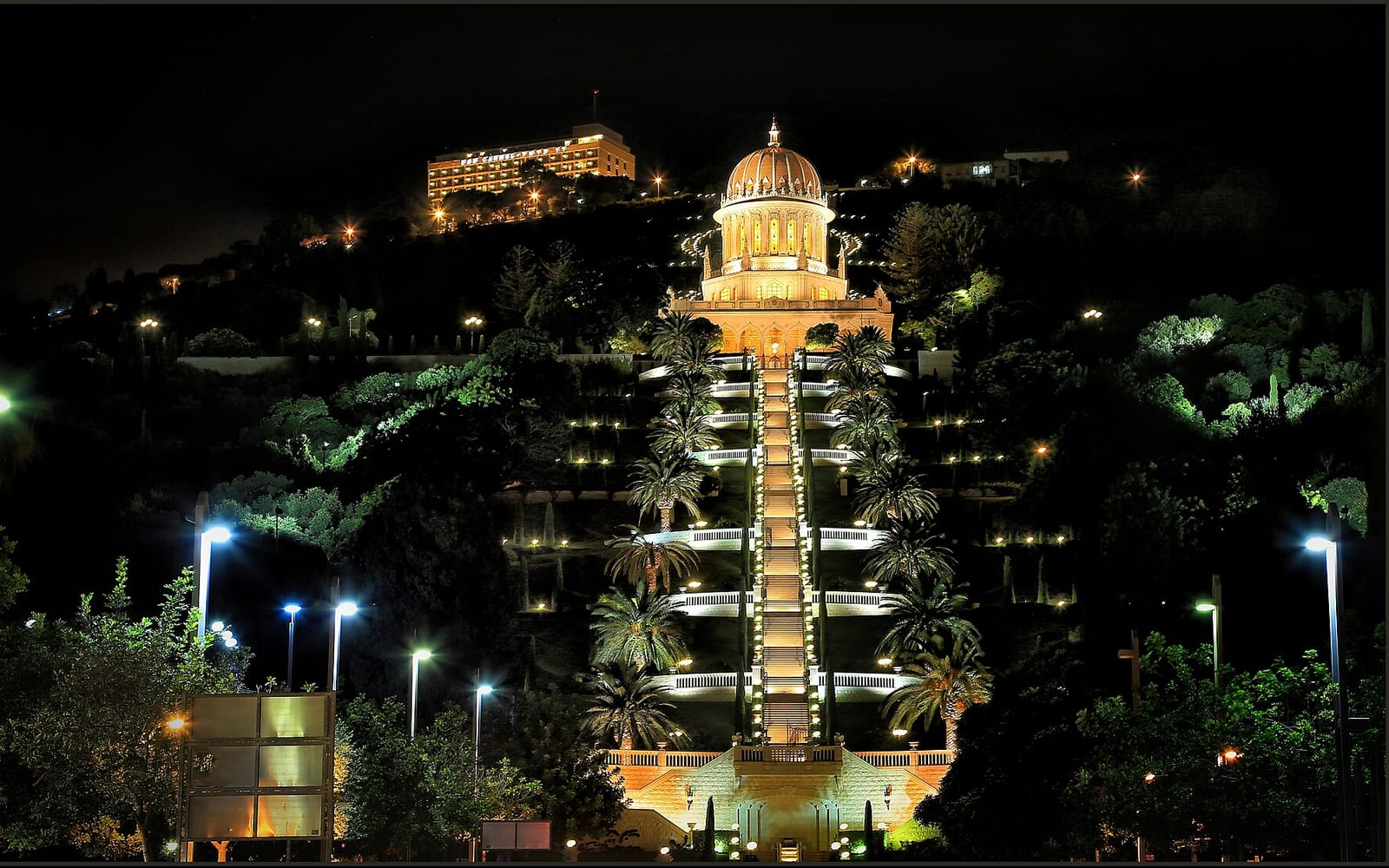
Haifa is not Tel Aviv and it is not Jerusalem — which is exactly why it belongs on a three-day itinerary of its own. Israel’s third city sits on the slope of Mount Carmel above a deep port bay, and its defining feature is vertical: the UNESCO Bahá’í Terraces cascade down nineteen levels from the Carmel ridge to the German Colony below, visible across the bay from Akko. Below that sits the Arab-Christian neighbourhood of Wadi Nisnas; higher up, the Druze villages of Daliyat el-Carmel. The city operates on a principle of coexistence that is visible on the street, not just described in tourism copy.
Haifa rewards honest expectations. It is less polished for tourists than Tel Aviv and less saturated with history than Jerusalem. Transport can be awkward, English signage thins out beyond the main sites, and the nightlife is limited. What it offers instead is authenticity — the Wadi Nisnas hummus institutions have been there for decades, the Bahá’í gardens are maintained with a quietude that survives even the busiest tour days, and the Druze village market in Daliyat el-Carmel is genuinely oriented toward local commerce, not tourism.
Three days is the right length: enough to move slowly through each of the city’s levels and one day trip onto the Carmel ridge.
Before You Go: Practical Prep for Three Days in Haifa
Getting to Haifa. From Tel Aviv HaShalom station, the Israel Railways train reaches Haifa Merkavit HaMifratz in about 60–70 minutes and runs frequently. From Jerusalem, take the train to Tel Aviv first (35 min high-speed), then continue to Haifa — total 1.5–2 hours. Driving from Tel Aviv is about 90 km via Route 2 (coastal highway, 1 hour in light traffic). From Ben Gurion Airport the train via Tel Aviv HaShalom is the simplest connection. See the Israel transportation guide for Rav-Kav card set-up and live timetables.
The Carmelit. Haifa’s underground funicular connects the port level (Paris Square) to the Carmel ridge (Gan HaEm) via six stations in about 10 minutes. Use the same Rav-Kav card as for trains. The Carmelit does not operate on Shabbat.
Where to stay. The German Colony at the base of the Bahá’í Terraces is the most atmospheric option — a 19th-century boulevard with restored limestone Templer buildings, walkable to the Bahá’í gardens and the port. Mount Carmel hotels have bay panoramas and direct Carmelit access. Budget options cluster near Haifa Central Station. For a full breakdown by neighbourhood, see the Haifa neighborhoods guide; for specific hotel picks at each tier, see best hotels in Haifa.
Shabbat. Haifa is more Shabbat-observant than Tel Aviv but less so than Jerusalem. Buses and the Carmelit stop Friday evening. Most German Colony and Wadi Nisnas restaurants stay open. Plan Carmelit-dependent morning activity for before Friday sunset and book a taxi or car for Saturday movement.
Day 1 — The Bahá’í Terraces, German Colony and the Port
Day one is about scale and arrival: descending the UNESCO terraces from the Carmel ridge to the German Colony, then following the bay around to the port.
Morning — Bahá’í Terraces
The Bahá’í Gardens are the immediate reason to visit Haifa. Nineteen terraces step from the Shrine of the Báb at the midpoint down to the German Colony, and the geometry — the symmetry of the gardens, the cypress-lined axis, the view of the bay — is unlike anything else in the country.
Two visitor modes operate on overlapping schedules. Free guided tours of the full terrace descent run Sunday through Friday, typically departing at 09:00 from the upper gate on Yefe Nof Street — advance reservation recommended via bahai-haifa.org, as places fill in peak season. The guided descent takes about 75 minutes; Bahá’í volunteer guides add context that self-guided walking cannot. Self-guided walking is permitted on the upper nine terraces during separate public hours (generally Sunday to Thursday 09:00–17:00, Friday 09:00–13:00 — check the current schedule before you visit, as hours change seasonally). Photography is welcome in the terraces; it is not permitted inside the Shrine of the Báb.
Practical note. The terraces are an active religious site, not a theme park. Dress respectfully (shoulders and knees covered). The climb back up the full nineteen terraces is about 250 steps — if you begin from the bottom (German Colony), expect a 20-minute ascent. The guided tour descends from the top; take the Carmelit or a taxi to Yefe Nof Street to start at the upper gate.
Afternoon — German Colony and Ben-Gurion Avenue
The German Colony at the foot of the terraces is one of Israel’s better-preserved 19th-century quarters. Ben-Gurion Avenue runs as a long tree-lined boulevard directly on the Bahá’í visual axis; the 1869 limestone houses built by Württemberg Templer settlers now hold cafés, design shops and brasseries. The view looking up the avenue to the Shrine of the Báb — especially in afternoon golden light — is Haifa’s most photographed angle.
Walk the full length of the avenue (about 20 minutes end to end), stopping at the Templer Cemetery at the southern end — the tombstones record German-speaking settlers who arrived decades before the Zionist movement. The Haifa Museum of Art sits on the edge of the Colony, a manageable 45-minute stop if you want a museum bookmark to the day.
Evening — Haifa Port
Continue north on foot or by bus to the port area. Haifa’s working port is not a tourist harbour in the Jaffa sense — it handles container shipping alongside cruise passengers — but the waterfront promenade and the restaurants above the port quay are pleasant. The bay view from the promenade, with the lights of Akko visible across the water, is a different scale from anything in the south of the country.
Day 2 — Wadi Nisnas, Carmel Market and Merkaz HaCarmel
Day two moves up Haifa’s hillside and into the Arab-Christian neighbourhood that gives the city much of its character.
Morning — Wadi Nisnas
Wadi Nisnas is a small, dense Arab-Christian quarter on Haifa’s lower hillside — one of the oldest continuously inhabited neighbourhoods in the city. The main draw is the food: several hummus and falafel institutions that have operated for decades, aimed primarily at local Arab residents rather than tourists. The atmosphere is genuinely neighbourhood-scale; the streets are narrow, street-art murals commissioned since 2011 cover many walls, and the pace is unhurried.
The Holiday of Holidays festival (usually December) fills Wadi Nisnas with markets, live music and cross-community events celebrating Jewish Hanukkah and Christian Christmas — a showcase of Haifa’s Arab, Jewish and Christian communities together. Ramadan follows the Islamic lunar calendar and does not fall in December. If your visit falls in December, this festival is worth building your trip around.
For food, the hummus institutions open early (from around 07:00) and serve through the late morning until they sell out — arrive by 09:00 for the best experience. The falafel stands operate through midday.
Midday — HaNevi’im Street Transition to Hadar
Walk uphill from Wadi Nisnas toward the Hadar neighbourhood — the former commercial heart of Jewish Haifa in the British Mandate period. The main shopping street, HaNevi’im, still has the scale and density of a 1940s commercial district: bookshops, electronics suppliers, hardware stores and fabric merchants alongside the newer cafés that have moved into the older premises.
The Carmel Market (Shuk HaCarmel Haifa — not to be confused with its Tel Aviv namesake) operates on the Hadar hillside near the Carmelit Hadar station: a working produce market serving local families. It is smaller and less curated than the Tel Aviv equivalent, which means it is more honest — the prices are for residents, not tourists.
Afternoon — Merkaz HaCarmel and Carmelit
Take the Carmelit from Hadar up to Merkaz HaCarmel (the ridge stop above Hadar) for the panoramic bay view and the garden park at Gan HaEm. The Carmelit ride itself — six minutes through the mountain in a carriage running on a 35-degree incline — is worth doing for its own sake; it has been running since 1959 and is genuinely unlike any other urban transit experience in Israel.
From Merkaz HaCarmel, the Stella Maris road leads southwest along the ridge toward the monastery — accessible on foot (30-minute walk) or by bus from Carmel Centre. You could visit Stella Maris on day two if you prefer to keep day three entirely car-based (Druze villages only).
Evening — Carmel Centre and Views
The Carmel Centre (Merkaz HaCarmel) area has the densest concentration of Haifa’s better restaurants — a mix of Israeli, Arab and international options at mid-range prices. The Louis Promenade along the Carmel ridge provides the elevated bay view that the German Colony level doesn’t — looking north across the bay toward Akko and south toward the coast.
Day 3 — Druze Villages and Stella Maris
Day three leaves the city for the Carmel ridge — the mountain plateau above Haifa that is home to the Druze community and one of the oldest Carmelite monasteries in the world. A car is strongly recommended; if you are car-free, a guided day trip or a taxi booked for the day covers the same ground.
Morning — Stella Maris Carmelite Monastery
Stella Maris sits on the cliff edge of Mount Carmel, 200 metres above the Mediterranean. The Discalced Carmelite Order has maintained a presence on this site since the 12th century; the current church dates from the 1820s. The interior holds the Cave of Elijah — the prophet’s traditional refuge, venerated by Jewish, Christian and Muslim pilgrims — and the ceiling fresco of the ceiling of the church is an unusual visual program.
From the monastery terrace, the view extends south along the Mediterranean coast and north across Haifa Bay. There is also a cable car from the monastery down to the Bat Galim beach promenade below — a 20-second descent of 75 metres that works as an alternative route back to sea level. Entry to the church is free; modest dress applies.
The monastery is not on the standard Haifa tourist circuit, which is why it rewards visiting: the experience is quiet, the site is significant, and the combination of monastic atmosphere and Mediterranean view is distinctive.
Late Morning to Afternoon — Druze Villages: Daliyat el-Carmel
Daliyat el-Carmel is 25 km from Haifa city centre on Route 672, about 35–40 minutes by car. It is Israel’s largest Druze village and the centre of the Carmel Druze community — a distinct Arab ethnoreligious group that serves in the Israeli military and maintains close but separate social ties with Jewish Israeli society.
The village’s main street (the Shuk) is a dense market of Druze crafts, textiles, spices and food — more commercially oriented than the equivalent in the Golan Druze villages, which makes it easier to engage with as a visitor. Saturday is the busiest market day by far, when Israeli visitors drive up from the coast; mid-week visits are calmer and the market stalls are more focused on local buyers.
Food. Druze pita — thin, char-grilled flatbread made on a convex saj griddle — with fresh white cheese and za’atar is the signature food of the village. Multiple small restaurants and street stalls serve it from morning through early afternoon. The quality is consistent across most operators; the ritual of watching the saj bread being made at the griddle is itself worth the trip. Fresh lemonade with mint is the traditional accompaniment.
El-Muhraka site. About 8 km further southeast from Daliyat on Route 672, the Muhraka Carmelite Monastery marks the traditional site of the biblical contest between Elijah and the priests of Baal (1 Kings 18). The Jezreel Valley panorama from the monastery terrace — the full agricultural plain stretching east toward the Jordan Valley — is one of the best elevated views in northern Israel. Entry is modest; a Carmelite friar is usually available for a brief explanation of the site.
Isfiya (the other main Druze village, 3 km from Daliyat) is smaller and quieter. It is worth a brief stop if you want the village atmosphere without the market commerce of Daliyat’s main street.
Afternoon Return — Carmel National Park
On the drive back toward Haifa, Carmel National Park covers the forested plateau between the villages and the city. The park has several marked walking trails through Mediterranean maquis forest — the short Nahal Lotem trail (about 45 minutes) suits a late-afternoon walk before return. In spring (February–April) the park floor has wildflower carpets; in summer the shade temperature is significantly cooler than the coast.
Optional Add-Ons if Your Stay Stretches
Akko (Acre). 25 minutes north of Haifa by train — the Crusader tunnels, Ottoman Khan el-Umdan, the covered souk and the sea walls form one of Israel’s most coherent historic cities. It pairs naturally with a Haifa base. See the Akko guide.
Rosh Hanikra. 45 minutes north of Haifa by car — chalk-cliff sea caves accessible by a 90-second cable car descent to grotto level at the Lebanese border. Best combined with an Akko morning. Details and logistics in the day trips from Haifa guide.
Caesarea. 45 minutes south of Haifa — the Roman-Byzantine harbour city with a theatre, hippodrome, aqueduct and crusader port, all maintained as a national park. Splits naturally with an early Haifa departure or as a stop between Haifa and Tel Aviv on your way south. See the Caesarea guide.
Budget Reference
| Travel style | Per person per day | 3 nights (hotels only) |
|---|
| Budget | ₪200–350 | ₪600–1,050 |
| Mid-range | ₪450–750 | ₪1,350–2,250 |
| Boutique / luxury | ₪900–1,800+ | ₪2,700–5,400+ |
Haifa is meaningfully cheaper than Tel Aviv for hotels and restaurants. The Bahá’í Terraces are free entry. Carmelit single fare is approximately ₪7 per ride. See the Israel cost and budget guide for the full breakdown.
Useful Cross-Links